 |
 It’s been a long, long time.
 26 September 2017 | by
 There are two of us in my department. Things were easier in Warren, as we both worked from the same (and only) building on campus. We staggered our lunch breaks so that one of us was always on duty. Here, at the new work QTH, we are split between two buildings, each one of us minding our own store, so to speak. Unless you master bi-location, you can't manage both buildings at the same time with one man.
That led towards a hiatus in lunchtime QRP operations as it just seemed not the greatest idea to spend so much time away from the desk. I know, it's time I'm entitled to (it's only an hour) and I really should get away from the desk to remain fresh in the afternoon.
So I decided to take advantage again, beginning this week.
I went out to the car yesterday and hooked up the KX3 to the Buddistick. I heard a lot of stations on 20 Meters, but got no answers to any of my calls. I know the equipment works, I figured it was just a bit of "rust" on my part. But, boy howdy, was it hot yesterday! It reached into the upper 80s (about 30C) here at lunchtime and since I was parked outside, it was hot like an oven in the car. It was a double negative experience - too hot and skunked on contacts.
Not one to be deterred, my little eye spied on something that I had forgotten. This campus has picnic tables! Many of the employees go out to eat outdoors on the nice days. There are plenty of tables, they are spaced widely enough apart where conversations cannot encroach on one another.
It dawned on me that this would be the perfect place to set up the KX3 and the magloop! Sure, I'd probably get some stares from the other lunchers, and maybe from some of the employees who take advantage of their lunch break to walk the perimeter of the campus - but what they heck? Right? It's not like I haven't been stared at before. It's not like people haven't come up to me to ask, "What is that?" before, so tossing self-consciousness into the wind, I decided to set up at one of the tables today.
I chose a table towards the end of the line of tables, the one with no umbrella. Sure, it would be a little hotter with no shade, but it's less than an hour and besides, there's be no metallic umbrella ribs to possibly interact with the magloop.
Before hunting for a QSO, I decided to call CQ for a bit on both 20 and 17 Meters. I really didn't expect anyone to answer, although there's no reason why anyone wouldn't. I just wanted to conduct a little Reverse Beacon Network experiment.
Experiment done, I went back to 20 Meters and found the "sweet spot" with the loop's tuning capacitor. (I was able to set up in under four minutes, by they way. Almost as fast as setting up the Buddistick on the car.) Tuning the KX3 around, there were a bunch of loud stations. Finally, I came upon GI4DOH, Rich in Northern Ireland. He had a strong signal and a great fist, so I gave him a call. He came back to me on the first shot! He was 559+ here in NJ, and I got a 559 in return.
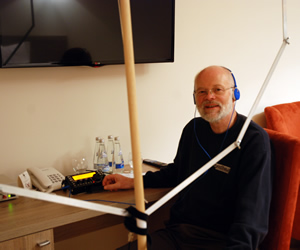
According to his QRZ page, the loop that Rich is using is a receive only loop. This was not a loop to loop QSO.
After working Rich, I popped on up to 17 Meters. There I heard OE3DXA, Wern in Austria calling CQ. Again, loud signal, great fist, so I gave him a call. Just as with GI4DOH, I gave him a 599+ report but this time I got a 599 in return. Both QSOs were solid with no repeats asked for with regard to info, so I am assuming I was at or near Q5 copy. (Even if the 599 in return wasn't exactly accurate.)

It was time to pack it in, and I was satisfied with the two DX QSOs for the day. With regard to my Reverse Beacon Network experiment, this was where the loop was allowing my signal to be heard:
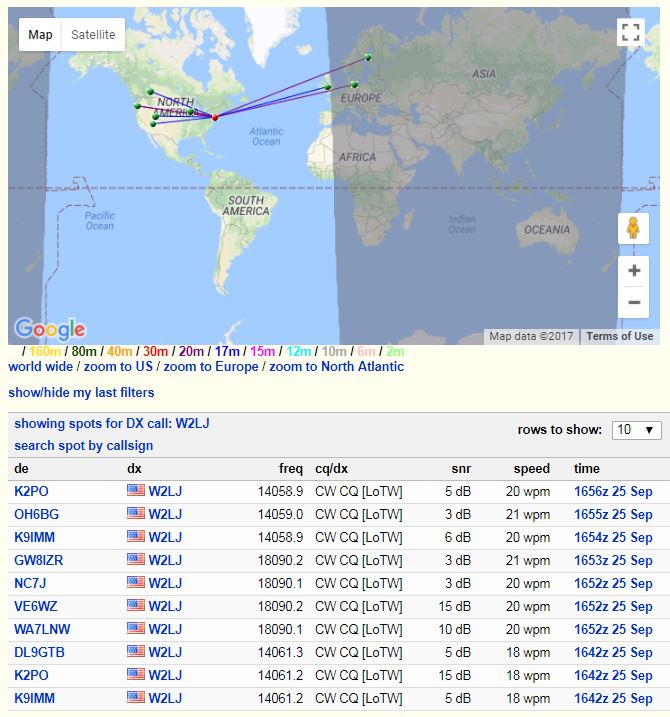
As for spectators, I did get one guy who stopped to ask, "What is that? And what are you doing?" I explained that it was Amateur Radio and an Amateur Radio antenna. In response, I got the (what seems to be standard) "People still do that?" question.
I went into "pitch" mode and explained that yes, Amateur Radio is alive and well, and that for a lot of people in the Caribbean right now it's the only way they can get word out to their families abroad, that they are OK after the hurricanes.
So it was a successful day, I'm happy and it looks like there might not be rain for the rest of the work week.
72 de Larry W2LJ
QRP - When you care to send the very least!
Larry Makoski, W2LJ, is a regular contributor to AmateurRadio.com and writes from New Jersey, USA. Contact him at [email protected].
DX from Rye Beach (QRP)
Judy and I drove over to the beach today to escape the heat. It was almost 90F here. I worked Italy, Finland, Hungary, Cuba and California from the shore.

What a fantastic day… and the drive paid off. It was nearly 10 degrees cooler at the beach with a nice breeze. We had lunch, rode our bikes and then Judy took a swim… while I set up the KX3 and a 30 foot wire.

I extended a DK9SQ 33 foot mast and attached the wire to the tip. Then I rised the mast and tied it to corner of a bench overlooking the harbor. Voila… I had a station. 17 meters was excellent from the beach, and I made 4 of my 6 contacts there. Here’s my log:
25 Sep-17 1920 18.076 CO8LY CW 599 599 Cuba
25 Sep-17 1922 18.082 IK3VUT CW 559 599 Italy
25 Sep-17 1928 18.085 IK5ZWU CW 559 599 Italy
25 Sep-17 1940 14.034 OH6NVC CW 559 579 Finland
25 Sep-17 1945 14.025 HA8VV CW 589 589 Hungary
25 Sep-17 1950 18.080 N6UOE CW 579 599 CA
Before heading home, we decided to take another bike ride. We went to a little laneway on the other side of the harbor. I got a snapshot of my operating position from there.

Jim Cluett, W1PID, is a regular contributor to AmateurRadio.com and writes from New Hampshire, USA. Contact him at [email protected].
LHS Episode #199: We Love WinuxOS
 Welcome to Episode #199 of Linux in the Ham Shack. This episode contains discussion on using web-based SDRs when local receivers are in adequate, JOTA and JOTI, the opening of the 630m and 2200m bands, Linux advocacy, EFF vs DRM, ttyd, Antergos and much more. Thank you for listening. Please tune in to Episode #200 on October 2nd. It's sure to be epic.
73 de The LHS Crew
Russ Woodman, K5TUX, co-hosts the Linux in the Ham Shack podcast which is available for download in both MP3 and OGG audio format. Contact him at [email protected].
This Spewed Out of the Internet #35
 I noticed that I’ve been blogging mostly about SOTA activations, so here’s something completely different: a bunch of exciting stuff flowing forth from the interwebz.
From the Why Do They Do That Department, Jeff/VA2SS shared this article on the origin of the radio term “Roger That.” See The story of why pilots say “Roger that”
This reminds me of the classic scene from the movie Airplane, with the flight crew named Roger, Victor and Clarence.
I recently came across the Wikipedia web page on Etymology of Ham Radio, which explains the origin of the term “ham radio.” Etymology: the origin of a word and the historical development of its meaning. About the same time, Dan/KB6NU wrote about the use of the term “ham radio”: HAM? HAM radio? ham radio? Amateur Radio? amateur radio! I have to admit that I do get annoyed by people that write “HAM” in all caps. What the heck is that?
The ARRL recently published a series of six posters promoting the value of amateur radio. I’m not quite sure where to deploy these but I do like them.
I was checking on electrical voltages and plugs in various countries and came across this site: Power Plugs and Sockets of the World Very handy and easy to use.
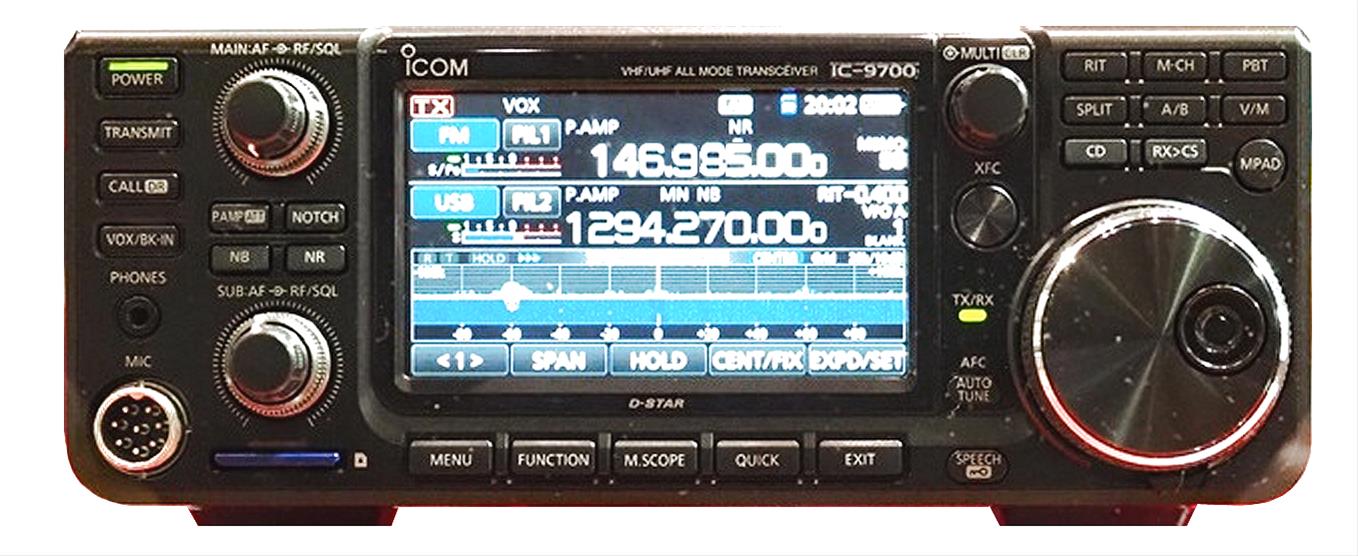
Twitter was abuzz with news about a new VHF/UHF transceiver from ICOM: the IC-9700. This is the first new radio aimed at VHF and up enthusiasts in a long while. I try to not get excited about these early product teasers and wait until the product is shipping in quantity. But I have to admit that this radio has my attention. I don’t have a lot of Icom gear in the shack but this radio may change that.
The DX Engineering web site shows these key features for this unreleased product:
Direct-Sampling SDR design
Three bands: 144 and 432 MHz (50 Watts), 1.2 GHz (10 Watts)
High definition Real-Time TFT display
Main and Sub RX
Dual Real-Time Spectrum and Waterfall displays
Dual Watch (with Spectrum/Waterfall displays)
Touchscreen interface (LCD touch-screen control)
That’s some good stuff spewing from the internet. What did I miss?
73, Bob K0NR
The post This Spewed Out of the Internet #35 appeared first on The KØNR Radio Site.
Bob Witte, KØNR, is a regular contributor to AmateurRadio.com and writes from Colorado, USA. Contact him at [email protected].
Ham College 33
Ham College episode 33 is now available for download.
Foreign contacts and third party traffic. Series and parallel Inductors. Inductor demonstration.
01:06:39
George Thomas, W5JDX, is co-host of AmateurLogic.TV, an original amateur radio video program hosted by George Thomas (W5JDX), Tommy Martin (N5ZNO), Peter Berrett (VK3PB), and Emile Diodene (KE5QKR). Contact him at [email protected].
Early Fall Along the Pemigewasset River
Judy and I rode our bikes along the Pemigewasset River today. It was a beautiful, beautiful day. I worked Bulgaria, Italy, Switzerland, and Hungary.

We rode south from Old Hill and stopped at the old bridge to Sanbornton. It was nearly 80F with an unbelievable stillness in the air. Brown, curled-up leaves covered parts of the old road and crunched beneath our bike wheels. The apple trees along the way have begun dropping fruit. Judy stopped to pick up some apples. The road was lined with asters.

I stopped at a huge pine tree a couple of miles down the road. I tossed my wire nearly 40 feet over a branch and sat on some moss. I used the KX3 and a 33 foot wire.

The bands were good. I worked eight stations. Here’s my log:
23 Sep-17 1935 14.014 LZ100SK CW 599 599 Bulgaria
23 Sep-17 1943 18.086 IK5ZWU CW 439 579 Italy
23 Sep-17 1947 14.019 HB0/DL5YL CW 559 589 Switzerland
23 Sep-17 1950 14.028 HA60KNA CW 579 599 Hungary
23 Sep-17 1955 14.030 W5FMH CW 599 599 TX
23 Sep-17 1957 14.032 VE4RAC CW 599 599 MB
23 Sep-17 2002 10.117 W8IX CW 549 599 IND
Today was a perfect day for getting outside and making a few radio contacts. At this time of year, I can count the days like this on one hand. I wish they would never end.

Jim Cluett, W1PID, is a regular contributor to AmateurRadio.com and writes from New Hampshire, USA. Contact him at [email protected].
Amateur Radio Weekly – Issue 174

EURAO Party: DMR meeting on the air
Connect to EURAO Talk Group 9201 to have fun and meet other hams, or just do SWLing.
eurao.org
D-STAR QSO Party 2017
Talk to the world by connecting to D-STAR repeaters around the globe.
Icom
In devastated Dominica, ‘Hams’ become vital communications link
Hams set up a Facebook page from their home in Craftsbury, Vt., to act as a clearinghouse for whatever information they could glean through the airwaves via ham operators on Dominica.
NPR
EMCOMM real talk: Lessons from Irma
The recent storms seemed to reignite the ever-smoldering embers of Ham Radio’s place in EMCOMM. No surprise to see the many hams out in force debating the relevance of Amateur Radio in an emergency.
Ham Radio 360
Look no further than the waterfall
It’s not much of a stretch to proclaim that there’s considerably more activity on the HF digital modes than can be found on CW.
KE9V
The joy of the QSO
Many of us spend a lot of time in the hobby, so where is the meaning, where is the value added to our lives?
amateurradio.com
How Grey Line propagation works
One of the most fascinating propagational irregularities is the effect of the grey line on HF radio comms.
Delta Alfa
portableradio.org
Promoting more “Field Day” style events.
portableradio.org
Video
Very simple portable dipole
Here’s my ultra-portable 40m wire dipole that is held up by a 6m squid pole anchored to an aluminium ground stake.
Peter Marks
Passing ARRL Field Day messages the easy way with packet radio
The usual CW and phone traffic nets get clogged easily during this crush, but with packet radio you can egress the messages via radio accurately and quickly.
vapn.org
DIY portable LiFePO4 power for Ham Radio QRP QRO
For the ham radio operator in the field, portable battery power needs to be light enough, small enough, modular, have enough capacity, and above all it should be possible to replenish it off-grid.
OH8STN
Simple SWR indicator for QRP
Simple homebrew SWR indicator for QRP, just a ferrite, a wire and a LED.
AC2RJ
Amateur Radio Weekly is curated by Cale Mooth K4HCK. Sign up free to receive ham radio's most relevant news, projects, technology and events by e-mail each week at http://www.hamweekly.com.
 Ham Radio Deluxe |
 W5SWL Electronics |
 Ham Radio Prep |
 KB3IFH QSL Cards  Hip Ham Shirts  HamRadioAuctions HamRadioAuctions Reliance Antennas Reliance Antennas Enigma Shop Enigma Shop |  morseDX  Ni4L Antennas  R&L Electronics R&L Electronics antennas.us antennas.us QRV QRV |
- Matt W1MST, Managing Editor
