 |
 QRSS experiments: FSKCW and Slow Hell
 27 December 2017 | by
 These last few days I’ve been experimenting with my QRPLabs Ultimate 2 and Ultimate 3s transmitting on 7 MHz. In addition to WSPR, the modes transmitted have been FSKCW with 6 second long dots, and Slow Hell with 17 second long characters. The result as received this morning can be seen on the display from the grabber of Les, G3VYZ in Northumberland, UK. This is a stack of 6 consecutive 10 second frames as can be found on the QRSS grabber site of AJ4VD.
 |
| FSKCW and Slow Hell reception of LA3ZA at G3VYZ |
My signal is on 7,039.870 kHz and has been set up with a FSK shift of 6 Hz. Power output was 0.2 W and the distance is about 890 km.
It works but the reception is much less reliable than for WSPR, which is not so unexpected. At the same time the WSPR signal was received all around Northern Europe (G, GM, DL, OON, OE, LX, LA, OY, OH, PA, SM) as well as on the Canary Islands, 3930 km away.
Sverre Holm, LA3ZA, is a regular contributor to AmateurRadio.com and writes from Norway. Contact him at [email protected].
FT8 anomaly or long delayed echo?
My friend Alf, LA2NTA, has sent med these screenshots from when he has been operating FT8. The first image is when operating 10 meters and took place early in November.
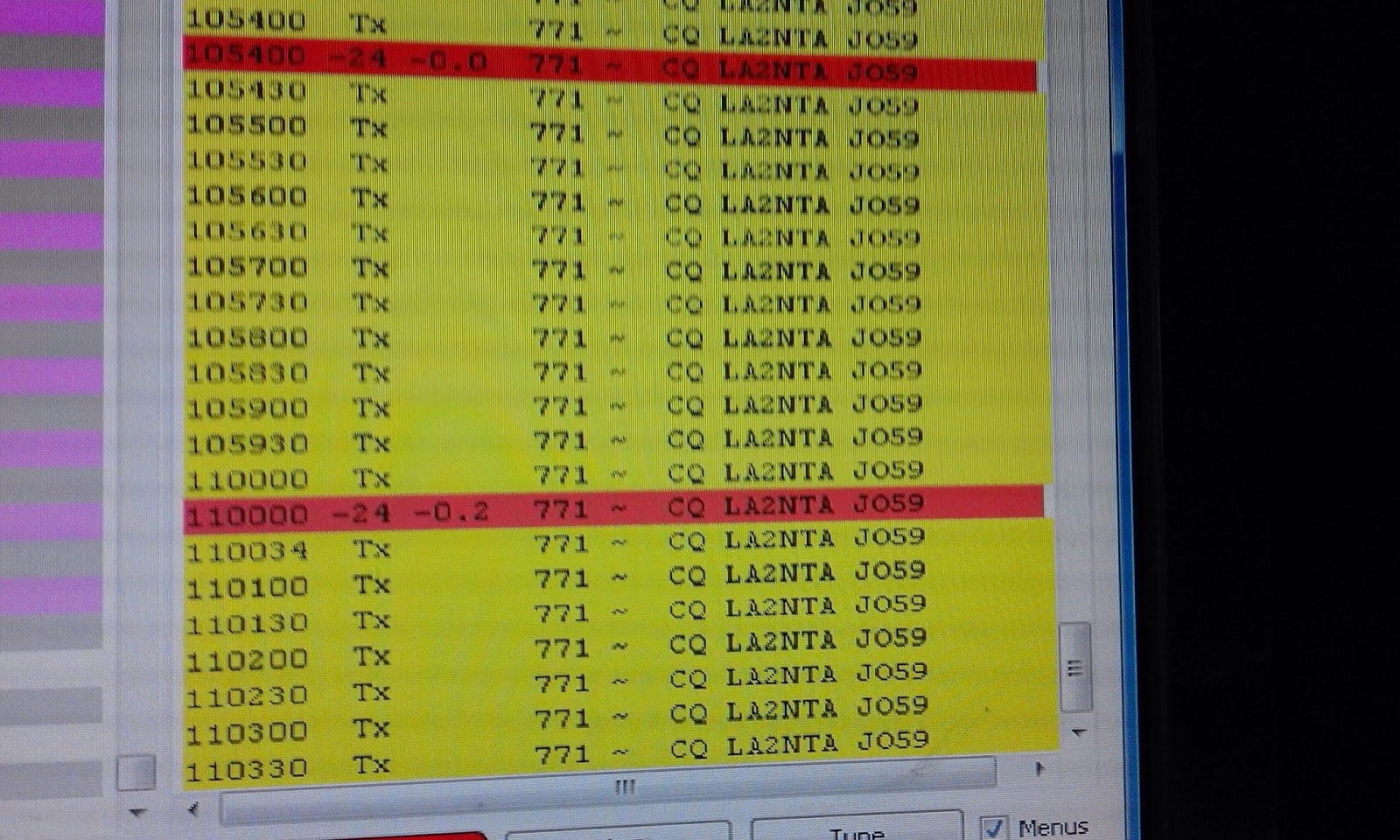 |
| Two of LA2NTA CQs being received by himself on 10 meter (in red) |
It shows how his own CQ comes back to him at 10.54.00 and at 11.00.00 and is decoded in his own receiver.
The second example is from 20 meters and took place just a few days ago.
 |
| LA2NTA CQ being received by himself on 20 meter (in red) |
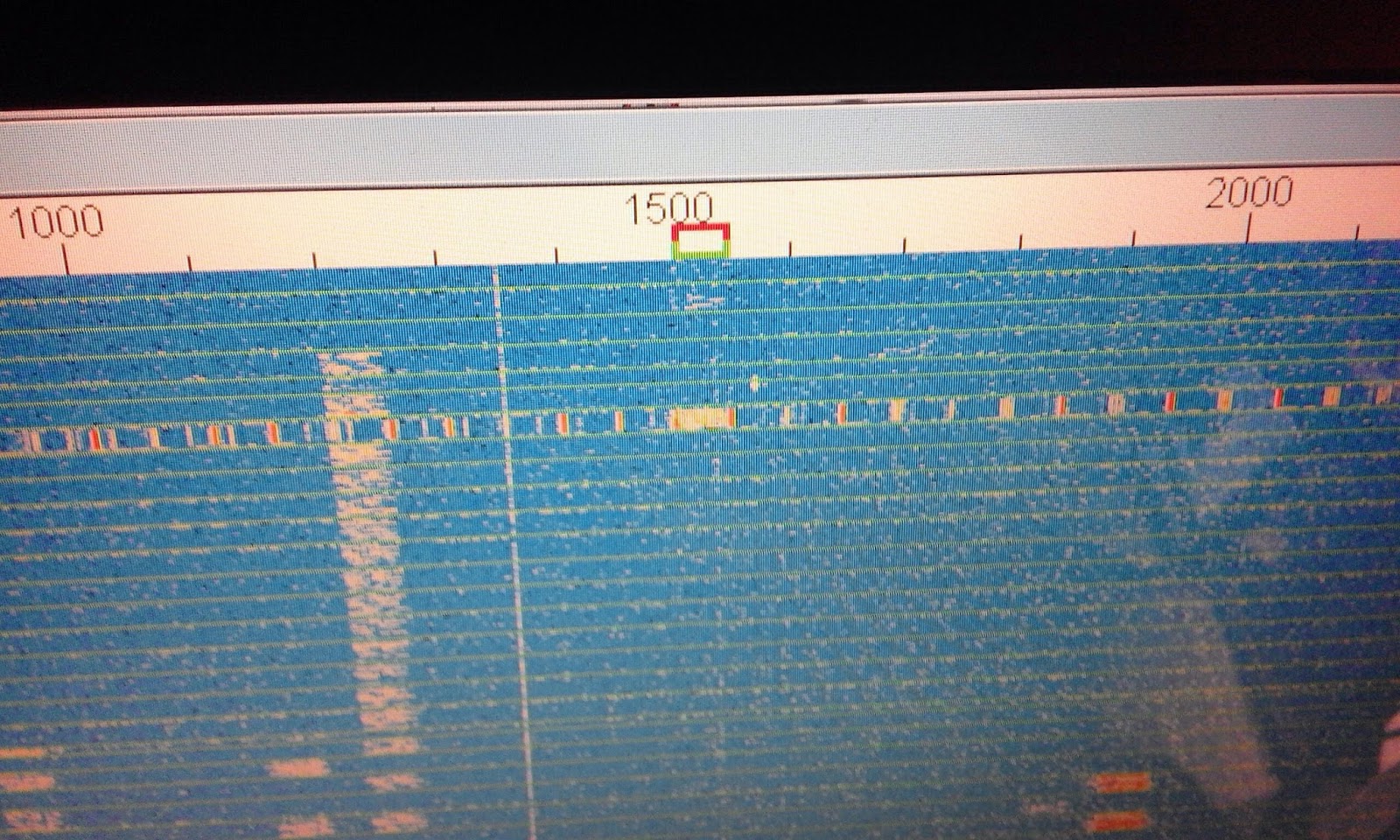 |
| FT8 band on 10 meters showing some form of noise all over the band |
Sverre Holm, LA3ZA, is a regular contributor to AmateurRadio.com and writes from Norway. Contact him at [email protected].
ICQ Podcast Episode 256 – Your Questions Answered
In this, our end of year episode, Colin M6BOY is joined by Martin M1MRB, Edmund Spicer M0MNG, Bill Barnes N3JIX, Ed Durrant DD5LP, Martin Rothwell M0SGL, Chris Howard M0TCH and Leslie Butterfield G0CIB to answer your Amateur / Ham Radio questions.
Colin Butler, M6BOY, is the host of the ICQ Podcast, a weekly radio show about Amateur Radio. Contact him at [email protected].
ICQ Podcast Episode 256 – Your Questions Answered
In this, our end of year episode, Colin M6BOY is joined by Martin M1MRB, Edmund Spicer M0MNG, Bill Barnes N3JIX, Ed Durrant DD5LP, Martin Rothwell M0SGL, Chris Howard M0TCH and Leslie Butterfield G0CIB to answer your Amateur / Ham Radio questions.
Colin Butler, M6BOY, is the host of the ICQ Podcast, a weekly radio show about Amateur Radio. Contact him at [email protected].
Amateur Radio Weekly – Issue 186

FCC penalizes marketer of Ham-band drone
The FCC has imposed a $180,000 civil penalty on a Sarasota, Florida, company that had been marketing noncompliant audio-visual transmitters intended for use on drones in violation of the Commission’s Amateur Service and marketing rules.
ARRL
Building a QRP Field Day Station
It helps to test the station set up in advance. The hub of my station is the Elecraft KX3 transceiver. A new addition is the Elecraft PX3 spectrum scope. Now add a computer and logging software, and you have a few things to integrate.
N4KGL
Homebrew LF Antenna
The main loop is made of 35 turns of enameled copper wire of 0.35mm diameter.
galvanix
Time warp: Simulated Novice FCC Morse Code exam
Novice Morse proficiency exam practice.
HamRadioQRP
Using a mixing console in the shack
If you have a few receivers kicking around in your radio shack, this is one way to hook them all together and send their audio on to your favourite monitoring speakers.
The SWLing Post
One of oldest U.S. radio stations to go dark
Unofficial accounts indicate that KQV started out as “special amateur station” 8ZAE, to be used by the Doubleday-Hill Electric Company primarily for two-way communication.
ARRL
Build a Nixie Tube power supply
I finally received a batch of 1n-14 nixie tubes that I purchased from ebay for a future clock project. The tubes need a power supply that can supply 170 volts DC, which I didn’t have, so I built one.
awsh.org
Is Amateur Radio still relevant?
For over half a century, the BBC has had its own amateur radio group. Now, after several years of planning, the group’s latest home has just opened in BBC Broadcasting House in London, UK.
BBC World Service
Why bother getting an Amateur Radio License?
The Federal Communications Commission provided US citizens with an amazing opportunity to experiment with and develop innovative technology when creating Part 97.
AmateurRadio.com
Video
Xiegu X108G HF Transceiver review and on-air test
This little gem is pretty awesome. An HF radio that covers 1.8-30mhz with USB PC rig control through Ham Radio Deluxe and other software.
HamRadioConcepts
Ethernet powered tower light
YouTube
Amateur Radio Weekly is curated by Cale Mooth K4HCK. Sign up free to receive ham radio's most relevant news, projects, technology and events by e-mail each week at http://www.hamweekly.com.
Amateur Radio: Narrowband Communications in a Broadband World
 For my day job in the test and measurement industry, I get involved in measurement solutions for wireless communications. Right now, the big technology wave that is about to hit is known as 5G (fifth generation wireless). Your mobile smartphone probably does 4G or LTE as well as the older 3G digital mobile standards. For more detail on LTE, see ExtremeTech explains: What is LTE?
5G will be the next cool thing with early rollouts planned for 2018. The design goals of 5G are very aggressive, with maximum download speeds of up to 20Gb/s. (See what I did there: I used the words “up to”, so don’t expect this performance under all conditions.) The actual user experience has yet to play out but we can assume that 5G is going to be blazing fast. For more details see: Everything You Need to Know About 5G. To achieve these high bandwidths, 5G will use spectrum at higher frequencies. Move up in frequency and you inherently get more bandwidth. The FCC recently allocated 11 GHz of new spectrum for 5G, including allocations at 28 GHz, 37 GHz, 39 GHz and 64-71 GHz: FCC 5G spectrum allocation demands 3 breakthrough innovations . Yes, those frequencies are GHz with a G…that’s a lot of cycles per second.
Amateur Radio
So my day job is focused on wider bandwidths and higher frequencies. Then I go home and play amateur radio which is a narrowband, low frequency activity. The heart of ham radio operation is on the HF bands, 3 to 30 MHz, almost DC by 5G standards. Many of us enjoy VHF and UHF but even then most of the activity is centered on 50 MHz, 144 MHz, maybe 432 MHz. I recently started using 1.2 GHz for Summits On The Air, so that at least gets me into the GHz-with-a-G category.
Not only does ham radio stay on the low end of the frequency range, we also use low bandwidth. The typical phone emission on the HF bands is a 3-kHz wide SSB signal. That’s kHz with a k. As we go higher in frequency, some of our signals are “wideband” such as a 16-kHz wide FM signal on the 2m band. In terms of digital modes, AX.25 packet radio and APRS typically use 1200 baud data rates but sometimes we go with a “super-fast” 9600 transmission mode. CW is still a very popular narrowband mode with bandwidths around 200 Hz, depending on Morse code operating speed. Lately, the trend has been to go even narrower in bandwidth to keep the noise out and operate at amazingly low signal-to-noise ratios. Some of the WSJT modes use bandwidths in the range of 4 to 50 Hz.
There are some good reasons that amateur radio remains narrowband. The two most important are:
- We love the ionosphere and what it does for radio propagation. The HF bands are great for making radio signals go around the world but they are narrow spectrum. For example, the 20m band is 350 kHz wide, going from 14.000 to 14.350 MHz. Operation is restricted to narrowband modes, else we’d use up the entire band with just a few signals.
- We just want to make the contact (and maybe talk a bit). For the most part, radio hams are just trying to make the contact. This is most pronounced during a DX pileup or during a contest when you’ll hear short exchanges that provide just the minimal amount of information. Some of us like to talk…rag chew…but that can be accomplished with narrowband (SSB) modulation with no problem. I suppose it would be handy from time to time to be able to send a 3 MB jpg file to someone I am working on 20m but that’s not the main focus of a radio contact.
Of course, not all amateur radio operation is below 1 GHz. There’s always someone messing around at microwave and millimeter wave frequencies. I’ve done some mountaintop operating at 10 GHz and achieved VUCC on that band. Recently, the ARRL announced a new distance record of 215 km on the 47 GHz band.
ICOM produced a D-STAR system at 1.2 GHz with a data rate of 128kbps, quite the improvement over AX.25 packet. However, adoption of this technology has been very limited and it remains a single-vendor solution.
There is significant work going on with High-Speed Multimedia (HSMM) Radio which repurposes commercially-available 802.11 (“WiFi”) access equipment. Broadband-Hamnet is focused primarily on using 2.4 GHz band to create mesh wireless mesh networks. Amateur Radio Emergency Data Network (AREDN) is doing some interesting work, mostly on the 2.4 GHz and 5.8 GHz bands. The HamWAN site has lots of information about a 5.8 GHz network in the Puget Sound area. The basic theme here is use commercial gear on adjacent ham bands…a common strategy for many VHF and higher ham radio systems.
Also worth mentioning is the FaradayRF work, currently aimed at creating a basic digital radio for the 33cm (902 MHz) amateur band. The raw data transfer rate is around 500 kbaud.
There are probably some other high-speed digital systems out there that I’ve missed but these are representative.
Infrastructure Rules
A critical factor in making LTE (and 5G) work is the huge investment in infrastructure by Verizon, AT&T and others. With cellular networks, the range of the radio transmission is limited to a few miles. One of the trends in the industry is toward smaller cells, so that more users can be supported at the highest bandwidths. With 5G moving up in frequency, small cells will become that much more important.
On the other hand, most amateur radio activity is “my radio talking to your radio” without any infrastructure in between. Most of us like the purity and simplicity of my station putting out electromagnetic waves to talk directly to fellow hams. In many cases, this simplicity and robustness has played well under emergency and disaster conditions.
FM (and digital voice) repeaters are a notable exception with the Big Box on the Hill retransmitting our radio signal. For decades now, FM repeaters have represented an infrastructure that individual hams and (more often) radio clubs put in place for use by the local ham community. There is a trend towards more infrastructure dependency in ham radio as repeaters are linked via the internet via IRLP, EchoLink and other systems. (Some hams completely reject any kind of radio activity that relies on established infrastructure, often claiming that it is irrational, unethical or just plain wrong.)
One interesting area that is growing in popularity is the use of hotspots (low power access points) for the digital voice modes (D-STAR, DMR, Fusion, etc.) In this use model, the ham connects a hotspot to their internet connection and talks to anyone on the relevant ham network while walking around the house with a handheld transceiver. See the Brandmeister web site to see the extend of this activity. It strikes me that this is the same “small cell” trend that the mobile wireless providers are following. You want good handheld coverage? Stick a hotspot in your house.
Looking at ham radio and broadband communications, I summarize it like this:
- The vast majority of ham radio activity is narrowband oriented, for reasons described above.
- There is some interesting ham radio work being done with broadband systems, mostly on 2.4 GHz and 5.8 GHz.
- Commercially available broadband technology (LTE, 5G, and beyond) will continue to increase total network bandwidth and performance increasing the difference between commercial broadband and narrowband ham radio.
Implications
The reason for writing this article is that the amateur radio community needs to recognize and understand this increasing bandwidth gap. We like to talk about the cool and exciting stuff we do with wireless communications but we need to also appreciate how this is perceived by someone with an LTE phone in their pocket. Just communicating with someone at a distance is no longer novel. After all, Amateur Radio is Not for Talking.
What do I conclude about this? Here’s a few options:
1. Don’t worry. We are all about narrowband and that’s good enough. This attitude might be sufficient as there are tons of fun stuff to do in this narrowband world. In terms of ham radio’s future, this implies that we need to expose newcomers to narrowband radio fun. We’ll need to get better at talking about how amateur radio makes sense in this broadband world.
2. Embrace commercially available broadband. Use it where it makes sense. This approach means that Part 97 remains mostly narrowband but we can make use of the ever-improving wired and wireless network infrastructure that is available to us.
3. Develop Part 97 ham radio broadband. I am initially a bit skeptical of this idea. How the heck does ham radio compete with the billions of dollars Verizon, AT&T and others poor into broadband wireless? But that may not be the point. Once again, I fall back to the universal purpose of amateur radio: To Have Fun Messing Around with Radios. Can we have fun building out a broadband network? Heck yeah, that sounds like an interesting challenge. Would it be useful? Maybe. Emergency communications might be an appropriate focus and some hams are already working on that. Create a network that operates independent from the commercial internet and make it as resilient as possible.
I think Option #3 is definitely worth considering. What do you think?
73, Bob K0NR
The post Amateur Radio: Narrowband Communications in a Broadband World appeared first on The KØNR Radio Site.
Bob Witte, KØNR, is a regular contributor to AmateurRadio.com and writes from Colorado, USA. Contact him at [email protected].
Holiday Hunt For NDBs In CLE 226 & 227
The next CLE event will be the special Christmas holiday event and includes two challenges! CLE 226 covers any NDB north of the Arctic Circle, while CLE 227 is a 'bearing' event, with each listener chosing a particular bearing from their receiving location and seeing how many beacons can be heard from states, provinces or countries through which that bearing slices! You will have plenty of time to listen as well, since the event runs from Monday 25th December to Tuesday 2nd January.
For those unfamiliar with this monthly activity, a 'CLE' is a 'Co-ordinated Listening Event', as NDB DXers around the world focus their listening time (usually) on one small slice of the NDB spectrum.
Normally, December provides some excellent propagation but the planet continues to be bombarded with seemingly non-stop coronal hole streaming that can cause geomagnetic disturbances disruptive to MF propagation. However, often these 'disruptions' are not as dire as they first appear and MF propagation can remain robust or even be enhanced.
Listeners in Canada and the northern states as well as those in northern Europe will have a much better chance of logging the Arctic beacons. Most of these are large 'enroute' navigation markers with big antennas and plenty of erp ... they are heard very well.
A pdf list of all NDBs within the Arctic Circle can be downloaded from here.
If you are interested in building a system for the new (U.S.) 630m band, the CLE will give you the chance to test out your MF receiving capabilities and compare against what others in your area might be hearing.
When tuning for NDBs, put your receiver in the CW mode and listen for the NDB's CW identifier, repeated every few seconds. Listen for U.S. NDB identifiers approximately 1 kHz higher or lower than the published transmitted frequency since these beacons are modulated with a 1020 Hz tone approximately.
For example, 'AA' in Fargo transmits on 365 kHz and its upper sideband CW identifier is tuned at 366.025 kHz while its lower sideband CW ident can be tuned at 363.946 kHz.
Often, one sideband will be much stronger than the other so if you don't hear the first one, try listening on the other sideband.
Canadian NDBs normally have a USB tone only, usually very close to 400 Hz. They also have a long dash (keydown) following the CW identifier.
All NDBs heard in North America will be listed in the RNA database (updated daily) while those heard in Europe may be found in the REU database. Beacons heard outside of these regions will be found in the RWW database.
From CLE organizer Brian Keyte, G3SIA, comes the usual 'heads-up':
Hello all
Time to tell you about our Holiday CLEs.
Yes – we have two of them, running at the same time, something we have often done in the Christmas – New Year period.
The Early Advice for both CLEs is described here, but we shall treat them quite separately after this.
==================================
CLE226 - SANTA’S BEACONS
We'll be sharing Santa's attempts to use the NDBs north of the Arctic Circle (Latitude N67 degrees) as he navigates his weary reindeer on the last stages of their long flights back home.
Please tell us of any normal NDBs north of the Arctic Circle that you manage to log.
Days: Monday 25th December – Tuesday 2nd January
Times: Midday on 25th Dec to Midday on 2nd Jan, your local time
QRG: Normal LF/MF frequencies
Target: NDBs within the Arctic Circle, north of Latitude 67 degrees
That is similar to what we did way back in Holiday CLE059 (Christmas 2004).
There are about 130 qualifying ‘active’ NDBs currently recorded in RWW.
(You can see the old results from CLE059 in the CLE Archives Section,
http://www.ndblist.info/cledata/CLE59santa.pdf It only ran for 24 hours after midday on Christmas Day).
We do apologise to the listeners who are too far south to hear anything. (The further north listeners often miss out in normal CLEs, especially in the summertime when there is very little sky wave propagation for them).
The Final Details for the Santa CLE, CLE226, will follow in a few days.
===================================
CLE227 - BEARINGS CLE
Like CLE226, this is also a re-run, something that was very much enjoyed over 10 years ago - as CLE092 during a weekend in early June 2007.
Days: Monday 25th December – Tuesday 2nd January
Times: Midday on 25th Dec to Midday on 2nd Jan, your local time
QRG: Normal LF/MF frequencies
Target: Up to 10 NDBs in each Radio Country in your chosen direction
You choose a line in any one direction from you. Then try to log 'normal' NDBs in each of the radio countries crossed by that line - not more than 10 NDBs from each country.
Your line can be at any bearing of your choice - e.g. 123 degrees but NOT including the opposite direction (303 degrees).
Preferably use a Great Circle map to choose your line and to see which radio countries it cuts (a country is included if any part of it is crossed).
Remember that each USA and Australian State and each Canadian Province is a separate Radio Country. See http://www.ndblist.info/ndbinfo/countrylist.pdf
(If your line crosses the sea, any platforms roughly in that direction would also qualify as a radio country for the CLE).
The event will give you an opportunity to plan your own tactics. You could:
Try out a directional aerial
Include a favourite country or countries
Listen for NDBs which mostly have your favourite offset
Concentrate either on DX or more local reception
Exclude signals from the direction of your worst QRN
- any or all of those things, and more.
The aim is not to try and include as many countries or as many NDBs as possible, though you could do that if you wanted to!
TO CHOOSE YOUR BEARING, for non-dx loggings you could use an ordinary map (Mercator projection), especially if your location is near to its middle.
Better would be a Great Circle map centred on your location - you should find that https://ns6t.net/azimuth/azimuth.html is good and very easy to download and use. Just put in your location (e.g. Locator), choose a distance and click on ‘Create Map’. It misses out smaller countries, but reference also to a ‘normal’ map should cater for that.
Perhaps ideal would be Google Earth if you can download that (it is a powerful program for lots of purposes). Click on its Ruler icon and draw a line with the mouse. It tells you distance and Bearing ('Heading'). (Feel free to tell us about any other suitable Great Circle programs)
I can highly recommend the ns6t map generator as it produces a very nice great circle map, shown below for my location on Mayne Island.
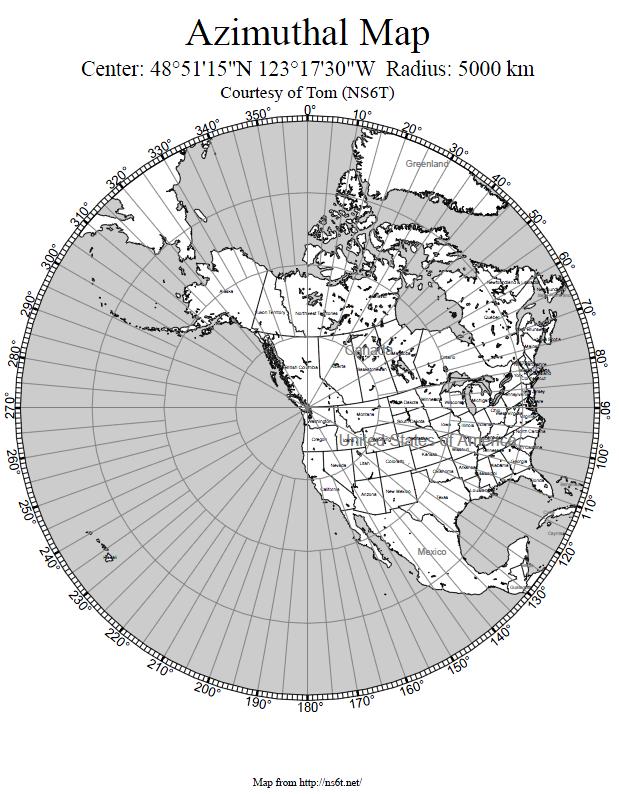 |
| courtesy: https://ns6t.net/azimuth/azimuth.html |
I have yet to decide which bearing I will choose but 81 degrees looks promising from here as it cuts across BC, Alberta, Saskatchewan, Manitoba and Ontario while catching the northern edges of Minnesota and North Dakota.
(If you wish you could use any one remote receiver for your loggings,
stating the location and owner – and with their permission if required.
A remote listener may NOT also use another receiver, local or remote,
to make further loggings for the same CLE.
These listening events serve several purposes. They:
- determine, worldwide, which beacons are actually in service and on-the-air so the online database can be kept up-to-date
- determine, worldwide, which beacons are out-of-service or have gone silent since the last CLE covering this range
- will indicate the state of propagation conditions at the various participant locations
- will give you an indication of how well your LF/MF receiving system is working
- give participants a fun yet challenging activity to keep their listening skills honed
Final details can be found at the NDB List website, and worldwide results, for every participant, will be posted there a few days after the event. If you are a member of the ndblist Group, results will also be e-mailed and posted there.
The very active Yahoo ndblist Group is a great place to learn more about the 'Art of NDB DXing' or to meet other listeners in your region. There is a lot of good information available there and new members are always very welcome. As well, you can follow the results of other CLE participants from night to night as propagation is always an active topic of discussion.
You need not be an ndblist member to participate in the CLEs and all reports, no matter how small, are of much value to the organizers.
'First-time' logs are always VERY welcome!
Reports may be sent to the ndblist or e-mailed to either myself or CLE co-ordinator, Brian Keyte (G3SIA), whose address appears above.
Please ... give the Holiday CLE a try ... then let us know what NDB's can be heard from your location! Your report can then be added to the worldwide database to help keep it up-to-date.
Have fun and Happy Holidays to everyone.
Steve McDonald, VE7SL, is a regular contributor to AmateurRadio.com and writes from British Columbia, Canada. Contact him at [email protected].
 Ham Radio Deluxe |
 W5SWL Electronics |
 Ham Radio Prep |
 KB3IFH QSL Cards  Hip Ham Shirts  HamRadioAuctions HamRadioAuctions Reliance Antennas Reliance Antennas Enigma Shop Enigma Shop |  morseDX  Ni4L Antennas  R&L Electronics R&L Electronics antennas.us antennas.us QRV QRV |
- Matt W1MST, Managing Editor
