 |
 Power regulator works as polarity protection
 12 April 2018 | by
 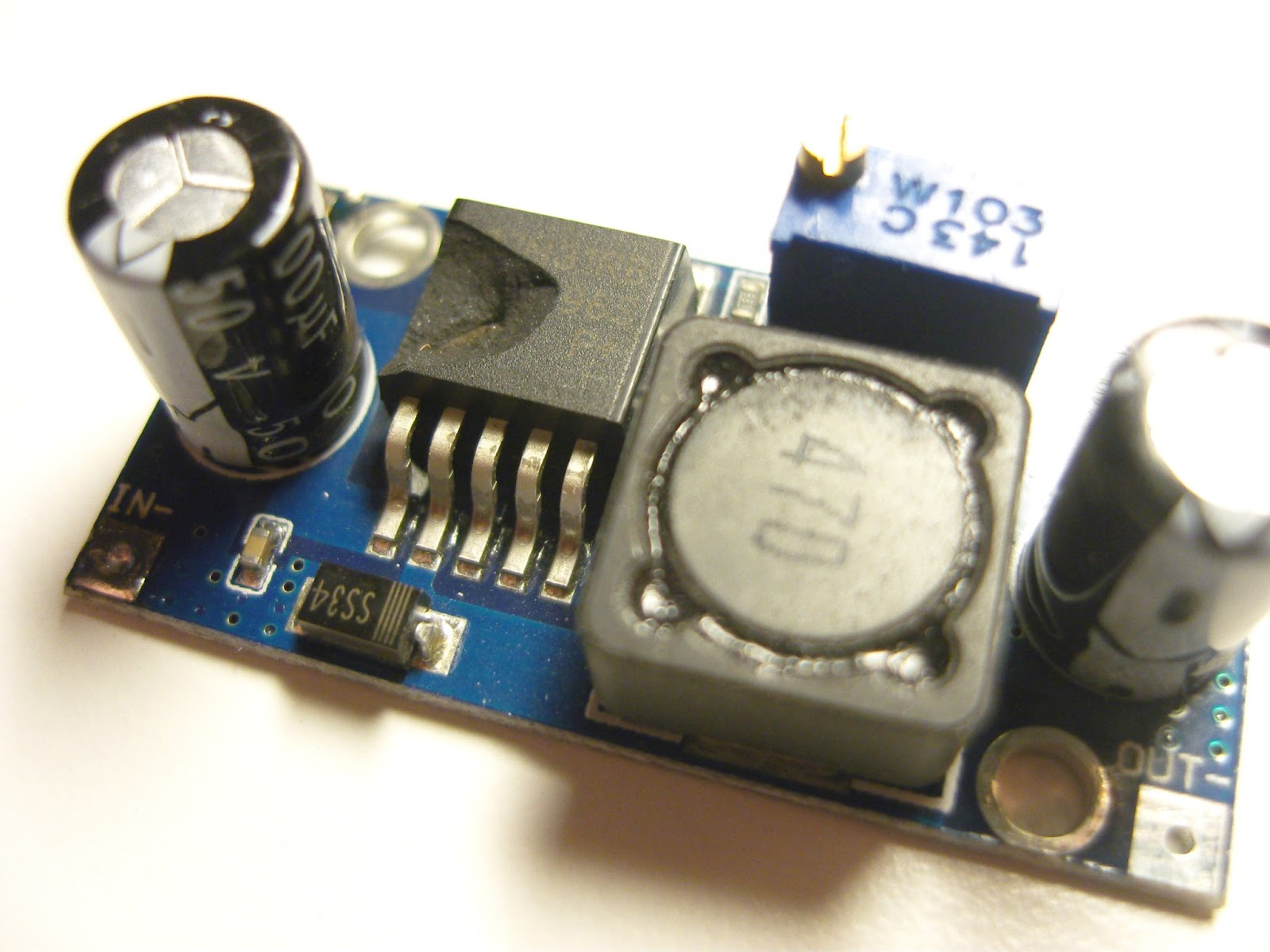 |
| Step-down converter based on LM2596. Note the damaged chip |
Ok, now I’ve done the test. My QRPLabs U3S runs off a 12 Volt power supply. There are two step-down converters, one for 5 Volts for the processor and another adjustable one for the power amplifier, if one can call 0.2-0.5 Watts a power amplifier. See picture of these voltage converters in this post.
I happened to make a new cable for 12 Volts which had the polarities inverted – and puff – there was a noise and absolutely no response from the U3S. I feared that I had blown the entire circuit. As my power amplifier was turned off, only the 5 Volts supply was affected and upon inspection I found that the voltage converter had a destroyed chip.
Since since they are so cheap, I had a spare. Luckily for me, the U3S worked as it should after replacement. So the LM2596 can take a reversed polarity and sacrifices itself in order to protect the rest of the electronics. Nice!
This post first appeared on the LA3ZA Radio & Electronics blog.
Sverre Holm, LA3ZA, is a regular contributor to AmateurRadio.com and writes from Norway. Contact him at [email protected].
Radio Virgin: the First QSO
My first QSO (and, yeah, it was with Morse code) was petrifying and…
What’s your story of your first QSO?
73 de NW7US
Visit, subscribe: NW7US Radio Communications and Propagation YouTube Channel
LHS Episode #220: Polysyllabic
 Welcome to Episode 220 of Linux in the Ham Shack. In this episode, we tackle such monumental topics as weather spotting, the ARRL Teacher's Institute open enrollment, AlaskIT.co, the EU and its stupid rules, the Open Container Initiative, HF packet, Echolink, big words and much more. Thanks for listening. Please donate to our GoFundMe campaign if you can. If you can't, please share, Share, SHARE!
73 de The LHS Crew
Russ Woodman, K5TUX, co-hosts the Linux in the Ham Shack podcast which is available for download in both MP3 and OGG audio format. Contact him at [email protected].
ICOM IC7300

Probably the best commercial radio available to radio amateurs currently is the IC7300. However, its price is still set by market forces: it could still be profitable at a much lower selling price.
Whether prices drop depends on many factors, but there is no doubt that the price is what it is largely because people are still prepared to buy at this price. If the dealers can still make a killing why would they reduce prices? Also, currently there is no real competition.
See https://icomuk.co.uk/IC-7300/Amateur_Radio_Ham_Base_Stations

Roger Lapthorn, G3XBM, is a regular contributor to AmateurRadio.com and writes from Cambridge, England.
Regulated voltage for Regenerative receiver project
Mr. Regula-tor
Fortunately, the regen circuit uses a ridiculously small amount of current for B+; about 4 to 5mA. Although I will likely change the audio side of the tube to deliver enough current for a speaker rather than the high impedance headphones in the current design, which may potentially double that to 10ma. For the first incarnation I'll stick with high-impedance headphones.
Generally batteries are used with regenerative receivers because they are so sensitive to power supply noise, but I wanted to give the power supply a shot first and if it proves too noisy I can fall back to battery power for the B+ and just use the filament voltage provided by this transformer.
Since I have a OB2 voltage regulation tube I want to use. The OB2 regulates at 108V so that's what I'm going with. An OB3 would regulate at 90V, but I don't have one of those.
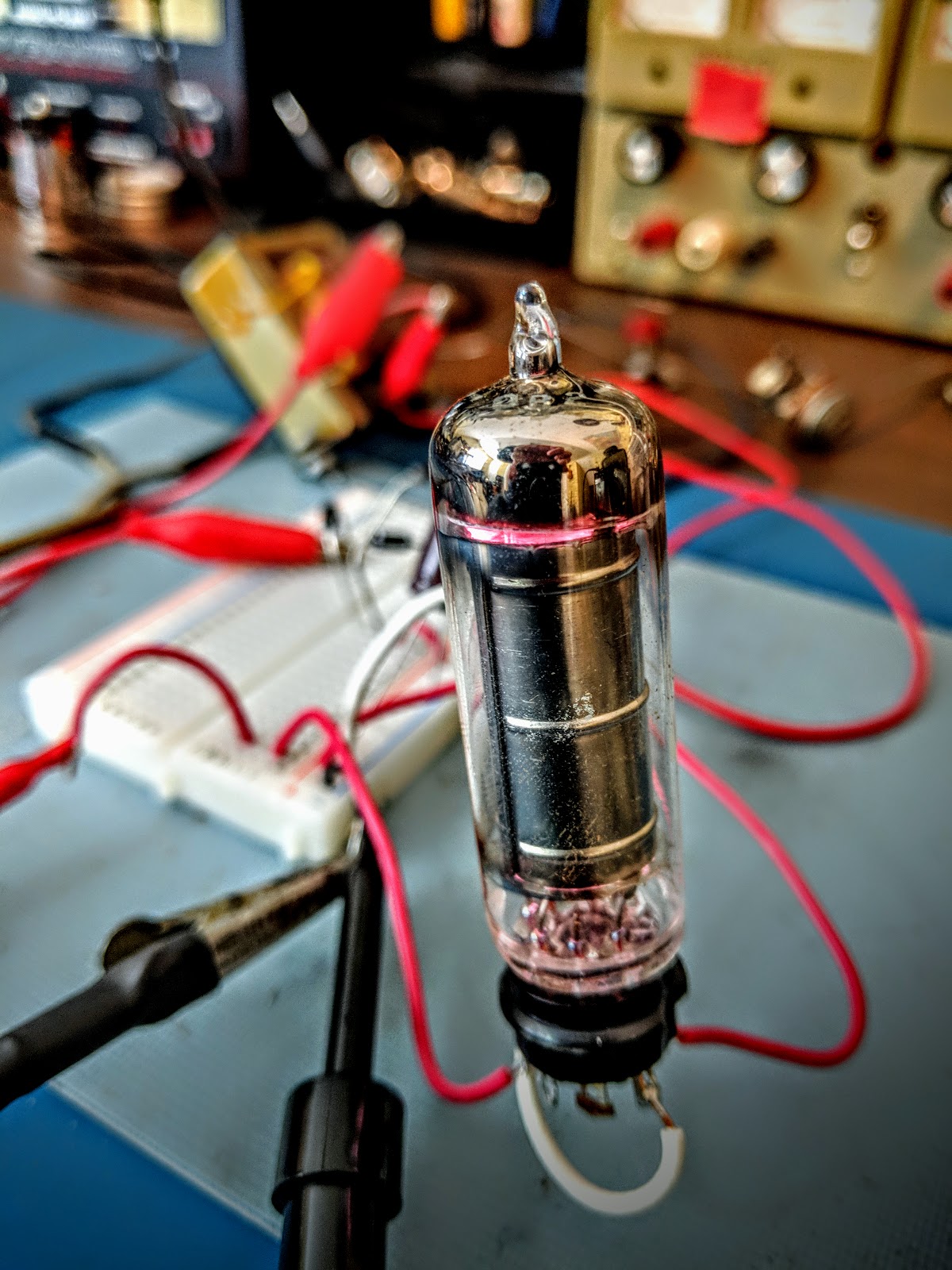 |
| OB2 in action... Glow baby, Glow! |
Calculating the resistor drop
Rdrop = (Vs - Vreg) / (Ireg + Isupply)So, in my case:
Voltage supply (Vs) = 189V
voltage regulation (Vreg) = 108V
regulator current (Ireg) the OB2 requires 5mA to do its job = 5mA
supply current (Isupply) the actual current required by the 6SN7 up to ~ 5mA
So, (189V - 108V) / (0.005A + 0.005A) comes out to a resistor value of 10,100 ohms. 10k is the closest standard size resistor and at 108V it should be able to dissipate 1.166 watts. So I'll need a 10k 2-watt resistor.
Parts is parts

Summary
With the current values I'm seeing 50mA ripple on my regulated voltage.
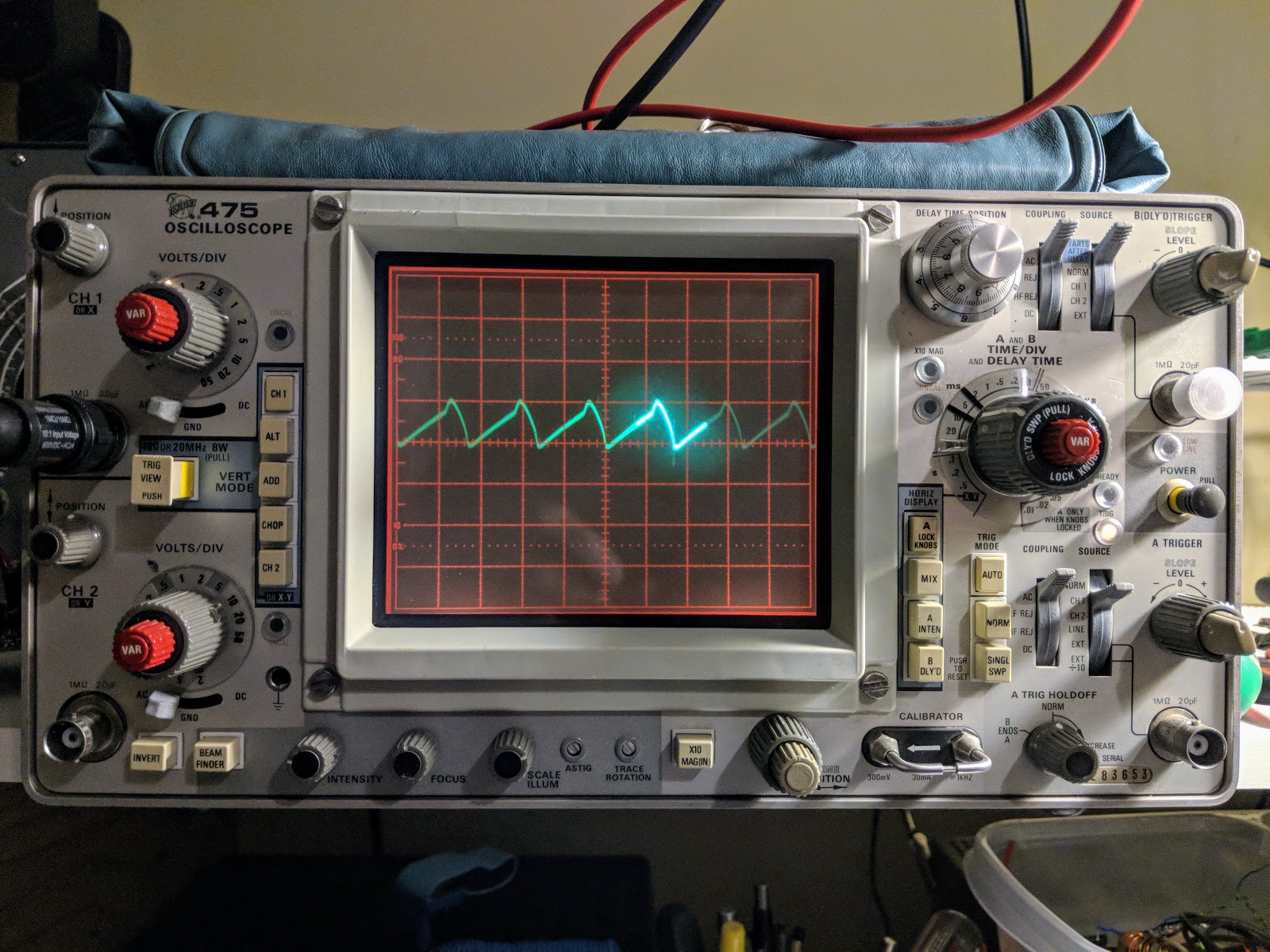 |
| A bit over 50mA ripple |
That's all for now....
So lower your power the old fashioned way, using a voltage regulator tube.
72/73
Richard, AA4OO
Richard Carpenter, AA4OO, is a regular contributor to AmateurRadio.com and writes from North Carolina, USA. Contact him at [email protected].
Weekly Propagation Summary – 2018 Apr 09 16:10 UTC
Here is this week’s space weather and geophysical report, issued 2018 Apr 09 0536 UTC.
Highlights of Solar and Geomagnetic Activity 02 – 08 April 2018
Solar activity was at very low levels throughout the period with only a few low level B-class flare observed on 03 Apr from Region 2703 (S08, L=193, class/area Axx/010 on 31 Mar). No Earth-directed coronal mass ejections were observed.
No proton events were observed at geosynchronous orbit.
The greater than 2 MeV electron flux at geosynchronous orbit reached high levels on 02-04 Apr and at moderate levels on 05-08 Apr. The largest flux of the period was 2,150 pfu observed at 02/1915 UTC.
Geomagnetic field activity was mostly quiet with unsettled periods observed on 05 Apr. Solar wind speed began the period slightly enhanced near 470 km/s with total field around 4-5 nT. Solar wind speed declined to near 320 km/s by 04 April before increasing briefly to near 450 km/s by late on 05 Apr. Total field increased to a maximum of 9 nT at 05/2130 UTC. By 07 Apr, solar wind speed had decreased to 330-380 km/s while the total field decreased to 5 nT or less.
Forecast of Solar and Geomagnetic Activity 09 April – 05 May 2018
Solar activity is expected to be at very low levels throughout the forecast period.
No proton events are expected at geosynchronous orbit.
The greater than 2 MeV electron flux at geosynchronous orbit is expected to reach high levels on 12-30 Apr due to recurrent coronal hole high speed stream (CH HSS) influence.
Geomagnetic field activity is expected to be at unsettled to active levels on 10-16 Apr and again from 19-23 Apr with G1 (minor) storm levels likely on 10-11 Apr due to recurrent CH HSS effects.
Don’t forget to visit our live space weather and radio propagation web site, at: http://SunSpotWatch.com/
Live Aurora mapping is at http://aurora.sunspotwatch.com/
If you are on Twitter, please follow these two users: 1. https://Twitter.com/NW7US 2. https://Twitter.com/hfradiospacewx
Check out the stunning view of our Sun in action, as seen during the last five years with the Solar Dynamics Observatory (SDO): https://www.youtube.com/watch?v=zXN-MdoGM9g
= = = = =
BOOK SALE: Space Weather and Sun Science – get these from Amazon, and help us stay online!
NOTICE: When you buy this (or any item after starting with this link), you are helping us keep our SunSpotWatch.com and other resources “on the air” (up and running!). In other words, you are helping the entire community. So, check out this book:
Here is the link to Amazon: http://g.nw7us.us/fbssw-aSWSC
We’re on Facebook: http://NW7US.us/swhfr
Visit, subscribe: NW7US Radio Communications and Propagation YouTube Channel
LHS Episode #219: The Weekender VII
 Welcome to another incredible (and we mean "in-cred-ible") edition of The Weekender. In this episode, we talk about some upcoming QSO parties for various US states, some special event stations coming up, SSTV from the ISS, NixOS, upcoming Linux and Open Source conferences, a Lowland Scotch whisky, really good ham sandwiches and drinking pine trees. All that and a lot more. Thanks for listening!
73 de The LHS Crew
Russ Woodman, K5TUX, co-hosts the Linux in the Ham Shack podcast which is available for download in both MP3 and OGG audio format. Contact him at [email protected].
 Ham Radio Deluxe |
 W5SWL Electronics |
 Ham Radio Prep |
 KB3IFH QSL Cards  Hip Ham Shirts  HamRadioAuctions HamRadioAuctions Reliance Antennas Reliance Antennas Enigma Shop Enigma Shop |  morseDX  Ni4L Antennas  R&L Electronics R&L Electronics antennas.us antennas.us QRV QRV |
- Matt W1MST, Managing Editor
