 |
 Will The Sun Get Too Quiet For Topband DX?
 13 April 2018 | by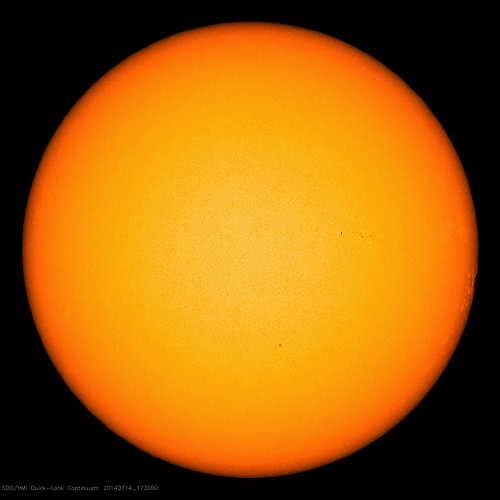
Those of us that like to hunt European DX on 160m from the west coast know that the best time for this is during the 'solar low' years, those quiet periods between the end of one solar cycle and the beginning of the next.
From the west coast, openings to Europe on 160m are not something that happens with much regularity and, unlike the more frequent paths to Europe enjoyed from the east coast, are almost exclusively limited to this quieter part of the solar cycle. The weakening of the Sun's magnetic field at these times allows for less prop-killing D and E-layer signal absorption, particularly through the northern auroral zone path required from the west coast.
In his October, 2016, posting to the Topband reflector, propagation guru Carl Luetzelschwab, (K9LA), suggested that the coming years of solar lows may actually be too low and that because of the likely unprecedented low levels not seen in our lifetimes, the planet could receive higher cosmic-ray bombardment than normally associated with these periods.
"Since galactic cosmic rays are mostly *very energetic* protons, they can get down to low atmospheric altitudes, causing collisional ionization in the D region (and lower E region). A cursory estimate using cosmic ray ionization rates confirms more ionization in the lower atmosphere. 160m is not very tolerant of more absorption, so we may see an adverse effect of the weakened solar magnetic field."
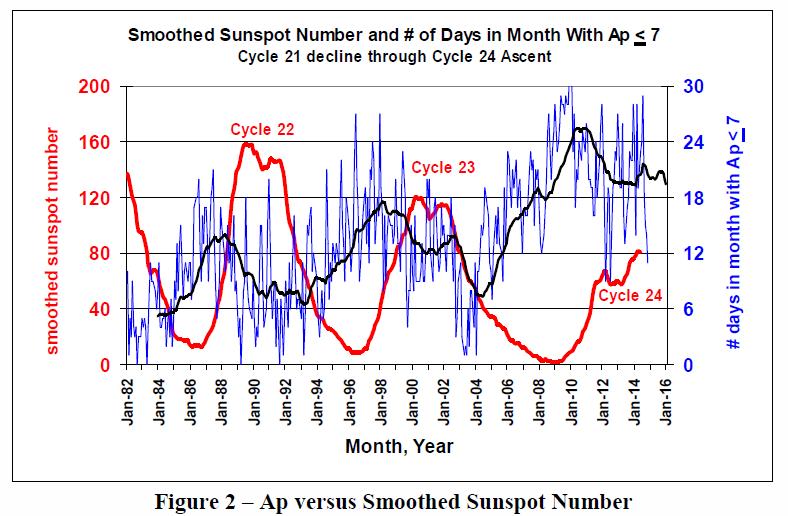
K9LA's Topband comments seems to have its roots in his May, 2015 article, "What's Going On With-160 Meters?", where he compares the solar minimum period between Cycles 22 and 23 to the minimum years between Cycles 23 and 24. Carl noted that the best 160m propagation period that he had seen in his lifetime was during the years between Cycle 22 and 23 and pondered why, during the even deeper prolonged low between Cycles 23 and 24, was it not producing the same levels of great propagation observed 11 years earlier. One possibility he puts forward was that ...
" ... it involves galactic cosmic rays (GCRs). At solar maximum, the Sun is more active, causing more geomagnetic field activity that is believed to be detrimental to 160-Meter propagation. Coupled with the Sun being more active is the fact that the Sun's magnetic field is stronger, which shields the Earth from galactic cosmic rays. Going the other way, when we're at solar minimum, the Sun's magnetic field is weakest, letting in more cosmic rays."
His graph shows the yearly trend of only the low Ap index days (geomagnetically quiet) versus smoothed sunspot numbers for several recent cycles. The blue line plots the trend of low Ap index values with the black line showing the smoothed values; the red line indicates the smoothed sunspot number (solar activity levels).
 |
| source: http://k9la.us/May15_What_s_Going_On_with_160-Meters.pdf |
Carl's earlier observations indicating that the best 160m propagation he had ever observed was during the low period between Cycle 22 and 23 and not during the much quieter low period between Cycle 23 and 24 are very much different than my own ... perhaps because of our different locations.
From the west coast, the most challenging topband path is over the pole to Europe. This only occurs during 'best propagation' periods as this path will only open during prolonged periods of very low geomagnetic activity. Unlike Carl's path to Europe, west coast signals need to traverse the signal-killing auroral zone.
During the first low period, I did experience several openings to Europe but nothing compared to what they were during the second low period, between Cycles 23 and 24, the one Carl did not experience propagation as good as the previous low. For several winters in a row, during the 23-24 low, I often found night after night of amazing propagation to Europe, the quality of which I had never heard before. Interestingly, on almost all of these nights, there were no other signals on the band but Europeans and nearby Washington or Oregon state W7s ... no signals at all from the rest of North America. At times it mimicked the sound of 20m CW to Europe, with signals often reaching S9 on my FT-1000 S-meter. I even worked one SM station on CW while running just 10W output!
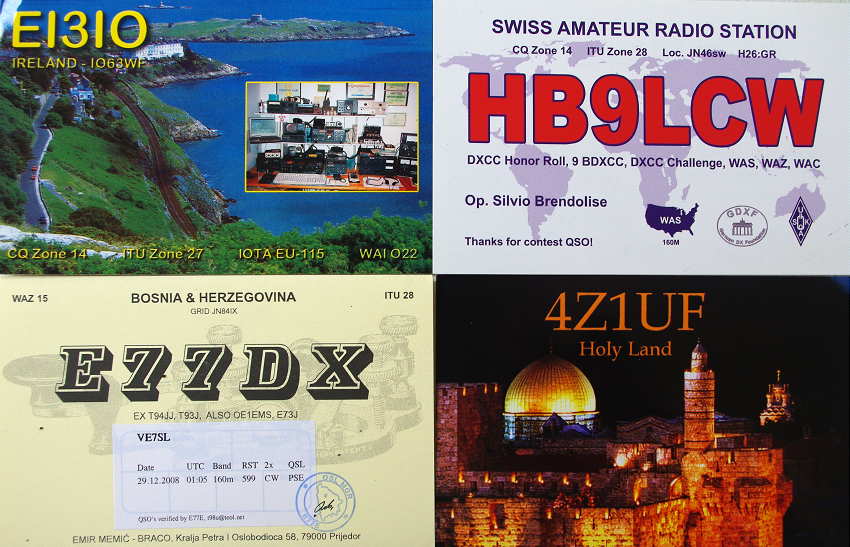
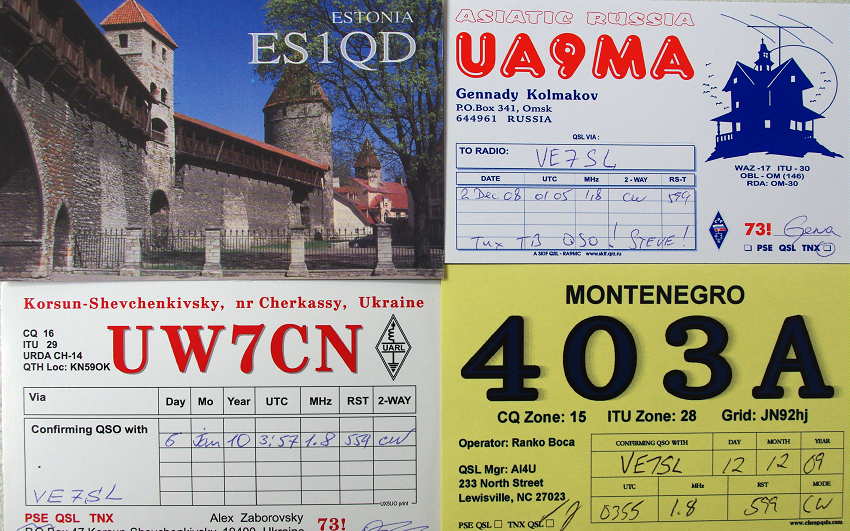
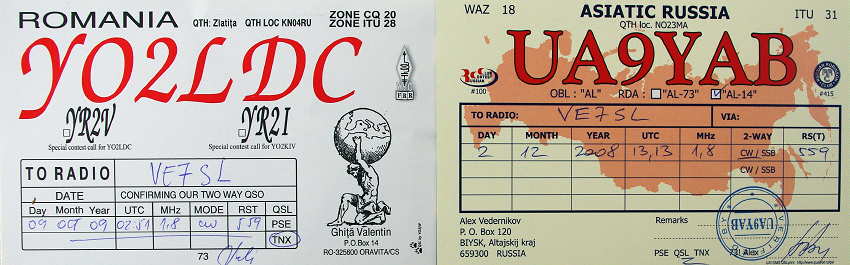
With this long intense low, cosmic ray bombardment should have been at an all time high ... maybe it was, but it didn't seem to be bothering the west coast path to Europe, via the seemingly dormant auroral zone.
I was prompted to address this topic after reading a recent report on the GeoSpace website, siting a new study led by Nathan Schwadron, professor of physics at the University of New Hampshire’s Space Science Center. In the study, recently published in the journal Space Weather, a publication of the American Geophysical Union, the researchers found that large fluxes in Galactic Cosmic Rays (GCR) are rising faster and are on a path to exceed any other recorded time in the space age.
The author's study predicted a 20% increase in radiation bombardment but their newest research shows current conditions exceed their predictions by about 10 percent, showing the radiation environment is worsening even more than expected.
With cosmic ray levels now predicted to increase by a whopping 30%, Carl and the rest of us may soon get some clarity on his original postulation that "maybe a solar minimum can be too deep for 160 meters."
With the next few cycles expected to be even poorer than the present one, the large increase in radiation levels from space may have profound impacts on more than just propagation ... satellites and, with a new appetite to return human activity to the moon, astronauts could be exposed to much higher radiation levels than ever before.
The next few years of (ultra?) solar-quiet should be very interesting!
Steve McDonald, VE7SL, is a regular contributor to AmateurRadio.com and writes from British Columbia, Canada. Contact him at [email protected].
How I Reunited Two Devils Brigade Canadian and American Veterans of World War Two
In the 1990s while living in eastern Montana, I had the amazing experience of reuniting two soldiers that served in the Devil’s Brigade. They both trained near Helena, Montana.
One day, I was operating on the amateur radio shortwave Ten-Meter band, and a gentleman answered my, “CQ, CQ, CQ, this is N7PMS in Montana, Over”. I took notes of our conversation.
The next day, when again I called for any station to answer my call for a conversation, another fellow, from Canada, answered me. I learned something amazing: Both of these two men mentioned that, during World War Two, they both were in the same special forces unit, training near Helena, Montana.
One of these Veterans served in the Canadian Armed Forces, and the other in the American Armed Forces. Listen to my story, for the full details of this amazing experience I had as an amateur radio operator.
Jump to 3:22 if you wish to skip my introduction to the story, during which I give some background on when and so on:
https://youtu.be/YFMplHjxy6s?t=3m22s
This certainly was one of the most memorable moments in my amateur radio hobby experience! The joy of reuniting friends is good.
From https://en.wikipedia.org/wiki/First_Special_Service_Force:
The 1st Special Service Force (also called The Devil’s Brigade, The Black Devils, The Black Devils’ Brigade, and Freddie’s Freighters), was an elite American-Canadian commando unit in World War II, under command of the United States Fifth Army. The unit was organized in 1942 and trained at Fort William Henry Harrison near Helena, Montana in the United States. The Force served in the Aleutian Islands, and fought in Italy, and southern France before being disbanded in December 1944.
The modern American and Canadian special operations forces trace their heritage to this unit. In 2013, the United States Congress passed a bill to award the 1st Special Service Force the Congressional Gold Medal.
Thank you for watching, and sharing. Comments are welcome: do you have a memorable moment in your radio hobby experience on the air?
73 de NW7US
Visit, subscribe: NW7US Radio Communications and Propagation YouTube Channel
Power regulator works as polarity protection
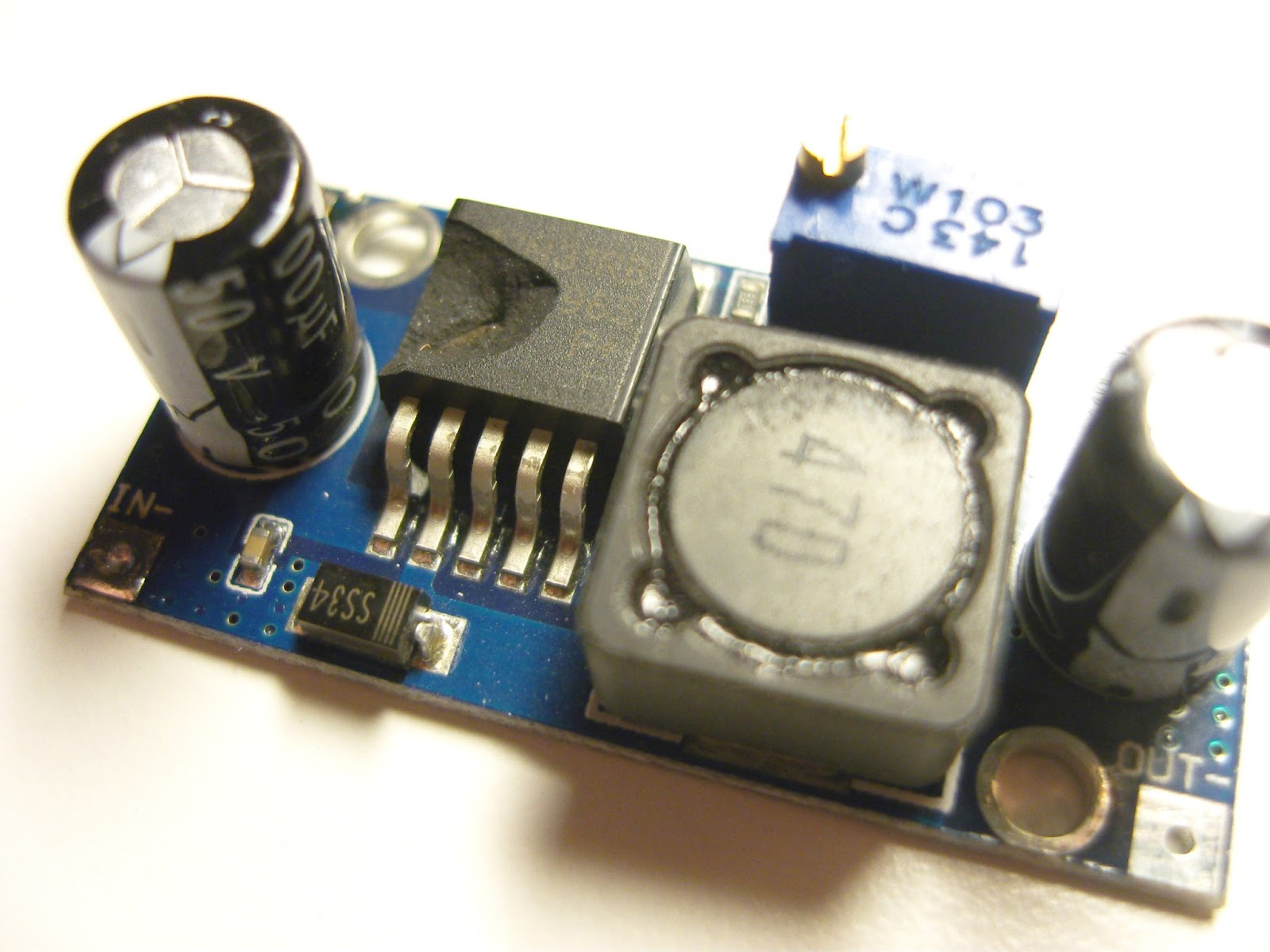 |
| Step-down converter based on LM2596. Note the damaged chip |
Ok, now I’ve done the test. My QRPLabs U3S runs off a 12 Volt power supply. There are two step-down converters, one for 5 Volts for the processor and another adjustable one for the power amplifier, if one can call 0.2-0.5 Watts a power amplifier. See picture of these voltage converters in this post.
I happened to make a new cable for 12 Volts which had the polarities inverted – and puff – there was a noise and absolutely no response from the U3S. I feared that I had blown the entire circuit. As my power amplifier was turned off, only the 5 Volts supply was affected and upon inspection I found that the voltage converter had a destroyed chip.
Since since they are so cheap, I had a spare. Luckily for me, the U3S worked as it should after replacement. So the LM2596 can take a reversed polarity and sacrifices itself in order to protect the rest of the electronics. Nice!
This post first appeared on the LA3ZA Radio & Electronics blog.
Sverre Holm, LA3ZA, is a regular contributor to AmateurRadio.com and writes from Norway. Contact him at [email protected].
Radio Virgin: the First QSO
My first QSO (and, yeah, it was with Morse code) was petrifying and…
What’s your story of your first QSO?
73 de NW7US
Visit, subscribe: NW7US Radio Communications and Propagation YouTube Channel
LHS Episode #220: Polysyllabic
 Welcome to Episode 220 of Linux in the Ham Shack. In this episode, we tackle such monumental topics as weather spotting, the ARRL Teacher's Institute open enrollment, AlaskIT.co, the EU and its stupid rules, the Open Container Initiative, HF packet, Echolink, big words and much more. Thanks for listening. Please donate to our GoFundMe campaign if you can. If you can't, please share, Share, SHARE!
73 de The LHS Crew
Russ Woodman, K5TUX, co-hosts the Linux in the Ham Shack podcast which is available for download in both MP3 and OGG audio format. Contact him at [email protected].
ICOM IC7300

Probably the best commercial radio available to radio amateurs currently is the IC7300. However, its price is still set by market forces: it could still be profitable at a much lower selling price.
Whether prices drop depends on many factors, but there is no doubt that the price is what it is largely because people are still prepared to buy at this price. If the dealers can still make a killing why would they reduce prices? Also, currently there is no real competition.
See https://icomuk.co.uk/IC-7300/Amateur_Radio_Ham_Base_Stations

Roger Lapthorn, G3XBM, is a regular contributor to AmateurRadio.com and writes from Cambridge, England.
Regulated voltage for Regenerative receiver project
Mr. Regula-tor
Fortunately, the regen circuit uses a ridiculously small amount of current for B+; about 4 to 5mA. Although I will likely change the audio side of the tube to deliver enough current for a speaker rather than the high impedance headphones in the current design, which may potentially double that to 10ma. For the first incarnation I'll stick with high-impedance headphones.
Generally batteries are used with regenerative receivers because they are so sensitive to power supply noise, but I wanted to give the power supply a shot first and if it proves too noisy I can fall back to battery power for the B+ and just use the filament voltage provided by this transformer.
Since I have a OB2 voltage regulation tube I want to use. The OB2 regulates at 108V so that's what I'm going with. An OB3 would regulate at 90V, but I don't have one of those.
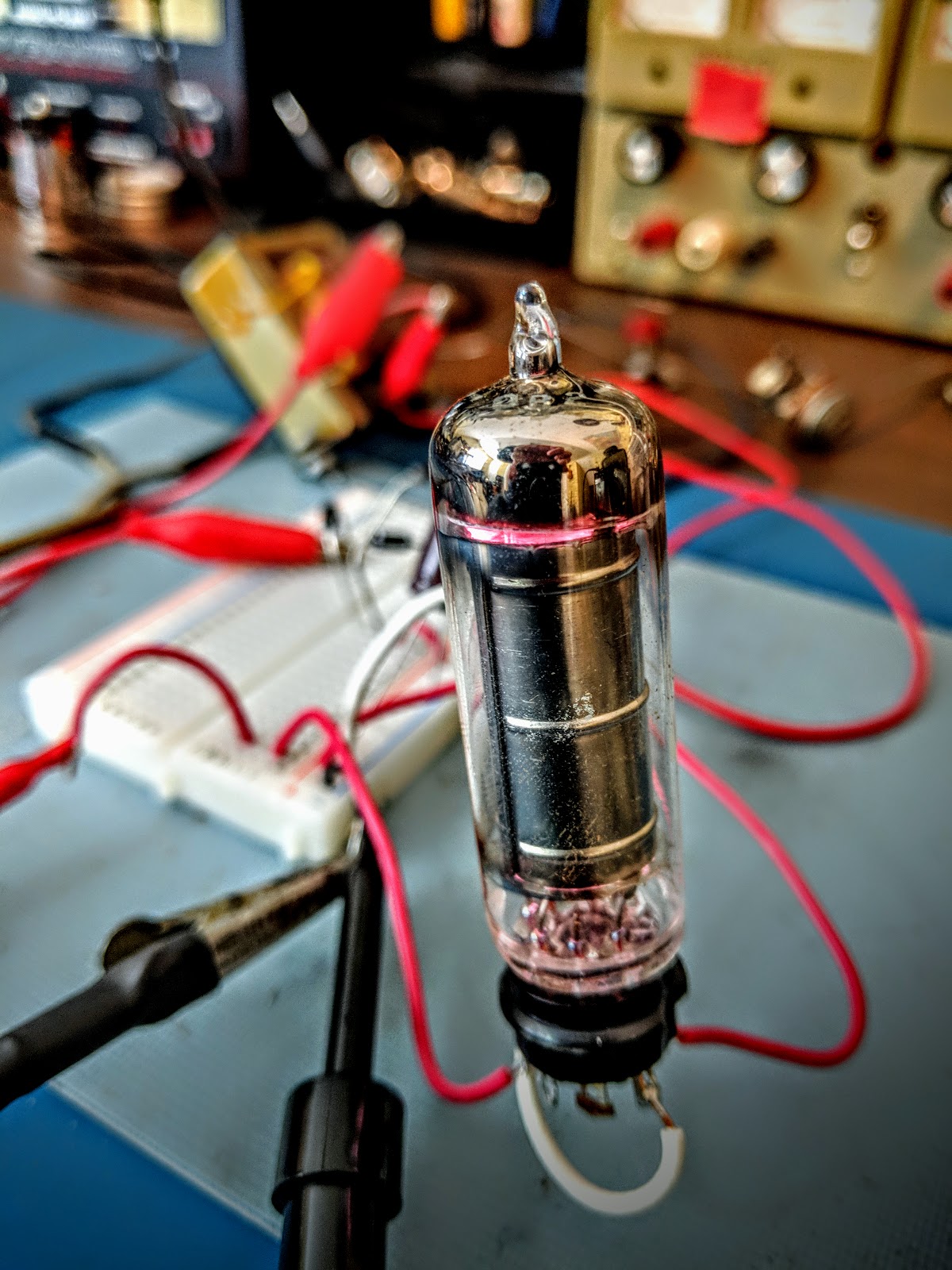 |
| OB2 in action... Glow baby, Glow! |
Calculating the resistor drop
Rdrop = (Vs - Vreg) / (Ireg + Isupply)So, in my case:
Voltage supply (Vs) = 189V
voltage regulation (Vreg) = 108V
regulator current (Ireg) the OB2 requires 5mA to do its job = 5mA
supply current (Isupply) the actual current required by the 6SN7 up to ~ 5mA
So, (189V - 108V) / (0.005A + 0.005A) comes out to a resistor value of 10,100 ohms. 10k is the closest standard size resistor and at 108V it should be able to dissipate 1.166 watts. So I'll need a 10k 2-watt resistor.
Parts is parts

Summary
With the current values I'm seeing 50mA ripple on my regulated voltage.
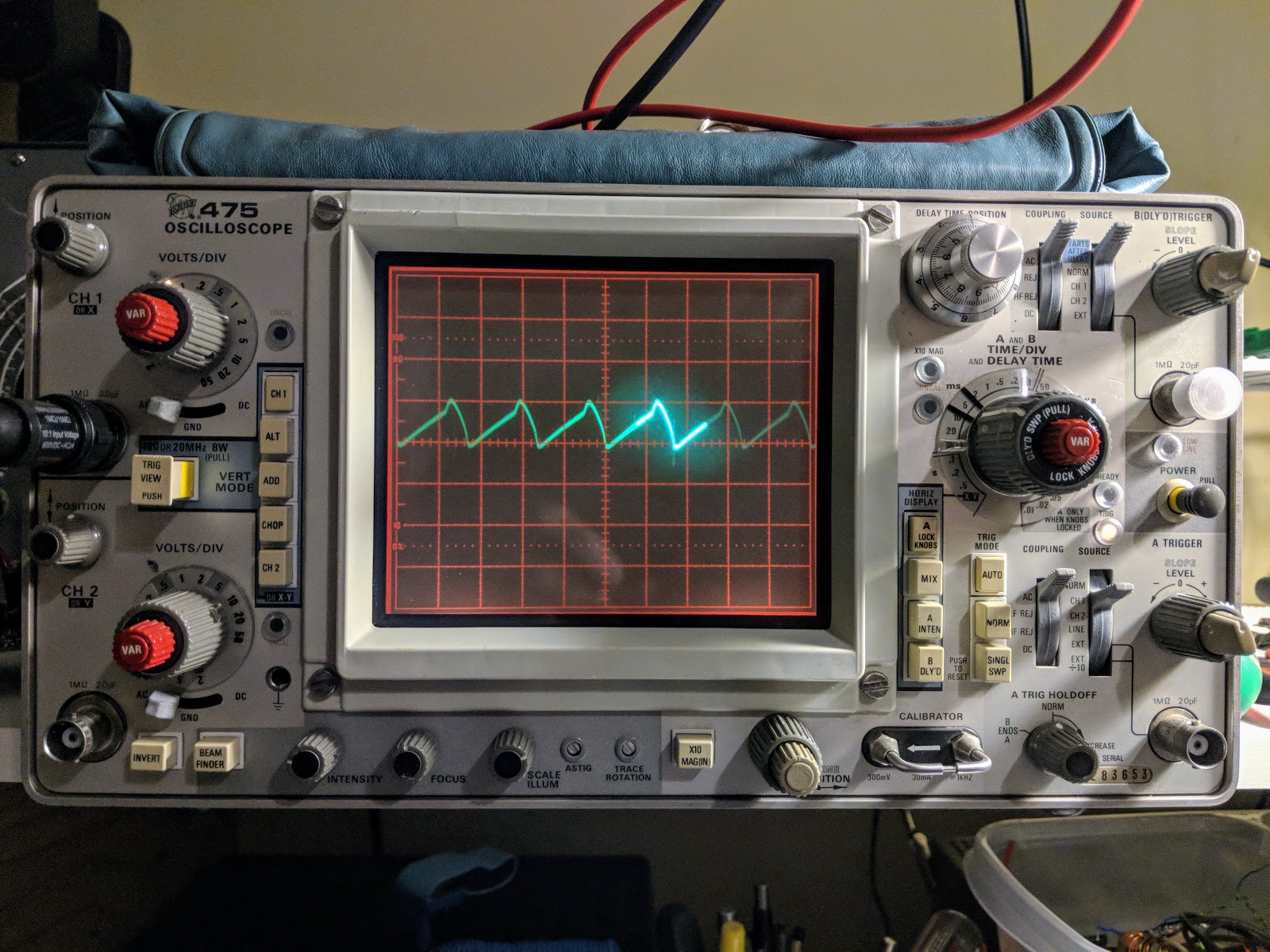 |
| A bit over 50mA ripple |
That's all for now....
So lower your power the old fashioned way, using a voltage regulator tube.
72/73
Richard, AA4OO
Richard Carpenter, AA4OO, is a regular contributor to AmateurRadio.com and writes from North Carolina, USA. Contact him at [email protected].
 Ham Radio Deluxe |
 W5SWL Electronics |
 Ham Radio Prep |
 KB3IFH QSL Cards  Hip Ham Shirts  HamRadioAuctions HamRadioAuctions Reliance Antennas Reliance Antennas Enigma Shop Enigma Shop |  morseDX  Ni4L Antennas  R&L Electronics R&L Electronics antennas.us antennas.us QRV QRV |
- Matt W1MST, Managing Editor
