 |
 Ham College 42
 1 July 2018 | by
 Ham College episode 42 is now available for download.
General Amateur Radio Exam part 13. Digital Modes pt 5, HF Antennas part 3.
01:00:21
George Thomas, W5JDX, is co-host of AmateurLogic.TV, an original amateur radio video program hosted by George Thomas (W5JDX), Tommy Martin (N5ZNO), Peter Berrett (VK3PB), and Emile Diodene (KE5QKR). Contact him at [email protected].
NEWS on heading in another direction!
Mike Weir, VE9KK, is a regular contributor to AmateurRadio.com and writes from New Brunswick, Canada. Contact him at [email protected].
Amateur Radio Weekly – Issue 209

Receive SSTV from Space June 29-July 1
These images will commemorate the various satellites that were hand-deployed from the ISS.
AMSAT UK
Attendance holds steady at Hamvention 2018
At 28,417 visitors, Hamvention recorded its third-largest attendance ever in its second year at its still-new location in Xenia, Ohio.
ARRL
“Baker is Brutal!” KH1/KH7Z DXpedition team reports
“They say it never rains on Baker,” the DXpedition noted in its June 28 update. “At midnight giant squalls came through knocking out one of our three antennas that we worked so hard to get up.
ARRL
That wasn’t good – that was great
180 degree opposites! As much as I feared that I wasn’t into Field Day this year, that’s how much it turned out to be a truly great experience.
W2JL
Field Day 2018 – Every day is field day
One of the primary goals of my station configuration, whether at home or in the field, is keeping the station as small and uncomplicated as possible.
OH8STN
The N4Y 2018 ARRL Field Day Report
Field Day this year was a two operator, one transmitter operation on emergency power.
N4KGL
The Apollo Survival Radio
The transceiver and its cylindrical battery pack were water-tight. It could operate in beacon mode for up to 24 hours.
The SWLing Post
Activating Southern Britain’s Highest Mountain on Top Band
I was pretty confident that I’d have enough space for an 80m dipole, as long as I setup well away from the main summit.
Adventures in Ham Radio
13 Colonies special event begins July 1
Celebrating 10 years honoring the original 13 colonies.
13colonies.net
Cuban special event
Activity is to commemorate the 120th anniversary of the Naval Battle during the Spanish, Cuban, American War.
Southgate
Video
Building a giant 2m corner reflector antenna
For GOES-16, pulsars and more.
YouTube
Basics of RF Bias Tees including applications and examples
Bias Tees are RF components that are used whenever you need to couple a DC, power or low-speed control signal onto an RF signal path.
W2AEW
Get Amateur Radio Weekly in your inbox.
Sign-up here
Amateur Radio Weekly is curated by Cale Mooth K4HCK. Sign up free to receive ham radio's most relevant news, projects, technology and events by e-mail each week at http://www.hamweekly.com.
Barn Door Wide!
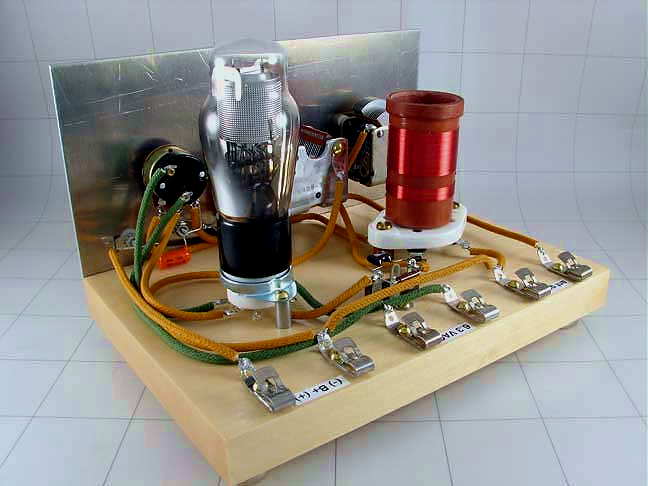 |
| Alfred Morgan 1 Tube Regen courtesy: KC9KEP |
The next CLE event will be the "Barn Door" listening activity which requires listeners to use receivers without the usual narrow filters. Some of the older tube radios can do this easily as can most homebrew receivers ... especially the regens!
If you've never listened to the NDB band with a wide bandwidth, it is a fascinating experience! If conditions are normal, you can typically hear a half dozen or more signals, all at various pitches, vying for your attention. It's almost as if you have plunked yourself down in the middle of the NDB forest of signals, and they are coming at you from all directions.
Many choose to use one of their homebrew receivers for this event, often as simple as a '1AD' or a '1 Active Device' circuit. A recent posting to the ndblist group from CLE organizer Brian Keyte (G3SIA), described just how much fun can be derived from such a simple radio. I'll let Brian's words speak for themselves below:
Recently I've had a few requests to provide details of my 1-transistor receiver, as used on my recent Scotland holiday and back in April 2009 for our first CLE for simple receivers. (There's still time to try making something for our next CLE145).
Here goes:
In March 2009 I was tempted to try following in the footsteps of Mike Tuggle and Finbar to see if I, as a complete D-I-Y beginner, could make a very simple 1-transistor NDB receiver. The story of making and using my own '1AD' (single active device) may help anyone also wondering whether to try some simple D-I-Y construction for CLE145, our second Listening Event for basic receivers.
I started by rounding up some likely old radios and a TV from my junk box and tried to see what I had in them that might be useful for a 1-transistor regen. receiver. From a list of the transistor types that I'd found, Mike identified a BF362 as probably the only suitable one. It is a 'normal' N-P-N silicon transistor (a BJT - bipolar junction transistor - as opposed to a field effect transistor like the MOSFETs) and is intended for low power high frequency applications. My background in making anything using transistors was just about nil and I knew almost nothing about them. The first challenge was removing the BF362 from its circuit board (a small board designed to amplify incoming UHF TV signals). Trying to play safe, I sawed round a big chunk of the actual board having snipped off most of the other components. A bit of brute force was needed as well as the hacksaw. Tests with a meter then showed that I should be able to solder to Collector, Base and Emitter without overheating the transistor. (Google helped when I entered ' BF362 data sheet ').
From the discarded MW / LW receivers there were several 2-gang variable capacitors and their tuning coils wound on ferrite rods - and of course lots of fixed capacitors and resistors. Many years ago a friend had passed to me the result of his construction of a basic amateur receiver (Heathkit RA1). That was useful because of the lack of a circuit board - the components were just soldered to lugs, most with still usefully-long wires. It also had a full list of parts and simple advice on construction. One of the old portable receivers I'd found had a plastic case that looked suitable for housing things (about the right size and shape, easy to drill, etc.).
First I tried a lash-up of the basic components on-the-bench (i.e. on the dining room table!) using the simplest transistor circuit without any regen. Trying my normal aerials, including a 100 metre long wire, I could weakly hear a few broadcast stations in the LF part of the MW band. Complete silence where there should have been NDBs - and my nearest, 316 EPM, is only 5 km away. When I tried adding regen. it proved to be an uncontrollable beast - stray capacitance effects due to all the loose connecting wires, etc. (I had made no use of a soldering iron yet!).
It seemed there was nothing for it but to start mounting the main components in the case - something I had wanted to do only after getting some real results. I had to try and guess where to site the components for likely best performance, ease of operation, etc. With no metal casing, it seemed to be a good idea to put a grounded copper wire as a 'busbar' round part of the case. That might help reduce any hand capacity effects and it would be useful for making the several ground connections including the '-' side of the little PP3 9v battery. Where possible the metal cases of the potentiometers were grounded to it too.
I had only just started fixing components in the case when Sue and I needed to move up to Lincolnshire for 5 days. That turned out to be good, as I would be well away from temptations to continue the component searches for 'something a bit better' and I could concentrate on what should be the fun part. There was a good ground connection there but I was limited to a 30 metre long wire aerial. With regen. working, that proved to be long enough to get some results from Broadcast stations, though still not loud. I was making slow progress by trying out different component values etc. and by the time came to come back home I had only heard TWO beacons. One, 338 FNY Doncaster/Sheffield International (Robin Hood Airport), only 15 miles away, was faint but fairly easy to find. The other, 365 KIM Humberside and also about 15 miles away was very faint and I only managed to hear it once. Listening during the evenings didn't add any more NDB loggings at all. I was very disappointed and ready to give up the project, but Sue reminded me I had said that if I heard just one NDB during the 5 days I would consider it a success!
Returning to Surrey my luck changed. Without making any alterations, I tried the set using my 100 metre long wire - and it was transformed! During a few minutes at dusk I heard about 25 beacons, mostly weak but clear - the 30 metre aerial in Lincolnshire must have been the problem. Listening briefly again later that evening, several European countries were there - and to my surprise I suddenly stumbled on OZN 372 (Greenland) among the loudest and clearest. That made me wonder if a Canadian beacon was possible, so I tried for DF 350 more or less at random as one of the more likely ones. Setting the receiver to 350 kHz could be difficult with no frequency markings yet, but then I noticed that it would be halfway between my locals FOS 348 and WOD 352, both of whose idents could be heard at the same time. But no luck!
Then, at about 01.15 and just before bed, I tried again. After a minute or two there appeared a weak intermittent carrier and then - sure enough - about 5 cycles of a definite 'DF' before it faded and was gone. Can you imagine my delight? Ten days after starting as a complete D-I-Y beginner, a 1-transistor device made entirely of a few junk box components was getting me Deer Lake, almost 4,000 km away (2,500 miles) in Newfoundland. After that I thought the set justified having a name, so it was christened 'Max' (contradicting its minimal design!).
The next morning I took Max to try it out when genuinely portable using a long fence not far from here. Midday conditions this time but, with the necessary short aluminium rod pushed into the ground, it gave around 25 beacons in about 10 minutes, including Wales, Belgium, Guernsey and France. Another advantage of a simple portable receiver - there are lots of places with very long ungrounded wire fences that I've noted on our walks. Then at the end of the month Sue and I had a week's holiday at a self-catering cottage on the Isles of Scilly, 50 km into the Atlantic off the far South-West of England. Travelling by train and ship (no car), my AR7030 receiver and power supply couldn't make it into my rucksack but Max did, a fraction of the weight, together with about 100 metres of light wire to drape on the hedgerows beside the cottage. Listening mainly at daytime I heard over 100 NDBs. Again, the signals were mostly quite weak, but crystal clear.
Back home I made a few overdue improvements - replacing most of the remaining twisted wires with soldered connections, fitting a terminal block for the aerial and earth, adding a little switch to select one or both of the capacitor gangs and changing connections in the output transformer giving a considerable increase in volume. I had wondered whether my reception of DF had really happened, despite the detailed notes that I had made at the time. Then early one morning there was DF again, much louder than before and it persisted for several minutes.
I used the set of course for our first 'Barn Door' listening event for basic receivers, CLE116, during Easter weekend 2009. I chose to listen only within two hours of midday using a long wire or one of my fixed passive loops and I just managed to reach 100 NDBs. 14 of the loggings were of beacons over 400 km away.
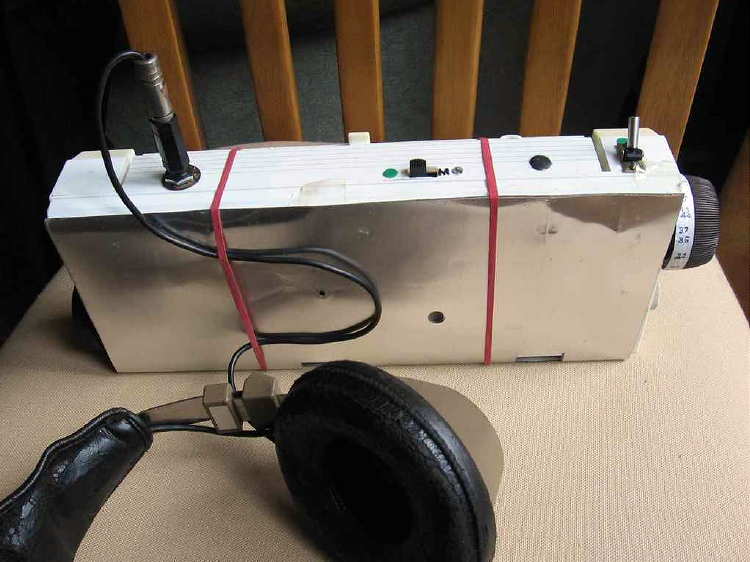
In June this year, with CLE145 coming at the end of July, Max needed to be re-awakened and tested before taking it with us to Scotland. It had always suffered a little from hand capacity effects - touching some parts caused minor changes in frequency, as did the aerial being blown about by strong winds, etc. I discovered that one of my old PC keyboards had a big metalised screen under the keys. This cured all those problems merely by placing it (fixed with rubber bands!) over the front of the receiver. It also stops an occasional 'fizzing' kind of interference if I slide the first few inches of the headphone lead under the rubber band to hold it against the screen (see picture). I assume that problem was caused by some kind of RF getting through to the 'phones.
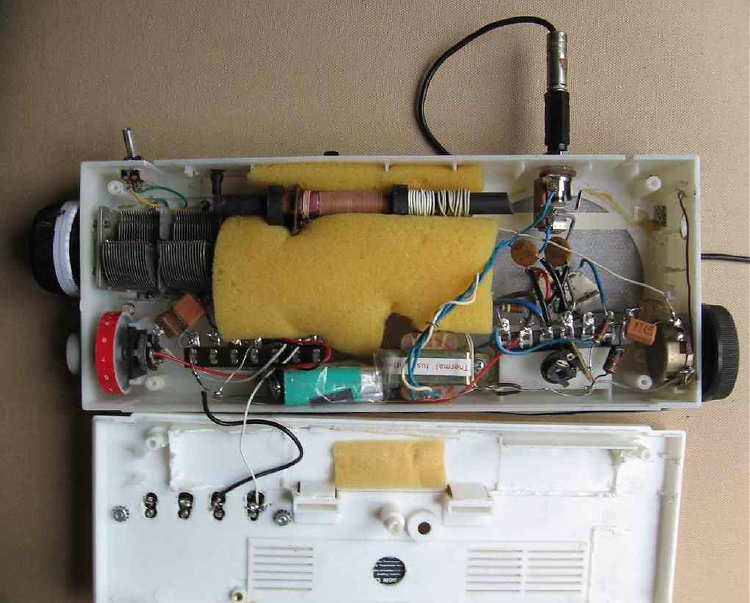
The attached pictures show Max's front view, the inside view with the back cover unscrewed and the circuit diagram.

In the front view the main tuning knob is at the top right hand side, still with primitive frequency markings on it! (35 = 350 kHz, etc.).
The regen. control is just visible at the bottom left hand side.
The top right hand switch extends the tuning range below 300 kHz by adding the second half of the variable capacitor.
(The top central switch is a refinement that allows the tuning to cover just the Medium Wave broadcast stations by using a different winding).
In the inside view, the main components are:
The transistor on its hacked bit of white circuit board which can be seen centre right.
The windings on the ferrite rod at the top are, left to right, the original main tuning coils, aerial coupling and the regen. coil.
The bottom right potentiometer is the regen. control.
The 'floating' pot. is the base bias control.
The large top left knob is main tuning, (I tried adding a fine tuning capacitor in parallel, but it added operating complication without any advantage and I removed it)
The bottom left pot. (still as in the original set) is spare, but it incorporates the battery ON/OFF switch.
The battery, wrapped in plastic in case it shorts things, can be changed using the hinged flap.
(However the battery drain is about 1 mA, so the battery would last for many months if I listened for an hour every day!)
The output matching transformer is next to the battery.
As you can see, my approach has been very 'Heath Robinson' and a real hit-and-miss affair, so don't put much reliance on it. The set does work pretty well, but I'm sure circuit design experts will see lots of things than could be improved - and not just the quality of the soldering! Others are likely to use different transistor types and component values and some connections may be different. A MOSFET would be expected to perform better.
In case you haven't used a regeneration set before, the regen. control allows feedback of some of the RF signal to the main tuning circuit. As the regen. knob is increased from zero it increases the apparent signal strength considerably. Broadcast stations get much louder and a very local NDB would just be heard from its audio ident (a 400 Hz or 1020 Hz Morse tone). Turning the regeneration control up further continues to increase the signal strengths until suddenly beat notes start to be heard when you tune across any carriers. Now you hear the NDB signals much as 'real' receivers would when using their CW setting and no filter (or a very wide one).
The regen. could be increased even further, but eventually the set starts to fizz or wail loudly and becomes a 'dirty' transmitter - not useful!
If you have read as far as this you must have already built a simple set or are at least a bit tempted to!
If you have a little spare time, do give it a try. It really is a fun project and when you start to get results it is like reliving all over again those early days when you were delighted by your first DX loggings - only this is even more satisfying!
I'm grateful to Mike and Finbar for their encouragement and suggestions. I sent details of their sets to the List on 10th June in my email introducing the 'Barn Door CLE145' in late July. It would be good to hear details from any others with working sets or who are well on their way to having them.
Good listening!
Brian
Now if this is something that might interest you, filling a log page of NDBs heard on your own little creation, then there is still plenty of time to whip something together. If you prefer 'modern', then Mike and Brian's circuits might be a good place to begin experimenting or you could just grab one of your old Handbooks and check out the simple regenerative circuits described ... from the '30s on up! Just beef up the L and C values enough to get you down below the broadcast band and you're in business.
There is also a ton of stuff on the web via the vintage magazine and book collection available at the American Radio History website here, with enough info to keep you at the workbench for a long time.
 |
| courtesy: American Radio History |
Here is the CLE info, direct from Brian:
Our 233rd Coordinated Listening Event is only just over, but Joachim and I
want to tell you a little about something special coming for our next CLE,
27th - 30th July.
For CLE234 we’ll have one of our occasional ‘Barn Door’ CLEs.
It will be an opportunity to bring back to life basic kinds of receiver -
anything with low selectivity which allows you to hear NDBs on several
frequencies simultaneously – “leaving the barn door wide open!”.
Our last Barn Door CLE was No. 209 in July two years ago.
Listening with 'back to basics' equipment often gives very satisfying and
unexpected results. It can also show us ways of improving our listening
when operating more normally.
To take part, you could use any one of the following:
1. A simple home-made receiver, such as a single transistor set with regen.
(e.g. based on the sets used by Mike Tuggle, Finbar and others).
2. OR - an ultralight receiver (maybe one converted to cover the NDB
frequencies with a modified aerial).
3. OR - an 'antique' receiver brought back to life (e.g. Scott,
Eddystone, R1155, etc.). Most of those are anything but ultralight!
4. OR - a normal receiver but with NO filtering, or using a WIDE FILTER,
(not less than about 2 kHz and with no selection of an audio filter).
Your 'barn door' should be open wide enough for you to hear any NDBs
on at least five adjacent frequencies all at the same time - E.g. NDBs on
348, 349, 350, 351 and 352 kHz with the receiver set to 350 kHz.
Listening to one NDB and ignoring several others of different pitch can be
quite a challenge - but it is very satisfying when you find how quickly it
becomes easier to do.
It may take a while to prepare for some of those ways of listening,
especially the first - hence this ‘Early Warning’!
The attached guide *** (click here) from the past by Mike Tuggle may help you if you are thinking of using a basic D-I-Y receiver.
The ‘Early Advice’ and ‘Final Details’ for the CLE will follow about 9 days
and 6 days before the event, earlier than usual to help you to get ready.
Good Listening!
Brian
-----------------------------------------------------------------
From: Brian Keyte G3SIA ndbcle'at'gmail.com
Location: Surrey, SE England (CLE coordinator)
----------------------------------------------------------------
Steve McDonald, VE7SL, is a regular contributor to AmateurRadio.com and writes from British Columbia, Canada. Contact him at [email protected].
Colorado 14er Event (2018)
 August 4 & 5, 2018
Saturday and Sunday
www.ham14er.org
Amateur Radio operators from around Colorado will be climbing many of Colorado’s 14,000-foot mountains and Summits On The Air (SOTA) peaks to set up amateur radio stations in an effort to communicate with other radio amateurs across the state and around the world. Join in on the fun during the 27th annual event and see how many of the mountaintop stations you can contact. The covers the entire weekend but many mountaintop activators will hit the trail early with the goal of being off the summits by noon due to lightning safety concerns.
Now including Summits On the Air (SOTA), which adds over 1700 potential summits! If you aren’t up to climbing a 14er, there are many other summits to choose from (with a wide range of difficulty). See the Colorado SOTA web page at w0c-sota.org
Radio operators who plan to activate a summit should post their intent on the ham14er Yahoo Group. To subscribe to the “ham14er” email list, visit the Yahoo groups site at http://groups.yahoo.com/group/ham14er/ . Also, be sure to check out the event information at http://www.ham14er.org It is also a great idea to post an ALERT on the SOTAwatch.org website.
Frequencies used during the event
Activity can occur on any amateur band including HF and VHF. The 2m fm band plan uses a “primary frequency and move up” approach. The 2m fm primary frequency is 147.42 MHz. At the beginning of the event, operators should try calling on 147.42 MHz. As activity increases on that frequency, move on up the band using the 30 kHz steps. Don’t just hang out on 147.42 MHz…move up! The next standard simplex frequency up from 147.42 MHz is 147.45 MHz, followed by 147.48 and 147.51 MHz.
| Frequency (MHz) | Comments | Frequency (MHz) | Comments |
| 147.42 | Primary 2m FM Frequency, then up in 30 kHz steps | 7.032 | 40m CW Frequency |
| 147.45 | Alternate 2m FM frequency | 7.185 | 40m SSB Frequency |
| 147.48 | Alternate 2m FM frequency | 10.110 | 30m CW Frequency |
| 147.51 | Alternate 2m FM frequency | 14.060 | 20m CW Frequency |
| 446.000 | Primary 70 cm FM frequency | 14.345 | 20m SSB Frequency |
| 446.025 | Alternate 70 cm FM frequency | 18.092 | 17m CW Frequency |
| 1294.50 | Primary 23cm FM frequency | 18.158 | 17m SSB Frequency |
| 144.200 | 2m SSB calling frequency | 21.060 | 15m CW Frequency |
| 50.125 | 6m SSB calling frequency | 21.330 | 15m SSB Frequency |
| 28.060 | 10m CW Frequency | ||
| Other Bands/Modes | Standard calling frequencies and/or band plans apply. | 28.350 | 10m SSB Frequency |
Warning: Climbing mountains is inherently a dangerous activity.
Do not attempt this without proper training, equipment and preparation.
More operating information here: www.ham14er.org
Sponsored by The Colorado 14er Event Task Force
Download: Colorado 14er Event Flyer 2018
The post Colorado 14er Event (2018) appeared first on The KØNR Radio Site.
Bob Witte, KØNR, is a regular contributor to AmateurRadio.com and writes from Colorado, USA. Contact him at [email protected].
Weekly Propagation Summary – 2018 Jun 25 16:10 UTC

Here is this week’s space weather and geophysical report, issued 2018 Jun 25 0343 UTC.
Highlights of Solar and Geomagnetic Activity 18 – 24 June 2018
Solar activity was at predominately very low levels with an isolated C2/Sf flare observed at 21/0115 UTC from Region 2715 (N08, L=231, class/area Dac/120 on 23 Jun). This region, as well as Region 2713 (N05, L=289, class/area Dao/070 on 23 Jun), also produced numerous B-class flares during the period. No Earth-directed CMEs were observed during the period.
No proton events were observed at geosynchronous orbit.
The greater than 2 MeV electron flux at geosynchronous orbit was at normal levels on 18 and 23 Jun and moderate levels on 19-22 Jun. High levels were reached on 24 Jun in response to an enhanced solar wind environment.
Geomagnetic field activity generally ranged from quiet to active levels with an isolated G1 (Minor) storm period observed early on 18 Jun. The period began under the influence of a waning, positive polarity CH HSS. Wind speeds peaked at 525-540 km/s early to midday on 18 Jun with the Bz component variable between +16 nT to -9 nT. On 18 Jun through midday on 19 Jun, field conditions ranged from quiet to isolated G1 geomagnetic storm conditions. From midday 19 Jun through early on 23 Jun, solar wind parameters were at mostly nominal levels with a quiet geomagnetic field.
Early on 23 Jun, solar wind parameters indicated a weak CIR signature in advance of another positve polarity CH HSS. Wind speeds gradually increased from about 325 km/s to a peak of near 515 km/s by the end of 23 Jun. Total field strength peaked at 15 nT midday on 23 Jun while the Bz component varied between +12 nT to -15 nT through midday on the 23rd before relaxing to a variable +/-9 nT through the summary end. Field conditions responded with quiet to active conditions on 23 Jun and quiet to isolated unsettled conditions on 24 Jun.
Forecast of Solar and Geomagnetic Activity 25 June – 21 July 2018
Solar activity is expected to be at predominately very low levels with a chance for C-class flare activity on 25-28 Jun until Region 2715 rotates off the visible disk. Very low levels are expected from 29 Jun – 10 Jul. With the return of old Region 2715 on 11 Jul, very low levels, with a chance for C-class flare activity, is expected through the remainder of the outlook period.
No proton events are expected at geosynchronous orbit.
The greater than 2 MeV electron flux at geosynchronous orbit is expected to be be at high levels on 25-26 Jun and 28 Jun – 10 Jul due to CH HSS influence. Normal to moderate levels are expected for the remainder of the outlook period.
Geomagnetic field activity is expected to be at unsettled to active levels on 25-30 Jun, 15 Jul and 20-21 Jul with G1 (Minor) storm levels expected on 27-28 Jun, all due to recurrent CH HSS activity.
Don’t forget to visit our live space weather and radio propagation web site, at: http://SunSpotWatch.com/
Live Aurora mapping is at http://aurora.sunspotwatch.com/
If you are on Twitter, please follow these two users: 1. https://Twitter.com/NW7US 2. https://Twitter.com/hfradiospacewx
– – – – – – – – – – – – –
Be sure to subscribe to our space weather and propagation email group, on Groups.io
https://groups.io/g/propagation-and-space-weather
Spread the word!
– – – – – – – – – – – – –
Links of interest:
+ Amazon space weather books: http://g.nw7us.us/fbssw-aSWSC
+ https://Twitter.com/NW7US
+ https://Twitter.com/hfradiospacewx
Space Weather and Ham Radio YouTube Channel News:
I am working on launching a YouTube channel overhaul, that includes series of videos about space weather, radio signal propagation, and more.
Additionally, I am working on improving the educational efforts via the email, Facebook, YouTube, Tumblr, and other activities.
You can help!
Please consider becoming a Patron of these space weather and radio communications services, beginning with the YouTube channel:
https://www.patreon.com/NW7US
The YouTube channel:
https://YouTube.com/NW7US
..
Visit, subscribe: NW7US Radio Communications and Propagation YouTube Channel
Ham radio as I know it is out
Mike Weir, VE9KK, is a regular contributor to AmateurRadio.com and writes from New Brunswick, Canada. Contact him at [email protected].
 Ham Radio Deluxe |
 W5SWL Electronics |
 Ham Radio Prep |
 KB3IFH QSL Cards  Hip Ham Shirts  HamRadioAuctions HamRadioAuctions Reliance Antennas Reliance Antennas Enigma Shop Enigma Shop |  morseDX  Ni4L Antennas  R&L Electronics R&L Electronics antennas.us antennas.us QRV QRV |
- Matt W1MST, Managing Editor
