 |
 Barn Door CLE Regen Results
 1 August 2018 | by
This past weekend's 'Barn Door' CLE' saw a lot of participation, in spite of the mid-summer doldrums and the universal nasty lightning noise.
After reading CLE-organizer Brian Keyte's interesting posting to the ndblist, describing his homebrew single transistor regenerative receiver, I was inspired enough to dig out the soldering iron and build one for myself.
The circuit widely described as a '1AD regen' was originally designed several years ago by crystal-radio guru Mike Tuggle out in Hawaii. Mike is widely known for his exquisitely designed "Lyonodyne" DX crystal radio, which inspired an entire decade of intense DX crystal radio building activity back in the late 90's.
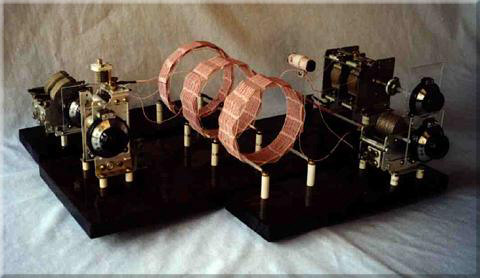 |
| Mike Tuggle's 'Lyonodyne' DX Crystal Radio |
His '1 Active Device' medium-wave regen consists of a handful of simple components and a MOSFET that is up to the task. His design was, and still is, being duplicated by many throughout the NDB DX listening community.
 |
| Mike's original 1AD regen |
Mike recently sent me the circuit diagram that he eventually settled with, showing two possible ways of extracting audio with the widely popular Bogen T725 output transformer.
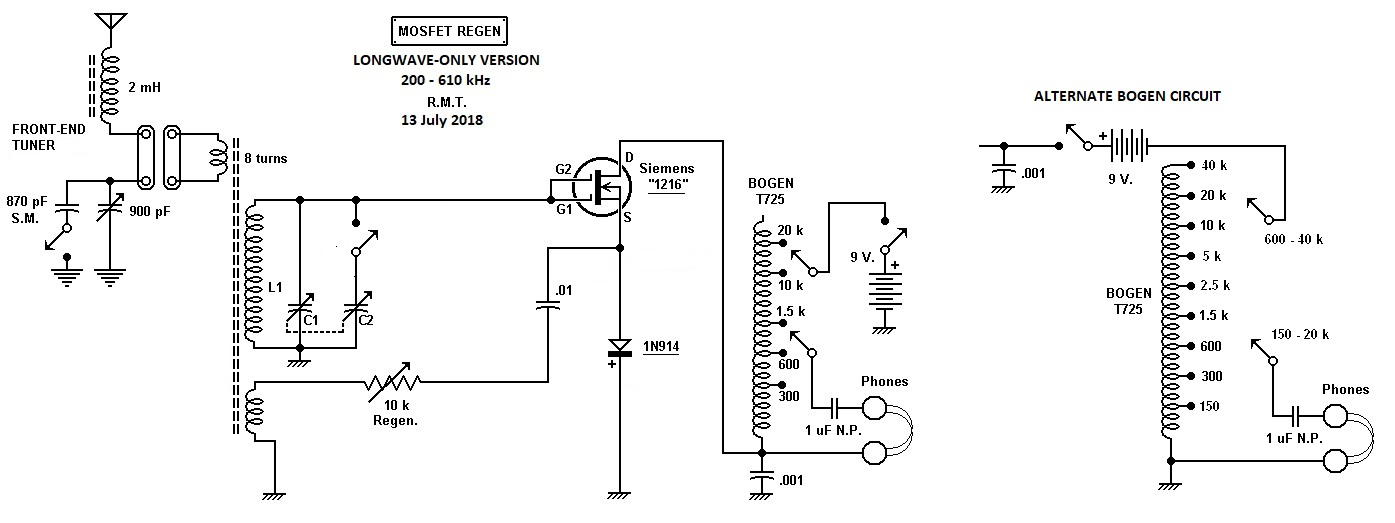
My own version used Mike's output scheme on the right and the RF circuitry in Roelof Bakker and Steve Ratzlaff's modified version, shown below. I had to increase the tickler (feedback) winding from 4 turns to 11 turns in order to get any regeneration. With 11 turns, my regeneration kicked-in at about three-quarters from the end of the regen control. At some point in time, while testing, some of the leads from my Bogen T725 output transformer momentarily brushed against each other, smoking my FET. Upon replacing it with another BF966, the receiver was much hotter, with regeneration kicking-in very close to the start of the pot. I'm not sure if the first FET was already damaged or that there is enough variation from FET to FET (of the same type) to make some have more gain than others. Accidentally blowing up the FET proved beneficial in the end!
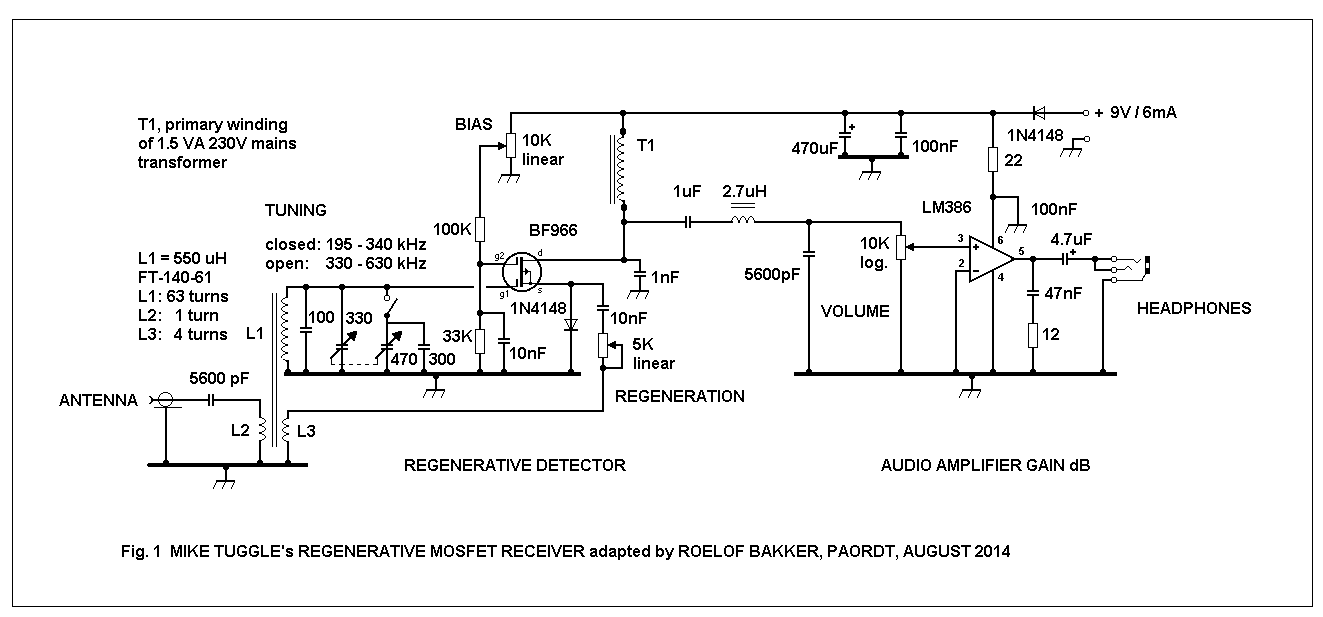
Although most users employ sensitive sound powered headphones with their regens, including myself, some use modern phones with an extra stage of audio, such as an LM386.
Although not nearly as pretty as Mike's regen, my own 1AD was built in an afternoon, just for the recent Barn Door CLE.
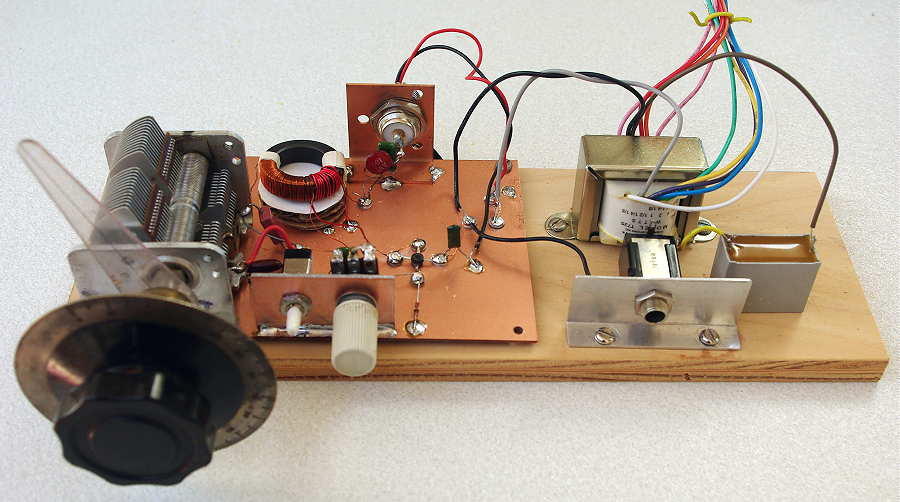 |
| My own MW 1AD regen |
I later added a calibrated dial plate, breaking the segment from 200kHz to 550kHz into two separate bands, with calibration ~ +/- 1kHz so that I pretty much new where I was tuning at all times. This allowed me to target specific beacons and wait for them to fade up.
When first published, Mike suggested the BF966 MOSFET seemed to work well and I purchased five of them with the intention of someday building a 1AD for the NDB band. The purchase came in handy, as today, the BF966 is no longer available. Apparently the similar, and still available BF998 works well (from tests done by Steve Ratzlaff) but is now in an SMD package at just 18 cents! No doubt there are dozens of MOSFETS that will do the job and at these prices, experimenting with various devices would be a very worthwhile project.
When operating, the regen proved to be surprisingly sensitive, and by using my 10' x 20' loop, I was able to put my local pest (AP-378 kHz and 1/2 mile away) into a deep null so that its huge signal was no longer blocking the top half of the NDB band. The null allowed me to hear beacons within a few kHz of the blowtorch signal as shown below:
I ended up with 70 stations logged, including a couple of Alaskans, in spite of the horrendous lightning noise on all three nights. Doing another 'Barn Door CLE' in the middle of the quiet DX season would be much more exciting and several 1AD users have indicated an appetite for such an event. If you put something together please let me know as having an army of 1AD's ready to go would be a great incentive to schedule another Barn Door weekend!
Steve McDonald, VE7SL, is a regular contributor to AmateurRadio.com and writes from British Columbia, Canada. Contact him at [email protected].
LHS Episode #239: Sighs, Sighs, Everywhere Sighs
 Welcome to Episode 239 of Linux in the Ham Shack. In this episode, the hosts discuss updates to Ubuntu, amateur radio satellites, updates to WSTJ-X, the latest Linux kernel, security tools, AX.25, logging and much more. Thank you for listening!
73 de The LHS Crew
Russ Woodman, K5TUX, co-hosts the Linux in the Ham Shack podcast which is available for download in both MP3 and OGG audio format. Contact him at [email protected].
Weekly Propagation Summary – 2018 Jul 30 16:10 UTC
Here is this week’s space weather and geophysical report, issued 2018 Jul 30 0029 UTC.
Highlights of Solar and Geomagnetic Activity 23 – 29 July 2018
Solar activity was very low throughout the week. No active regions with sunspots were observed this period and a single B1 flare at 29/2148 UTC, from an unnumbered region behind the eastern limb, was the only flare reported this week.
No proton events were observed at geosynchronous orbit.
The greater than 2 MeV electron flux at geosynchronous orbit reached high levels on 25-29 Jul and moderate levels were observed on 23-24 Jul.
Geomagnetic field activity reached active levels on 24 Jul due to the influence of a negative polarity coronal hole high speed stream. Quiet to unsettled conditions were observed on 25 Jul and generally quiet conditions were observed throughout the remainder of the period.
Forecast of Solar and Geomagnetic Activity 30 July – 25 August 2018
Solar activity is expected to be very low throughout the outlook period.
No proton events are expected at geosynchronous orbit.
The greater than 2 MeV electron flux at geosynchronous orbit is expected to reach high levels on 30-31 Jul, and 21-25 Aug. The greater than 2 MeV electron flux is expected to remain below event threshold throughout the remainder of the outlook period.
Geomagnetic field activity is likely to reach G1 (Minor) geomagnetic storm levels on 20 Aug and active levels are likely on 17 and 21 Aug, all due to the influences of multiple coronal hole high speed streams. Quiet or quiet to unsettled levels are expected throughout the remainder of the outlook period.
Don’t forget to visit our live space weather and radio propagation web site, at: http://SunSpotWatch.com/
Live Aurora mapping is at http://aurora.sunspotwatch.com/
If you are on Twitter, please follow these two users: 1. https://Twitter.com/NW7US 2. https://Twitter.com/hfradiospacewx
– – – – – – – – – – – – –
Be sure to subscribe to our space weather and propagation email group, on Groups.io
https://groups.io/g/propagation-and-space-weather
Spread the word!
– – – – – – – – – – – – –
Links of interest:
+ Amazon space weather books: http://g.nw7us.us/fbssw-aSWSC
+ https://Twitter.com/NW7US
+ https://Twitter.com/hfradiospacewx
Space Weather and Ham Radio YouTube Channel News:
I am working on launching a YouTube channel overhaul, that includes series of videos about space weather, radio signal propagation, and more.
Additionally, I am working on improving the educational efforts via the email, Facebook, YouTube, Tumblr, and other activities.
You can help!
Please consider becoming a Patron of these space weather and radio communications services, beginning with the YouTube channel:
https://www.patreon.com/NW7US
The YouTube channel:
https://YouTube.com/NW7US
..
Visit, subscribe: NW7US Radio Communications and Propagation YouTube Channel
Indication versus measurement
The nature of a technical hobby gives way to the ‘buying of stuff’. Sometimes this is the tool required to carry out the crux of the hobby, in our case I’m referring to the transceiver. Sometimes this is the tool required to check that the main tool is working correctly, in our case this could any number of tools such as an antenna analyser.
There are also many hams that like to buy the box, or series of boxes and do the minimal amount of testing to ensure safe operation and there are those that will only operate what they have built themselves. Most of us fit on that spectrum. I certainly do, it just varies on what I’m doing.
For longer than I care to admit I have used an antenna analyser that belongs to my local club. It is free to be loaned but I’ve used it more than my fair share of times. I also like to build the odd antenna. This means I measure the length and then cut the wire and check it’s various characteristics and generally cut it again until I’m happy that I have a suitable compromise. Its a really useful tool. I assume its quite accurate because it cost a lot. But do I really need it?
Separating needs from wants is not that easy, partly because what starts out as a want can quite easily become a need. I made a decision recently, I was going to buy my own analyser. But which one? Que the usual looking through specs and performance criteria, guess what happened next. I started with a small requirement for a HF analyser and ended up looking long and hard at analyser >£300. Reflecting on this it becomes easy to bump up the needs because I never really noted down what I actually wanted.
So what did I actually need? In this case I wanted to ensure that I wasn’t going to damage a transceiver and transmit spurious rubbish (as opposed to my usual cw rubbish). So I didn’t really need a tool to measure, I needed a tool to indicate. But ah ha, I still needed to cut the antenna to the right length, so I did need something to measure but did it need to be really accurate?
It turns out it didn’t. It’ll be a good idea to get a rough idea but to 3 decimal places? nope, it just isn’t that important. So I duly purchased a cheapo SARK analyser off ebay for around £30 and it’s allowed me to measure and get the right length(s) (I built a multiband end fed antenna this time) and use a cheapo end fed tuner and the analyser to get the correct swr and impedance for safe and fairly optimised operation.
The lesson learned is that if I don’t set out the requirements first then I’m going to end up spending 10 times on a product that I probably don’t need.
Alex Hill, G7KSE, is a regular contributor to AmateurRadio.com and writes from Cumbria, UK. Contact him at [email protected].
Ham College 43
Ham College episode 43 is now available for download.
General Amateur Radio Exam part 14. Emergency Communications, Skywaves, Yagi Antennas.
53:58
George Thomas, W5JDX, is co-host of AmateurLogic.TV, an original amateur radio video program hosted by George Thomas (W5JDX), Tommy Martin (N5ZNO), Peter Berrett (VK3PB), and Emile Diodene (KE5QKR). Contact him at [email protected].
Technician License Class – Black Forest, CO
 Time: Saturday Sept 15 and Saturday Sept 22 (8 AM to 5 PM) 2018
Location: Black Forest Fire Station 1
(intersection of Burgess Rd. & Teachout Rd., Black Forest, Colorado)
Sponsored by the Tri-Lakes Monument Radio Association
The FCC Technician license is your gateway to the world-wide excitement of Amateur Radio, and the very best emergency communications capability available!
- Earn your ham radio Technician class radio privileges
- Pass your FCC amateur radio license exam right in class on the second day
- Multiple-choice exam, No Morse Code Required
- See live equipment demonstrations
- Learn to operate on the ham bands, 10 Meters and higher
- Learn to use the many VHF/UHF FM repeaters in Colorado
- Find out how to participate in emergency communications
For more background on ham radio, see Getting Started in Ham Radio.
Registration fee: $30 adults, $20 under age 18
In addition, students must have the required study guide:
HamRadioSchool.com Technician License Course
New Edition, effective 2018 – 2022, $22.95
Advance registration is required (No later than one week before the first session, earlier is better, first-come sign up basis until class is full.)
To register for the class, contact: Bob Witte KØNR
Email: [email protected]
The post Technician License Class – Black Forest, CO appeared first on The KØNR Radio Site.
Bob Witte, KØNR, is a regular contributor to AmateurRadio.com and writes from Colorado, USA. Contact him at [email protected].
Amateur Radio Weekly – Issue 212

Significant changes in store for FT8 and MSK144
Enhanced versions of the MSK144 and FT8 protocols will extend the message payload to 77 bits.
ARRL
ISS SSTV activation July 30-31
The Russian cosmonauts on the International Space Station are expected to activate amateur radio Slow Scan Television (SSTV) transmissions.
AMSAT UK
Why wire diameter is important
The larger the cross-sectional area of the conductor, the more electrons are available to carry the current.
VE7SAR
3D printed Arrow II portable satellite antenna clips
WI9LL has designed clips for use with the Arrow II Portable hand held satellite antenna.
WI9LL
Operating tips for VHF SOTA
I’ve been using VHF and higher frequencies for SOTA exclusively and have activated over 100 summits in Colorado and other states.
K0NR
FCC proposes $18,000 fine for Ham in interference case
“Given his history as a repeat offender, these apparent violations warrant a significant penalty.”
ARRL
A visit to the home of FreeDV and codec2
I knew I was in the right place when the squid pole supporting a corner dipole came in to view.
Marxy
WWFD in AM HD
America’s only AM HD station.
The SWLing Post
Is your repeater ID boring? Try something like this.
If your repeater ID is getting a little stale, perhaps this will give you some ideas on how to freshen it up a bit.
KB6NU
Receiving astronaut Amateur Radio conversations with an RTL-SDR
If you live in an area that can ‘see’ the ISS at the same time as the school then you can easily pick up the downlink.
RTL-SDR.com
Send APRS data/telemetry via Xastir command line
You can do it all via RF if your Xastir setup is already paired to the radio and configured to transmit.
S55MA
Get Amateur Radio Weekly in your inbox.
Sign-up here
Amateur Radio Weekly is curated by Cale Mooth K4HCK. Sign up free to receive ham radio's most relevant news, projects, technology and events by e-mail each week at http://www.hamweekly.com.
 Ham Radio Deluxe |
 W5SWL Electronics |
 Ham Radio Prep |
 KB3IFH QSL Cards  Hip Ham Shirts  HamRadioAuctions HamRadioAuctions Reliance Antennas Reliance Antennas Enigma Shop Enigma Shop |  morseDX  Ni4L Antennas  R&L Electronics R&L Electronics antennas.us antennas.us QRV QRV |
- Matt W1MST, Managing Editor
