 |
 Weekly Propagation Summary – 2018 Aug 27 16:10 UTC
 27 August 2018 | by
Here is this week’s space weather and geophysical report, issued 2018 Aug 27 0539 UTC.
Highlights of Solar and Geomagnetic Activity 20 – 26 August 2018
Solar activity was at very low levels. Regions 2719 (S07, L=131, class/area Cro/040 on 23 Aug) and 2720 (N08, L=136, class/area Dao/100 on 25 Aug) developed on the solar disk on 18 Aug and 23 Aug respectively. Both regions were responsible for several low level B-class flares. The largest was a B4 flare at 25/1048 UTC from Region 2720. Other activity included two coronal mass ejections (CME) observed on 19 and 20 Aug. The first was a narrow CME off the SW limb at 19/0812 UTC in SOHO/LASCO C2 imagery. The CME originated from a filament eruption near S09W06 at 19/0542 UTC. The latter CME was caused by a filament eruption at approximately 20/1100 UTC from the NW quadrant. An associated faint partial halo CME was observed off the W/SW limb at 20/2136 UTC in C2 imagery. WSA/ENLIL modelling of the events showed only weak effects from possible glancing blows late on 21 Aug and late on 24 Aug.
No proton events were observed at geosynchronous orbit.
The greater than 2 MeV electron flux at geosynchronous orbit reached high levels throughout the period. The largest flux of the period was 10,300 pfu observed at 21/2150 UTC.
Geomagnetic field activity ranged from quiet to G3 (Strong) geomagnetic storm levels. The period began under the influence of a negative polarity coronal hole high speed stream (CH HSS). Solar wind speeds were elevated to near 670 km/s with total field initially at 12 nT on 20 Aug. By 21 Aug, solar wind speed was in decline while total field was at 5 nT or less. Solar wind slowly decreased over the next few days as nominal conditions were reached by 23 Aug. The geomagnetic field responded with quiet to active levels on 20 Aug, quiet to unsettled levels on 21-22 Aug and quiet levels on 23 Aug. By 24 Aug, a small discontinuity could be seen in the total field. A small increase to 7 nT was observed at 24/1116 UTC while the Bz component deflected southward to -6 nT, however the solar wind speed continued to decrease to near 325 km/s by the end of the day. As a result, quiet to unsettled levels were observed on 24 Aug. By 25 Aug, solar wind speed increased briefly to 460 km/s at 25/1305 UTC before declining once again, however total field began to increase beginning at 25/1210 UTC as effects from the 20 Aug CME were beginning. By 26 Aug, total field increased to 18 nT and remained there for approximately 12 hours. The Bz component was mostly negative reaching a maximum of -17 nT for approximately 24 hours beginning at 25/1600 UTC. Solar wind speed once again showed an increase at 26/0730 UTC from 370 km/s to near 550 km/s by the periods end as the solar wind stream was transitioning into a positive polarity CH HSS. The geomagnetic field responded with quiet to active levels on 25 Aug and unsettled to G3 (Strong) storm levels on 26 Aug.
Forecast of Solar and Geomagnetic Activity 27 August – 22 September 2018
Solar activity is expected to be at very low levels with a slight chance for C-class flare activity on 27-29 Aug and again on 11-22 Sep as Regions 2719 and 2720 return to the visible disk. Very low levels are expected for the rest of the forecast period.
No proton events are expected at geosynchronous orbit.
The greater than 2 MeV electron flux at geosynchronous orbit is expected to be at high levels on 27 Aug-03 Sep, 12-15 Sep, and again on 17-19 Sep due to recurrent CH HSS influence.
Geomagnetic field activity is expected to be at unsettled to active levels on 27-30 Aug, 01-02 Sep, 07 Sep, 11-17 Sep, and 22 Sep with G1 (Minor) geomagnetic storm levels expected early on 27 Aug due to CH HSS activity.
Don’t forget to visit our live space weather and radio propagation web site, at: http://SunSpotWatch.com/
Live Aurora mapping is at http://aurora.sunspotwatch.com/
If you are on Twitter, please follow these two users: 1. https://Twitter.com/NW7US 2. https://Twitter.com/hfradiospacewx
– – – – – – – – – – – – –
Be sure to subscribe to our space weather and propagation email group, on Groups.io
https://groups.io/g/propagation-and-space-weather
Spread the word!
– – – – – – – – – – – – –
Links of interest:
+ Amazon space weather books: http://g.nw7us.us/fbssw-aSWSC
+ https://Twitter.com/NW7US
+ https://Twitter.com/hfradiospacewx
Space Weather and Ham Radio YouTube Channel News:
I am working on launching a YouTube channel overhaul, that includes series of videos about space weather, radio signal propagation, and more.
Additionally, I am working on improving the educational efforts via the email, Facebook, YouTube, Tumblr, and other activities.
You can help!
Please consider becoming a Patron of these space weather and radio communications services, beginning with the YouTube channel:
https://www.patreon.com/NW7US
The YouTube channel:
https://YouTube.com/NW7US
..
Visit, subscribe: NW7US Radio Communications and Propagation YouTube Channel
The QSX SDR HF from QRP Labs
The QCX has proved a QRP Labs British success story for such a niche product in it's own right.
Of course Hans (G0UPL) wasn't going to rest on his laurels and an SSB radio had been rumoured to be on the design board for quite sometime. Infact he had told me at the begining of this year, these projects takes a while before they hop off the design board and reach fruition to complete into a working project.
So it wasn't no surprise that G0UPL has again used YOTA 2018 (Youngsters On The Air) hosted in South Africa this year, to pre launch the QSX a 10 Band HF SDR project. You could say that YOTA is used like a test bed to iron out any last minute technical and constructional difficulties, found, or encountered, before he begins to put the kit into full time mass production in a couple of months or so. Most of what the new SDR single/10 band rig will do and it's outlined specification, is set out on his website here: QRP LABS - QSX
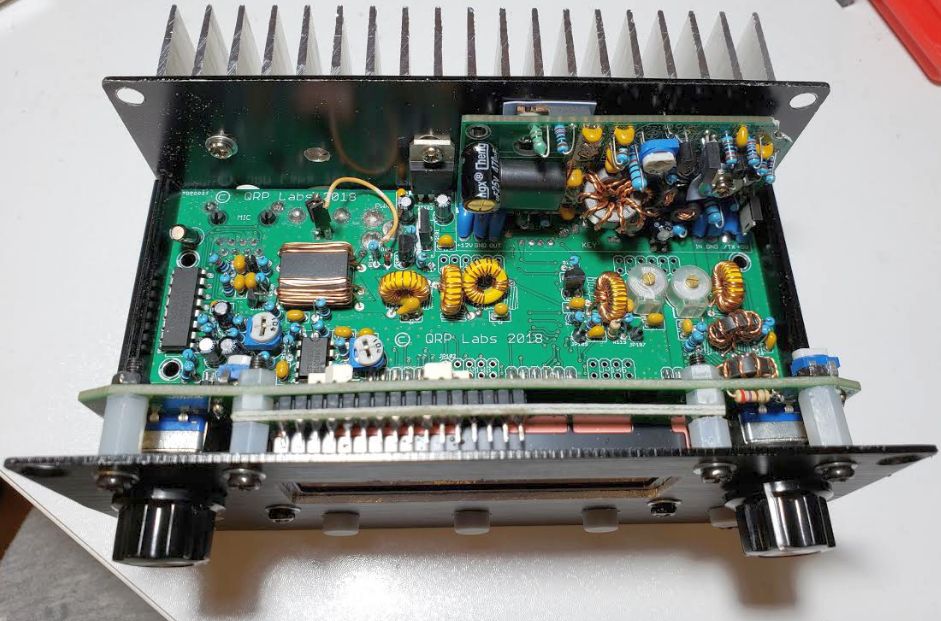
I was fortunate enough to have a short electronic messaging chit chat with Hans earlier this week, and he was able to put me well in the picture with one or two technical details about the project.
While emissions and spurs are all the the talk of the town at the moment on another QRP project from another company not associated with QRP-Labs . The QSX will have "no" spuri issues!
Using 2 IRF510's in the QSX's linear HF PA, Hans reports the performance is excellent! The PA module being driven by two BS170's in Push Pull, giving an overall gain of around 26-28dB. This concludes in easily producing 10W across all HF bands using 12V.
Gain Flatness is better than 2dB across the spectrum between 2-30MHz. It is about 4dB down at 6m and 8dB down at 4m.Thus the same drive level that produces 10W across the HF bands gives a very useable 5W on the 6m band.
Hans also reports the linearity is excellent too!
Harmonics are low even before it even enters the LPF: 80m measurements 2nd harmonic is at -38dBc, 3rd -31dbC Making it very easy for the LPF to clean up what remains and make it a very high performance radio.
All this is acheived using cheap Chinese IRF510's

The heatsink is BIG!! Testing, it ran at 10W output for 1 hour continous 100% duty cycle, no forced air or cooling, the heatsink temperature was still reasonable about 40C over ambient.
Destruction tested at:
1) 20V supply.
2 25W output.
3) 15W 100% duty cycle for 15 mins.
4) Open load.
5) Short circuit.
6) Various mismatches.
All tests resulted in no failure.
Steve, G1KQH, is a regular contributor to AmateurRadio.com and writes from England. Contact him at [email protected].
Amateur Radio Weekly – Issue 216

Atomic clocks’ final tock
The atomic clock time signal station that synchronizes time devices, may be shut down next year if a presidential budget request passes as proposed.
The SWLing Post
QRP experiment with FT8Call
Even with a relatively small amount of output power, I’m having keyboard to keyboard QSOs with stations in Europe and North Africa.
OH8STN
Antenna sales are rising
The lowly, unsightly TV antenna, consigned to garages or forgotten altogether when people switched to cable and satellite services for TV, is rising again.
Star Tribune
Using a HackRF to spoof GPS navigation in cars and divert drivers
This uses a clever algorithm that ensures that the spoofed GPS location remains consistent with the actual physical road networks, to avoid the driver noticing that anything is wrong.
RTL-SDR.com
Using multi-meters
Multi-meters have the ability to measure voltage, current and resistance and more expensive models may add other functions such as temperature.
VE7SAR
6m lightweight delta loop for sporadic E
This is a simple, cheap, lightweight horizontally polarised somewhat-directional antenna.
M0LTE
Antenna comparison on 6m during a Sporadic-E opening
I’ve been operating on 6m using two less than ideal antennas and was interested to see how they compared during a recent opening on 6m.
Adventures in Ham Radio
What is VSWR: Voltage Standing Wave Ratio
Standing waves are a key value for any system using transmission lines / feeders where measurements of the VSWR, Voltage Standing Wave Ratio are important.
electronicsnotes
Send APRS objects or telemetry via Bash
This is to internet only, not to RF.
S55MA
Video
FT8Call quick start guide basics calling CQ and QSO
I’m having fun with this new FT8Call and I think you will too.
K0PIR
Speaker wire antenna
In this video I show you my infamous speaker wire antenna.
KG6HQD
3D printed universal cable fix
A 3D printed small enclosure that can be used as a join box for cables or cords,
FunElectronicsToday
Get Amateur Radio Weekly in your inbox.
Sign-up here
Amateur Radio Weekly is curated by Cale Mooth K4HCK. Sign up free to receive ham radio's most relevant news, projects, technology and events by e-mail each week at http://www.hamweekly.com.
SOTA Activation: Unnamed Summit 12306 (W0C/SR-129)
It is always fun to do the first Summits On The Air (SOTA) activation of a peak. Most of the Colorado peaks have been climbed by someone along the way but there are still many that have never been activated for SOTA using amateur radio.

I noticed that an unnamed summit not too far from our cabin, referred to as 12306 or W0C/SR-129 had not been activated. At first glance, I thought this was because it was difficult to access. Further investigation revealed US Forest Service info on the Hayden Gulch Road (FS 396) that goes to the Hayden Gulch Trailhead at the west edge of the Buffalo Peaks Wilderness area. Joyce/K0JJW and I approached the trailhead from the west, starting at Granite, CO on Hwy 24, turning east onto FS 397 (marked at the highway) and then quickly looking for signs for FS 396. The San Isabel National Forest map is somewhat helpful but the Latitude 40 recreational map for Salida/Buena Vista is much better. The road is mostly easy 4WD but it is narrow in many places and moderate difficultly in a few spots. We saw crossover SUVs carefully driving the road with success. It was easy-peasy in our Jeep Wrangler.

Starting the hike, we followed the Hayden Gulch trail to the east. We actually had to search a bit to make sure we were really on the trail as we left the trailhead, as it was not super obvious. Hint: stay to the north (left) of the trailhead sign.

The trail follows an old road that was likely closed when the wilderness area was formed. Once we cleared the trees (shown accurately on the map above), we left the trail and traveled off-trail towards the summit, trying to follow the contour lines and not lose a bunch of elevation. The hike promised to be very pleasant except that we had 30 to 40 mph winds from the west. This was not enough to stop us but certainly made the hike less enjoyable. The views were spectacular but a little difficult to enjoy with the wind blowing.

The hike was 1.8 miles one-way with about 1000 feet of vertical gain. Once on the summit, we got out the standard VHF SOTA gear: Yaesu FT-90 transceiver, LiFe battery and 3-element Arrow yagi. We both quickly worked Bob/W0BV, Walt/W0CP, Steve/WG0AT and Brad/WA6MM. WG0AT was on his way down from Eagle Rock (W0C/SP-113) so we missed a Summit-to-Summit opportunity with him. (We did work him earlier when he was on the summit but we were not.) WA6MM was a successful S2S contact from Mount Logan (W0C/FR-017).
This turned out to be a successful activation and a fun hike. We both concluded that we need to do it again…with a little less wind.
73 Bob K0NR
The post SOTA Activation: Unnamed Summit 12306 (W0C/SR-129) appeared first on The KØNR Radio Site.
Bob Witte, KØNR, is a regular contributor to AmateurRadio.com and writes from Colorado, USA. Contact him at [email protected].
LHS Episode #242: FreeDV/Codec2 Deep Dive
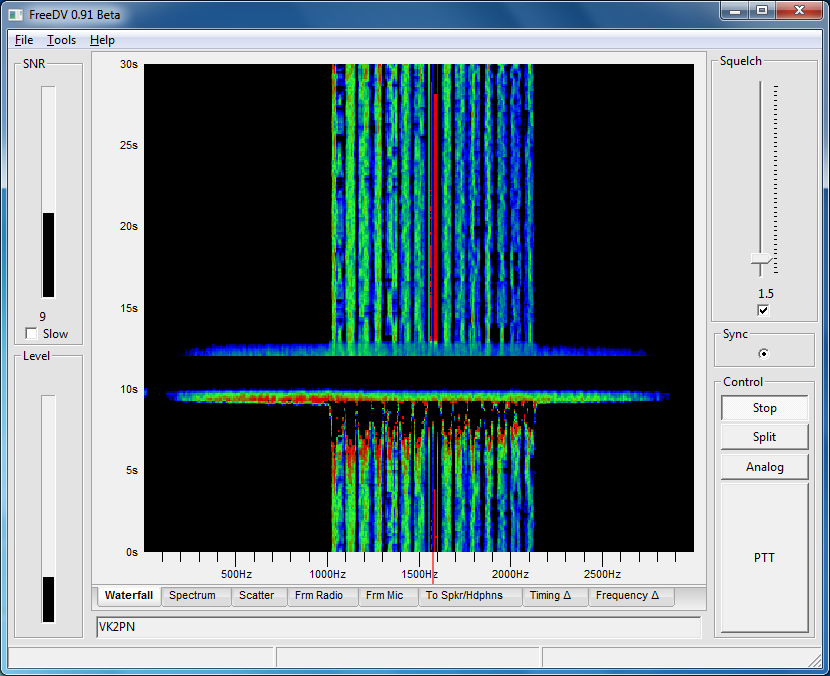 Welcome to Episode 242 of Linux in the Ham Shack! In this episode, we bring back a guest to the show we haven't talked with in almost five years. His name is David Rowe, VK5DGR. He is the creator of the open source sound codec known as Codec2. He is also co-creator and maintainer of the FreeDV application for amateur radio digital voice communication, as well as a contributor to many other cool and interesting technical projects. Hope you enjoy our interview with David and this deep dive into FreeDV, codec2 and more.
73 de The LHS Crew
Russ Woodman, K5TUX, co-hosts the Linux in the Ham Shack podcast which is available for download in both MP3 and OGG audio format. Contact him at [email protected].
Hunting For NDBs In CLE 235
 |
| BF-362 courtesy: Steven M O'Kelley |
This coming weekend will see another monthly CLE challenge. This time the hunting grounds will be 350.0 - 369.9 kHz.
For those unfamiliar with this monthly activity, a 'CLE' is a 'Co-ordinated Listening Event', as NDB DXers around the world focus their listening time on one small slice of the NDB spectrum.
A really good challenge in this one is to hear BF-362, located in Seattle, Washington. I suspect that it's a 25-watter but is rarely logged outside of the Pacific Northwest region. If you are east of Montana and can hear it, your system is working well!
Listen for BF's upper-sideband CW identifier (with your receiver in the CW mode) on 363.030 kHz while its lower-sideband can be heard on 360.943 kHz.
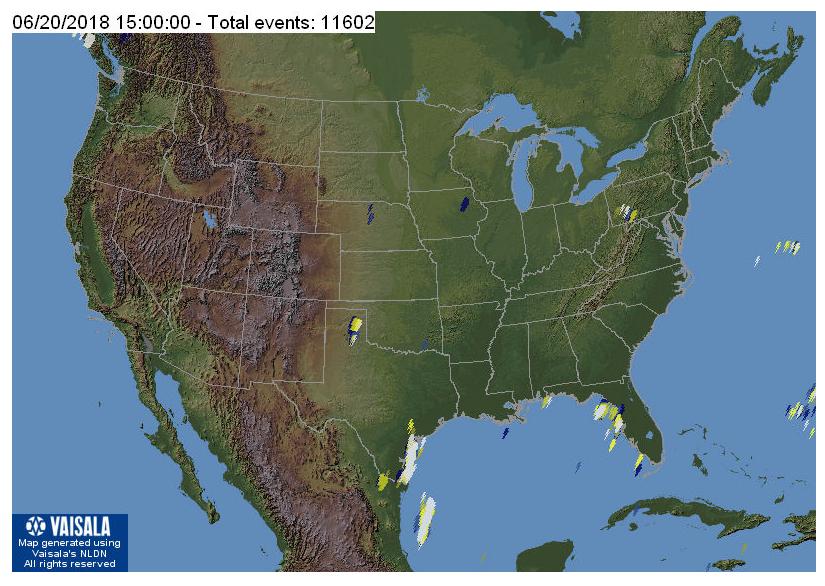
Although we are getting ever-closer to the fall DX season, lightning storms may yet be a problem, but at this time of the year we may get a lucky few quiet nights like this one in mid-June.
 |
| courtesy: http://thunderstorm.vaisala.com/explorer.html |
If you are interested in building a system for the new (U.S.) 630m band, the CLE will give you the chance to test out your MF receiving capabilities and compare against what others in your area might be hearing.
When tuning for NDBs, put your receiver in the CW mode and listen for the NDB's CW identifier, repeated every few seconds. Listen for U.S. NDB identifiers approximately 1 kHz higher or lower than the published transmitted frequency since these beacons are modulated with a 1020 Hz tone approximately.
For example, 'AA' near Fargo, ND, transmits on 365 kHz and its upper sideband CW identifier is tuned at 366.025 kHz while its lower sideband CW ident can be tuned at 363.946 kHz. Its USB tone is actually 1025 Hz while its LSB tone is 1054 Hz.
Often, one sideband will be much stronger than the other so if you don't hear the first one, try listening on the other sideband.
Canadian NDBs normally have an USB tone only, usually very close to 400 Hz. They also have a long dash (keydown) following the CW identifier.
All NDBs heard in North America will be listed in the RNA database (updated daily) while those heard in Europe may be found in the REU database. Beacons heard outside of these regions will be found in the RWW database.
From CLE organizer Brian Keyte, G3SIA, comes the details:
Hello all
Here are the full details for this weekend's co-ordinated listening event.
It is open to everyone including CLE new-comers:
Days: Friday 24 August - Monday 27 August
Times: Start and end at midday, your LOCAL time
Range: 350.0 - 369.9 kHz
This range is a busy one, usually giving us a high number of NDBs heard.
We last concentrated on these frequencies during CLE219 in May 2017.
Wherever you are, please join us and log the NDBs that you can positively
identify that are listed in this busy frequency range (it includes 350.0 kHz
but not 370 kHz) plus any UNIDs that you come across there.
Send your CLE log to the List, preferably as a plain text email
(not in an attachment) with "CLE235 - FINAL Logs" at the start of its
subject line.
Please show on EVERY LINE of your log:
# The date ( e.g. 2018-08-24 or just the day no. 24 ) and UTC
(the day changes at 00:00 UTC).
# kHz (the beacon's nominal published frequency, if you know it)
# The Call Ident.
Show those main items FIRST on each line, before other optional details
such as Location, Distance, Offsets, Cycle time, etc.
If you send any incomplete logs to the List during the event, please also
send your 'FINAL', complete one.
Please always make your log interesting to everyone by showing your
own location and brief details of the receiver and aerial(s), etc., that
you were using.
We will send the usual 'Any More Logs?' email so that you can check that your log has been found OK.
You can check on all CLE-related information from the CLE Page
http://www.ndblist.info/cle.htm
It includes a link to seeklists for the Event from the Rxx Database.
Good listening
Brian
----------------------------------------------------------
From: Brian Keyte G3SIA ndbcle'at'gmail.com
Location: Surrey, SE England (CLE coordinator)
----------------------------------------------------------
(REMINDER: You could use any one remote receiver for your loggings,
stating the location and owner - with their permission if required.
A remote listener may NOT also use another receiver, whether local
or remote, to obtain further loggings for the same CLE).
-------------------------------------------------------------------
- determine, worldwide, which beacons are actually in service and on-the-air so the online database can be kept up-to-date
- determine, worldwide, which beacons are out-of-service or have gone silent since the last CLE covering this range
- will indicate the state of propagation conditions at the various participant locations
- will give you an indication of how well your LF/MF receiving system is working
- give participants a fun yet challenging activity to keep their listening skills honed
The Yahoo ndblist Group has been moved to Groups.io and The NDB List Group will now be found there! The very active group is a great place to learn more about the 'Art of NDB DXing' or to meet other listeners in your region. There is a lot of good information available there and new members are always very welcome. As well, you can follow the results of other CLE participants from night to night as propagation is always an active topic of discussion.
You need not be an NDB List member to participate in the CLEs and all reports, no matter how small, are of much value to the organizers.
Remember - 'First-time' logs are always VERY welcome!
Reports may be sent to the NDB List Group or e-mailed to CLE co-ordinator, Brian Keyte (G3SIA), whose address appears above. If you are a member of the group, all final results will also be e-mailed and posted there.
Please ... give the CLE a try ... then let us know what NDB's can be heard from your location! Your report can then be added to the worldwide database to help keep it up-to-date.
Have fun and good hunting!
Steve McDonald, VE7SL, is a regular contributor to AmateurRadio.com and writes from British Columbia, Canada. Contact him at [email protected].
Weekly Propagation Summary – 2018 Aug 20 16:10 UTC
Here is this week’s space weather and geophysical report, issued 2018 Aug 20 0445 UTC.
Highlights of Solar and Geomagnetic Activity 13 – 19 August 2018
Solar activity was very low. Two small regions developed on the visible disk this period. Region 2718 (S07, L=191, class/area Hrx/020 on 17 Aug) developed on 14 Aug and decayed to plage by 19 Aug. Region 2719 (S06, L=133, class/area Bxo/010 on 19 Aug) developed in the SE quadrant on 19 Aug. No significant flare events occurred from either region. Other activity included a filament eruption centered near S11W04 observed lifting off the solar disk at approximately 19/0538 UTC. An associated coronal mass ejection was observed off the SW limb in SOHO/LASCO C2 imagery at 19/0812 UTC. WSA/Enlil modelling of the event suggested the ejecta was primarily directed westward of the Sun-Earth line and is not expected to cause any significant effects.
No proton events were observed at geosynchronous orbit.
The greater than 2 MeV electron flux at geosynchronous orbit was at normal levels on 13-15 Aug, moderate levels on 16-17 Aug, and at high levels on 18-19 Aug. The largest flux of the period was 18,287 pfu observed at 19/1800 UTC.
Geomagnetic field activity ranged from quiet to active levels over the period. Solar wind speed was at nominal levels at the beginning of the period with solar wind speed ranging from 310-430 km/s while total field was between 1-4 nT. The geomagnetic field was quiet on 13-14 Aug. By 15 Aug, solar wind speed increased to approximately 450-500 km/s with total field increasing to a maximum of 14 nT by 16/1005 UTC as a positive polarity coronal hole high speed stream (CH HSS) moved into geoeffective position. A further increase in solar wind speed to near 570 km/s was observed late on 17 Aug before slowly receding to nominal levels by midday on 19 Aug. The geomagnetic field responded with quiet to active levels on 15-18 Aug. By late on 19 Aug, total field increase again to 12 nT along with an increase in solar wind to near 550 km/s as a negative polarity CH HSS was becoming geoeffective. However, only quiet levels were observed on 19 Aug.
Forecast of Solar and Geomagnetic Activity 20 August – 15 September 2018
Solar activity is expected to continue at very low levels.
No proton events are expected at geosynchronous orbit.
The greater than 2 MeV electron flux at geosynchronous orbit is expected to reach high levels on 22-27 Aug and again on 13-15 Sep due to CH HSS influence.
Geomagnetic field activity is expected to be unsettled to active levels on 20-25 Aug, 03-04 Sep, 07 Sep, and 11-15 Sep with a chance for G1 (Minor) geomagnetic storm levels on 20-21 Aug due to recurrent CH HSS activity.
Don’t forget to visit our live space weather and radio propagation web site, at: http://SunSpotWatch.com/
Live Aurora mapping is at http://aurora.sunspotwatch.com/
If you are on Twitter, please follow these two users: 1. https://Twitter.com/NW7US 2. https://Twitter.com/hfradiospacewx
– – – – – – – – – – – – –
Be sure to subscribe to our space weather and propagation email group, on Groups.io
https://groups.io/g/propagation-and-space-weather
Spread the word!
– – – – – – – – – – – – –
Links of interest:
+ Amazon space weather books: http://g.nw7us.us/fbssw-aSWSC
+ https://Twitter.com/NW7US
+ https://Twitter.com/hfradiospacewx
Space Weather and Ham Radio YouTube Channel News:
I am working on launching a YouTube channel overhaul, that includes series of videos about space weather, radio signal propagation, and more.
Additionally, I am working on improving the educational efforts via the email, Facebook, YouTube, Tumblr, and other activities.
You can help!
Please consider becoming a Patron of these space weather and radio communications services, beginning with the YouTube channel:
https://www.patreon.com/NW7US
The YouTube channel:
https://YouTube.com/NW7US
..
Visit, subscribe: NW7US Radio Communications and Propagation YouTube Channel
 Ham Radio Deluxe |
 W5SWL Electronics |
 Ham Radio Prep |
 KB3IFH QSL Cards  Hip Ham Shirts  HamRadioAuctions HamRadioAuctions Reliance Antennas Reliance Antennas Enigma Shop Enigma Shop |  morseDX  Ni4L Antennas  R&L Electronics R&L Electronics antennas.us antennas.us QRV QRV |
- Matt W1MST, Managing Editor
