 |
 LHS Episode #266: #$%&! Net Neutrality
 15 January 2019 | by
Welcome to the first episode of Linux in the Ham Shack for 2019. In this episode, the hosts discuss topics including the 2018 RTTY Roundup using FT-8, Cubesats and wideband receivers in space, the ORI at Hamcation, Wekcan, Raspberry Pi-based VPN servers, the LHS Linux distributions, CW trainers and much more. Thank you for listening and we hope you're having a wonderful new year so far.
73 de The LHS Crew
Russ Woodman, K5TUX, co-hosts the Linux in the Ham Shack podcast which is available for download in both MP3 and OGG audio format. Contact him at [email protected].
AmateurLogic 126: Blue Thumb DV & 1/4 Wave Stubs
AmateurLogic.TV Episode 126 is now available for download.
Tommy reviews the Blue Thumb DV. George and the crew pull out the test equipment and experiment with 1/4 wave stubs. This live demonstration helps clear up some of the mystery. Mike, VE3MIC sits in for the Cheap Old Man to help keep expenses under control.
1:31:49
George Thomas, W5JDX, is co-host of AmateurLogic.TV, an original amateur radio video program hosted by George Thomas (W5JDX), Tommy Martin (N5ZNO), Peter Berrett (VK3PB), and Emile Diodene (KE5QKR). Contact him at [email protected].
The 2019 Winter “Classic Exchange”
 |
| W7OS - Radio Club of Tacoma working the CX |
The "CX" encourages participants to use older vintage gear including any homebrew equipment, both receivers and transmitters. A unique scoring system provides bonus points for various equipment and combinations as well as encouraging 'repeat contacts' when you switch to different equipment.
 |
| W8KM and his wonderful vintage station |
No vintage gear? ... no problem! All amateurs are invited to participate and get in on the fun no matter what they are using and submit their scores.
 |
| K3MD's Heathkit AT-1 and Hallicrafters HT-37 ready for the CX |
The CX is a low-key relaxing affair and the 'extra' Tuesday operating period should encourage a lot of midweek activity from the vast numbers of retired operators who cherish and run older gear.
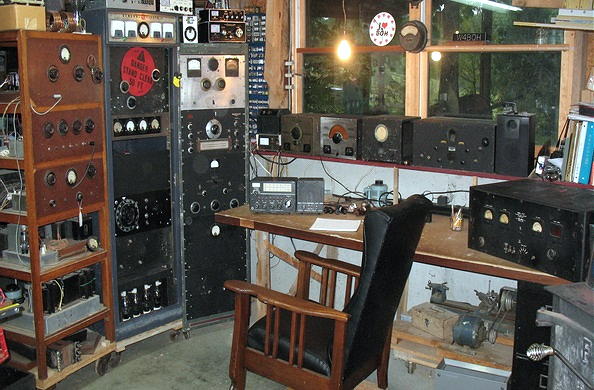 | ||||||||||||||||||||||||
| Lots of combos ready at W4BOH's CX setup |
 |
| K6ZI, Las Vegas - WWII ARC-5s ready to go |
A summary of the Fall 2018 CX and soapbox comments, along with some wonderful vintage-station eye candy, may be found here.
For complete details of the upcoming event, see the web site announcement here.
If you've never entered the Classic Exchange, why not give it a try this year as it truly is a case of 'the more the merrier' ... and eastern operators, make sure to keep the porch light on for those out west!
Steve McDonald, VE7SL, is a regular contributor to AmateurRadio.com and writes from British Columbia, Canada. Contact him at [email protected].
Effective Radiated Power, APRS and HF Transmitter Hunting
 Stories you’ll find in our January, 2019 issue:
Exploring the Mysteries of Effective Radiated Power (ERP)
By Richard Fisher KI6SN
Why is it that some amateur stations you hear on the high frequency bands sound like they are international broadcasting stations? Sure, some may be running the full “legal limit” but many claim to be running just a few hundred watts. The secret is in their antenna—the higher the gain, the greater the Effective Radiated Power (ERP). This month Richard shows us that not only antenna gain but transmission mode has a lot to do with how big your signal sounds on the air and it doesn’t even require a lot of higher math to understand.
APRS and Other Related Digital Communications—Part II
By Cory GB Sickles WA3UVV
As a follow-up to Part 1, which appeared in the August 2018 issue of TSM, this month Cory takes a look at some of the interesting digital modes available that are used for more than simply communicating between stations. While packet radio may seem like a relic of the 1980s and 90s, it’s still widely used in a variety of applications—including communicating through the International Space Station. Cory shows us how this is done and what kind of equipment you need to do it—hint: it’s not all expensive gear with a steep learning curve and you don’t have to have a ham ticket to monitor the action.
HF Transmitter Hunting using KiwiSDRs and TDoA
By Tony Roper
The proliferation of the globally connected and remotely operated KiwiSDRs (software defined radios) has proved a boon to shortwave listeners the world over. It’s also providing an intriguing platform for high-frequency transmitter hunters. Where are those numbers stations originating from? What is the location of those Over-the-Horizon Radar installations causing havoc on the band? Longtime HF sleuth (and professional Air Traffic Controller), Tony Roper, a regular contributor to TSM walks us through the process of using these convenient radios to help answer these age-old shortwave questions.
Winter Shortwave Reading: TSM Reviews the Top Three Shortwave Guides
“Klingenfuss 2019/20 Guide to Utility Radio Stations” and “2019 Shortwave Frequency Guide”
Reviewed by Bob Grove W8JHD
This year Joerg Klingenfuss celebrates his 30th anniversary of publishing his “Guide to Utility Radio Stations” and his “Shortwave Frequency Guide.” Both publications have become indispensable guides to radio hobbyists around the world.
Gayle Van Horn’s “Global Radio Guide”
Reviewed by Ken Reitz KS4ZR
This year marks the debut of Gayle Van Horn’s “Global Radio Guide,” a 456-page compendium of global broadcasting as an e-book available only in Kindle format. The Global Radio Guide replaces her very successful “International Shortwave Broadcasting Guide.”
“World Radio Television Handbook”
Reviewed by Gayle Van Horn W4GVH
The 73rd edition of the World Radio Television Handbook is a wealth of vital information for any radio or television hobbyist and remains the most comprehensive exemplary reference book and a must-have for your listening post.
Scanning America
By Dan Veeneman
Nevada Shared Radio System
Federal Wavelengths
By Chris Parris
Hiding in Plain Sight: Federal Communications Systems
Milcom
By Larry Van Horn N5FPW
Monitor’s Guide to NAS Whiting Field and Training Wing Five
Utility Planet
By Hugh Stegman
Cuban and Russian “Numbers” Continue
Shortwave Utility Logs
By Mike Chace-Ortiz and Hugh Stegman
VHF and Above
By Joe Lynch N6CL
Space and Near Space Communications
Digitally Speaking
By Cory GB Sickles WA3UVV
Double Vision
Amateur Radio Insights
By Kirk Kleinschmidt NT0Z
New Year, New Milestone, New Tidbits
Radio 101
By Ken Reitz KS4ZR
AIR in DRM and Understanding RDS
Radio Propagation
By Tomas Hood NW7US
State of the Union, er…High Frequencies (An Outlook for 2019)
The World of Shortwave Listening
By Jeff White, Secretary-Treasurer NASB
European SW DXers Meet in Slovakia and Austria
The Shortwave Listener
By Fred Waterer
WRNO’s Powerful Return; WRMI’s International Programming: BBC Lineup
Maritime Monitoring
By Ron Walsh VE3GO
Snow, Ice and RF
Adventures in Radio Restoration
By Rich Post KB8TAD
Part 15: Radio as You Like It
Antenna Connections
By Dan Farber AC0LW
Stealth: Fighting Antenna Oppression
The Spectrum Monitor is available in PDF format which can be read on any desktop, laptop, iPad®, Kindle® Fire, or other device capable of opening a PDF file. Annual subscription is $24. Individual monthly issues are available for $3 each.
Ken Reitz, KS4ZR, is publisher and managing editor of The Spectrum Monitor. Contact him at [email protected].
ICQ Podcast Episode 284 – Workshop Projects
Hello fellow Amateur / Ham Radio enthusiasts - and welcome to this, the 284th episode of the ICQ Amateur / Ham Radio Podcast, supported by Luke Aurich (AD0KI), Bob Terry, David Reid (W6KL) along with our monthly and annual subscription donors.
In this episode, Martin M1MRB is joined by Edmund Spicer M0MNG and Bill Barnes N3JIX to discuss the latest Amateur / Ham Radio news. Colin M6BOY rounds up the news in brief and this episode’s feature is Workshop Projects.
Germany on 70 MHz in 2019
ARRL Petitions FCC to Incorporate Parity Act Provisions into its Amateur Radio Rules
Youngsters On The Air Bulgaria 2019 Amateur Radio
US Radio Amateurs Help to Make YOTA Month Happen in Ethiopia
G5 plus 3 Letter Amateur Radio Callsigns available
Swiss 90th Anniversary Special Event Callsign
2019 Marks 50th Anniversary of Worked All Britain Award
EU Directive on Car Radios
$900,000 Settlement in Unauthorized Satellite Launch Case
G3TXQ Silent Key
Colin Butler, M6BOY, is the host of the ICQ Podcast, a weekly radio show about Amateur Radio. Contact him at [email protected].
RAC contest and the new IC7610

 |
| Won't make that mistake agian. |
I was thrilled with the Icom 7610 I didn't as of yet get the time to set up N1MM+ contest software so during the contest I was old school with a paper and pencil. The audio was crisp and clean, I stayed with the 250Hz filter and had not even one issue with very close adjacent stations bothering my contact station. The touch screen is very responsive and an absolute joy to use. I took advantage of the 2 independent receivers, I turned on dual watch and had one VFO on an RAC station such as VE7RAC who was very popular and the other VFO I search and pounced. With one simple button push I muted the VE7RAC station and could unmute to check on the pileup. Once things slowed down I was able to put VE7RAC in the log.
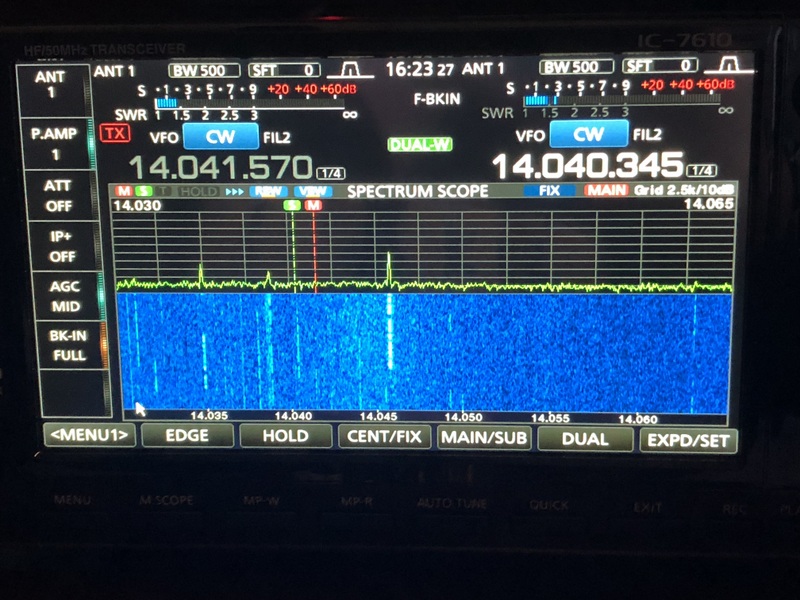 |
| Dual Watch on |
Mike Weir, VE9KK, is a regular contributor to AmateurRadio.com and writes from New Brunswick, Canada. Contact him at [email protected].
2019 Technician License Class

Black Forest, Colorado; Sat March 16 and 23; 8 AM to 5 PM
Black Forest Fire Station, intersection Burgess Rd. & Teachout Rd.
The Technician license is your gateway to the world-wide excitement of Amateur Radio, and the very best emergency communications capability available!
• Earn your ham radio Technician class radio privileges
• Pass your FCC amateur radio license exam right in class on the second day
• Multiple-choice exam, No Morse Code Required
• Live equipment demonstrations
• Learn to operate on the ham bands, 10 Meters and higher
• Learn to use the many VHF/UHF FM repeaters in Colorado
• Find out how to participate in emergency communications
Registration fee: $30 adults, $20 under age 18
In addition, students must have the required study guide: HamRadioSchool.com Technician License Course Third Edition, effective 2018 – 2022, $22.95 print, $19.99 Kindle
Advance registration is required (No later than two weeks before the first session, earlier is better, first-come sign up basis until class is full.) To register for the class, contact: Bob Witte KØNR Email: [email protected] or Phone: 719/659-3727
Sponsored by the Tri-Lakes Monument Radio Association For more information on amateur (ham) radio visit www.arrl.org
The post 2019 Technician License Class appeared first on The KØNR Radio Site.
Bob Witte, KØNR, is a regular contributor to AmateurRadio.com and writes from Colorado, USA. Contact him at [email protected].
 Ham Radio Deluxe |
 W5SWL Electronics |
 Ham Radio Prep |
 KB3IFH QSL Cards  Hip Ham Shirts  HamRadioAuctions HamRadioAuctions Reliance Antennas Reliance Antennas Enigma Shop Enigma Shop |  morseDX  Ni4L Antennas  R&L Electronics R&L Electronics antennas.us antennas.us QRV QRV |
- Matt W1MST, Managing Editor
