 |
 Bummer: Work Howard Event Canceled
 3 May 2019 | by
 A solid 1960’s saying for disappointing but not tragic events was … bummer! That’s fitting for this announcement from the ARRL with the ICQ Podcast’s endorsement. We’d certainly not want an event, no matter how exciting, to get the W1AW station license in dutch with Part 97. After all, the League should lead by setting examples of following the rules.

“Put Howard to Work” Event Canceled
05/03/2019
Earlier this week, ARRL announced that ARRL CEO Howard Michel, WB2ITX, would be on the air at W1AW on Monday, May 13, giving ARRL members a chance to chat with the CEO and get to know him better as a ham. An issue was raised, however, that this event may pose a potential FCC rule violation.
The particular rule is §97.113: “A station is also not allowed to transmit communication in which the station licensee or control operator has a pecuniary interest, including communications on behalf of an employer.”
Given that ARRL is Michel’s employer and that an effort was made to publicize an event at which members of the organization could chat with the CEO, such an event could be perceived as a benefit to the organization. So, out of an abundance of caution and to avoid any potential violation of FCC rules, or even the appearance of a violation, Michel has decided to cancel plans for the “Put Howard to Work” event.
“I’ve operated W1AW before and will continue to do so in the future,” Michel said. “I hope to meet many of you on the air, but only as part of my regular ham radio activities and not as part of an ARRL-promoted event.”
The “Put Howard to Work!” event was conceived by the ICQ Amateur/Ham Radio Podcast, on which Michel was a guest on March 31. “We are disappointed, of course, at this turn of events but fully understand and endorse ARRL’s decision,” said ICQ Podcast Presenter Frank Howell K4FMH.
Frank Howell, K4FMH, is a regular contributor to AmateurRadio.com and writes from Mississippi, USA. Contact him at [email protected].
Book rather than Blog
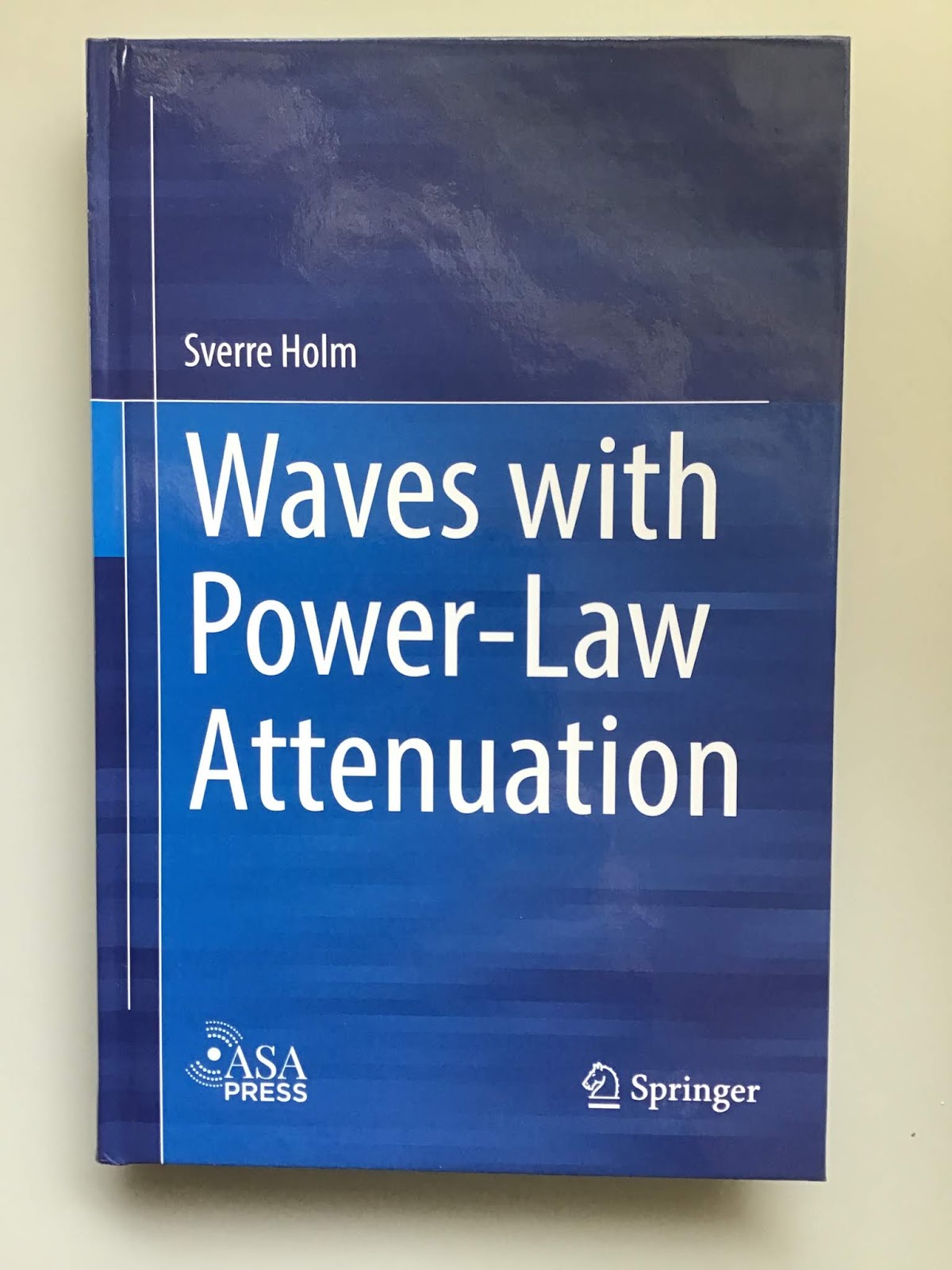
My blog has suffered in recent years and here is the reason. For three years now I have been writing a book entitled “Waves with Power-Law Attenuation”. It is now in Springer’s catalogue under classical continuum physics and I’m also very happy that it is published in the Acoustical Society of America Press series.
The emphasis is on models for waves that experience attenuation that follows a power-law in frequency. Topic-wise it is more about mechanical than electromagnetic waves, but analogies are drawn between the two fields as many of the models are the same. Power-law models in electromagnetics are in particular useful for waves in biological tissue, which is indeed also the case for acoustic and elastic waves.
The description starts like this:
“This book integrates concepts from physical acoustics with those from linear viscoelasticity and fractional linear viscoelasticity. Compressional waves and shear waves in applications such as medical ultrasound, elastography, and sediment acoustics often follow power law attenuation and dispersion laws that cannot be described with classical viscous and relaxation models. This is accompanied by temporal power laws rather than the temporal exponential responses of classical models.“
Read more on Springer’s site.
Sverre Holm, LA3ZA, is a regular contributor to AmateurRadio.com and writes from Norway. Contact him at [email protected].
Digipeating the ISS, RTTY and QRP
 Stories you’ll find in our May, 2019 issue:
Digipeating: APRS to the International Space Station – At Your Convenience
By Richard Fisher KI6SN
Making contact with the International Space Station by amateur radio is challenging on its face—the ISS orbit must be somewhere above your horizon; it is a moving target, and your antenna needs to be tracking its position as the space station moves across the sky. For FM voice contact, you may be in competition with lots of other Earth-based stations with the same goal as yours. But, thanks to the ISS’s digital repeater, contact with ISS is quite possible, but even so, for success, there are still lots of stars that must align. Richard tells us how it’s done.
TSM Reviews: The Mobile VHF/UHF COMPACtenna
By Bob Grove W8JHD
Is it possible for a 7.5-inch antenna to provide equal, or even superior, performance compared to a conventional 18-inch whip? After all, doesn’t a longer element capture more signal energy than a smaller element? Even with some reduction in signal strength, would overall improvement in uninterrupted reception translate to better performance? Bob examines this new mobile VHF/UHF antenna.
TSM Reviews: COMPACtenna for Shortwave
By Chris Parris
Chris was recently offered a chance to use the COMPACtenna SW (shortwave) model at home. The “SW” specifications show that it is 20 inches tall, designed for continuous receive over 3 MHz to 30 MHz and uses a standard 3/8-inch – 24 thread mount that most CB antennas are designed for. As someone who has tried for many years to find a good mobile/portable shortwave antenna solution, this seemed too good to be true. He decided to take the COMPACtenna out and try it on his personal vehicle along with several radios and other shortwave antennas to see how it fared.
RTTY: Old School Digital
By Cory GB Sickles WA3UVV
In his previous articles about other forms of digital communications as well as his three-part series on “Piggy Bank Ham Radio,” Cory found that there appears to be a good deal of interest in radioteletype and a desire to use some older gear. Coupling that with questions about pre-1990 HF rigs, there would seem to be a convergence of ideas. While older gear may not be suitable for the latest in digital modes, they are still perfectly fine radios and the fun of RTTY awaits you – with several ways to get on the air. Cory traces the history and continued use of this vintage amateur mode.
CRKits HT-1A Dual Band QRP Transceiver
By James Hannibal KH2SR
This dual band transceiver, available as a kit or factory-built, has a transmit frequency range of 7.0-7.2 MHz and 14.0-14.35 MHz. And, even though it only transmits CW, it does have the ability to listen to SSB signals. It also has an extended receive range, covering everything between 5.9-16 MHz, which means shortwave broadcast reception while in SSB mode. James puts this little rig to the test as it was meant to be used, outside in the wild with a small battery pack and portable antenna.
Scanning America
By Dan Veeneman
Groton, Connecticut; Amtrak Update
Federal Wavelengths
By Chris Parris
Have Scanner, Will Travel
Milcom
By Larry Van Horn N5FPW
Monitoring the 14thFighter Training Wing
Utility Planet
By Hugh Stegman
South Korean HFDL Takes Off
VHF and Above
By Joe Lynch N6CL
Owen Garriott W5LFL Silent Key
Digitally Speaking
By Cory GB Sickles WA3UVV
Get Yourself Connected
Amateur Radio Insights
By Kirk Kleinschmidt NT0Z
Are You a Member of the “Tower Tribe?”
Radio 101
By Ken Reitz KS4ZR
Baseball on the Radio: 2019
Radio Propagation
By Tomas Hood NW7US
E-Layer Sporadic Ionospheric Propagation
The World of Shortwave Listening
By Jeff White, Chairman, HFCC
Shortwave Broadcasters Discuss Future of the Medium and Time Changes or Does it?
The Shortwave Listener
By Fred Waterer
Radio Lectures; Classical on SW and Radio Santa Cruz
Amateur Radio Astronomy
By Stan Nelson KB5VL
Long Duration Meteor Trails
Adventures in Radio Restoration
By Rich Post KB8TAD
Millen’s Ham Superhet: The National FB-7
The Spectrum Monitor is available in PDF format which can be read on any desktop, laptop, iPad®, Kindle® Fire, or other device capable of opening a PDF file. Annual subscription is $24. Individual monthly issues are available for $3 each.
Ken Reitz, KS4ZR, is publisher and managing editor of The Spectrum Monitor. Contact him at [email protected].
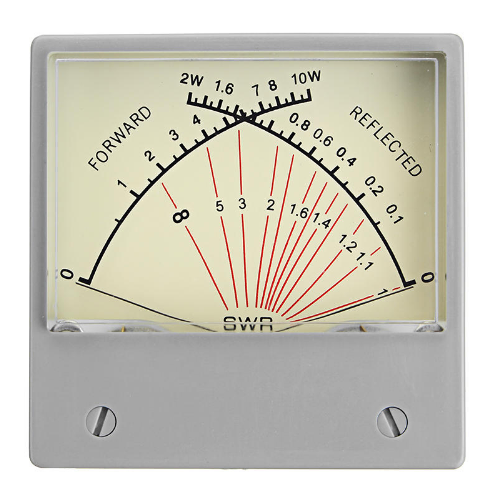
The SZ-70 cross needled SWR movement.
Steve, G1KQH, is a regular contributor to AmateurRadio.com and writes from England. Contact him at [email protected].
Go Ahead and Call CQ on 2m FM
 The conventional wisdom in amateur radio is that we should not call CQ when using FM on the VHF and UHF bands, especially on repeaters. The reasoning for this is that during normal VHF/UHF FM operating, radio amateurs are tuned to a specific frequency and will easily hear a call on FM.
Compare this to the HF bands, where the other ham is generally tuning around to find someone to contact and stumbles onto your transmission. In that case, you want to make a long call (CQ CQ CQ Hello CQ This is Kilo Zero November Romeo calling CQ CQ CQ…) so people tuning the band will find you and tune you in. On VHF/UHF FM, the assumption is that the other hams have their radio set on the repeater or simplex channel being used and will immediately hear you. FM communications are often quite clear and noise free, which also helps. The normal calling method is to just say your callsign, perhaps accompanied with another word like “monitoring” or “listening.” For example, I might say “KØNR monitoring.”
Question T2A09 in Technician exam pool reinforces this idea:
T2A09 (B)
What brief statement indicates that you are listening on a repeater and looking for a contact?
A. The words “Hello test” followed by your call sign
B. Your call sign
C. The repeater call sign followed by your call sign
D. The letters “QSY” followed by your call sign
Gary/KN4AQ wrote this tongue-in-cheek article HamRadioNow: Do NOT Call CQ on Repeaters which says that calling CQ on a quiet repeater works well because it is likely that someone will come on and tell you not to call CQ. Gary wrote:
So I trot out my standard advice: make some noise. I even recommend calling CQ, because that’s almost guaranteed to get someone to respond, if only to tell you that you’re not supposed to call CQ on repeaters.
There is also an interesting thread on the topic on reddit: 2 meter calling frequency.
Scanning and Multitasking
Some important things have changed in our use of VHF/UHF FM over past decades. The most important shift is dispersion of activity: while the number of VHF/UHF channels has increased, the total amount of VHF/UHF radio activity has declined. This means that we have tons of channels available that are mostly quiet. Tune the bands above 50 MHz and you’ll hear a lot of dead air. In response to this, some hams routinely scan multiple repeater and simplex frequencies. While getting ready for Summits On The Air (SOTA) activity, I’ve had hams ask me to make a long call on 146.52 MHz so they can be sure to pick me up on scan.
Another factor that comes into play is the multitasking nature of our society. Hams don’t generally sit in front of a 2m radio waiting for activity to occur. More commonly, they are doing something else and listening to the FM rig in the background. VHF FM is the Utility Mode, always available but not necessarily the top priority. A short call (“KØNR listening”) on the frequency can easily be missed.
Recommendations
My conclusion is that the Old School “KØNR Monitoring” style of making a call on VHF is no longer sufficient. First off, it sends the message of “I am here if you want to talk to me.” If that’s your intent, fine. However, if you really want to make a contact, being more explicit and a bit assertive usually helps. Follow Gary’s advice and make some noise.
For example, during a SOTA activation I’ll usually call on 146.52 MHz with a bit of a sales pitch. Something like: “CQ CQ 2 meters, this is Kilo Zero November Romeo on Pikes Peak, Summits On The Air, anyone around?” This is way more effective than “KØNR Monitoring.” I might also include the frequency that I am calling on, to help out those Scanning Hams. Something like “CQ CQ 146.52, this is KØNR on Pikes Peak, Summits On The Air.” Note that these calls are still pretty much short and to the point, only taking about 15 seconds. This is a lot shorter than the typical HF CQ.
If I am driving through another town and want to make contact on the local repeater, I will adjust my approach accordingly. For example, on a relatively quiet repeater, I might say “CQ, anyone around this morning? KØNR mobile I-25 Denver.” Or if I have a specific need, I’ll go ahead and ask for it. “This is KØNR looking for a signal report.”
Keep in mind that VHF/UHF operating tends to be local in nature, so it makes sense to adapt your approach to both local practice and the specific situation.
- It’s OK to call CQ on VHF FM, make some noise on the frequency.
- Give other operators a reason to contact you.
- Don’t make your CQ too long, maybe 15 to 20 seconds.
- The callsign/listening approach is fine too.
Those are my thoughts. What do you think?
73 Bob K0NR
The post Go Ahead and Call CQ on 2m FM appeared first on The KØNR Radio Site.
Bob Witte, KØNR, is a regular contributor to AmateurRadio.com and writes from Colorado, USA. Contact him at [email protected].
Weekly Propagation Summary – 2019 Apr 29 16:10 UTC
Here is this week’s space weather and geophysical report, issued 2019 Apr 29 0213 UTC.
Highlights of Solar and Geomagnetic Activity 22 – 28 April 2019
Solar activity was very low throughout the reporting period. No spotted regions were observed on the solar disk. No Earth-directed CMEs were observed in available coronagraph imagery.
No proton events were observed at geosynchronous orbit.
The greater than 2 MeV electron flux at geosynchronous orbit was at moderate levels on 22-23 Apr and decreased to normal levels for the remainder of the reporting period.
Geomagnetic field activity ranged from quiet to unsettled. A solar sector boundary crossing was observed late on 23 Apr which caused several periods of unsettled early into 24 Apr. No other significant signatures were observed in the solar wind data. Quiet conditions were observed for the remainder of the reporting period.
Forecast of Solar and Geomagnetic Activity 29 April – 25 May 2019
Solar activity is expected to be at very low levels over the outlook period.
No proton events are expected at geosynchronous orbit.
The greater than 2 MeV electron flux at geosynchronous orbit is expected to range from normal to high levels. High levels are expected on 02-12 May; moderate levels are expected on 29 Apr-01 Mar and 13-23 May. The remainder of the outlook period is expected to be at normal levels.
Geomagnetic field activity is expected to range from quiet to active levels. Active levels are expected on 01-02 May and 07 May; unsettled levels are expected on 30 Apr, 03 May, 05-06 May, 08-10 May and 19 May. The remainder of the outlook period is expected to be at quiet levels. All enhancements in geomagnetic activity are due to the anticipation of multiple, recurrent CH HSSs.
Don’t forget to visit our live space weather and radio propagation web site, at: http://SunSpotWatch.com/
Live Aurora mapping is at http://aurora.sunspotwatch.com/
If you are on Twitter, please follow these two users: 1. https://Twitter.com/NW7US 2. https://Twitter.com/hfradiospacewx
– – – – – – – – – – – – –
Be sure to subscribe to our space weather and propagation email group, on Groups.io
https://groups.io/g/propagation-and-space-weather
Spread the word!
– – – – – – – – – – – – –
Links of interest:
+ Amazon space weather books: http://g.nw7us.us/fbssw-aSWSC
+ https://Twitter.com/NW7US
+ https://Twitter.com/hfradiospacewx
Space Weather and Ham Radio YouTube Channel News:
I am working on launching a YouTube channel overhaul, that includes series of videos about space weather, radio signal propagation, and more.
Additionally, I am working on improving the educational efforts via the email, Facebook, YouTube, Tumblr, and other activities.
You can help!
Please consider becoming a Patron of these space weather and radio communications services, beginning with the YouTube channel:
https://www.patreon.com/NW7US
The YouTube channel:
https://YouTube.com/NW7US
..
Visit, subscribe: NW7US Radio Communications and Propagation YouTube Channel
Ham College 52
Ham College episode 52 is now available for download.
General Amateur Radio Exam part 23. Solid State devices, Standing Waves.
1:04:40
George Thomas, W5JDX, is co-host of AmateurLogic.TV, an original amateur radio video program hosted by George Thomas (W5JDX), Tommy Martin (N5ZNO), Peter Berrett (VK3PB), and Emile Diodene (KE5QKR). Contact him at [email protected].
 Ham Radio Deluxe |
 W5SWL Electronics |
 Ham Radio Prep |
 KB3IFH QSL Cards  Hip Ham Shirts  HamRadioAuctions HamRadioAuctions Reliance Antennas Reliance Antennas Enigma Shop Enigma Shop |  morseDX  Ni4L Antennas  R&L Electronics R&L Electronics antennas.us antennas.us QRV QRV |
- Matt W1MST, Managing Editor
