 |
 The SZ-70 cross needled SWR movement.
 2 May 2019 | by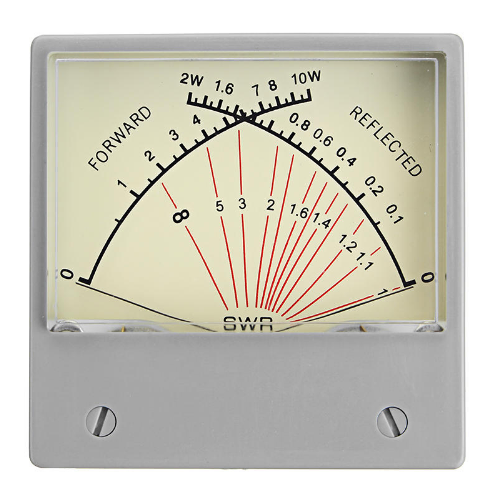
Steve, G1KQH, is a regular contributor to AmateurRadio.com and writes from England. Contact him at [email protected].
Go Ahead and Call CQ on 2m FM
 The conventional wisdom in amateur radio is that we should not call CQ when using FM on the VHF and UHF bands, especially on repeaters. The reasoning for this is that during normal VHF/UHF FM operating, radio amateurs are tuned to a specific frequency and will easily hear a call on FM.
Compare this to the HF bands, where the other ham is generally tuning around to find someone to contact and stumbles onto your transmission. In that case, you want to make a long call (CQ CQ CQ Hello CQ This is Kilo Zero November Romeo calling CQ CQ CQ…) so people tuning the band will find you and tune you in. On VHF/UHF FM, the assumption is that the other hams have their radio set on the repeater or simplex channel being used and will immediately hear you. FM communications are often quite clear and noise free, which also helps. The normal calling method is to just say your callsign, perhaps accompanied with another word like “monitoring” or “listening.” For example, I might say “KØNR monitoring.”
Question T2A09 in Technician exam pool reinforces this idea:
T2A09 (B)
What brief statement indicates that you are listening on a repeater and looking for a contact?
A. The words “Hello test” followed by your call sign
B. Your call sign
C. The repeater call sign followed by your call sign
D. The letters “QSY” followed by your call sign
Gary/KN4AQ wrote this tongue-in-cheek article HamRadioNow: Do NOT Call CQ on Repeaters which says that calling CQ on a quiet repeater works well because it is likely that someone will come on and tell you not to call CQ. Gary wrote:
So I trot out my standard advice: make some noise. I even recommend calling CQ, because that’s almost guaranteed to get someone to respond, if only to tell you that you’re not supposed to call CQ on repeaters.
There is also an interesting thread on the topic on reddit: 2 meter calling frequency.
Scanning and Multitasking
Some important things have changed in our use of VHF/UHF FM over past decades. The most important shift is dispersion of activity: while the number of VHF/UHF channels has increased, the total amount of VHF/UHF radio activity has declined. This means that we have tons of channels available that are mostly quiet. Tune the bands above 50 MHz and you’ll hear a lot of dead air. In response to this, some hams routinely scan multiple repeater and simplex frequencies. While getting ready for Summits On The Air (SOTA) activity, I’ve had hams ask me to make a long call on 146.52 MHz so they can be sure to pick me up on scan.
Another factor that comes into play is the multitasking nature of our society. Hams don’t generally sit in front of a 2m radio waiting for activity to occur. More commonly, they are doing something else and listening to the FM rig in the background. VHF FM is the Utility Mode, always available but not necessarily the top priority. A short call (“KØNR listening”) on the frequency can easily be missed.
Recommendations
My conclusion is that the Old School “KØNR Monitoring” style of making a call on VHF is no longer sufficient. First off, it sends the message of “I am here if you want to talk to me.” If that’s your intent, fine. However, if you really want to make a contact, being more explicit and a bit assertive usually helps. Follow Gary’s advice and make some noise.
For example, during a SOTA activation I’ll usually call on 146.52 MHz with a bit of a sales pitch. Something like: “CQ CQ 2 meters, this is Kilo Zero November Romeo on Pikes Peak, Summits On The Air, anyone around?” This is way more effective than “KØNR Monitoring.” I might also include the frequency that I am calling on, to help out those Scanning Hams. Something like “CQ CQ 146.52, this is KØNR on Pikes Peak, Summits On The Air.” Note that these calls are still pretty much short and to the point, only taking about 15 seconds. This is a lot shorter than the typical HF CQ.
If I am driving through another town and want to make contact on the local repeater, I will adjust my approach accordingly. For example, on a relatively quiet repeater, I might say “CQ, anyone around this morning? KØNR mobile I-25 Denver.” Or if I have a specific need, I’ll go ahead and ask for it. “This is KØNR looking for a signal report.”
Keep in mind that VHF/UHF operating tends to be local in nature, so it makes sense to adapt your approach to both local practice and the specific situation.
- It’s OK to call CQ on VHF FM, make some noise on the frequency.
- Give other operators a reason to contact you.
- Don’t make your CQ too long, maybe 15 to 20 seconds.
- The callsign/listening approach is fine too.
Those are my thoughts. What do you think?
73 Bob K0NR
The post Go Ahead and Call CQ on 2m FM appeared first on The KØNR Radio Site.
Bob Witte, KØNR, is a regular contributor to AmateurRadio.com and writes from Colorado, USA. Contact him at [email protected].
Weekly Propagation Summary – 2019 Apr 29 16:10 UTC
Here is this week’s space weather and geophysical report, issued 2019 Apr 29 0213 UTC.
Highlights of Solar and Geomagnetic Activity 22 – 28 April 2019
Solar activity was very low throughout the reporting period. No spotted regions were observed on the solar disk. No Earth-directed CMEs were observed in available coronagraph imagery.
No proton events were observed at geosynchronous orbit.
The greater than 2 MeV electron flux at geosynchronous orbit was at moderate levels on 22-23 Apr and decreased to normal levels for the remainder of the reporting period.
Geomagnetic field activity ranged from quiet to unsettled. A solar sector boundary crossing was observed late on 23 Apr which caused several periods of unsettled early into 24 Apr. No other significant signatures were observed in the solar wind data. Quiet conditions were observed for the remainder of the reporting period.
Forecast of Solar and Geomagnetic Activity 29 April – 25 May 2019
Solar activity is expected to be at very low levels over the outlook period.
No proton events are expected at geosynchronous orbit.
The greater than 2 MeV electron flux at geosynchronous orbit is expected to range from normal to high levels. High levels are expected on 02-12 May; moderate levels are expected on 29 Apr-01 Mar and 13-23 May. The remainder of the outlook period is expected to be at normal levels.
Geomagnetic field activity is expected to range from quiet to active levels. Active levels are expected on 01-02 May and 07 May; unsettled levels are expected on 30 Apr, 03 May, 05-06 May, 08-10 May and 19 May. The remainder of the outlook period is expected to be at quiet levels. All enhancements in geomagnetic activity are due to the anticipation of multiple, recurrent CH HSSs.
Don’t forget to visit our live space weather and radio propagation web site, at: http://SunSpotWatch.com/
Live Aurora mapping is at http://aurora.sunspotwatch.com/
If you are on Twitter, please follow these two users: 1. https://Twitter.com/NW7US 2. https://Twitter.com/hfradiospacewx
– – – – – – – – – – – – –
Be sure to subscribe to our space weather and propagation email group, on Groups.io
https://groups.io/g/propagation-and-space-weather
Spread the word!
– – – – – – – – – – – – –
Links of interest:
+ Amazon space weather books: http://g.nw7us.us/fbssw-aSWSC
+ https://Twitter.com/NW7US
+ https://Twitter.com/hfradiospacewx
Space Weather and Ham Radio YouTube Channel News:
I am working on launching a YouTube channel overhaul, that includes series of videos about space weather, radio signal propagation, and more.
Additionally, I am working on improving the educational efforts via the email, Facebook, YouTube, Tumblr, and other activities.
You can help!
Please consider becoming a Patron of these space weather and radio communications services, beginning with the YouTube channel:
https://www.patreon.com/NW7US
The YouTube channel:
https://YouTube.com/NW7US
..
Visit, subscribe: NW7US Radio Communications and Propagation YouTube Channel
Ham College 52
Ham College episode 52 is now available for download.
General Amateur Radio Exam part 23. Solid State devices, Standing Waves.
1:04:40
George Thomas, W5JDX, is co-host of AmateurLogic.TV, an original amateur radio video program hosted by George Thomas (W5JDX), Tommy Martin (N5ZNO), Peter Berrett (VK3PB), and Emile Diodene (KE5QKR). Contact him at [email protected].
ICQ Podcast Episode 292 – Yaesu FTDX 101D Hands-On
In this episode, Martin M1MRB is joined by Edmund Spicer M0MNG, Bill Barnes N3JIX and Ed Durrant DD5LP to discuss the latest Amateur / Ham Radio news. Colin M6BOY rounds up the news in brief and this episode’s feature is Martin M1MRB, Edmund M0MNG and Colin M6BOY visit to Yaesu to get hands-on with the new FTDX 101D.
ICQ AMATEUR/HAM RADIO PODCAST DONORS
We would like to thank Nigel Wells (2W0CGM) and our monthly and annual subscription donors for keeping the podcast advert free. To donate, please visit - http://www.icqpodcast.com/donate
- UK Foundation Licence Changes - Bouvet Island DXpedition News - New Digital Mode FT4 - Radio Ham to Set Up Emergency Communications Centre - RSGB ARDF Championships 2019 - Experts Predict Long and Deep Solar Minimum
Colin Butler, M6BOY, is the host of the ICQ Podcast, a weekly radio show about Amateur Radio. Contact him at [email protected].
Put That ARRL CEO to Work, Would Ya?
In a recent episode of the ICQ Podcast, I had Howard Michel WB2ITX as my interview guest. He’s the CEO of the American Radio Relay League as of late last year. It was important that Howard get interviewed about League matters as he was hired after a brief misfire to replace the legendary CEO David Sumner K1ZZ. As I told ARRL President Rick Roderick in the Q&A session with him a year or so ago at the Mississippi Section Convention in Jackson, MS, “You guys made a mistake in hiring someone from Wall Street to be CEO of a membership non-profit organization. Don’t make one again.” My Division Director, David Norris K5UZ, was seated in the row in front of me, nodded his head and turned to give me a knowing look. From my interview with Howard Michel, and from what else I’ve seen coming from him, they did not make a mistake.
One of the strategic matters that this new CEO faces is the common perception that Chief Executives are walled-off from the organization’s customers or just come out of their catacombs to glad-hand, smile, and ask for something.
Indeed, if you listen to my interview with him here, I think you’ll find that he has a clear but not tight-fisted vision for making the Headquarters more customer service oriented, inclusive, and modern in it’s business operations. This should yield better service experiences for members. Perhaps equally important, it may attract new members to the League as the 150,000 or so current members pale by comparison to the 750,000 licensed hams in the U.S.
One of the strategic matters that this new CEO faces is the common perception that Chief Executives are walled-off from the organization’s customers or just come out of their catacombs to glad-hand, smile, and ask for something. As error prone as this perception is, there is enough of an everyday reality that validates it to the rank-and-file customer base to make it the default mental setting, so to speak. In addition, there’s the “We’re the ARRL. And You’re Not!” barrier (apologies to the comedian Chevy Chase of Saturday Night Live fame).
As I was listening to Howard respond to my questions, I was pondering these matters. It hit me that it might be informative for all involved if there were opportunities to interact with Howard as just another ham operator so as to “see” him that way as opposed to a mostly a face with a monthly column in QST or on the pages of the ARRL’s website. An idea was formulated on the spot: get him on the air in a mini-event so as to work Howard on the air at W1AW!

(original photo courtesy of ARRL. Graphic rendering by Frank K4FMH
So I sprang this on him without any real sense of how he would respond by asking a one of my final questions: How’d you like to make some news? I proposed that we set up a date and time to appear on W1AW’s station on 20 meters and let the ICQ Podcast team promote it as a joint mini-event where hams could “put the CEO to work” by working WB2ITX on the air. He immediately caught the humorous pun in this and agreed enthusiastically.
Please put May 13, 2019 at 2:00pm Eastern Time on your calendars. Tune your antennas, rigs, and amplifiers (if you have them) to 14.254+/- and put that CEO to work! Howard promises a special QSL card from the League HQ for worked contacts.
Frank Howell, K4FMH, is a regular contributor to AmateurRadio.com and writes from Mississippi, USA. Contact him at [email protected].
Hunting For NDBs In CLE243
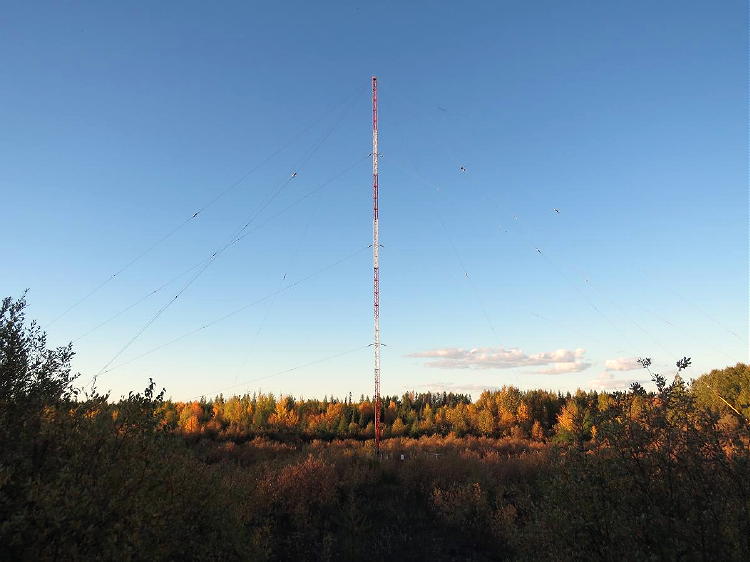 |
| YPM - 274 courtesy: VE3GOP |
This coming weekend will see another monthly CLE challenge. This time the hunting grounds will be 270.0 - 319.9 kHz.
For those unfamiliar with this monthly activity, a 'CLE' is a 'Co-ordinated Listening Event', as NDB DXers around the world focus their listening time on one small slice of the NDB spectrum.
If you've been meaning to participate in CLE, then maybe this weekend is a fine time to try!
A nice challenge in this one is to hear YPM - 274, located in northwest Ontario near Pikangikum.
'YPM' runs just 25W into a 100' vertical but is well-heard throughout North America. Listen for its upper-sideband CW identifier (with your receiver in the CW mode) on 274.368 kHz.
Summer lightning storms may provide additional listening challenges but maybe we will get lucky.
When tuning for NDBs, put your receiver in the CW mode and listen for the NDB's CW identifier, repeated every few seconds. Listen for U.S. NDB identifiers approximately 1 kHz higher or lower than the published transmitted frequency since these beacons are modulated with a 1020 Hz tone approximately.
For example, 'AA' near Fargo, ND, transmits on 365 kHz and its upper sideband CW identifier is tuned at 366.025 kHz while its lower sideband CW ident can be tuned at 363.946 kHz. Its USB tone is actually 1025 Hz while its LSB tone is 1054 Hz.
Often, one sideband will be much stronger than the other so if you don't hear the first one, try listening on the other sideband.
Canadian NDBs normally have an USB tone only, usually very close to 400 Hz. They also have a long dash (keydown) following the CW identifier.
All NDBs heard in North America will be listed in the RNA database (updated daily) while those heard in Europe may be found in the REU database. Beacons heard outside of these regions will be found in the RWW database.
From CLE organizer Brian Keyte, G3SIA, comes the details:
Hello all
Our 243rd co-ordinated listening event is this weekend, covering a 50 kHz
frequency range - about three times wider than usual.
Days: Friday 26 April - Monday 29 April
Times: Start and end at midday, your LOCAL time
Range: 270.0 - 319.9 kHz (NDB signals only)
In part of the frequency range it might be quite a challenge to tease out
the NDB signals from among the DGPS ones.
Any first-time CLE logs will be very welcome, as always.
Please log the normal NDBs you can identify that are listed in the range
(it includes 270 kHz but not 320 kHz).
Please send your CLE log to NDB List, if possible as a plain text email
and not in an attachment, with 'CLE243 FINAL' at the start of its title.
Show on EVERY line of your log:
# The Date e.g. '2019-04-26', etc. (or just '26')
# UTC (the day changes at 00:00 UTC).
# kHz - the beacon's nominal published frequency if you know it.
# The Call Ident.
Those main items can be in any order within themselves, but BEFORE any
other optional details (Location, Distance, etc.) later in the same line.
As always, give details in your log of your own location and the receiver,
aerial(s), etc. that you were using.
If you send any interim logs, be sure to send a FINAL (complete) one.
You can find anything else to help you, including CLE seeklists for your
part of the World, from the CLE page, http://www.ndblist.info/cle.htm
Please look out for our 'Any More Logs?' email at about 17:00 UTC on
Tuesday so that you can check that your CLE log has been found OK.
Do make sure that your log has arrived at the very latest by 08:00 UTC
next Wednesday, 1st May.
We are hoping to make all the combined results within a day or two.
Enjoy your listening
Brian and Joachim
-----------------------------------------------------------------
From: Brian Keyte G3SIA ndbcle'at'gmail.com
Location: Surrey, SE England (CLE coordinator)
-----------------------------------------------------------------
(Reminder: You could use any one remote receiver for your loggings,
stating its location and owner - with their permission if required.
A remote listener may NOT also use another receiver, whether local
or remote, to obtain further loggings for the same CLE).
- determine, worldwide, which beacons are actually in service and on-the-air so the online database can be kept up-to-date
- determine, worldwide, which beacons are out-of-service or have gone silent since the last CLE covering this range
- will indicate the state of propagation conditions at the various participant locations
- will give you an indication of how well your LF/MF receiving system is working
- give participants a fun yet challenging activity to keep their listening skills honed
The NDB List Group is a great place to learn more about the 'Art of NDB DXing' or to meet other listeners in your region. There is a lot of good information available there and new members are always very welcome. As well, you can follow the results of other CLE participants from night to night as propagation is always an active topic of discussion.
You need not be an NDB List member to participate in the CLEs and all reports, no matter how small, are of much value to the organizers.
Remember - 'First-time' logs are always VERY welcome!
Reports may be sent to the NDB List Group or e-mailed to CLE co-ordinator, Brian Keyte (G3SIA), whose address appears above. If you are a member of the group, all final results will also be e-mailed and posted there.
Please ... give the CLE a try ... then let us know what NDB's can be heard from your location! Your report can then be added to the worldwide database to help keep it up-to-date.
Have fun and good hunting!
Steve McDonald, VE7SL, is a regular contributor to AmateurRadio.com and writes from British Columbia, Canada. Contact him at [email protected].
 Ham Radio Deluxe |
 W5SWL Electronics |
 Ham Radio Prep |
 KB3IFH QSL Cards  Hip Ham Shirts  HamRadioAuctions HamRadioAuctions Reliance Antennas Reliance Antennas Enigma Shop Enigma Shop |  morseDX  Ni4L Antennas  R&L Electronics R&L Electronics antennas.us antennas.us QRV QRV |
- Matt W1MST, Managing Editor
