 |
 CW Part 2
 27 June 2019 | by
In 2016, I posted that I was learning CW by taking the CW Ops level 1 course. I did complete the class, made two on air QSO’s then life got in the way of the ham radio hobby and until recently, I left CW alone. In January this year, I decided to get started again and set a goal to make 100 CW QSO’s by the end of the year.
I started reviewing the CW Ops materials I had from 2016. I also copied the all the K7QO code course mp3 files to my phone so I could listen to that while in the car. In addition to those two things, I am also trying to listen to live QSO’s on the radio. Most of them go too fast for me to not miss a bunch of characters. Some QSO’s are difficult due to timing or no spacing. I heard a CQ call that sounded like “CQCQdeCallSignk”. There were no spaces in between the characters or words. One long string of dits and dahs.
So far, I am making progress. I relearned the alphabet, numbers and a few punctuation marks, and am trying to gain faster recognition so I can understand more.
I did make my first CW QSO of the year last week. It was a bit of a mess but we managed to actually exchange enough info to make an official QSO! That lead to an exchange of emails and this fellow ham and I made another scheduled QSO and he’s going to help me make more so I can practice CW! Gotta love the ham radio community!
If anyone is thinking of trying to learn CW, do it! If I can do it, then I think most people could do it as well. It’s going to take some effort and time but what doesn’t? 73.
Wayne Patton, K5UNX, is a regular contributor to AmateurRadio.com and writes from Arkansas, USA. Contact him at [email protected].
An RF-Quiet Light Dimmer

This blog first appeared in February 2016 but is just as relevant today as it was then!
I admit it. I have an extraordinarily kind next door neighbour!
Ever since erecting a new, much bigger LF antenna several years ago, she has allowed me to run its large, three-wire 100' tophat, directly over the top of her house to a tree on the far edge of her property. As well, she removed her only light dimmer, knowing that it was creating a LOT of nasty RF 'hash' throughout the LF / MF spectrum, seriously degrading my LF reception. To hear the RF noise-signature of a typical light dimmer, listen here, on the ARRL's helpful page of 'household' RFI recordings ... that's just how it sounded here as well!
She recently did a major renovation, which included a new multi-light dining-room fixture and expressed to me a desire to be able to dim it ... oh-oh, I was definitely not looking forward to this.
I did a little web-research and soon learned that some of the most RF-quiet dimmers were being produced by Lutron. One model in particular, claimed to pay special attention to RF noise-filtering and that was the "Centurion", whose smallest model is a 600 watt-capable unit, with a large finned heatsink front plate ... model #C-600P-WH.
I decided to order one from the only dealer I could find in Vancouver that seemed to carry this line of dimmers. The cost was just a little over $40 Canadian (sells for about $25 in the U.S.A.) ... cheap enough if it would do the job!
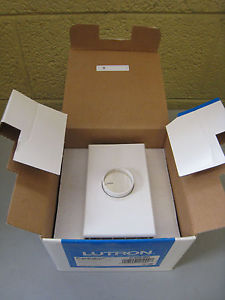
When the unit came in, I picked it up on my next ferry trip to the city and upon my return, installed it the following afternoon. Before doing the installation, I fired-up the receiving system, tuned to 300kHz, and with the baby monitor set up beside the speaker, took the portable monitor with me.
After installing the new dimmer, I turned on the baby monitor, held my breath ... and turned on the light fixture. Wow ... not a trace of hash could be heard! Adjusting the dimmer from high to low produced no difference in the noise level. I later did a more thorough bandscan and could find no evidence of RFI, on any frequency. The only RFI that I could detect was when placing my Sony ICF-2010 close to the actual dimmer. I was unable to detect any noise further than 6" away from the lights or the dimmer!
So it seems that this model can be highly recommended, for your own home or if you have a next door neighbour 'light-dimmer problem'.
Steve McDonald, VE7SL, is a regular contributor to AmateurRadio.com and writes from British Columbia, Canada. Contact him at [email protected].
LHS Episode #290: Where the Wild Things Are

Welcome to Episode 290 of Linux in the Ham Shack. In this short format show, the hosts discuss the recent ARRL Field Day, LIDs getting theirs, vandalism in Oregon, a Canonical flip-flop, satellite reception with SDR and much more. Thank you for tuning in and we hope you have a wonderful week.
73 de The LHS Crew
Russ Woodman, K5TUX, co-hosts the Linux in the Ham Shack podcast which is available for download in both MP3 and OGG audio format. Contact him at [email protected].
Weekly Propagation Summary – 2019 Jun 24 16:10 UTC

Here is this week’s space weather and geophysical report, issued 2019 Jun 24 0133 UTC.
Highlights of Solar and Geomagnetic Activity 17 – 23 June 2019
Solar activity was at very low levels. No sunspots were observed on the visible disk. No Earth-directed CMEs were observed in available imagery.
No proton events were observed at geosynchronous orbit.
The greater than 2 MeV electron flux at geosynchronous orbit was at moderate levels on 17 Jun with a peak flux of 109 pfu observed at 17/2025 UTC. Normal levels were observed on 18-23 Jun.
Geomagnetic field activity was at quiet levels with an isolated unsettled period observed for 0600-0900 UTC period on 20 June. Solar wind parameters were at mostly nominal levels through the period. A peak wind speed of near 425 km/s was observed early on 22 Jun. Bt and Bz parameters were at mostly nominal levels.
Forecast of Solar and Geomagnetic Activity 24 June – 20 July 2019
Solar activity is expected to be at very low levels throughout the outlook period.
No proton events are expected at geosynchronous orbit.
The greater than 2 MeV electron flux at geosynchronous orbit is expected to be moderate to high levels on 25 Jun – 03 Jul in response to elevated wind speeds associated with recurrent CH HSS activity. Normal levels are expected for the remainder of the outlook period.
Geomagnetic field activity is expected to reach unsettled to isolated active levels on 24-26 Jun, 06 Jul and 10-11 Jul due to negative polarity CH HSS influence. Quiet conditions are expected for the remainder of the outlook period.
Don’t forget to visit our live space weather and radio propagation web site, at: http://SunSpotWatch.com/
Live Aurora mapping is at http://aurora.sunspotwatch.com/
If you are on Twitter, please follow these two users: 1. https://Twitter.com/NW7US 2. https://Twitter.com/hfradiospacewx
– – – – – – – – – – – – –
Be sure to subscribe to our space weather and propagation email group, on Groups.io
https://groups.io/g/propagation-and-space-weather
Spread the word!
– – – – – – – – – – – – –
Links of interest:
+ Amazon space weather books: http://g.nw7us.us/fbssw-aSWSC
+ https://Twitter.com/NW7US
+ https://Twitter.com/hfradiospacewx
Space Weather and Ham Radio YouTube Channel News:
I am working on launching a YouTube channel overhaul, that includes series of videos about space weather, radio signal propagation, and more.
Additionally, I am working on improving the educational efforts via the email, Facebook, YouTube, Tumblr, and other activities.
You can help!
Please consider becoming a Patron of these space weather and radio communications services, beginning with the YouTube channel:
https://www.patreon.com/NW7US
The YouTube channel:
https://YouTube.com/NW7US
..
Visit, subscribe: NW7US Radio Communications and Propagation YouTube Channel
ICQ Podcast Episode 297 – HMS Belfast – D-Day Communication Ship
In this episode, Colin M6BOY is joined by Bill Barnes (N3JIX), Leslie Butterfield (G0CIB). Edmund Spicer (M0MNG) and Ed Durrant (DD5LP) to discuss the latest Amateur / Ham Radio news. Colin M6BOY rounds up the news in brief and this episode’s feature is HMS Belfast, D-Day’s Communication Ship.
ICQ AMATEUR/HAM RADIO PODCAST DONORS
We would like to thank Kenny Johns (WN8Y) and our monthly and annual subscription donors for keeping the podcast advert free. To donate, please visit - http://www.icqpodcast.com/donate
- New Beta Version of FT4 Now Available
- AMSAT President Joe Spier, K6WAO, Awarded Russian E.T. Krenkel Medal
- French Proposes 144-146 MHz for Aeronautical Mobile Service
- PW Contest Used to Publicise Amateur Ham Radio
- Could a New Licence Counter Threats at VHF and Above?
- Ham Radio at Women in Tech Event
- YCP Group Taking Part in IARU HF Contest
- RASA Calls for 1 kW for Australia
Colin Butler, M6BOY, is the host of the ICQ Podcast, a weekly radio show about Amateur Radio. Contact him at [email protected].
LHS Episode #289: Linux Deep Dive

Hello and welcome to Episode #289 of Linux in the Ham Shack. In this episode, LHS gets a visit from Jon "maddog" Hall, a legend in the open source and Linux communities. He discusses--well--Linux. Everything you ever wanted to know about Linux from its early macro computing roots all the way up to the present. If there's something you didn't know about Linux, you're going to find it here. Make sure to listen to the outtake after the outro for 30 more minutes on Linux you problem didn't know anything about. Thanks to Jon for an illuminating and fascinating episode.
73 de The LHS Crew
Russ Woodman, K5TUX, co-hosts the Linux in the Ham Shack podcast which is available for download in both MP3 and OGG audio format. Contact him at [email protected].
VHF/UHF Omni Antenna for SOTA Use
For Summits On The Air (SOTA), I’ve been using just the VHF/UHF ham bands, with the 2m band being the most popular. For most activations, I use a 3-element Arrow II yagi antenna that has a gain of about 6 dBd. Sometimes that extra gain makes the difference between completing a contact or not.
Omnidirectional Antenna

But it is also handy to have an omnidirectional antenna that is easy to deploy. Sometimes I’d rather just call or monitor using an omni without having to point the antenna. “Easy and good enough” can be an effective strategy for SOTA.
A key advantage to an omnidirectional antenna is that it is always pointed in the right direction.
I usually carry one of the TWAYRDIO RH770 VHF/UHF antennas for use with my 2m/70cm handheld transceiver. Despite its low cost, I have found that its performance to be quite good. That antenna is offered with a variety of connectors, including a BNC.
This led me to the idea of putting together a simple antenna mount with a BNC on it, attach an RH770 antenna to it and support it using some kind of pole. I have several monopod devices (intended for use as a camera support) that use the standard 1/4-20 thread. I also have a trekking pole that has the same camera mounting thread. Another option is to use an actual camera tripod which is a bit bulky but may work for some SOTA activations.
After a short visit to the hardware store, I selected crossbar for mounting a light fixture that was about the right size and shape. I happened to have a bulkhead-mount BNC-to-BNC connector which I inserted into the large hole in the crossbar. That hole was not quite large enough for the connector, but a few minutes work with a round file solved that problem.

The crossbar was originally flat but I bent one one end of it 90 degrees, with the idea that this might offer other mounting configurations in the future. For example, I might be able to strap or tape the 90 degree angle member to a pole or support.

The other end of the crossbar has a large slot that accommodated the 1/4-20 mounting stud. Actually, the slot was not quite wide enough, so some addition work with a round file opened it up. I secured the 1/4-20 thread using a nylon wing nut.

I’ve used this setup on one SOTA activation and was pleased with the results. I carried the crossbar mount attached to the monopod in my pack. On the summit, I simply installed the RH770 antenna onto the top BNC and extended the monopod. On this summit, I found the perfect pile of rocks that made a good support for the monopod. Then I used a short length of RG-8X coax between the bottom BNC and the 2m/70cm transceiver.

Although my primary interest was with the 2 meter band, it was really convenient to have both 2m and 70cm on the same antenna. I am pleased with operation of the antenna and the ability to deploy it quickly. I expect to carry this on most of my SOTA activations.
73 Bob K0NR
The post VHF/UHF Omni Antenna for SOTA Use appeared first on The KØNR Radio Site.
Bob Witte, KØNR, is a regular contributor to AmateurRadio.com and writes from Colorado, USA. Contact him at [email protected].
 Ham Radio Deluxe |
 W5SWL Electronics |
 Ham Radio Prep |
 KB3IFH QSL Cards  Hip Ham Shirts  HamRadioAuctions HamRadioAuctions Reliance Antennas Reliance Antennas Enigma Shop Enigma Shop |  morseDX  Ni4L Antennas  R&L Electronics R&L Electronics antennas.us antennas.us QRV QRV |
- Matt W1MST, Managing Editor
