 |
 Weekly Propagation Summary – 2019 Aug 12 16:10 UTC
 12 August 2019 | by
Here is this week’s space weather and geophysical report, issued 2019 Aug 12 0624 UTC.
Highlights of Solar and Geomagnetic Activity 05 – 11 August 2019
Solar activity was very low. No Earth-directed CMEs were observed during the period.
No proton events were observed at geosynchronous orbit.
The greater than 2 MeV electron flux at geosynchronous orbit was at moderate levels on 05 Aug and at high levels from 06-11 Aug. The largest flux of the period was 26,161 pfu observed at 07/1930 UTC.
Geomagnetic field activity was at quiet to G1 (Minor) storm levels over the period. The period began as a positive polarity coronal hole high speed stream (CH HSS) was becoming geoeffective. Total field increased to 23 nT by 05/0855 UTC as the Bz component became variable between +11 nT/-19 nT. Solar wind speed reached a maximum of 745 km/s at 06/0750 UTC. The geomagnetic field responded with four consecutive periods of G1 (Minor) storm levels on 05 Aug followed by quiet to unsettled levels on 06 Aug. Two further enhancements in solar wind speed were observed on 08 Aug and on 09-10 Aug. The first peaked around 575 km/s while the second peaked at approximately 650 km/s. However, no significant increases in total field were observed. Quiet conditions were observed on 07 Aug with quiet to unsettled levels on 08-11 Aug.
Forecast of Solar and Geomagnetic Activity 12 August – 07 September 2019
Solar activity is expected to continue at very low levels for the forecast period (12 Aug-07 Sep).
No proton events are expected at geosynchronous orbit.
The greater than 2 MeV electron flux at geosynchronous orbit is expected to reach high levels on12-16 Aug and again on 02-07 Sep due to recurrent CH HSS influence.
Geomagnetic field activity is expected to be reach unsettled levels on 12 Aug, 16 Aug, 26-28 Aug, and 06-07 Sep due to recurrent CH HSS activity. Unsettled to active levels are expected on 01-02 Sep with G1 (Minor) storming likely on 01 Sep also due to recurrent CH HSS activity.
Don’t forget to visit our live space weather and radio propagation web site, at: http://SunSpotWatch.com/
Live Aurora mapping is at http://aurora.sunspotwatch.com/
If you are on Twitter, please follow these two users: 1. https://Twitter.com/NW7US 2. https://Twitter.com/hfradiospacewx
– – – – – – – – – – – – –
Be sure to subscribe to our space weather and propagation email group, on Groups.io
https://groups.io/g/propagation-and-space-weather
Spread the word!
– – – – – – – – – – – – –
Links of interest:
+ Amazon space weather books: http://g.nw7us.us/fbssw-aSWSC
+ https://Twitter.com/NW7US
+ https://Twitter.com/hfradiospacewx
Space Weather and Ham Radio YouTube Channel News:
I am working on launching a YouTube channel overhaul, that includes series of videos about space weather, radio signal propagation, and more.
Additionally, I am working on improving the educational efforts via the email, Facebook, YouTube, Tumblr, and other activities.
You can help!
Please consider becoming a Patron of these space weather and radio communications services, beginning with the YouTube channel:
https://www.patreon.com/NW7US
The YouTube channel:
https://YouTube.com/NW7US
..
Visit, subscribe: NW7US Radio Communications and Propagation YouTube Channel
The Antuino from HF Signals
HF Signals the small company in India headed by VU2ESE, that has recently brought us lots of fun with the BITX40 and the uBITX HF radio kits, has now done it again with the launch of the Antuino.
His headline for the device is A compact Radio Lab for Antennas and Radio circuits.

I would like to think of it as a mini Radio Test Set that can help us understand what is going on up the antenna, as well as being useful tool to help analyse what is happening within the radio or what problems exist within the RF signal it outputs. The plus of course it is hackable, so anyone can join in the fun and improve it with addons or make it's firmware better.
At $99 this is sure going to be another useful instrument to any Amateurs test equipment toolbox.
For a better understanding pop down to HF signals link http://www.hfsignals.com/index.php/antuino/
Steve, G1KQH, is a regular contributor to AmateurRadio.com and writes from England. Contact him at [email protected].
Still here!
All the best to you all!
73 Steve
Steve, G1KQH, is a regular contributor to AmateurRadio.com and writes from England. Contact him at [email protected].
It was time to pack up the shack for the move.
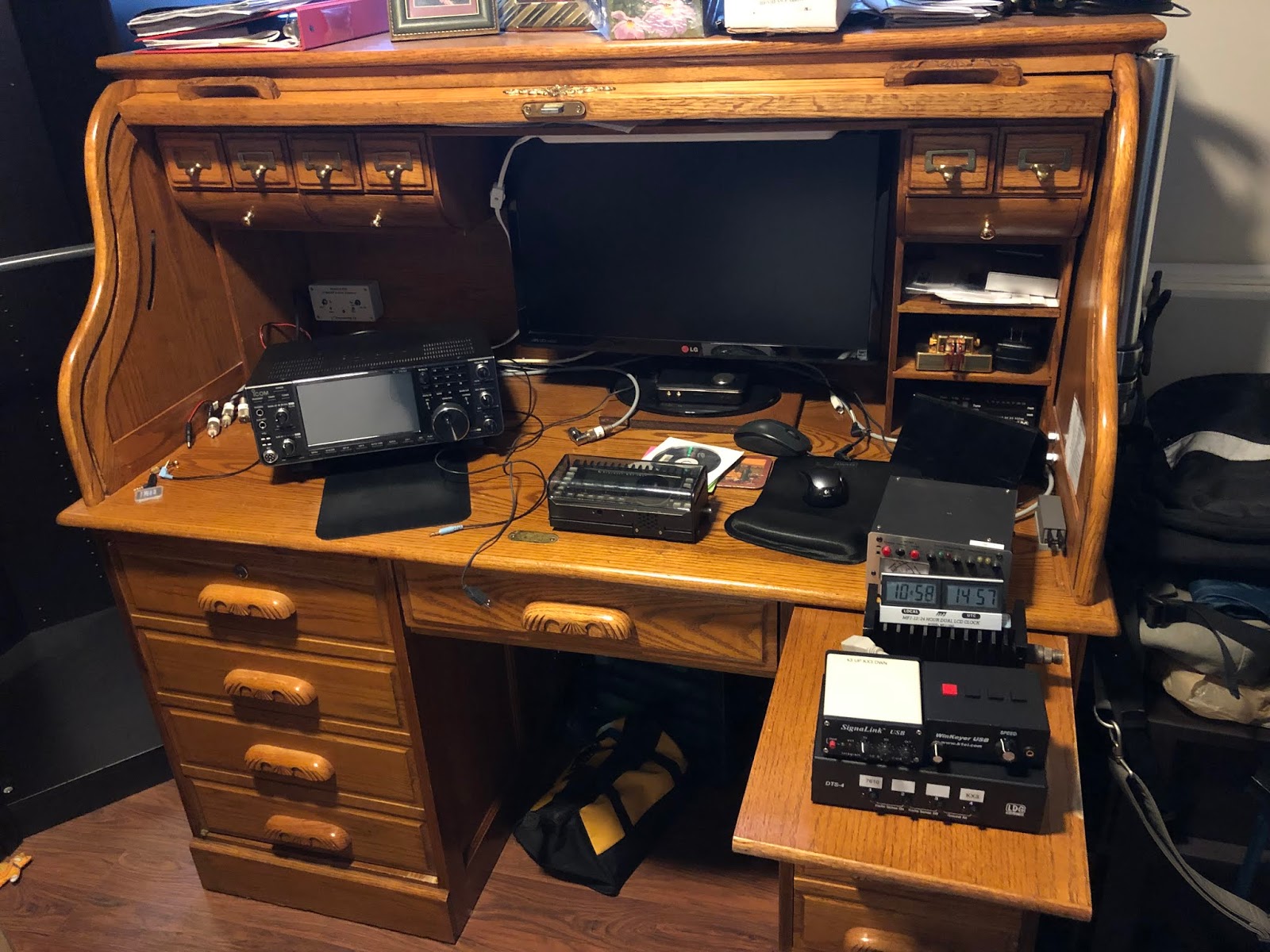 |
| And so it begins |

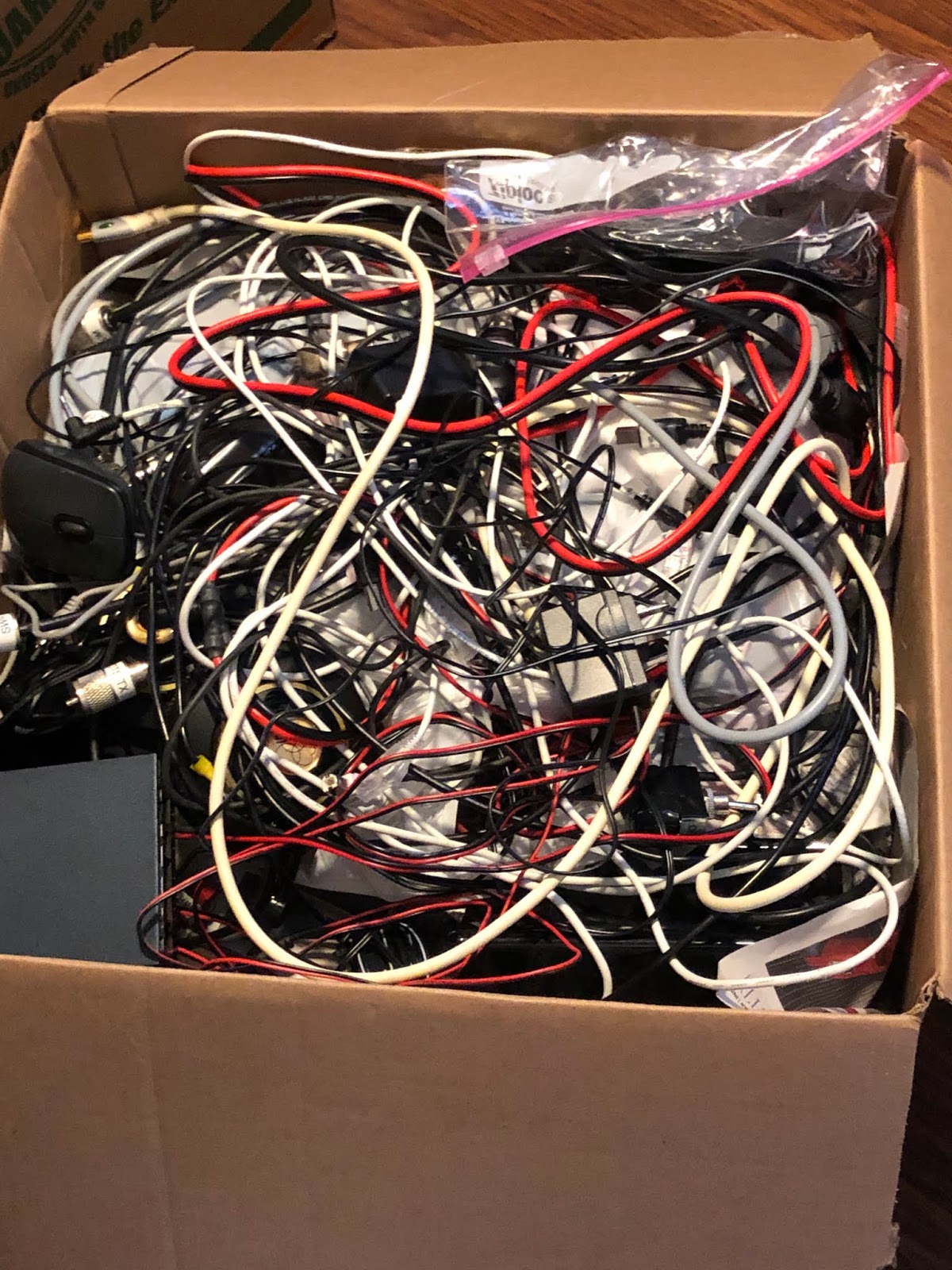 |
| To top off the box...cables and cables. |
Mike Weir, VE9KK, is a regular contributor to AmateurRadio.com and writes from New Brunswick, Canada. Contact him at [email protected].
Weak Signal Volume Levels
The following blogspot was originally published in July, 2016. Hopefully some will find this of interest as the topic is still very relevant.
***************
A recent posting on Yahoo's Perseus SDR Group inquired about the use of external or PC-based DSP manipulation of signals partially masked by noise to improve readability. The most interesting part of this short discussion was the result of one response indicating:
"BTW one of the best and most simple noise reductions is to lower the volume."
to which the original inquirer responded:
"BTW, lower the volume to reduce noise ... ?? That was a joke, right ??"
Other comments soon followed, including my own, initially:
"Actually, for whatever reason, this works...at least when copying very very weak CW signals. I think it is more of an ear-brain thing where the noise
gets more focus than the signal when listening at moderate levels but
cranking everything down to a very low level has always improved copy for
me....not sure why this works as well as it does."
From Roelof Bakker, PAØRDT:
"The ear brain system works much better at low volume as it is easily
overloaded by strong signals. Similar like too much direct light in
your eyes will degrade contrast. I guess this is getting worse with
age, but I am not sure about that.
I have been watching many videos on YouTube which demonstrate ham
radio gear and most if not all use far to high volume settings,
which degrades readability. I believe it is a normal habit to raise
the volume for weak signals, but this is often contra productive.
When listening for weak signals at low volume settings, a quiet room
is mandatory. I have taken considerable effort in building a quiet
PC, that is aurally quiet.
What does wonders for copying weak signals with the PERSEUS is to
switch off the AGC."
"No it's not a joke and it's not the RF Gain. It's one of the capabilities of the human ear.
Of course qrm can be limited and reduced but noise is difficult. What you often see is that with all those noise reduction things is that the volume drops. Make an audio recording of a part with and without a (white) noise limiter switched on. Open it into an audio editor and you will see that the amplitude of the part where the noise reduction is on is lower. Now amplify that part to the same level as where the limiter is not active and play it back. You will be astonished how little the difference is.
It's probably also a thing that can differ from person to person but I've never seen tools that can make an unreadable signal readable. Most of the time they sound just different, not better."
Likely there is a ton of data showing how our ear / brain link deals with noise or tones buried in noise. With audio levels set to anything above bare minimum, I think it's very easy for your brain to react mainly to the noise and not to the tone. Reducing this level possibly puts the two back on even levels ... even though there really has been no change in signal-to-noise ratio.
When trying to copy very weak, difficult signals, I've always found that turning audio levels down to bare minimums helps me personally. As Roelof mentioned, the entire environment must be dead quiet as well so that there are no outside distractions. Even the sounds of the headphone cord, brushing against clothing or the table top, can make the difference between copy and no copy. Decades of copying very weak ndb CW idents buried in the noise as well as spending several years on 2m CW moonbounce, has taught me that my ear-brain connection works best when audio inputs are very, very low.
 |
| courtesy: http://justagwailo.com/ |
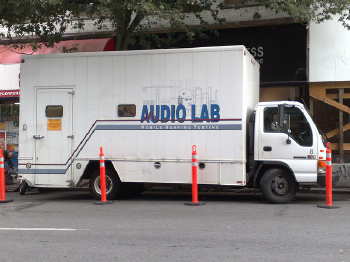
As an interesting aside, my years of copying weak CW tones, has shown itself in other ways as well. Before retirement as a high school tech ed teacher, staff were required to have their hearing checked annually, as part of the medical plan's requirement. Each year the mobile audio lab would roll-up for the tests. I would always make sure to sit perfectly still, with no headphone cord wires brushing against my clothing. The tones varied in frequency and intensity and were often extremely weak, not unlike the weak echoes I was used to copying from the lunar surface. The reaction from the examiner was always the same, every year ... complete astonishment when checking the results and usually a comment that I had the hearing of a teenager! Thankfully my hearing, which I've always been careful to protect, remains exceptionally good, for which I am truly grateful ... so often this is a genetic thing and there is little one can do about controlling hearing-loss as one ages.
I shudder anytime I see a young person with headphones or earbuds firmly in place and with the music volume cranked up to unbelievably high levels. Sadly, many of them will likely pay the price for this later in life as such hammering-away at the delicate auditory mechanism has a cumulative rather than a short-term effect.
So ... the next time you find yourself trying to copy that ultra-weak signal just riding along in the noise, try turning the audio way, way down. Take a deep breath and listen to the tone, not the noise. If you ask me, the best signal filter is still the one between our ears.
Steve McDonald, VE7SL, is a regular contributor to AmateurRadio.com and writes from British Columbia, Canada. Contact him at [email protected].
General License Class – Black Forest, CO
 Sat Sep 28 and Sat Oct 5
(8 AM to 5 PM)
Black Forest Fire Station
11445 Teachout Road
Colorado Springs, CO 80908
The General License provides access to regional and worldwide communications on the HF bands, greatly expanding your ham radio fun!
• Upgrade from Technician to General Class radio privileges
• Pass your FCC General Class amateur license exam Oct 12*
• See live equipment demonstrations and activities
• Learn to operate on the HF bands, 10 Meters to 160 Meters
• Gain a deeper understanding of radio electronics and theory
• Take the next step with antennas, amplifiers, digital modes
Registration fee: $30 ($20 for under 18 years of age)
Prerequisite: Students must already have their Technician License
 The required study guide is:
HamRadioSchool.com General License Course
Third Edition, effective 2019 – 2023, $24.95
* Free FCC exam session on Oct 12 at Black Forest Fire Station 9:30 am.
To register for the class, contact Bob KØNR, [email protected]
Sponsored by the Tri-Lakes Monument Radio Association
The post General License Class – Black Forest, CO appeared first on The KØNR Radio Site.
Bob Witte, KØNR, is a regular contributor to AmateurRadio.com and writes from Colorado, USA. Contact him at [email protected].
Yagis, DMR Portables and Underwater Communications
 Stories you’ll find in our August, 2019 edition:
The Yagi-Uda Mystery: The Remarkable Backstory of this Ubiquitous Antenna
By Richard Fisher KI6SN
Shintaro Uda and Hidetsugu Yagi were mirror images of the antenna they created in 1926—known around the world today simply as the Yagi—an array invented by Uda in collaboration with Yagi. Ninety-three years later, this design is still widely in use for both amateur and commercial installations on the HF, VHF/UHF bands and beyond. It is the antenna so often seen atop amateur radio towers, at military installations and many municipal and commercial buildings. Yet Shintaro Uda seems to have faded from the picture of the origins of this antenna. Richard tells us about two stories of intrigue and historical significance behind the Yagi.
TSM Reviews: Yaesu FT3DR and Radioditty GD-73A
By Cory GB Sickles WA3UVV
The Yaesu FT3DR and the Radioddity GD-73A are two very different digital voice (DV) portables, with widely divergent feature sets. Each needs to be considered for its merits and the applications you have in mind. The Yaesu FT3DR is the latest of a series of DV hand-held portables with the features you’d expect from a full-featured HT. The Radioddity GD-73A is a UHF-only, DMR/analog portable with minimal features: There is no provision for an external antenna and the internal one protrudes under plastic, much in the same way as a 0.5-watt blister-pack FRS (Family Radio Service) transceiver is packaged. Cory goes deep into the details and tells us there’s more to each than may be at first apparent.
The USS Thresher on Eternal Patrol
By Scott A. Caldwell
The USS Thresher(SSN 593) was an icon of the United States Navy and was often used in recruitment posters. She was regarded as the most technologically advanced submarine in active service, designed to hunt and engage Soviet submarines that patrolled the deep North Atlantic Ocean. Her loss on April 10, 1963 shocked the entire nation and the subsequent inquiry raised more questions than answers, in light of the confusing radio transmission with the submarine escort vessel USS Skylark (ASR 20). Underwater communications were subjected to temperature and density fluctuations that often deflected and distorted the amplitude of the sound waves. Scott looks at the difficulties of undersea communications while telling the story of this disaster.
The Care and Feeding of Electronic Equipment: Part 2
By Robert Gulley K4KPM
Electronic equipment for our radio hobby requires periodic checks for proper operation, as well as occasionally performing preventive maintenance or repair as needed. This includes radios, power supplies/connections, computer hardware, antenna systems, and a host of other potential troublemakers. In this second article Robert discuss troubleshooting tips, electrical and antenna system maintenance, computer hardware/software updates, and other preventative measures to help keep things running as smoothly as possible.
Scanning America
By Dan Veeneman
Scanning Michigan
Federal Wavelengths
By Chris Parris
Las Vegas Mysteries and Frequencies
Milcom
By Larry Van Horn N5FPW
A New Way to Monitor the Military on January 1, 2020
Utility Planet
By Hugh Stegman
Cycle 25: Coming to an Ionosphere Near You
Shortwave Utility Logs
By Mike Chace-Ortiz and Hugh Stegman
VHF and Above
By Joe Lynch N6CL
The ‘Ah-Ha’ Behind Some Types of Aurorae
Digitally Speaking
By Cory GB Sickles WA3UVV
Another Look at D-Star
Radio 101
By Ken Reitz KS4ZR
The Trouble with Alexa
Radio Propagation
By Tomas Hood NW7US
Sunspot Cycle 24 Solar Minimum is Coming!
The World of Shortwave Listening
By Rob Wagner VK3BVW
Whatever Happened to the 11-Meter Band?
The Shortwave Listener
By Fred Waterer
German via Shortwave Plus BBC Highlights
Amateur Radio Astronomy
By Stan Nelson KB5VL
The Next Generation Very Large Array: ngVLAA
Adventures in Radio Restoration
By Rich Post KB8TAD
The Rolls-Royce of Radios: National HRO Part 2
Antenna Connections
By Dan Farber AC0LW
The End-Fed Antenna
The Spectrum Monitor is available in PDF format which can be read on any desktop, laptop, iPad®, Kindle® Fire, or other device capable of opening a PDF file. Annual subscription is $24. Individual monthly issues are available for $3 each.
Ken Reitz, KS4ZR, is publisher and managing editor of The Spectrum Monitor. Contact him at [email protected].
 Ham Radio Deluxe |
 W5SWL Electronics |
 Ham Radio Prep |
 KB3IFH QSL Cards  Hip Ham Shirts  HamRadioAuctions HamRadioAuctions Reliance Antennas Reliance Antennas Enigma Shop Enigma Shop |  morseDX  Ni4L Antennas  R&L Electronics R&L Electronics antennas.us antennas.us QRV QRV |
- Matt W1MST, Managing Editor
