 |
 Antenna planning for the fall and winter.
 12 September 2019 | by
 Any input from fellow hams who have faced such an adventure would be great.
Mike Weir, VE9KK, is a regular contributor to AmateurRadio.com and writes from New Brunswick, Canada. Contact him at [email protected].
DXing With The Heathkit CR-1 Crystal Radio
If you’re a regular blog reader, you will likely recall my description of “The Enigmatic Heathkit CR-1 Crystal Radio” a few weeks ago.
Back then I mentioned that I was ‘eager to get my mitts on one’ and that I had arranged to borrow a CR-1 from another VE7 who was fortunate enough to own one.
A few weeks after posting the blog, I received an e-mail from Larry, WB5OFD, in Texas.
"Reading thru your blogs the other night ... discovered your article on Crystal Radio reception reports. I am in the process of disposing of a lot of radio gear I have collected over the past sixty years and in that pile is a Heathkit CR-1. Yours for free if you would like to have it."
Needless to say I was overjoyed, both at the opportunity to actually own a CR-1 myself and at Larry's exceptional generosity!
Larry went on to explain that he had been in the Air Force and his little CR-1 had been all around the world with him, from Alaska to Turkey ... but from its fine appearance, you would never know it.
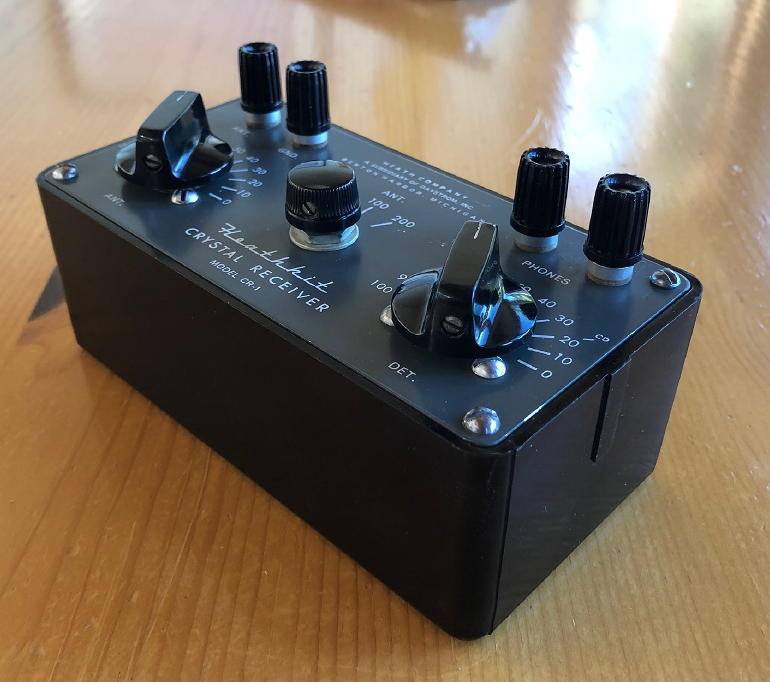 |
| Larry's gift! |
He was happy to pass it on knowing that it was going to a good home. I am most appreciative of this kind gesture from a fellow radio amateur, knowing that these things are not too easy to find ... and are somewhat pricey!
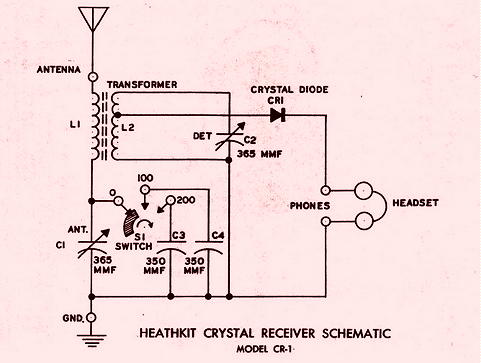
As can be seen in the schematic diagram above, the CR-1 is a simple double-tuned crystal receiver, utilizing a series-tuned tank circuit for antenna-tuning, coupled into the detector tank circuit. The detector diode, a 50’s-era 1N34, is tapped down on the tank for headphone impedance-matching and to reduce circuit loading. Reducing the load on the tank circuit improves selectivity but diminishes sensitivity. Crystal radio design is always a trade-off between these two critical characteristics.
Although I had heard good things about the CR-1, I must admit that I was somewhat skeptical ... just how good could an unmodified CR-1’s simple double-tuned design really be? I was about to find out.
My listening location, on the eastern shoreline of Mayne Island, puts me directly across several miles of saltwater from sixteen exceptionally loud 'blowtorch' signals whose antennas are located near the water on the other side of Georgia Strait. Six of these stations run 50kW ... 24/7. All of these signals are wide and strong, being well-over S9. It is a difficult location for crystal radio DXing as separating weak DX signals from the blowtorches can be challenging.
My previous experience with crystal radio DX is well-documented on my website here. Back then, I quickly adopted the standard protocols to help hear DX. This included the use if a separate ‘spotter’ radio to first find signals that might possibly be strong enough to be heard on the crystal detector. I also used an RF signal generator that let me temporarily put a weak tone-modulated carrier on the frequency of a station that I was trying to hear. Using the tone, the antenna tuning as well as the detector circuit can be optimized for maximum signal. I also used a 100 microamp meter in series with the headphones to make peaking these circuits accurately. The same protocol was used for my CR-1 DXing as well.
Since there are so many very strong signals here, I have added two inline L-C traps on the antenna lead.

My first trap was made from a ferrite bar loopstick inductor salvaged from an old transistor radio.

The second trap is made with a ferrite toroid and Litz wire and produces deeper nulls than the ferrite bar. The bar will soon be replaced by a second toroid trap.

The traps allow me to significantly null any strong signals that could be covering up a nearby weaker signal. For nulling, I set the signal generator on the frequency of the pest signal and then tune the trap for a null while watching the meter. Once everything has been tuned, I’ll often just sit and wait for the desired signal to fade up to a detectable level on the crystal radio and then confirm its audio match to what can be heard on the spotter radio. Very often, a signal initially too weak to be detected, will quickly pop up in signal strength to an easy-copy level for several minutes, before dropping below the threshold of diode detection level once again.
I am presently using a pair of RCA WWII sound-powered ('Big Cans') phones, impedance matched to the CR-1’s output with a multi-tap audio transformer. I have also used a nice set of extremely sensitive Western Electric 509Ws, manufactured in the late 20s. These are also impedance-matched to the CR-1's output. On weak signal tone tests, I can see only a very tiny improvement with the RCAs versus the old 509Ws as both are very sensitive.

There is a large variation in propagation quality on the broadcast band, especially this far north on the southern edge of the auroral zone. The difference from one night to the next can often be quite dramatic. On most nights the band favors the north-south path while on geomagnetically quieter nights it’s the east-west path that dominates. The band needs to be in good shape for any worthwhile hope of DX on a crystal radio.
On one of the recent better nights, of which there have been very few of lately, one of the stations in Alberta was so strong that it needed trapping! This was something I saw quite often with my previous DX set but I didn't expect to see it with the CR-1.
For crystal radio DX, propagation is the best helper. Small incremental improvements (in terms of db losses) can be made in any part of crystal radio's systems but on nights of good propagation, tens of db improvement will magically appear, thanks to Mother Nature!
When in Turkey, Larry had the opportunity to connect the CR-1 to the large FLR-9 circular antenna array used during the cold war for HF direction-finding of targeted signals. Covering 1.5MHz to 30MHz, the FLR-9 consisted of ninety-six 120' towers, suspending 1056 vertical elements ... all over a 1500' diameter ground screen! His notes show that he logged the BBC, Italy and West Germany on the CR-1 while using the array!
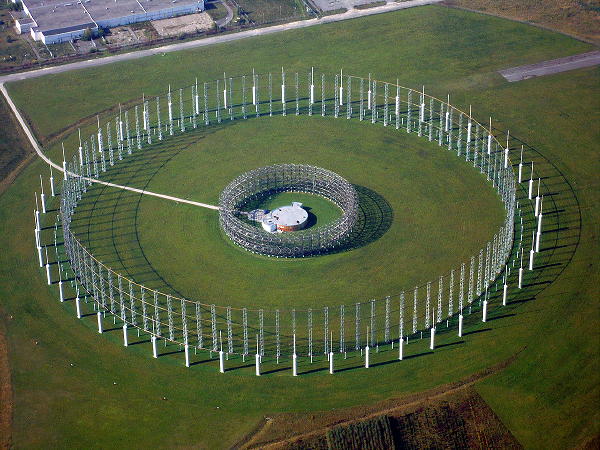 |
| The FLR-9 array in Augsburg, Germany |
Over the past few weeks, I have been spending a few nights patrolling the band between 9:30 and 10:30PM, to see what might be heard with the CR-1. So far, I've logged 50 different stations ... far more than I had expected to hear.
The log below shows all of the stations heard. The stations in red are all local line-of-sight transmitters and are extremely strong ... all are well over S9 on my Sony spotter radio. The stations shown in blue are all ‘DX’, with the furthest so far being KOA in Denver, at 1100 miles.


The log illustrates just how much the blowtorch signals prevent weak-signal detection, even with traps! The stations logged on 1510 and 1530 were only possible when the 1550 blowtorch lost their audio for about five minutes one evening! Selectivity becomes increasingly more difficult towards the top end of the band and, unfortunately, there is a larger concentration of strong locals (who seem to delight in over modulation and splatter), making reception up there extremely challenging.
There are still some lower-band signals that I have yet to log and they have been gradually growing stronger as the nights get longer. As well, the region above 1600kHz may still provide a few opportunities over the next few weeks, if the loud local on 1600 can be sufficiently trapped ... the next few weeks will tell if there’s anything left in the CR-1’s tank!
Steve McDonald, VE7SL, is a regular contributor to AmateurRadio.com and writes from British Columbia, Canada. Contact him at [email protected].
Saving Your Amateur Radio Club, the Airspy HF+ Discovery, and More
 Stories you’ll find in our September, 2019 issue:
TSM Reviews:
Airspy HF+ Discovery: It’s a Whole New World of Radio
By Larry Van Horn N5FPW and Gayle Van Horn W4GVH
While the term “digital radio” has been around since the 1970s in US government circles, it wasn’t until 1984 that the term “software defined radio” first surfaced. At first, many old-timers in the radio hobby scoffed at the idea that any radio that didn’t have a tuning knob and all the circuitry associated with it was a real radio. People pushing a computer-based technology were on the outside looking in as far as major manufacturers were concerned. It did not take long for software defined radio, or SDR, to come out of the shadows and be embraced by the radio hobby industry. Larry takes a look at the Airspy HF+ Discovery, the latest in a series of high-performance, low cost SDRs that are changing the world of HF radio listening.
Digital TV Ten Years Later and ATSC 3.0 Today
By Ken Reitz KS4ZR
The mass migration of analog television transmissions to digital television (DTV) broadcasting in the US officially went into effect June 12, 2009. The run up to the switch was years in development and involved extensive technical testing and a huge investment on the part of broadcast TV interests. There was nothing smooth about the transition. Ten years later, the dream of HDTV with 5.1 Dolby Surround Sound has faded considerably, with few channels actually achieving that benchmark. Now the FCC is preparing to do it again—this time with DTV’s successor: ATSC 3.0, which promises landmark 4K Over-the-Air TV channels and auxiliary channels in HDTV. Unfortunately, ATSC 3.0 is not compatible with any ATSC 1.0 TV sets in use today. Having failed to deliver ATSC 1.0, will the broadcast TV industry be able to deliver on ATSC 3.0.? And, anyway, whatever happened to ATSC 2.0?
The Hunt for the Bismarck
By Scott A. Caldwell
Summer 1941 was a dark time for the British Empire, which in reality was alone and isolated. Nazi Germany was rampant in its military conquest of mainland Europe and now one of the most powerful battleships in the world was ready for a commerce raiding campaign in the North Atlantic Ocean. The pursuit and sinking of the Bismarck was a turning point in naval strategy that was based on the utilization of a central command structure, which acted as a clearing house for intelligence information. Scott examines the communications systems used by both German and British commanders and how mistakes were made on both sides that led to the sinking of both German and British naval vessels and how the eventual sinking of the Bismarck became a turning point in the war for sea superiority.
Zen and the Art of
Amateur Radio Club Maintenance – Part 2
By Cory GB Sickles WA3UVV
If you did your homework from the previous installment, you have some better perspective into the size, finances, direction and overall health of your amateur radio club. Hopefully, you did not find yourself in or on the edge of critical mass, where your organization is about to fail. Even if you did, there is probably time to still be able to turn things around. If not, then perhaps the answer is to reflect on what went wrong and start anew. Cory gives us all more tips on how to save your ham club from itself.
Scanning America
By Dan Veeneman
Scanning Sumner County, Tennessee
Federal Wavelengths
By Chris Parris
Nevada DoE Update; FAA Closeup
Milcom
Larry Van Horn N5FPW
Phantoms in the Desert
Utility Planet
By Hugh Stegman
It’s Summer “Numbers” Time!
Shortwave Utility Logs
By Hugh Stegman and Mike Chace-Ortiz
VHF and Above
By Joe Lynch N6CL
PTRX-7300: A Panadapter Module for the IC-7300
Digitally Speaking
By Cory GB Sickles WA3UVV
Digital Voice Moves On
Radio 101
By Ken Reitz KS4ZR
Hits and Misses: Grace Digital Mondo+
The World of Shortwave Listening
By Jeff White, Secretary-Treasurer NASB
Can the Internet Replace Shortwave? Plus: NASB and SWL Fest 2019 Report
The Shortwave Listener
By Fred Waterer
WWII Radio Commemorations
Amateur Radio Satellites
By Keith Baker KB1SF/VA3KSF
Amateur Radio Satellite Primer (Part V)
The Longwave Zone
By Kevin O’Hern Carey N2AFX
Gearing Up!
Adventures in Radio Restoration
By Rich Post KB8TAD
Reviving a “Poor Man’s Collins” The Heathkit SB-301 Receiver
Antenna Connections
By Dan Farber AC0LW
Top Band: Antennas for 160 Meters
The Spectrum Monitor is available in PDF format which can be read on any desktop, laptop, iPad®, Kindle® Fire, or other device capable of opening a PDF file. Annual subscription is $24. Individual monthly issues are available for $3 each.
Ken Reitz, KS4ZR, is publisher and managing editor of The Spectrum Monitor. Contact him at [email protected].
AM & SSB: A ‘Gentlemen’s Agreement’
Hello to my friends and Directors of the ARRL,
I noted with pleasure that the ARRL Board has passed a motion addressing HF data bandwidth.
For many years, there has been an outcry from HF AM operators to have the ARRL Board address the situation of the original ‘Gentlemen’s’ agreement that was set up – basically from the stations that operated AM. In the mid 50’s, SSB became more in use, the “wars” began and I can attest, personally that there were actual wars. I was not a part of the physical ‘wars’ but knew some that did get involved. All of this came to the end when both sides met and formed a ‘Gentlemen’s agreement which – at the time, the ARRL helped to adopt and publish the agreement. Everything became calm. The two modes worked side by side, respecting each other.
The ‘agreement ‘ on 75 meters was originally 1.885 – 1.900, 3.870 – 3.890. 7.290 – 7.295. 14.280 – 14.290 This ‘Gentlemen’s’ agreement worked for more that a decade but as new license holders came on the scene, they knew nothing of this verbal agreement as the ARRL no longer published or admonish the original ‘Gentlemen’s’ agreement. Little was said of it – nor the need. If they did publish, one had to dig deep to find any of the information about the AM window. To answer some of the complaints , the ARRL set out to publish their own band plans… however most of the times the band plan is published, the AM Window is never mentioned…. Perhaps just a calling frequency. The DX windows, the SSTV windows have all been rewarded the strength of the ARRL to help publish their operating window and helped to keep those published and policed. Why has the ARRL not continued what was set forth back in the late 1950’s ?
With the advent of the newer transmitters and SDR equipment that all work beautifully on AM, there is a resurgence of the mode joining the scores of vintage operators that have been operating in those windows for many years….. usually having to put up with many unruly operators that could care less about a’window’. Little is published or talked about from the ARRL, so why should they worry? The respect of other operators has certainly dwindled. The other issue of maintaining these windows, is that new operators are invited to join an entirely new form of Amateur Radio communication. Without your help, AM operation sometimes become a vast wasteland of SSB operators that feel they can land anywhere, thus causing very unwelcome places to operate. Each of us work hard to bring young operators onto the frequency bands, but I know – first hand that when some of these brilliant, inquisitive young minds are looking into modes that have never worked they sometimes discover some very unpleasant conversations. All of this can be corrected by publications, articles and some policing by the new Volunteer Observers organization. Without the help of the Board of Directors to maintain this ‘Agreement’, the VOO have no ’teeth’.
I, along with many AM operators truly believe that if the Board of Directors would address THIS situation as they have the data bandwidth situation, it will further the development of new operators to join fellow AM operators and brings yet another aspect of Amateur Radio without conflict.
I look forward to being of any help to bring the ‘Gentlemen’s Agreement’ back into play.
Regards,
Dr. Bob Heil, K9EID
Dr. Bob Heil, K9EID, is the founder of Heil Sound and host of TWiT.tv's Ham Nation which streams live each Tuesday at 6:00pm PT (9:00pm ET) at http://live.twit.tv. Contact him at [email protected].
Becoming a Ham
 A few days ago I was tuning 40 meters, I heard some slow CW, about 8 wpm. As I mentally copied the CW, my mind drifted back to 1956 when I first became a ham. Back then, to be a Novice, you had to know CW at 5 wpm and pass a written test. Well, the anticipation of being able to communicate with people by radio from your home was a tremendous turn-on for me.
At an early age, I built crystal radios, and would listen far into the night, sliding my contact arm on the home wound coil and using a cat whisker to peck around in the crystal. My earphones gave just enough volume to hear baseball games, storytellers and even picked up some stations with languages foreign for a ten year old.
Later, I would pull my red wagon up and down alleys, and gather anything that was remotely connected to electricity. Motors from washing machines, junked radios, and on one occasion I hit the jackpot with a television!
With an old coal bin in the basement turned into my “shack,” I would spend hours tearing apart motors, radios, vacuums and getting them running. My greatest accomplishment was repairing a TV, as at that time my parents did not have one! What a surprise when they returned home from work and found me watching a RCA 9″ TV with Howdy Doody!
The year before I entered High School I took my Novice test and passed and became a Novice. With money from my paper route I had bought a used SX-99 Hallicrafters receiver and a Heathkit transmitter. I strung a dipole between my neighbors house and mine. With a few fixed crystals I was ready to talk to the world. Hour after hour I would send out CQ’s and tune up and down for reply’s. I made hundreds of CW contacts from all over the US and even some DX!
I was now ready for the big time. Phone! Voice! AM! Time to get my General. Aha! 13 wpm CW and a technical test on vacuum tubes, power supplies, receivers, transmitters, rules, and operating procedures. Well I had read, studied, used, and practiced CW till I was blue in the face. Test time came and as I set in the cold, dreary FCC testing room in St. Louis, my palms sweated and my hands trembled. What was this 13 year boy trying to do? Fourteen other adults and me.
Then came the CW test. We had to copy 13 words error free out of a 5 minute test. The tape was turned on. The first sounds were like the blast of a machine gun. Just one continuous stream of ‘dits’ and ‘dahs.’ After about one minute I had a jumbo mix of letters and numbers that made little or no sense. Trying to focus I let my mind start leading my fingers with little or no thinking about what I was copying. I did not look back at the words, I just kept copying and writing.
Suddenly the tape ended. The silence was almost deafening. Out of the 15 in the room, four got up and left without turning in their CW copy. I quickly scanned the crooked letters on the paper. There were words! Real words five letters long. Did I have 13 in a row? The monitor quickly gathered the papers. He said that we could not take the written test unless we passed the CW portion. Two more got up and walked out!
Time passed as I watched the second hand on the clock seemingly stop, and at one point it appeared to actually click backwards! The monitor called each individual up to the front. He mumbled a few words and the individual either returned to his seat or if he had failed he would walk out. Then with a thundering roar like God from Mount Sinai, I heard my name! This was the do or die, the beginning or the end, to fly like an Eagle or sink like a rock. I slowly rose, my knees felt weak, a sicken feeling rose from stomach. Did I pass? Would I have to do this all over in 3 months? He looked in my eyes and raised the test paper. Here it comes. “You managed to pass.” he mumbled. Return to your seat for the written portion.
I had not really let it sink in. I had actually passed! I had actually passed! As I fell limply into my seat I knew that I was going to be a General Class Amateur. The technical test would be a no-brainer. In about an hour, he said the magic words. “Congratulations K9LLY.”
Today I am still active with an Extra Class License and former President of a radio club in Florida. I still love the hobby and find the new technical modes exciting. We are getting young people involved again, despite the competition from cell phones, games and PC’s.
Guy Johnson, N4DEL, is a special contributor to AmateurRadio.com and writes from Florida, USA.
LHS Episode #301: Pi-Star Deep Dive Part 1
Welcome to Episode 301 of Linux in the Ham Shack. In this episode, the hosts have an in-depth talk with Andy Taylor, MW0MWZ, the author and maintainer of the Pi-Star project. Pi-Star is a Linux operating system and application suite for single-board computers which creates a hotspot for digital VHF and UHF operation. We quickly discover this topic requires more than one deep dive so this will be the first in a series on Pi-Star and digital operation. Thank you for listening!
73 de The LHS Crew
Russ Woodman, K5TUX, co-hosts the Linux in the Ham Shack podcast which is available for download in both MP3 and OGG audio format. Contact him at [email protected].
Weekly Propagation Summary – 2019 Sep 09 16:10 UTC
Here is this week’s space weather and geophysical report, issued 2019 Sep 09 0301 UTC.
Highlights of Solar and Geomagnetic Activity 02 – 08 September 2019
Solar activity was at very low levels. Region 2748 (N14, L=205, class/area Hsx/020 on 02 Sep) was quiet and stable and decayed to plage on 03 Sep. No Earth-directed CMEs were observed.
No proton events were observed at geosynchronous orbit.
The greater than 2 MeV electron flux at geosynchronous orbit was at very high levels on 02-04 Sep and high levels on 05-08 Sep. Electron flux reached a maximum of 87,900 pfu at 04/1835 UTC.
Geomagnetic field activity ranged from quiet to G1 (minor) storm levels on 02 Sep due to effects from a large, recurrent, positive polarity CH HSS. From 03-06 Sep, quiet to active levels were observed as HSS effects continued. Quiet to unsettled levels were observed from 07-08 Sep. Wind speeds began the period near 750 km/s, but slowly decayed to end the period near 400 km/s.
Forecast of Solar and Geomagnetic Activity 09 September – 05 October 2019
Solar activity is expected to be at very low levels.
No proton events are expected at geosynchronous orbit.
The greater than 2 MeV electron flux at geosynchronous orbit is expected to be at high levels from 09-13 Sep, and again from 27 Sep – 06 Oct due to HSS effects. Normal to moderate levels are expected on 14-26 Sep.
Geomagnetic field activity is expected to be at mostly quiet levels on 09-26 Sep. Isolated unsettled periods are possible on 23, 26 and 30 Sep, and 01-03 Oct. G1 (minor) to G2 (moderate) geomagnetic storm levels are likely on 27-29 Sep due to positive polarity CH HSS effects.
Don’t forget to visit our live space weather and radio propagation web site, at: http://SunSpotWatch.com/
Live Aurora mapping is at http://aurora.sunspotwatch.com/
If you are on Twitter, please follow these two users: 1. https://Twitter.com/NW7US 2. https://Twitter.com/hfradiospacewx
– – – – – – – – – – – – –
Be sure to subscribe to our space weather and propagation email group, on Groups.io
https://groups.io/g/propagation-and-space-weather
Spread the word!
– – – – – – – – – – – – –
Links of interest:
+ Amazon space weather books: http://g.nw7us.us/fbssw-aSWSC
+ https://Twitter.com/NW7US
+ https://Twitter.com/hfradiospacewx
Space Weather and Ham Radio YouTube Channel News:
I am working on launching a YouTube channel overhaul, that includes series of videos about space weather, radio signal propagation, and more.
Additionally, I am working on improving the educational efforts via the email, Facebook, YouTube, Tumblr, and other activities.
You can help!
Please consider becoming a Patron of these space weather and radio communications services, beginning with the YouTube channel:
https://www.patreon.com/NW7US
The YouTube channel:
https://YouTube.com/NW7US
..
Visit, subscribe: NW7US Radio Communications and Propagation YouTube Channel
 Ham Radio Deluxe |
 W5SWL Electronics |
 Ham Radio Prep |
 KB3IFH QSL Cards  Hip Ham Shirts  HamRadioAuctions HamRadioAuctions Reliance Antennas Reliance Antennas Enigma Shop Enigma Shop |  morseDX  Ni4L Antennas  R&L Electronics R&L Electronics antennas.us antennas.us Ears to Our World Ears to Our World |
- Matt W1MST, Managing Editor
