 |
 Is the ARRL Listening About Shipping? Or is it just me…
 7 December 2019 | by
 A few months ago, I challenged the ARRL’s new mission to serve members in a more effective way by bringing “value” to members. I suggested that one quick “win” would be to stop selling through Amazon (at a 55% discount) and use that money-per-book to fund “free shipping” for members who purchase books. Many readers just didn’t read beyond the title of “free shipping” before raining down the it-will-just-be-passed-along-to-members rhetoric. This does not understand that the League would make a greater profit margin by selling at the 100% retail price (even with whatever discount the member may receive by being a Certified Instructor, etc.), charging no shipping, and still recouping a higher profit than the automatic 55% “loss” through the standard wholesale discount.
In one of my interviews with Howard Michel ARRL CEO on the ICQ Podcast, he said he ran the numbers and that it wouldn’t work out. I did not directly challenge him on that issue since it’s clearly his call. My thought was that it was a pure and simple strategy to demonstrate his new vision of “increasing value.” But enough with my recommendations, already!

However, perhaps it’s just me, but has the ARRL increased their free or discounted shipping stance in marketing publications? Like other League members, I’m sure, I received the above coupon code for Cyber Monday (after Thanksgiving). It’s FREE SHIPPING on $50 or more. That’s an incentive, especially with the new Handbook out and discounted temporarily at $40. So, I thought I’d grab another discounted book to reach $50 or more and get a FREE SHIPPING discount. On my daily driver desktop, I run Linux Mint on a Dell T-5500 8-core CPU with 72GB of RAM and a gigbit Internet service via ethernet to my commercial class switch. I rarely ever have buffering of websites from my end. Ever. But, boy, did I on this Cyber Monday order at ARRL.org! It took several HOURS for me to get the order through to checkout. I tried several different machines, in addition, just to ensure it wasn’t on my end. It wasn’t as I did a network speed operation test on getting packets to and from the ARRL.org server. It was on that end…because, no doubt, there was a boatload of customers ordering. So that’s the point of marketing offers, no? And I’m very happy to see evidence of it drawing a crowd at the virtual checkout page at the League’s website.
And, here are several more adverts e-mailed to members, all with $5 discounted shipping. So, has the ARRL been rolling out a version of this “free shipping” strategy? Well, only some offers reflect actually free shipping but a cap at $5 shipping is also a winning offer, too. I’m delighted at this marketing move by ARRL Product Development Manager Bob Inderbitzen, NQ1R. Keep it up, Bob! This increases value to members who receive the code coupons.


Frank Howell, K4FMH, is a regular contributor to AmateurRadio.com and writes from Mississippi, USA. Contact him at [email protected].
Not Getting It
ARRL announced today that they have filed comments with the FCC requesting a dismissal of the Petition for Declaratory Ruling filed by New York University (NYU) regarding digital encoding and encryption. This petition basically claims that proprietary and closed protocols like PACTOR violate current FCC rules, an opinion I’ve had for several years. I think the AMBI vocoder used in D-STAR and other digital voice modes falls into the same category as well as it’s not openly documented, like the rules require. Due to the lack of documentation and openness, such encoding is de facto encryption, which is prohibited.
ARRL’s filing has me smacking my head. Rather than openly addressing the issue of protocols in amateur radio that are closed and proprietary, they attack the language proposed by the Petition. Furthermore, they pull CW into this, stating,
“The proposed prohibition arguably could include, presumably unintentionally, CW (Morse Code), which is a longstanding means of encoding transmissions. The very fact that messages sent in CW are “encoded” by any definition of the term starkly demonstrates the problem with this proposal.“
I’m not sure if ARRL is intentionally being obtuse or just doesn’t understand the crux of the issue with “un-openly” documented digital protocols. CW, while technically encoding, is 100% openly documented, and has been for a century or more. It doesn’t require proprietary hardware, software, or algorithms to decode. PACTOR until most recently could only be decrypted with proprietary hardware. AMBI and others continual to be closed protocols. That’s the problem, not semantics over the proposed language in the petition snagging CW as encoding, and encryption.
A few weeks ago I started writing comments to file with the FCC, but I quite honestly lost interest. I don’t have a horse in this race, other than wanting to see amateur radio continue on well into the future. I’m just disappointed ARRL doesn’t get what the real problem is, doesn’t make an effort to correct it, and fails to even acknowledge that closed digital protocols are antithetical to the openness and historical foundation of amateur radio.
This article originally appeared on Radio Artisan.
Anthony, K3NG, is a regular contributor to AmateurRadio.com.
W9DYV Symposium Line-Up Finalized
The line-up of speakers for the Wes Schum W9DYV Radio Symposium at the St. Louis area Winterfest 2020 has now been finalized. Nick Tusa K5EF, coordinator for the Symposium, was pleased to announce that long-time boat anchor operator and aficionado Lynn Fisk, K5LYN is the final speaker.

Lynn Fisk grew up in the Texas Panhandle in the 1950s/early 1960s and enjoyed playing with radios since an early age. Amateur radio has been his life-long passion after earning his General Class ticket at age 15. Lynn was drawn to the early Central Electronics exciters developed and sold by Wes Schum W9DYV that were on the air everywhere in those days. However, he had to grow up, go to college and become a professional in Latin America History first! He eventually moved into the healthcare industry, later retired from the State of Texas in 1997 and resides in Austin, Texas.
Since retirement, Lynn has been a full-time restorer of vintage radio equipment and avid homebrewer. His more recent projects have included the design of transceiver adapters for 9MHz phasing exciters and the construction of medium-power linear amplifiers.
Lynn is extremely active in the vintage radio community while serving as one of the net control stations for both the Boatanchors Unlimited and Vintage Sideband HF nets. His nets are quite lively and often start off with a short description of how the early days of single sideband progressed in the 1950s-70s.
Nick Tusa said, “The Symposium is enhanced significantly by Lynn’s agreement to speak in the final slot on the program. His long background and standing in the ‘boat anchor’ community will supplement what our other fine speakers contribute to this year’s program at Winterfest 2020.”

K5EF also has a lengthy history with Wes Schum’s SSB and Central Electronics equipment. Nick started his adventure into Amateur Radio in 1963 as a novice class attendee at the Jefferson Amateur Radio Club. First licensed as WN5NID and later WA5RMC, Nick’s interest in Ham Radio led to an Electrical Engineering degree from Tulane University and a 40-year career in Radio/Microwave system engineering. K5EF also has a lengthy history with Wes Schum’s SSB and Central Electronics equipment. Nick started his adventure into Amateur Radio in 1963 as a novice class attendee at the Jefferson Amateur Radio Club. First licensed as WN5NID and later WA5RMC, Nick’s interest in Ham Radio led to an Electrical Engineering degree from Tulane University and a 40-year career in Radio/Microwave system engineering.
A life-long resident of the New Orleans area, Tusa Consulting Services – the firm he founded – has developed and implemented numerous public safety conventional and trunked analog and digital voice/paging radio systems throughout the US. Nick’s hobby interests – aside from Triumph sports cars – include antenna system design, homebrewing of HF equipment of all types, and the restoration of vintage radio gear (Collins, Central Electronics and TMC) and mechanical Teletype equipment.
All in all, this year’s W9DYV Symposium could be the best one yet! See videos from last year’s speakers for a flavor of the event held then in Slidell, LA. Make you plans now as this is a growing hamfest sponsored by the St. Louis and Suburban Radio Club.

Frank Howell, K4FMH, is a regular contributor to AmateurRadio.com and writes from Mississippi, USA. Contact him at [email protected].
Innovation in Vehicle Labeling
Twitter is such a wonderful source of knowledge and a great place to pick up amateur radio operating tips. I saw this post from Johnny/W5KV, talking about getting a 146.52 sticker for his truck. (146.52 MHz is the 2m National Simplex Calling Frequency.) I’ve written about these stickers here: Get Your Mobile Frequency Sticker On

These oval stickers originated in Europe, to indicate the country where a vehicle is registered. In general, these oval stickers have become popular for indicating all kinds of things, including country, state, airport code, national park, etc. One of the most common stickers you’ll see has “26.2” on it to indicate the distance in miles of a marathon run. In other words, it means “I ran a freaking marathon” or maybe “I want you to think I ran a freaking marathon.” You’ll also see “13.1” to indicate the completion of a half marathon. Hence, W5KV’s comment about 6 full marathons. You will see other numbers used on these stickers, such as “5.56” for you firearms enthusiasts.
So I posted this photo of the back of my truck. My 146.52 is actually a magnetic sign, not a stick-on label but the intent is the same.

But of course, radio amateurs are always innovating to find new ways of doing things. Michael/K2MTS posted this photo of his vehicle with a dust-enabled 146.520 indicator on it.

Like many brilliant innovations, I immediately realized the advantages of using vehicle dust to indicate operating frequency:
- No cost to implement
- Flexibility: the frequency can be easily modified
- Text messages can be appended, such as “CQ CQ” or “Call Me”
One disadvantage is that it requires your vehicle to be dirty but that seems like a minor obstacle, easily overcome by a short drive down a dirt road.
73 Bob K0NR
The post Innovation in Vehicle Labeling appeared first on The KØNR Radio Site.
Bob Witte, KØNR, is a regular contributor to AmateurRadio.com and writes from Colorado, USA. Contact him at [email protected].
LHS Episode #315: The Weekender XXXVIII
It's time once again for The Weekender. This is our bi-weekly departure into the world of amateur radio contests, open source conventions, special events, listener challenges, hedonism and just plain fun. Thanks for listening and, if you happen to get a chance, feel free to call us or e-mail and send us some feedback. Tell us how we're doing. We'd love to hear from you.
73 de The LHS Crew
Russ Woodman, K5TUX, co-hosts the Linux in the Ham Shack podcast which is available for download in both MP3 and OGG audio format. Contact him at [email protected].
Regulated power supplies, sunspot cycles, ham radio satellites and more
 Stories you’ll find in our December, 2019 issue:
Before Radio’s First Century: “Pre-Broadcasting” Activity in North America
By John Schneider W9FGH
For many decades, the prevailing myth has been that broadcasting in the United States first occurred on the night of November 2, 1920. According to this general conviction, no broadcasting took place anywhere before that date, but then, in a brilliant stroke of genius, it was suddenly invented that night by the Westinghouse Corporation when its new station, KDKA, broadcast the Harding-Cox election returns. Nothing could be farther from the truth! By 1920, experimental broadcasting had already been happening around the US for many years. John takes a look at the country’s transition from that early experimentation to formal broadcasting.
Radio’s Role During Pearl Harbor’s ‘Day of Infamy’
By Scott A. Caldwell
Diplomatic relations between the United States and the Japanese Empire had steadily deteriorated in the years that followed the First World War. On May 7, 1940 the US Navy Fleet reluctantly relocated its operating headquarters from San Pedro, California to Pearl Harbor, Hawaii. President Franklin D. Roosevelt considered the redeployment as vital because it represented a significant military deterrent to the growing Japanese bellicosity. However, there was great concern and opposition to this action that was headed by Admiral James O. Richardson, Commander-in-Chief US Fleet, who believed that they would be unnecessarily exposed to attack from the Japanese Navy. Seven months later a price would be paid.
Those Regulated Power Supplies from Heathkit and Others
By Rich Post KB8TAD
In recent columns on testing and restoring the National SW-3, FB-7 and the HRO Senior, Rich initially used metered regulated power supplies in place of the matching “doghouse” power supplies to keep those vintage National supplies from possible overloads and damage before full restoration of the receivers. In his previous column on the HRO, he mentioned replacing the entire HRO power pack with a totally voltage-regulated supply since varying the RF gain control changed the set’s current draw somewhat and thus the B+ on both the oscillator and the mixer. As promised, he takes a second look at that supply.
Novice-era Hamming Today: Still a Thrill
By Cory GB Sickles WA3UVV
Cory’s first amateur radio station consisted of a solid-state Realistic (Radio Shack) DX-150A general coverage receiver and a gently used Heathkit DX-20 transmitter, that incorporated three tubes to produce 20 Watts out. He used a set of house switches in a metal box to swap the antenna between the receiver and transmitter, plus mute the receiver when transmitting. It was not the best solution, but it was cheap, and it worked. If you, like Cory, have a hankering to revisit your old Novice operator days, it can still be done—with vintage gear or even their modern equivalent. Cory explains how you can start your own Novice-era memories.
Scanning America
By Dan Veeneman
Tillamook County, Oregon; Vintage Scanner Crystals
Federal Wavelengths
By Chris Parris
Scanning Projects
Milcom
By Larry Van Horn N5FPW
Monitoring the DoD High Frequency Global Communications System
Utility Planet
By Hugh Stegman
HF Utility in Troubled Ukraine
Shortwave Utility Logs
By Mike Chace-Ortiz and Hugh Stegman
VHF and Above
By Joe Lynch N6CL
Planet Alignment and Sunspot Cycles Linked?
Digital Voice
By Cory GB Sickles WA3UVV
Three Short Subjects for New Hams
Amateur Radio Insights
By Kirk Kleinschmidt NT0Z
A Log-Periodic Tragedy
Radio 101
By Ken Reitz KS4ZR
Free-to-Air Satellite TV Update
Radio Propagation
By Tomas Hood NW7US
Largest Sunspot in Solar Sunspot Cycle 24
The World of Shortwave Listening
By Rob Wagner VK3BVW
Online SDRs: Impacting the Way We Listen to Shortwave
The Shortwave Listener
By Fred Waterer
Shortwave Listening Past and Present
Amateur Radio Satellites
By Keith Baker KB1SF/VA3KSF
Amateur Radio Satellite Primer (Part VI)
The Longwave Zone
By Kevin O’Hern Carey N2AFX
LF Info: 101
Adventures in Radio Restorations
By Rich Post KB8TAD
Helping Dan: A Silvertone 6230A Farm Set
Antenna Connections
By Dan Farber
Feedlines: Getting There from Here
The Spectrum Monitor is available in PDF format which can be read on any desktop, laptop, iPad®, Kindle® Fire, or other device capable of opening a PDF file. Annual subscription is $24. Individual monthly issues are available for $3 each.
Ken Reitz, KS4ZR, is publisher and managing editor of The Spectrum Monitor. Contact him at [email protected].
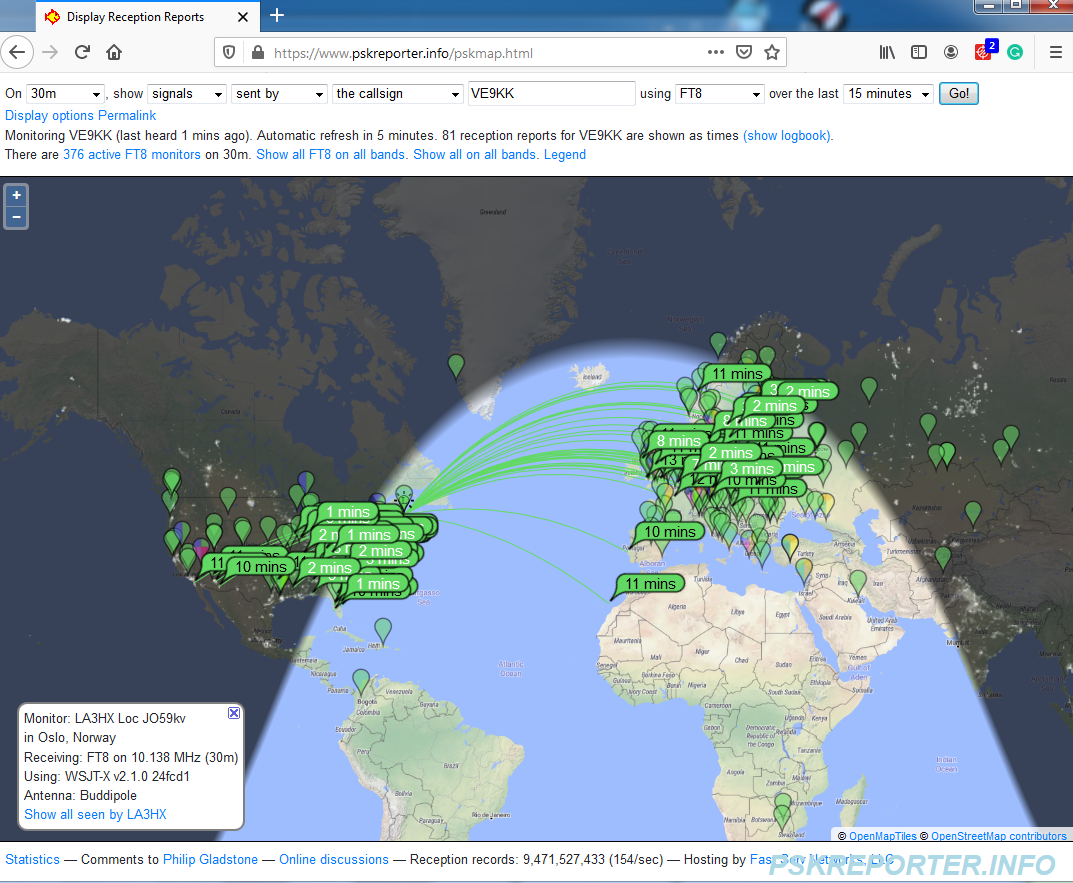
30m FT8
Mike Weir, VE9KK, is a regular contributor to AmateurRadio.com and writes from New Brunswick, Canada. Contact him at [email protected].
 Ham Radio Deluxe |
 W5SWL Electronics |
 Ham Radio Prep |
 KB3IFH QSL Cards  Hip Ham Shirts  HamRadioAuctions HamRadioAuctions Reliance Antennas Reliance Antennas Enigma Shop Enigma Shop |  morseDX  Ni4L Antennas  R&L Electronics R&L Electronics antennas.us antennas.us Ears to Our World Ears to Our World |
- Matt W1MST, Managing Editor
