 |
 ARRL CEO Is Out! YouTubers Bunch #10
 25 February 2020 | by
 A while back, several other Ham Radio YouTubers and myself started these collaboration videos and the feedback we have received on them has been very positive. Thanks to all in the Ham Community who support our efforts.
In this 10th episode of our Collaboration efforts, we talk about the most reent CEO of the ARRL, Howard Michel, WB2ITX, and how his term was so short-lived. I hope you enjoy the episode, feel free to comment below.
[embedyt] https://www.youtube.com/watch?v=ULlSlEQJRQU[/embedyt]
Jason Johnston, KC5HWB, is a regular contributor to AmateurRadio.com and writes from Texas, USA. Contact him at [email protected].
LHS Episode #328: KiCad Deep Dive

Hello and welcome to the 328th episode of Linux in the Ham Shack. In this Episode, the hosts interview Barry Buelow, W0IY, about his experience in engineering, circuit design, PCB design, schematics and the benefits of using the Open Sourcea tool KiCad for drawing, modeling and manufacturing hardware projects. Thanks for listening. We hope you find the information useful and entertaining.
73 de The LHS Crew
Russ Woodman, K5TUX, co-hosts the Linux in the Ham Shack podcast which is available for download in both MP3 and OGG audio format. Contact him at [email protected].
So You Think You Have a Big Antenna
Many hams put up some pretty impressive antenna farms with large towers and big arrays. I have a small tower up at the cabin but it is quite puny (about 30 feet) compared to these more serious stations. I like to check out big antenna installations, especially the big commercial towers, as we travel around the country.
There are quite a few radio towers in the range of 2000 feet (~600 meters), as listed on this Wikipedia page. At 2063 feet, the KVLY-TV mast in North Dakota is the tallest radio mast in the world. The WEAU tower in Wisconsin, listed as 2000 feet, collapsed in 2011 due to a winter ice storm. Pete/WD4IXD recently pointed me to this video that describes how the tower was rebuilt within one year of the failure. Amazing story!
So you may think your antenna is big but it’s probably not 2000 feet tall.
73 Bob K0NR
The post So You Think You Have a Big Antenna appeared first on The KØNR Radio Site.
Bob Witte, KØNR, is a regular contributor to AmateurRadio.com and writes from Colorado, USA. Contact him at [email protected].
Weekly Propagation Summary – 2020 Feb 24 16:10 UTC

Here is this week’s space weather and geophysical report, issued 2020 Feb 24 0149 UTC.
Highlights of Solar and Geomagnetic Activity 17 – 23 February 2020
Solar activity was very low. No active regions with sunspots were observed and no apparent earth-directed CMEs were detected this period.
No proton events were observed at geosynchronous orbit.
The greater than 2 MeV electron flux at geosynchronous orbit reached moderate levels on 17-19 Feb and high levels on 20-23 Feb.
Geomagnetic field activity reached active levels on 18 Feb and active to G1 (Minor) geomagnetic storm levels on 19 Feb. The enhanced geomagnetic field activity on 18-19 Feb were attributed to the passage of a transient solar wind feature. Active conditions were once again observed on 21 Feb due to negative polarity CH HSS influence. Generally quiet or quiet to unsettled conditions were observed throughout the remainder of the week.
Forecast of Solar and Geomagnetic Activity 24 February – 21 March 2020
Solar activity is expected to be very low throughout the outlook period.
No proton events are expected at geosynchronous orbit.
The greater than 2 MeV electron flux at geosynchronous orbit is expected to reach high levels on 24 Feb-01 Mar, 05-09 Mar, and 19-21 Mar. Normal or normal to moderate levels are expected to prevail throughout the remainder of the outlook period.
Geomagnetic field activity is expected to reach active levels on 26 Feb, 04-05 Mar, and 19 Mar due to the infuences of multiple recurrent CH HSSs. Generally quiet or quiet to unsettled conditions are expected to prevail throughout the rest of the outlook period under a nominal solar wind regime.
Don’t forget to visit our live space weather and radio propagation web site, at: http://SunSpotWatch.com/
Live Aurora mapping is at http://aurora.sunspotwatch.com/
If you are on Twitter, please follow these two users: 1. https://Twitter.com/NW7US 2. https://Twitter.com/hfradiospacewx
– – – – – – – – – – – – –
Be sure to subscribe to our space weather and propagation email group, on Groups.io
https://groups.io/g/propagation-and-space-weather
Spread the word!
– – – – – – – – – – – – –
Links of interest:
+ Amazon space weather books: http://g.nw7us.us/fbssw-aSWSC
+ https://Twitter.com/NW7US
+ https://Twitter.com/hfradiospacewx
Space Weather and Ham Radio YouTube Channel News:
I am working on launching a YouTube channel overhaul, that includes series of videos about space weather, radio signal propagation, and more.
Additionally, I am working on improving the educational efforts via the email, Facebook, YouTube, Tumblr, and other activities.
You can help!
Please consider becoming a Patron of these space weather and radio communications services, beginning with the YouTube channel:
https://www.patreon.com/NW7US
The YouTube channel:
https://YouTube.com/NW7US
..
Visit, subscribe: NW7US Radio Communications and Propagation YouTube Channel
Morse Runner can now run on a Mac!
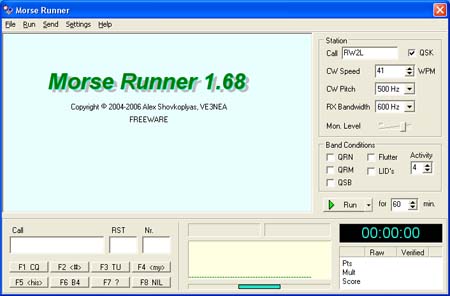
Mike Weir, VE9KK, is a regular contributor to AmateurRadio.com and writes from New Brunswick, Canada. Contact him at [email protected].
LHS Episode #327: The Weekender XLII

It's time once again for The Weekender. This is our bi-weekly departure into the world of amateur radio contests, open source conventions, special events, listener challenges, hedonism and just plain fun. Thanks for listening and, if you happen to get a chance, feel free to call us or e-mail and send us some feedback. Tell us how we're doing. We'd love to hear from you.
73 de The LHS Crew
Russ Woodman, K5TUX, co-hosts the Linux in the Ham Shack podcast which is available for download in both MP3 and OGG audio format. Contact him at [email protected].
Barn Door Wide! Hunting For NDBs In CLE253

This weekend's upcoming CLE event will be the "Barn Door" listening event.
Participants are required to use receivers without the usual narrow filters. Some of the older tube radios can do this easily as can most homebrew receivers ... especially the regens!
If you've never listened to the NDB band with a wide bandwidth, it is a fascinating experience! If conditions are normal, you can typically hear a half dozen or more signals, all at various pitches, vying for your attention. It's almost as if you have plunked yourself down in the middle of the NDB forest of signals, and they are coming at you from all directions.
Many choose to use one of their homebrew receivers for this event, often as simple as a '1AD' or a '1 Active Device' circuit.
From organizer Brian Keyte:
Times: Start at Midday on Friday 21st, your LOCAL time
End at Midday on Monday 24th, your LOCAL time
Frequencies: Centred on 360 kHz (see below)
NDBs: NOT MORE than 100 'normal' NDBs including any UNIDs
(That is not intended to be a target to reach)

Whichever you choose, use the same receiver throughout the CLE.
**************************
These listening events serve several purposes. They:
- determine, worldwide, which beacons are actually in service and on-the-air so the online database can be kept up-to-date
- determine, worldwide, which beacons are out-of-service or have gone silent since the last CLE covering this range
- will indicate the state of propagation conditions at the various participant locations
- will give you an indication of how well your LF/MF receiving system is working
- give participants a fun yet challenging activity to keep their listening skills honed
The NDB List Group is a great place to learn more about the 'Art of NDB DXing' or to meet other listeners in your region. There is a lot of good information available there and new members are always very welcome. As well, you can follow the results of other CLE participants from night to night as propagation is always an active topic of discussion.
You need not be an NDB List member to participate in the CLEs and all reports, no matter how small, are of much value to the organizers.
Remember - 'First-time' logs are always VERY welcome!
Reports may be sent to the NDB List Group or e-mailed to CLE co-ordinator, Brian Keyte (G3SIA), whose address appears above. If you are a member of the group, all final results will also be e-mailed and posted there.
Please ... give the CLE a try ... then let us know what NDB's can be heard from your location! Your report can then be added to the worldwide database to help keep it up-to-date.
Have fun and good hunting!
Steve McDonald, VE7SL, is a regular contributor to AmateurRadio.com and writes from British Columbia, Canada. Contact him at [email protected].
 Ham Radio Deluxe |
 W5SWL Electronics |
 Ham Radio Prep |
 KB3IFH QSL Cards  Hip Ham Shirts  HamRadioAuctions HamRadioAuctions Reliance Antennas Reliance Antennas Enigma Shop Enigma Shop |  morseDX  Ni4L Antennas  R&L Electronics R&L Electronics antennas.us antennas.us Ears to Our World Ears to Our World |
- Matt W1MST, Managing Editor
