 |
 What About the Yaesu FT-4XR?
 5 March 2020 | by
  A few years ago, the Baofeng UV-5R set a new price point for an entry-level handheld transceiver and quickly became the “easy choice” for a newly licensed Technician. It is a very impressive piece of technology for the money (about $30).
However, it is well known that the UV-5R struggles to meet the FCC Part 97 emission requirements. The ARRL lab has published the results of testing a large number of the Baofeng radios and many of them do not meet the FCC spec. Also, the receiver performance is not that great, primarily with respect to adjacent channel and out-of-band rejection. In other words, it is easily overloaded by strong radio signals.
In response, Yaesu created a low-cost radio using similar technology as the UV-5R but with (supposedly) higher quality. This radio escaped my attention when introduced but some recent reviews caught my eye. In particular, the QST review of the radio includes a detailed lab test report. (The ARRL does a good job with these test reports.) The review basically says that this radio performs well, especially considering its price class. The price of the radio is currently about $70, so it is more expensive than the UV-5R, but under $100.
Evaluating the FT-4XR
So I went ahead and purchased an FT-4XR to try it out for myself. The main question on my mind is should I recommend the FT-4XR as a good choice for a new radio amateur. I am a license class instructor for our radio club (W0TLM), so I often encounter new hams that are looking for advice on what radio to buy.
My general impression of the FT-4XR is that it looks and feels like a quality product, giving a better first impression than the Baofeng. It fits nicely in my hand and just felt good.
The usability of the FT-4XR is on par with the Baofeng, but a notch down from something like a Yaesu FT-60. In particular, the FT-4XR loads up the keys with multiple functions: press quickly for one function, press and hold for another function, use the “function shift” key for a third function. Yikes! None of this is labeled so you have to memorize all of this or carry a quick reference card with you. Not a huge problem because these are mostly features that are not used frequently or maybe not at all. This means that the FT-4XR is a radio that needs to be set up via programming software to get the desired memories in place. Then, you just choose the right memory / channel. Not any worse than the Baofeng and similar to many, many radios on the market these days.
The standard FT-4XR manual is adequate but not great. There is an “advanced manual” available on the Yaesu.com web site that may help. The USA version of the radio does not allow transmit outside of the ham bands. This is probably a good thing, especially for a new user. Some people may see this as a disadvantage compared to the Baofeng, which usually transmits over a wider range of frequencies.
Transmitter Harmonics
I trust the ARRL lab tests but I wanted to measure the transmitter to see the harmonic performance up close and personal. The spectrum analyzer measurement below shows the transmitter with very clean harmonics on 2m, just as I would expect from Yaesu. If you look carefully, you can see a tiny third harmonic just poking up out of the noise floor. (Sorry about the poor graphics, I just took a quick photo of the screen using my phone.)

The 70 cm harmonic performance is also very solid, as shown below.

I also checked the power output, transmit frequency, FM deviation and receiver sensitivity on both bands. Very solid performance. Again, nice job, Yaesu!
Yaesu Inconsistency
One thing I found disappointing is that the radio operation and accessories are not consistent with other Yaesu radios. I’ve got a decent collection of Yaesu handhelds, speaker/microphones, antennas, programming cables, etc. None of these work with the FT-4XR. In particular, the FT-4XR uses the male SMA connector (same as Baofeng) and requires a new type of programming cable. However, for the first-time buyer, this doesn’t matter and it is no different than buying a Baofeng.
Some other reviews that you may want to consider:
Recommendations
Back to the main question:
Do I recommend the FT-4XR as a good choice for a new radio amateur?
The answer is YES, this is a better radio than the Baofeng UV-5R and it actually meets FCC Part 97 requirements. If you are considering the UV-5R, scrape up a few more bucks and get the FT-4XR.
If you want an even better radio, I’d suggest moving up to something like the tried and true Yaesu FT-60, about $160. It has a more robust receiver and is easier to use.
The post What About the Yaesu FT-4XR? appeared first on The KØNR Radio Site.
Bob Witte, KØNR, is a regular contributor to AmateurRadio.com and writes from Colorado, USA. Contact him at [email protected].
Attracting Youth to Ham Radio: Get Out of Their Way!
Amateur radio has a demographic problem. In the U.S., there is a clear belief that members of the hobby are old. And getting older. What that means in actual age distribution just isn’t known. Unfortunately, our “visions of gray” are based not upon accurate scientific measurement but on the assembled impressions we get through our personal “windshields” as we go about our daily travels. It’s standard convention to hear us hams urge everyone in hearing or reading range: we need to get more young people into amateur radio!
But whose amateur radio? The extant one driven by us largely gray-haired middle-aged to geezer-dom adult (men)? Yep, that’s the one generally being referred to in this wisdom. Our collective strategy amounts to getting them to come to “us.” How’s that working out for us? Given that our knickers are a bit tangled up over the issue, I’d say not so good.
Lee Corso, the curmudgeonly ESPN television sports announcer, is famous for his Not So Fast! comment when he questions another view or approach to the featured college football game being broadcast. Our attempts to bring new, young hams to our clubs is, in principle, admirable and understandable. But how is that working? Imagine a hobby dominated by young people. Say, competitive eSports (video games). We geezer-dom adults are approached to come to a teen-driven club, learn about it, and then join to continue to attend each month. How many readers would find that appealing? I’d bet not that many.

My recent interview in Episode 319 of the ICQ Podcast with Graham Brody KD9NTQ illustrates the clear market failure that this singular “come to us” approach has yielded. Graham’s interview suggests that while this is a good outreach program for many young prospective hams, it’s not enough to engage them broadly. And, it simply does not reach the market where the most likely candidates are socially engaged. Instead, Graham says help them get started…and get out of their way!
Graham KD9NTQ started the Illinois Young Ham Club to engage young people to converse about ham radio and grow into the hobby. We should listen to him and learn what one approach is to do what we collectively tell one another must happen. Talk is cheap. The walk, well, is just more effort. I’ll let you listen to my interview with him for the nuances of the details. But here are some bullet points that are take-away strategies.
- Do encourage young people to get involved with adult-driven ham clubs. But then encourage, sponsor and assist them to create their own youth-driven groups. Get out of their way but be available to help when called upon!
- Rich environments for exposing young people, both male and female, to amateur radio lie in Maker Spaces and Gamer Groups. Seek out, especially, maker spaces which tend to be advertised in local communities. Clubs should offer to give a demo—not longer than 30 minutes—without a lecture but with an actual demonstration of amateur radio operations.
- ARRL and RSGB should “tag” youth-driven or youth-oriented clubs in their Find-A-Club databases. Graham found the North Shore ARC in the Find A Club database. The Illinois Young People Ham Club, for instance, should be tagged as a youth club as should any others. ALL ARRL-affiliated clubs should report annually the number of members who are less than 25 years of ago so the League can track them. This should be a bench-mark metric to gauge progress in recruiting youth into amateur radio and the League itself. (To my knowledge, the ARRL is doing nothing released publicly to track youth members or contacts.)
- ARRL should offer a “build a club” set of actions to help young inquirers to the League start their own club. They will want to engage with others of a similar age range, Graham says, and the League should explicitly foster that activity, perhaps matching them with an existing adult-driven club for assistance. Be there if asked but get out of their way when they are enjoying the hobby! Walking the walk here as the League has already been talking the talk.
- Should the ARRL and RSGB buy adverts (or give ad swaps) in gaming magazines, promoting ham radio contesting as a greater challenge? Yes! Track the “how did you find out about us” using conventional “use this code” tags in the adverts. If one thinks they’ll just run across QST at their local Barnes & Nobles, they are very sadly mistaken. Graham bumped into ham radio on Youtube!
- Help them get launched. Get out of their way. They will grow into mid-adulthood and join our extant adult-driven clubs. Plant the seed. And get out of their way!
It is unfortunate that many organizations are heavily imbued with a “not invented here” mindset. That is challenging for outsiders to the inner circle of power to break through. See the thread and comment by W9WHE on eHam.net regarding the ARRL, for instance. There are many other examples of this opinion regarding the League. I suppose similar comments could be made about the RSGB, of which I am also a member. But whether “invented” by the central staff or Board of either organization, this teenager has given us a general road map to reaching young people, both boys and girls, similar to him: interested in technology but had to run across something called “amateur radio” on YouTube rather than the explicit efforts of the League. Quit talking without walking.
Graham’s a leader at age 15 already, just won his Extra license, and clearly has an understanding of many of these issues. We have to resist the conjuring up of all the reasons of why they won’t work from a geezer-dom world view. Well, a guy like me can dream, right?
Frank Howell, K4FMH, is a regular contributor to AmateurRadio.com and writes from Mississippi, USA. Contact him at [email protected].
LHS Episode #329: The Third Dimension
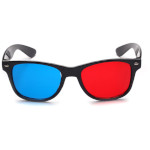
Welcome to the 329th episode of Linux in the Ham Shack. In this short topics episode, the hosts discuss the Coronavirus and Hamvention, open positions at the ARRL, Kubeflow, LineageOS, SRain, Sweet Home 3D and much more. Thank you for listening and hope to see you all in Xenia this May.
73 de The LHS Crew
Russ Woodman, K5TUX, co-hosts the Linux in the Ham Shack podcast which is available for download in both MP3 and OGG audio format. Contact him at [email protected].
Weekly Propagation Summary – 2020 Mar 02 16:10 UTC
Here is this week’s space weather and geophysical report, issued 2020 Mar 02 0510 UTC.
Highlights of Solar and Geomagnetic Activity 24 February – 01 March 2020
Solar activity was very low over the period under a spotless solar disk. No Earth-directed CMEs were observed.
No proton events were observed at geosynchronous orbit.
The greater than 2 MeV electron flux at geosynchronous orbit was at normal to moderate levels on 24-25 Feb, 27 Feb, and again on 29 Feb-01 Mar. High levels occurred on 26 and 28 Feb with a peak flux of 2,170 pfu observed at 26/1950 UTC.
Geomagnetic field activity ranged from quiet to active levels over the period. Solar wind parameters were at nominal levels from 24 Feb through early on 28 Feb. At 28/0650 UTC total field began to increase to around 8 nT while the Bz component became variable between +/-7 nT. Solar wind speed initially increased to 503 at 29/0248 UTC before increasing a second time to 573 km/s at 29/1942 UTC. This increase in solar wind parameters was due to a connection to a negative polarity southern crown coronal hole high speed stream (CH HSS) followed by a connection with an isolated negative polarity CH HSS. The geomagnetic field responded with quiet levels on 24-28 Feb and quiet to active levels on 29 Feb-01 Mar.
Forecast of Solar and Geomagnetic Activity 02 March – 28 March 2020
Solar activity is expected to continue at very low levels.
No proton events are expected at geosynchronous orbit.
The greater than 2 MeV electron flux at geosynchronous orbit is expected to reach moderate levels on 02-03, 10-18, 22-28 Mar. High levels are expected on 04-09 and 19-21 Mar due to CH HSS influence.
Geomagnetic field activity is expected to increase to unsettled levels on 02-07, 18-20, 27-28 Mar with active periods likely on 02, 19, 27-28 Mar due to CH HSS activity.
Don’t forget to visit our live space weather and radio propagation web site, at: http://SunSpotWatch.com/
Live Aurora mapping is at http://aurora.sunspotwatch.com/
If you are on Twitter, please follow these two users: 1. https://Twitter.com/NW7US 2. https://Twitter.com/hfradiospacewx
– – – – – – – – – – – – –
Be sure to subscribe to our space weather and propagation email group, on Groups.io
https://groups.io/g/propagation-and-space-weather
Spread the word!
– – – – – – – – – – – – –
Links of interest:
+ Amazon space weather books: http://g.nw7us.us/fbssw-aSWSC
+ https://Twitter.com/NW7US
+ https://Twitter.com/hfradiospacewx
Space Weather and Ham Radio YouTube Channel News:
I am working on launching a YouTube channel overhaul, that includes series of videos about space weather, radio signal propagation, and more.
Additionally, I am working on improving the educational efforts via the email, Facebook, YouTube, Tumblr, and other activities.
You can help!
Please consider becoming a Patron of these space weather and radio communications services, beginning with the YouTube channel:
https://www.patreon.com/NW7US
The YouTube channel:
https://YouTube.com/NW7US
..
Visit, subscribe: NW7US Radio Communications and Propagation YouTube Channel
North and South Carolina QSO parties are in the books.
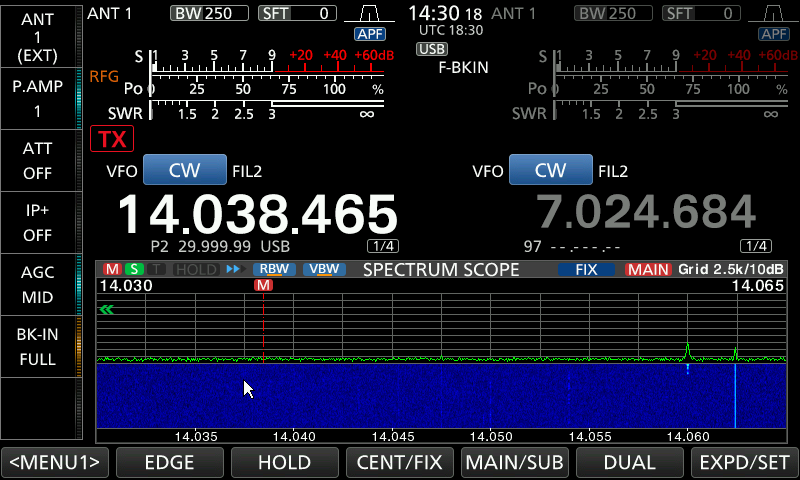 |
| Not much action during the contest. |
Well it's Saturday morning and I am on the air both on 20m and 40m and I am just not hearing much action for the South Carolina QSO party. The UBA CW contest is going strong with DX into VE9KK. All was not lost I was able to make 4 contacts in the South Carolina contest on Saturday for a score of 4 QSO's for a score of 274. On Sunday there were either more North Carolina stations in the contest or conditions were just a little bit better as I was able to make 9 QSO's for a score of
316.
Mike Weir, VE9KK, is a regular contributor to AmateurRadio.com and writes from New Brunswick, Canada. Contact him at [email protected].
ICQ Podcast Episode 319 – Launching the Illinois Young Ham Club
In this episode, Martin M1MRB is joined by Leslie Butterfield G0CIB, Edmund Spicer M0MNG and Dan Romanchik KB6NU to discuss the latest Amateur / Ham Radio news. Colin M6BOY rounds up the news in brief and this episode’s feature is - Launching the Illinois Young Ham Club and a report from the BRATS Rally.
ICQ AMATEUR/HAM RADIO PODCAST DONORS
We would like to thank our monthly and annual subscription donors for keeping the podcast advert free. To donate, please visit - http://www.icqpodcast.com/donate
- Successful 47 GHz Ham Radio Moon Bounce Test
- Amateur Radio Operating Procedures
- British Radio Antenna Arrives at Space Station
- Spy Radio Found During Archaeological Dig
- SOTA Flavours Challenge DV Week 1-7 March 2020
- ICQPodcast's Ruth on Air
- UK 5 MHz Beacon to Close
- ISWL Callsigns for March 2020
- Distracted Driving Regulations in Canada Update
Colin Butler, M6BOY, is the host of the ICQ Podcast, a weekly radio show about Amateur Radio. Contact him at [email protected].
Here Comes The Novice Rig Roundup (NRR) 2020!
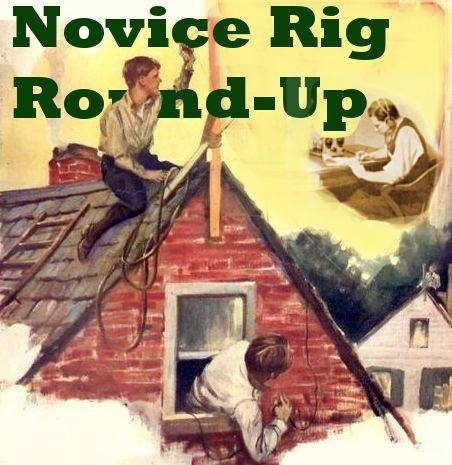
One of the most enjoyable operating events of the year is fast approaching -- the Novice Rig Roundup or 'NRR'. Technically, it is a contest, but I have the feeling that most participants think of it as just a lot of fun and a nice opportunity to hear and work some of the great old 'classics' of the past -- rigs that were used when they were teenage Novices or rigs that they could only drool about owning, back in those formative years when they each discovered the magic of radio.
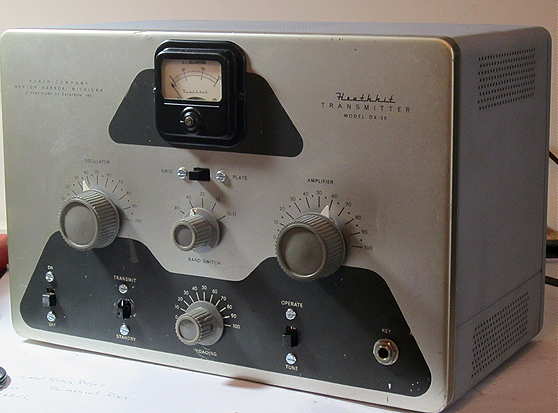
The dates to remember are 0000 UTC March 7 to 2359 UTC March 16 and this multi-day opportunity is, for me, what makes the NRR so enjoyable. With a nice diversion from the usual 'contest frenzy' associated with standard weekend operating events, the NRR can be enjoyed throughout the week, whenever you choose to participate. If last year's operating patterns continue, you should find activity at any time of the day ... and even more as sunset arrives.
With the fast-approaching solar minimum, we will be hard-pressed to relive the glory days of worldwide 15m propagation, but many transcon contacts were made during last year's event thanks to some well-timed solar activity! With a little luck and, hopefully, a well-timed solar flare, we may get lucky! If you operate during the daylight hours, please get on 15m and give it a shot ... and be sure to announce your activity on the NRR's sked and chat page here, so that others will know where to find you, especially if you are rock bound in true Novice fashion. With our present spotty conditions, we need all the help we can get and the sked page proved a very valuable asset during last year's affair.
Although technically not required, if you plan to participate it's best to obtain your own NRR number, which is an easy 30-second process.
Additionally, there is an online logger where participants can post their daily log. The nifty logger also keeps track and figures out your score as it goes and no 'after contest' log needs to be submitted. If you plan on submitting a log, the logger is a requirement. The logger will also require you to set up a 'log-in' and once again, a simple 30-second process will take care of that from here. If you used the logger last year, you will have to set it up again for this year as the old system has been changed.
Stations may run either crystal-control or VFO or can switch between either method ... the online logger will keep track and score things appropriately.
All of the rules and information can be found on the NRR's excellent website. As well, the soapbox comments and station pictures from last year's NRR may provide the inspiration that you need to spark-up your own activity in this year's event ... from what I can tell, this year will be bigger and busier than ever!
There is also a dedicated NRR Group, often the source of much valuable discussion but there is a now HUGE group of great NRR chat and activity now on Facebook's NRR Group here. I avoided Facebook for many years and have now discovered that it is an excellent forum for real time chat and information exchange ... one can still choose to maintain a very low profile and avoid unwanted interaction if set up correctly.
In 2017 I ran my homebrew Longfeller in the (now eliminated) QRP category, and had a ton of fun. You can read about it here. Last year, I refurbished a nice Drake 2NT that had been gathering dust in the basement for over 25 years and ran it during the 2018 NRR. You can read about my activity and some of the rigs encountered during last year's fun here.
If you have access to the web while operating, be sure to bookmark and check into the NRR's realtime chat page. Many ops that are crystal controlled will announce their operating frequencies, making it easier for you to find them ... sometimes way up or down from the normal NRR watering holes of ~ 3550 - 3650 kHz, 7100 -7125 kHz, 21.100 - 21.150 MHz and 28.114, 28.120 MHz ... and don't forget to check the colorburst crystal frequency of 3579!
'CQ'ers should always remember to tune up and down the watering hole for replies from other NRR stations that may be crystal controlled and not able to answer you on your own frequency!! This is extremely important and a real reminder of what was common practice back in the Novice days.
 |
| courtesy: Harry - VE7AIJ |
You still have time to get that old clunker on the air but if that's not possible, you can join the fun with your modern rig as well ... all are welcome to jump in and have a great week of radio-fun. I think you will be surprised, just as I was last year, how good some of these old classics can sound ... and you'll hear some great bug-fists as well.
Need more inspiration? ... here's a summary of my own experience of the 2018 NRR:
***********************
The NRR once again provided many notable highlights over the nine day event.
Almost topping the list was just experiencing the variety of old classics and hearing how well almost all of them sounded. Numerous Knight T-60s, Drake 2NTs, Heath DX-40s, Johnson Adventurers and Eico 720s, along with a nice variety of homebrew MOPAs and one-tube power oscillators graced the nightly airwaves. These oft-forgotten shelf-queens always seem to develop super-powers, far beyond their expectations, when the NRR rolls around!
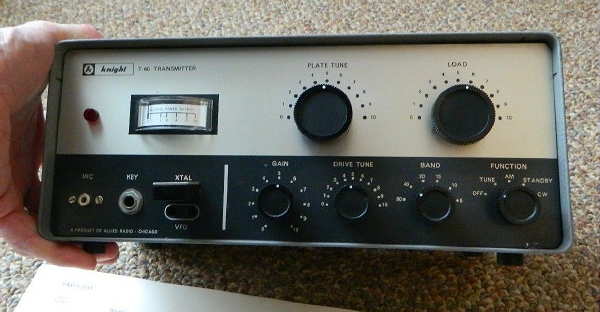
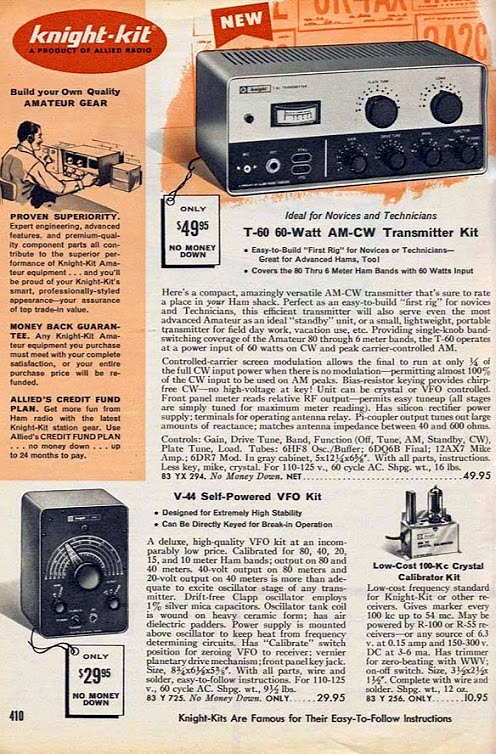
I was really surprised to work so many T-60s, a small and inexpensive 60 watt transmitter kit from 1962 using a popular 6DQ6 television sweep tube ... one never expected to achieve such RF greatness! I was very impressed with every one that I heard.
What radio-struck pre-Novice teen, dreaming about getting on the air, could resist a clever ad like this.
Scott, KA9P's 80m T-60 signal sounded as sweet as it looks in his 2018 setup, paired with his Heathkit HR-10B inhaler.
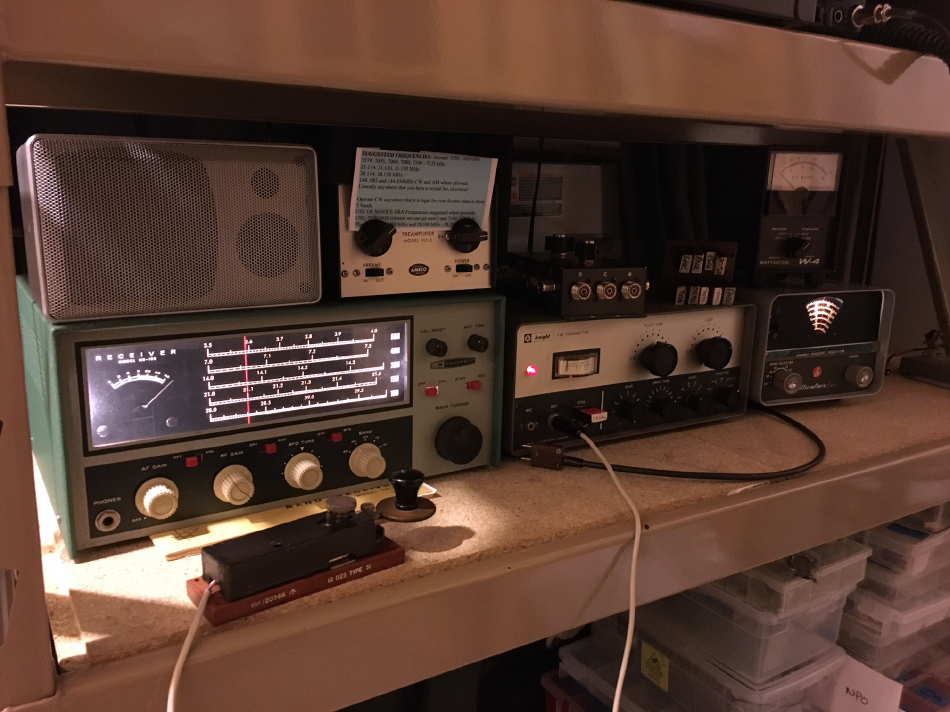 |
| KA9P 2018 NRR station with RAF Vulcan bomber Type 51 hand pump |
Right up there with the plethora of T-60s was the Drake 2NT, another great sounding radio and also my choice for this year's event. My summer refurbishing project, described here, proved a worthy companion, although my much-treasured VF-1 VFO's short term drift probably had my 2NT getting red in the face whenever I took her off of crystal control to scurry around the band, seeking out the CQ'ers. I've had a love-hate relationship with the VF-1 ever since buying my first one back in '63!
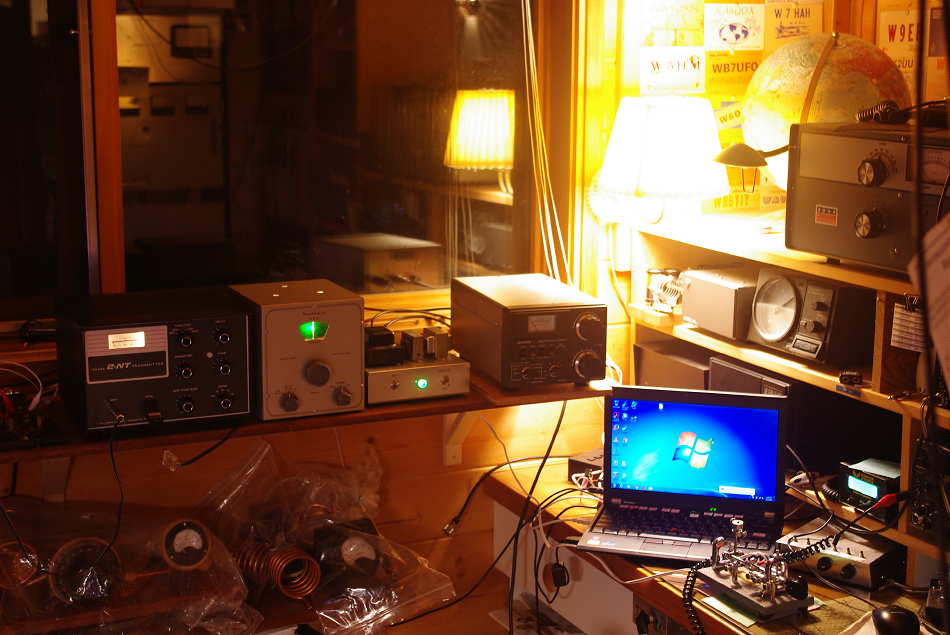 |
| VE7SL 2018 NRR with 2NT, VF-1 and my Original '63 Vibroplex |
Yet another 2NT packed a powerful punch from West Virginia, keyed by Dave, W3NP, when we exchanged 579 reports on 40m, 45 minutes before sunset.
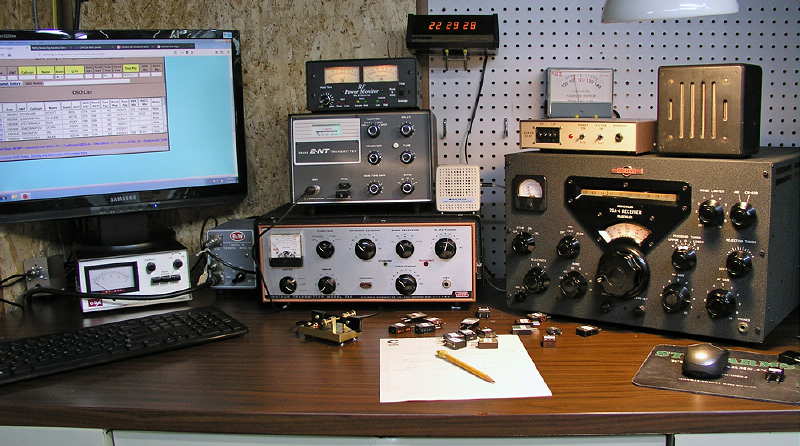 |
| W3NP - 2018 NRR setup |
I made three contacts on 15m this year: W5IQS in Texas, K2YWE in Maryland and WN4NRR in Florida, whose S9 reply to my 'CQ NRR' just about took my head off ... what a nice surprise to hear the booming signal from Bry's 2NT powerhouse. Dan, K2YWE, was no slouch either, as his Globe Scout was music to my ears when his signal quickly rose out of the noise just long enough to make the coast-to-coast journey. If the predictions for future solar cycles become reality, there may be many more NRRs before we experience the magic of 15m once again.
 |
| K2YWE's Globe Scout and Adventurer were worked on all three bands! |
My NRR exchanges with George, N3GJ (KA3JWJ) in Pennsylvania, truly demonstrated just how well the low bands were performing. More than an hour before my local sunset, I responded to his 569 40m 'CQ NRR' only to learn that his signal, now reaching a solid 579, was coming from an original Ameco AC-1! This one-tube crystal-controlled power oscillator has, over the years, reached Holy Grail status among many amateurs. Originals are guarded like precious jewels and handed down from father to son ... or in George's case, from uncle to nephew!
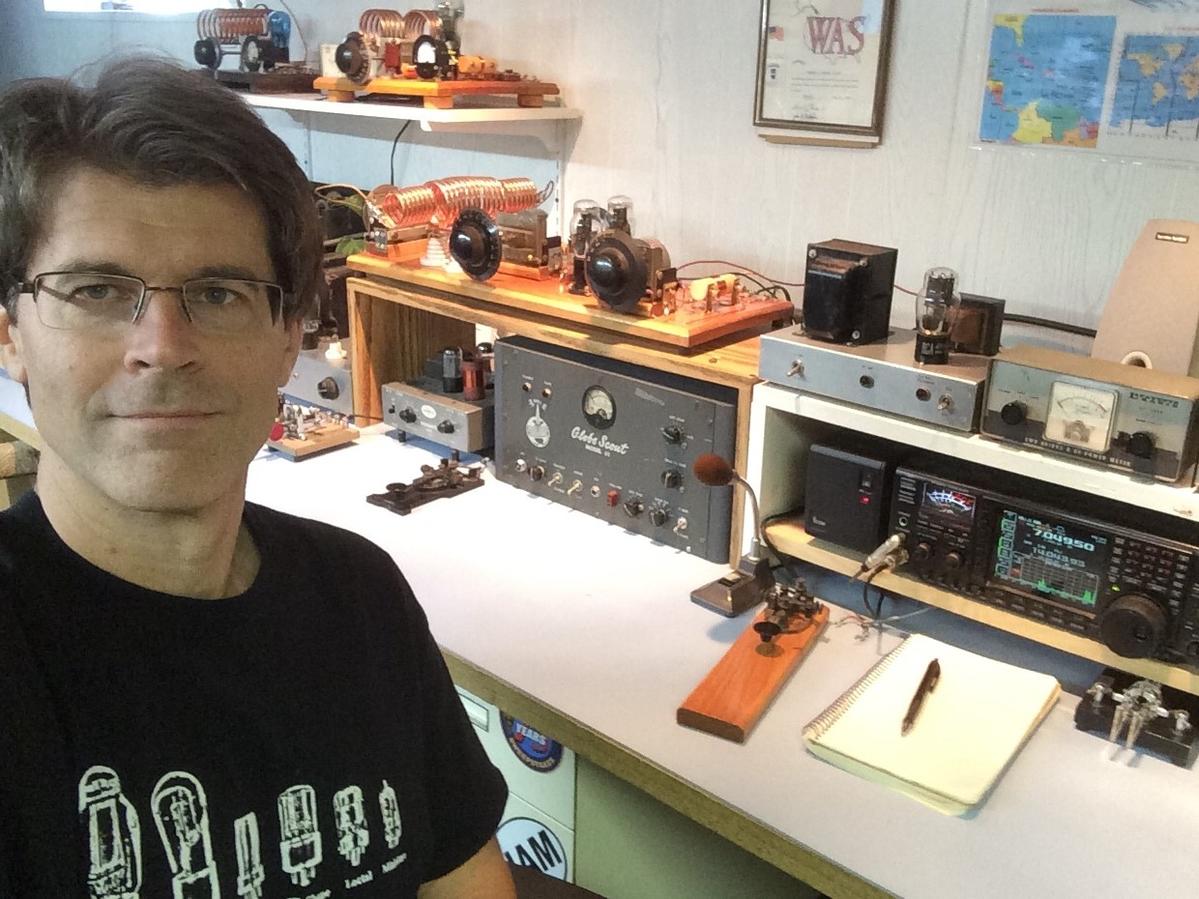 |
| N3GJ and his all powerful original AC-1 |
Heathkits were plentiful too, with the DX-60 seeming to be the rig of choice, often paired with the matching HG-10 VFO. Both Mark, VA7MM and Gary, W8PU, packed a wallop with these fine examples.
 |
| VA7MM - 2018 NRR set-up |
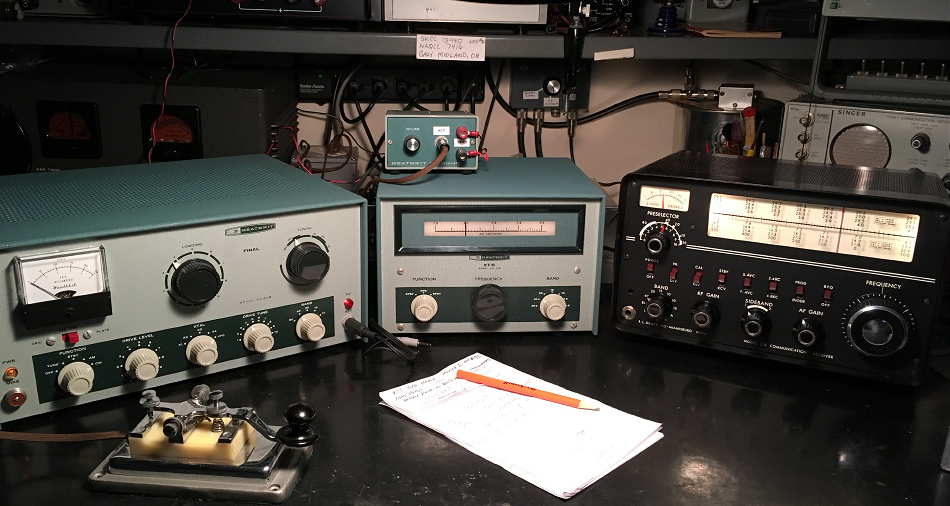 |
| W8PU - 2018 NRR set-up |
But it wasn't just DX-60s representing Benton Harbor engineering in the NRR. All of these neat old Heaths made it out to the west coast, sometimes on both 40 and 80. KN8RHM's (Rick) HW-16 made it here on 40m with a solid signal almost every night, while KE4OH (Steve) sported a modernized DX-20 in the form of Heath's HX-11. Steve even received the highly-treasured 'OO' report for his NRR chirp ... good job!
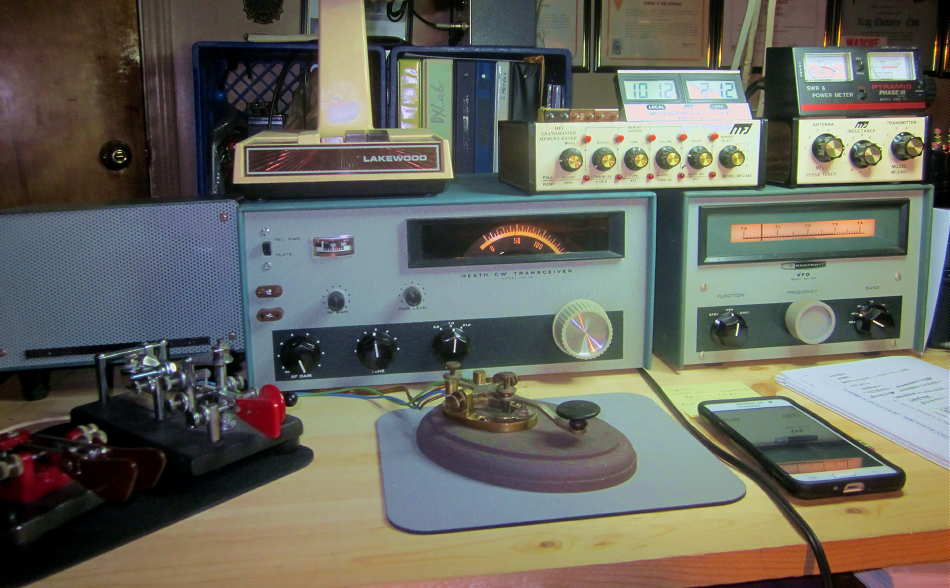 |
| KN8RHM - HW-16 NRR set-up |
 |
| KE4OH - HX-11 NRR station |
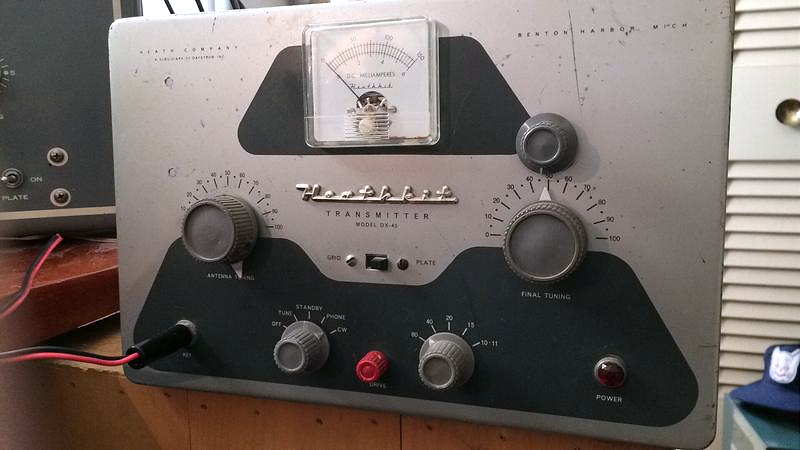 |
| N3PDT - DX-40 NRR transmitter |
Rich, WN7NRR / AG5M operating in nearby Washington state put some of his 44 crystals to work with his HW-16 ... that's some collection!
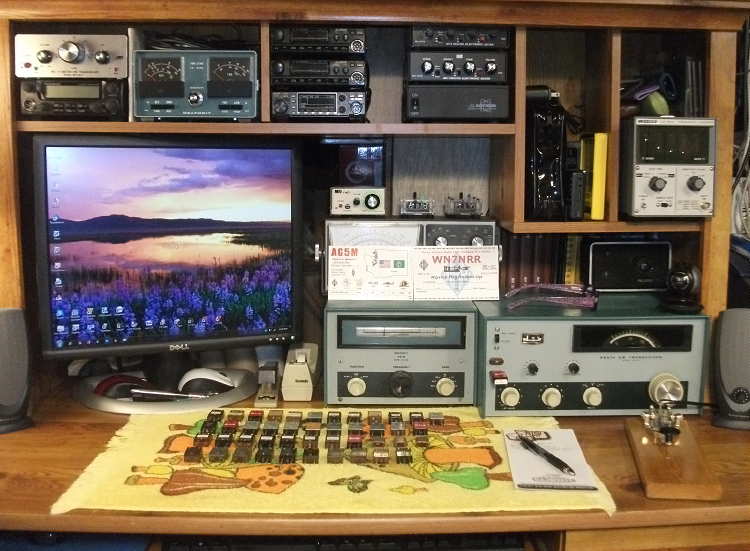 |
| WN7NRR - HW-16 NTT set-up |
Howie, WB2AWQ in Reno, was using his homebrew pair of 807s, driven with a Millen 90700 swing-arm VFO from 1945. Most shacks worldwide, including the Novices, found plenty of use for the 807 as they were dirt-cheap in the post war surplus market. The filament has a beautiful illumination and if a bit gassy as most are by now, emit a wonderous blue glow with each press of the key.
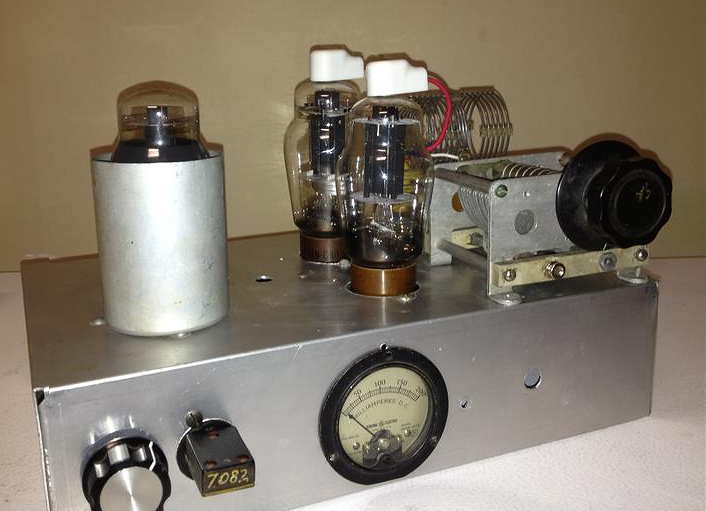 |
| WB2AWQ - 807s |
 |
| Millen VFO from 1945 at WB2AWQ |
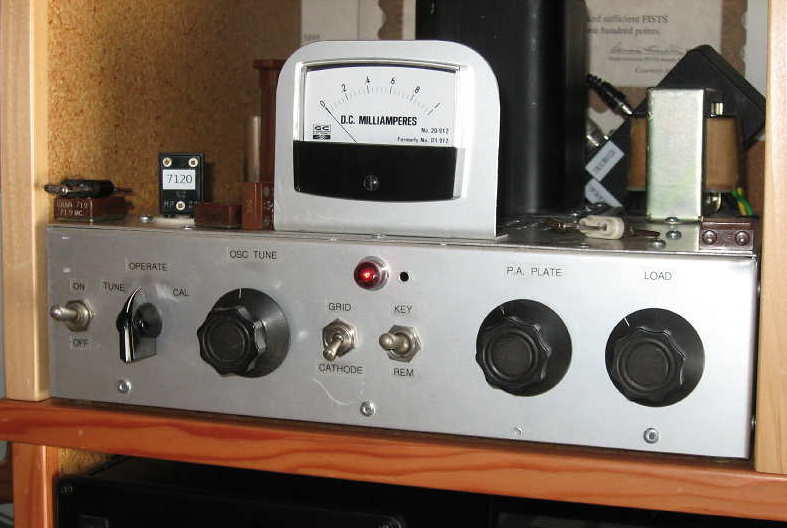 |
| KD7JG's 1625 NRR mainstay |
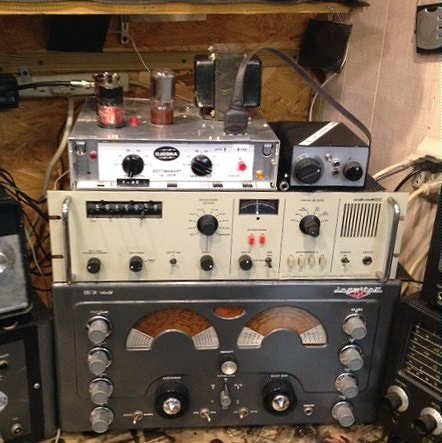 |
| K4IBZ's 10 watter |
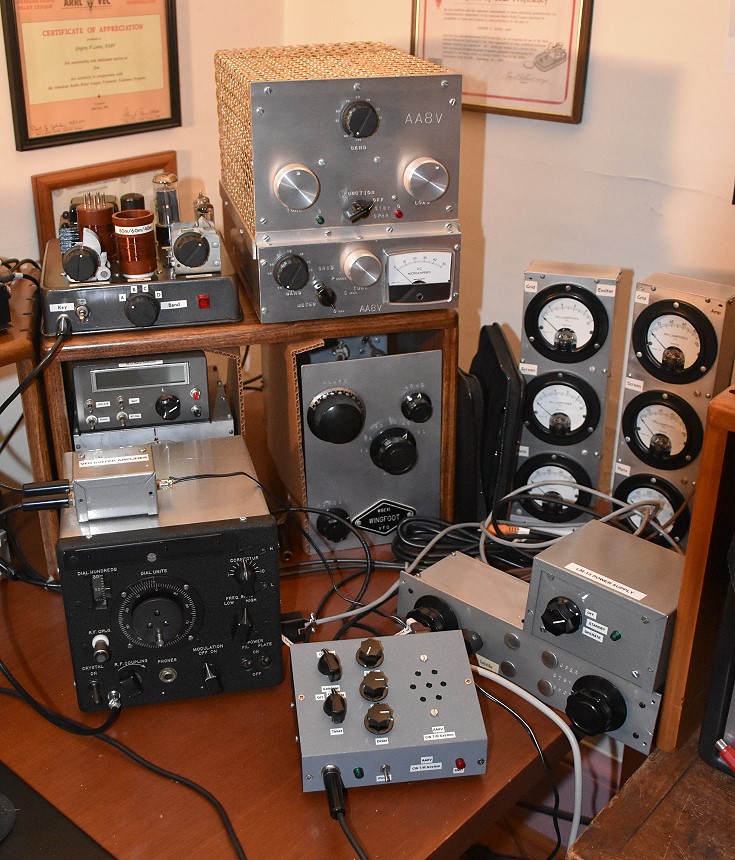 |
| AA8V's homebrew NRR stack |
 |
| VE3BDV / VE3AWA - 50C5 Bare - Essentials power oscillator |
I finished up the NRR with 123 contacts, a lot better than last year's event when I was running the Longfeller at 5 watts.
As indicated on the NRR website, this is "more of an EVENT than just a typical contest ... once again taking our OLD ham radios off the shelf and putting them to use again! "
See you in the 2020 NRR!
Steve McDonald, VE7SL, is a regular contributor to AmateurRadio.com and writes from British Columbia, Canada. Contact him at [email protected].
 Ham Radio Deluxe |
 W5SWL Electronics |
 Ham Radio Prep |
 KB3IFH QSL Cards  Hip Ham Shirts  HamRadioAuctions HamRadioAuctions Reliance Antennas Reliance Antennas Enigma Shop Enigma Shop |  morseDX  Ni4L Antennas  R&L Electronics R&L Electronics antennas.us antennas.us Ears to Our World Ears to Our World |
- Matt W1MST, Managing Editor
