 |
 Weekly Propagation Summary – 2020 Apr 06 16:10 UTC
 6 April 2020 | by
Here is this week’s space weather and geophysical report, issued 2020 Mar 30 0104 UTC.
Highlights of Solar and Geomagnetic Activity 23 – 29 March 2020
Solar activity was very low throughout the period. No active regions with sunspots were observed and no earth-directed CMEs were detected.
No proton events were observed at geosynchronous orbit.
The greater than 2 MeV electron flux at geosynchronous orbit reached high levels on 23-26 Mar and moderate levels were observed on 27-29 Mar.
Geomagnetic field activity was at quiet or quiet to unsettled levels throughout the period.
Forecast of Solar and Geomagnetic Activity 30 March – 25 April 2020
Solar activity is expected to be very low throughout the outlook period.
No proton events are expected at geosynchronous orbit.
The greater than 2 MeV electron flux at geosynchronous orbit is expected to reach high levels on 19-22 Apr, and normal to moderate levels are expected to prevail throughout the remainder of the outlook period.
Geomagnetic field activity is expected to reach active levels on 30-31 Mar due to CH HSS influence. Generally quiet or quiet to unsettled conditions are expected to prevail throughout the remainder of the outlook period.
Don’t forget to visit our live space weather and radio propagation web site, at: http://SunSpotWatch.com/
Live Aurora mapping is at http://aurora.sunspotwatch.com/
If you are on Twitter, please follow these two users: 1. https://Twitter.com/NW7US 2. https://Twitter.com/hfradiospacewx
– – – – – – – – – – – – –
Be sure to subscribe to our space weather and propagation email group, on Groups.io
https://groups.io/g/propagation-and-space-weather
Spread the word!
– – – – – – – – – – – – –
Links of interest:
+ Amazon space weather books: http://g.nw7us.us/fbssw-aSWSC
+ https://Twitter.com/NW7US
+ https://Twitter.com/hfradiospacewx
Space Weather and Ham Radio YouTube Channel News:
I am working on launching a YouTube channel overhaul, that includes series of videos about space weather, radio signal propagation, and more.
Additionally, I am working on improving the educational efforts via the email, Facebook, YouTube, Tumblr, and other activities.
You can help!
Please consider becoming a Patron of these space weather and radio communications services, beginning with the YouTube channel:
https://www.patreon.com/NW7US
The YouTube channel:
https://YouTube.com/NW7US
..
Visit, subscribe: NW7US Radio Communications and Propagation YouTube Channel
LED Lights In The Shack
 |
| Utilitech Pro Soft White LED Bulb |
A recent posting by Phil, KO6BB, to Yahoo Group's ndblist, described his recent search for some LED lamps to replace the CFL's in his shack / radio workbench area. If you have been wondering how much RFI that LED lamps might be producing, you may find Phil's findings of some value.
"Recap
I had a 60W equivalent CFL in the floor lamp directly over my operating position. I'd tried a 100W equiv one but it was extremely noisy! Also a couple CFLs in the ceiling lamp.
This is a floor lamp with a crookneck at the top and a triangular metal
shade reminiscent of the old style desk lamps, bulb is horiz to the
floor. I've used it for years and like it because it places the light
directly over the operating position work area (keyboard, radios etc).
The actual bulb was about 4.5 inches from the front of the Softrock SDR
receiver (in a plastic case), with the base of the lamp (where the
electronics are) about 7.5 inches (somebody asked about the distances).
This coupled a LOT of RFI directly into the SDR, visible on the
waterfall. For best results when recording and having the light on I'd
slip a 60W incandescent lamp in place of the CFL. The lamp is also
about 16 inches above the operating table, and when listening to ANY
portable radio on the table, if it was in the AM or Longwave band and
using the built in loopstick antenna, got a LOT of RFI from the lamp
(unless the lamp was off ;-)
So today I went down to Lowes (we have a Costco, but I don't have a
card) and looked at their LED lamp offerings. As I expected they had a
large variety of them, from a low cost 3 pack for ~$9.00 for 60W units
to about $18.00 or so each (Sylvania). From what I read here I wanted
to avoid the REALLY cheap ones as some reported them to be 'noisy'.
Also, I wanted to put a 75W equivalent unit in the one over the
operating position, and a pair of 100W equivalent units in the ceiling
lamp. All three had CFLs, and if I walked around the radio room with a
portable radio and the ceiling lamp on I could hear it's 'hash' anywhere
in the room. . .
The ones I settled on were a brand I'd never heard of, "UtiliTech Pro"
soft white, 75W for the bench and 2 100W ones for the ceiling. They
were what I'd call "mid-priced", $8.98 for the 75W and $9.98 for the
100W ones.
Specs:
75 W one draws 12W and gives 1100 Lumens.
100W one draws 16.5W and gives 1600 Lumens (the pair in the ceiling
should then be 3200 Lumens if I calculated right).
How low is the RFI to my Radios?
75W one over the bench:
NO trace from the lamp electronics visible in the SDR waterfall at
all. With a portable radio on the bench-top, NO audible RFI. Put a
portable radio up to the "bulb" part (light area) and with no station
tuned in can't hear ANY RFI. Move the portable to the base area of the
lamps there is SOME RFI, but I won't be putting the radio that close to
the lamp, move it a couple inches away and the noise disappears.
100W ones in the ceiling lamp, NO audible RFI in the portable when
walking around the room, RFI just barely perceptible right next to the
light wall switch that turns the lamp on, again, audible IF I put the
radio right up to the base of the lamps, not a likely real-world scenario!
Upshot?
Based on the sample of three that I bought and the almost
non-existent RFI from them I'd consider the UtiliTech Pro lamps to be a
good product and suitable for use in the radio room. I consider them
good value for the ~$30.00 I spent for three."
If you have tested anything similar (other brands / models), please let me know and I will add it to Phil's helpful information.
KO6BB's website can be found here, along with some of his homebrew equipment.
Steve McDonald, VE7SL, is a regular contributor to AmateurRadio.com and writes from British Columbia, Canada. Contact him at [email protected].
LHS Episode #336: The Weekender XLV

It's time once again for The Weekender. This is our bi-weekly departure into the world of amateur radio contests, open source conventions, special events, listener challenges, hedonism and just plain fun. Thanks for listening and, if you happen to get a chance, feel free to call us or e-mail and send us some feedback. Tell us how we're doing. We'd love to hear from you.
73 de The LHS Crew
Russ Woodman, K5TUX, co-hosts the Linux in the Ham Shack podcast which is available for download in both MP3 and OGG audio format. Contact him at [email protected].
CWops club
 |
| CW ops in action |
Mike Weir, VE9KK, is a regular contributor to AmateurRadio.com and writes from New Brunswick, Canada. Contact him at [email protected].
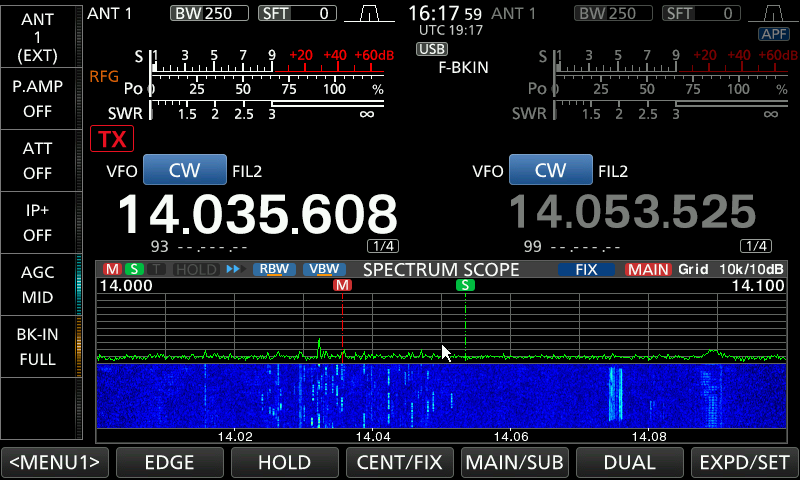
A short but rewarding time on 30m last evening.
I then moved onto the next CW signal on the waterfall of my Icom 7610 and 4O4T from Montenegro Lou's signal was very crip as well and once again my 100 watts had no issue making the trip to Montenegro. At 2200 UTC the band seemed to drop it's DX adventures and it was time to move on to things such as reading my many amateur radio periodicals a rewarding evening on the radio none the less.
Mike Weir, VE9KK, is a regular contributor to AmateurRadio.com and writes from New Brunswick, Canada. Contact him at [email protected].
LHS Episode #335: Clean My Glasses

Welcome to Episode 335 of Linux in the Ham Shack. In this short topics episode, we cover COVID-19 and contesting (duh), virtual amateur radio exams, emergency broadband on 5.8GHz, the Hamvention 2020 QSO party, exFAT, OBS, AREDN and much more. Thank you for listening. Stay safe and play more radio!
73 de The LHS Crew
Russ Woodman, K5TUX, co-hosts the Linux in the Ham Shack podcast which is available for download in both MP3 and OGG audio format. Contact him at [email protected].
Weekly Propagation Summary – 2020 Mar 30 16:10 UTC
Here is this week’s space weather and geophysical report, issued 2020 Mar 30 0104 UTC.
Highlights of Solar and Geomagnetic Activity 23 – 29 March 2020
Solar activity was very low throughout the period. No active regions with sunspots were observed and no earth-directed CMEs were detected.
No proton events were observed at geosynchronous orbit.
The greater than 2 MeV electron flux at geosynchronous orbit reached high levels on 23-26 Mar and moderate levels were observed on 27-29 Mar.
Geomagnetic field activity was at quiet or quiet to unsettled levels throughout the period.
Forecast of Solar and Geomagnetic Activity 30 March – 25 April 2020
Solar activity is expected to be very low throughout the outlook period.
No proton events are expected at geosynchronous orbit.
The greater than 2 MeV electron flux at geosynchronous orbit is expected to reach high levels on 19-22 Apr, and normal to moderate levels are expected to prevail throughout the remainder of the outlook period.
Geomagnetic field activity is expected to reach active levels on 30-31 Mar due to CH HSS influence. Generally quiet or quiet to unsettled conditions are expected to prevail throughout the remainder of the outlook period.
Don’t forget to visit our live space weather and radio propagation web site, at: http://SunSpotWatch.com/
Live Aurora mapping is at http://aurora.sunspotwatch.com/
If you are on Twitter, please follow these two users: 1. https://Twitter.com/NW7US 2. https://Twitter.com/hfradiospacewx
– – – – – – – – – – – – –
Be sure to subscribe to our space weather and propagation email group, on Groups.io
https://groups.io/g/propagation-and-space-weather
Spread the word!
– – – – – – – – – – – – –
Links of interest:
+ Amazon space weather books: http://g.nw7us.us/fbssw-aSWSC
+ https://Twitter.com/NW7US
+ https://Twitter.com/hfradiospacewx
Space Weather and Ham Radio YouTube Channel News:
I am working on launching a YouTube channel overhaul, that includes series of videos about space weather, radio signal propagation, and more.
Additionally, I am working on improving the educational efforts via the email, Facebook, YouTube, Tumblr, and other activities.
You can help!
Please consider becoming a Patron of these space weather and radio communications services, beginning with the YouTube channel:
https://www.patreon.com/NW7US
The YouTube channel:
https://YouTube.com/NW7US
..
Visit, subscribe: NW7US Radio Communications and Propagation YouTube Channel
 Ham Radio Deluxe |
 W5SWL Electronics |
 Ham Radio Prep |
 KB3IFH QSL Cards  Hip Ham Shirts  HamRadioAuctions HamRadioAuctions Reliance Antennas Reliance Antennas Enigma Shop Enigma Shop |  morseDX  Ni4L Antennas  R&L Electronics R&L Electronics antennas.us antennas.us Ears to Our World Ears to Our World |
- Matt W1MST, Managing Editor
