 |
 Giving Back to Elmers: the Soldering Platform Edition
 25 February 2021 | by
 We all have Elmers in this hobby through one medium or another. I’ve certainly been blessed with a number of them. I’ve tried to be an Elmer to a number of others, too. We get Elmering through other means besides in-person discussions, of course, as various social media platforms—especially Youtube—has exploded with how-to videos and such. Some Elmers are now charging for their premium educational services! But Elmering as an activity is rarely a monolithic endeavor as very few hams tend to “know it all,” although every reader can name a few on QRZ.com or eHam.net who seem to be legends in their own mind.
I’m talking here about one Elmer helping explain something about the hobby over a period of time where the learner becomes more competent in that subject matter within the scope of the hobby. It’s entirely likely that the learning ham can give back to specific Elmers on another aspect of the diverse hobby that is amateur radio. I’ve tried to do that in spots where it was clear that I could. Here is one recent example.
Thomas N5WDG is a local ham who is an RF network engineer at a three-letter cellular company. He holds the E.E. from Mississippi State University and an MBA from Millsaps College. We’ve been friends for almost a decade now, having many overlapping social network connections. He’s one of the go-to folks for repeaters in the Jackson MS area. I have learned a great deal from him about repeaters, installations, and RF testing in general. As I’ve been building my RF Lab, he’s been a constant source of information and advice. But when I recently built a small jig to simply hold two wires for my soldering platform, I thought I’d just build another for N5WDG, too. After texting him to blindly ask what he was using for a soldering position in his home workbench, he sent back a picture very familiar to most all hams who have ever attended a hamfest or visited Radio Shack back in the day.

He said it has served him well. I’m sure it has as it has me (cheap hamfest model with small magnifying glass) and thousands of other hams and makers over the decades. When I sent him a return text showing him a jig that I’d made and would give one to him soon, he make positive comments about the soldering platform in the background, something I built a few years ago. Hmm. Here’s a chance to give something back to one of my Elmers! And, there’s ice on the ground outside, I’m hold up at home, and I’ve got stuff in my junk-box.

Steel Soldering Platform
So over a few days, I built a version of a steel soldering platform that uses magnets for everything attached on top with four metal feet on the bottom. Instant heat sink for even a 500 watt soldering iron or gun job! The one on my workbench is a 12″ x 12″ square of thin steel but I only had an 8″ x 12″ remnant in my junk-box. The picture below illustrates the various aids I included on Thomas’ soldering platform.

All aids except the Aven circuit board holder have magnets on the bottom to put them where needed and removal entirely when desired.
Two of the two-wire jigs were included since we all lose one sooner or later, right? The medical clamps are mainly for temporary heat sinks. I’ve melted either insulation or plastic portions of switches so many times that I always attach one of these clamps near the solder joint so as to isolate the heat dispersal. Works better than I imagined!
There are four “helping hands” purchased from Quadhands.com (and on Amazon). I’ve homebrewed several aids like this but their price point is close enough to make it just worth going with theirs. They come in various lengths but these are the 12″ versions. In fact, I noticed when I bought these arms that Quadhands now actually makes a metal soldering platform with four of these helping hands for just over $50USD.
There is a knitting dowel on the upper left with a round magnet glued on the bottom. This is for winding toroids, except for the very small ones. Put the doughnut toroid on the top and let it find it’s own place on the pole. Wind your wire through by sliding the toroid up just enough to let the wire pass. I’ve not then had the wire move very much before I measure the toroid with an LC-meter or something. Then gently remove it for applying “Q dope” if you use that to hold the wire in place.
The small staging vice has four magnets glued on the bottom (using epoxy). I got these neat little (used) devices from Marlon P. Jones in Florida where I also bought various magnets used in the build. They are very useful to hold various parts like copper-clad board and other parts while soldering things to them.
There is a small rectangular magnet on the upper right (I’m right-handed) but it can be placed anywhere. It’s to hold down a round tin of soldering tip paste so that it doesn’t move around, a real nuisance when when you’re chasing it with a hot soldering iron!

The soldering jigs were made from a magnet bar from MPJ along with alligator clips from eBay and a metal screw. The magnet bar has a shallow steel U-shaped cover for the three Neodymium Rare Earth Magnet squares inside. This means that they stick lick heck to the steel platform! I matched a carbon steel drill to the hole in the magnet before using my drill press to drill through the steel on each end magnet. A Dremel tool with a cone shaped steel grinding bit was used to debur the hole on the steel case side and to enlarge it very slightly so that the fitting end of each alligator clip would slide snugly through the hole. I screwed in a Phillips-head metal screw from the magnet side into the alligator clip so that the screw would wedge the clip into the hole without allowing it to work it’s way out. Then, on to grinding off the screw’s head so that it would be flat on the steel platform surface. After doing that using the Dremel tool’s steel grinding bit, I put a bit of Gorilla tape over the magnet side and trimmed it with an Exacto knife so that the bottom of the steel case and magnets would not chip the paint on the steel platform.

Here’s a word to the wise. I should have used a Dremel cutting bit to just but off the screw heads. That would have left just a minor grinding job to get the remaining screw tip flat with the magnet’s surface. But no! I had to grind them off. Remember that there are magnets? The shavings don’t just fall away but stick to the magnet. And if you absentmindedly just use your fingers to wipe the shards away, you get what’s in the picture below. Do not attempt to replicate this step, LOL! Use a cloth, work gloves or strong compressed air.

Finally, the Aven circuit board holder has some competitors but it’s fairly inexpensive on Amazon, works superbly, and the rubber feet tend to have some suction to them which holds things in place for the most part. I could have substituted magnets for the rubber feet but decided not to do that here.
Setup and Build Steps
Here’s the setup and build process. I’ve seen a number of other homebrew builds over the past few years so not much of this is my own invention. Perhaps the exact organization of the aids but that’s not anything to jump up and down about. They just reflect what I’ve found I can use to “do stuff” involving a soldering iron or gun on my workbench.
The 1/8″ steel base is 8″ x 12″ in size. I buy most of my metal materials like this from an eBay vendor with the ID of quality_metals out of Chicago. Good price but can be slow to ship on occasion. I rub any oil off of it which many sellers spray on to reduce rust. I always use a Dremel tool to round the corners just a bit so they don’t injure someone (me) in use. I debur the edges too. Dremel has so many fittings that I use for building. The metal grinding tools come in many, many different sizes and grades, especially for use in jewelry making. Once this step is done. I put down a paint drop cloth (old bed sheet usually) to prevent over-spray. I like Rust-oleum’s Hammered Spray Paint (I buy this at Lowes), applying a light coat on the top, letting it dry completely, and then one on the bottom. Once both are dry, I use a common heat gun on the low setting to “bake” the paint on a bit before applying a second coat. Drying and another bake session completes the job. This coating I’ve found makes the solder drips cool almost instantly without adhering to the steel platform, wiping off much like dust after a job is completed.
At this point, I mark the four corners on the bottom for attaching round metal feet. I’ve been using those in the picture below, cutting off the metal spike (nail) that is used to attach these feet to wood chair legs. After removing the spike, I outline the remaining rubber side that will be glued to the steel platform base. Using a Dremel tool, I remove the Rust-Oleum paint where the rubber side of the metal foot will attach and apply epoxy mixed on the spot of the metal. Then, clamps are applied to keep the foot and base together for the expoxy to cure overnight. (It took longer because of the sub-freezing temps in the area.) Rough up both the rubber on the foot and the metal circle where the epoxy will be applied for a better seal.

I’ve detailed how I built the two-wire soldering jigs above. I went with commercial products for the helping hands (instead of the mechanical arms I used on my platform earlier) and the circuit board holder (Aven, as I did on my own platform). The knitting dowel was purchased at a local art store and the magnet was glued on it’s wooden base using Gorilla glue. The medical clamps were bought a a pack of 12 on eBay a few years ago. They are widely available. This set of soldering aids can be used mix-and-match depending on the project or task. I keep the helping hands on mine all the time but store the Aven holder until there’s a circuit board in the project. While I have other tools used in soldering, stored on a metal magnet bar underneath the shelves above my workbench, this set is what I’ve found to be useful. The magnets make this very versatile. I prefer them instead of mounting the helping hands using nuts-and-bolts.
Thomas N5WDG seemed thrilled to receive this surprise gift. I was pleased that he was. The circuit of Elmering was complete. And perhaps Elmering in amateur radio should be more like that. To really learn something well, it’s said to teach it. Learning from an Elmer should inspire a ham to return the favor when it’s appropriate. I am happy to give back to one of mine.
Frank Howell, K4FMH, is a regular contributor to AmateurRadio.com and writes from Mississippi, USA. Contact him at [email protected].
A very nice surprise.
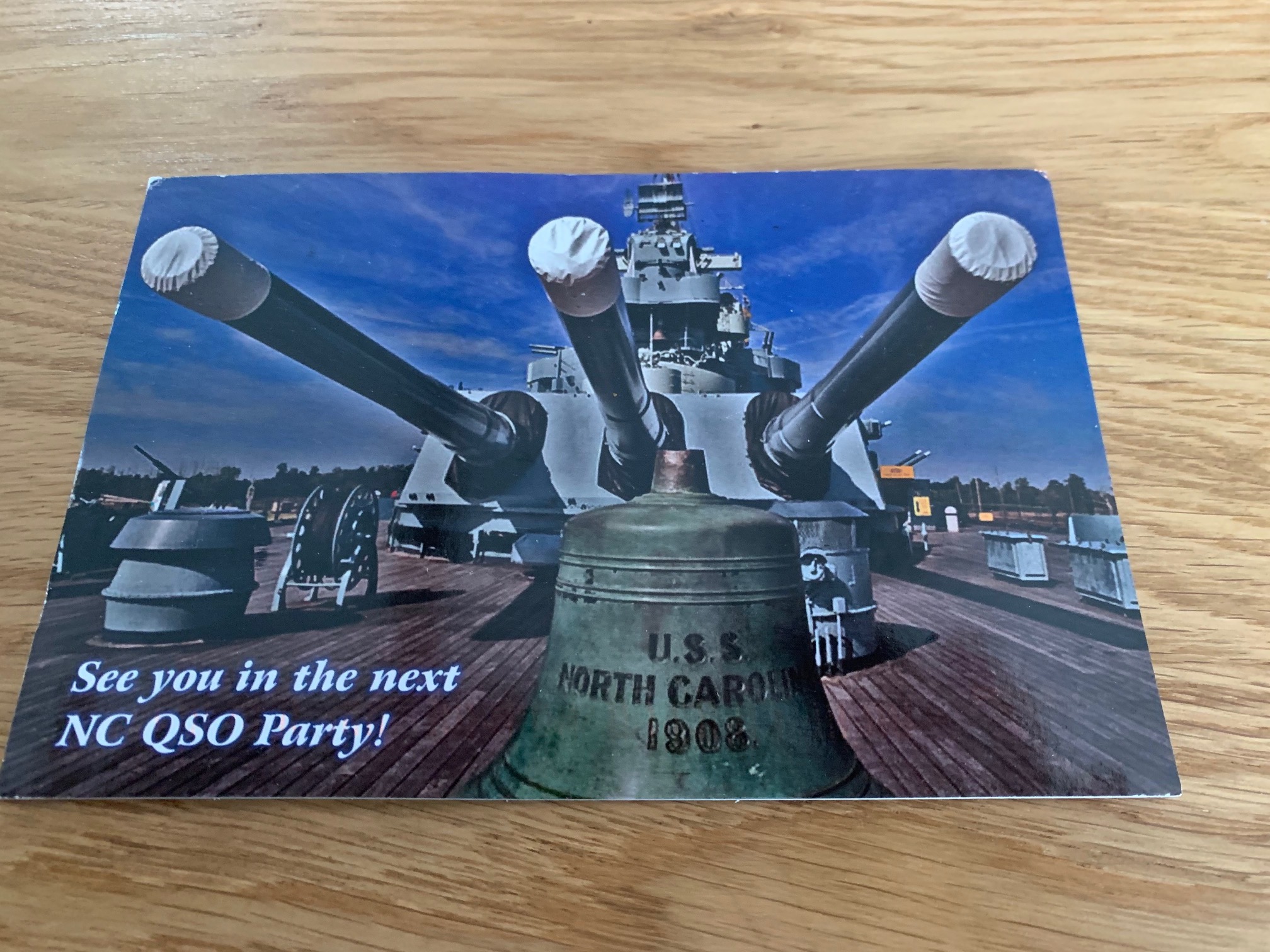 |
| USS North Carolina |
This weekend is both the North and South Carolina QSO parties and my plans are to take part in both contests. It's a nice way to spend a bit of the weekend with the South Carolina QSO party on Saturday and the North Carolina QSO party on Sunday.
Mike Weir, VE9KK, is a regular contributor to AmateurRadio.com and writes from New Brunswick, Canada. Contact him at [email protected].
LHS Episode #395: It’s a Virtual, Virtual, Virtual, Virtual World
Hello and welcome to Episode 395 of Linux in the Ham Shack. In this short topics episode, we talk with Eric Guth, 4Z1UG, about the upcoming QSO Today expo. We then move on to several stories including potential FCC fee amnesty from the ARRL, Flameshot, OwnCloud, AMD and the new Linux kernel, DUDE-Star and much more. Thank you for listening and have a wonderful week.
73 de The LHS Crew
Russ Woodman, K5TUX, co-hosts the Linux in the Ham Shack podcast which is available for download in both MP3 and OGG audio format. Contact him at [email protected].
ARRL international CW contest.

Mike Weir, VE9KK, is a regular contributor to AmateurRadio.com and writes from New Brunswick, Canada. Contact him at [email protected].
LHS Episode #394: The Weekender LXVI
It's time once again for The Weekender. This is our bi-weekly departure into the world of amateur radio contests, open source conventions, special events, listener challenges, hedonism and just plain fun. Thanks for listening and, if you happen to get a chance, feel free to call us or e-mail and send us some feedback. Tell us how we're doing. We'd love to hear from you.
73 de The LHS Crew
Russ Woodman, K5TUX, co-hosts the Linux in the Ham Shack podcast which is available for download in both MP3 and OGG audio format. Contact him at [email protected].
Lemmings Over a Demographic Cliff?
Tradition and change are terrible bedfellows

It was an honor to have been invited to prepare what turned into a 2-article series in the ARRL’s National Contesting Journal on the aging demographics of hams who participate in the radio “sport” of contesting. These appeared in the July/August (Vol 48, No. 4) and Sept/Oct (Vol 48, No 5) issues. Dr. Scott Wright K0MD, Editor, asked me to assist with more fully analyzing the results of a survey conducted by the League office in Newington of their past and present subscriber list of NCJ recipients. I agreed but added some key data from four other sources. It particularly piqued my interest since amateur radio is a hobby. I spent part of my career studying the effects of sport participation and teaching undergraduate and graduate courses on the Sociology of Sports as a Professor. In future writing, I’ll compare amateur radio contesting to accepted definitions and elements of competitive sports.
In this Social Circuits column, there are several components. demography, the life course, vested interests and social capital. They are each valuable concepts to understand the Demographic Cliff facings U.S. contesting. But first, I’ll cover the additional data sources used in the two-part NCJ articles.
One data source was age distribution data from the U. S. Bureau of the Census (a source where I’ve lived, breathed, and used incessantly over the years). A second was the Time Use Survey from the Bureau of Labor Statistics. A third was from the ARRL’s membership files on age of member. A fourth was from the 2011 and 2013 surveys I conducted for the four states in the Delta Division as Assistant Director. Properly assembled, these four sources gave a much more illuminating picture of the challenges facing radio sport in the next decade. No, contesting is not likely to “die,” as great pessimists are likely to say, but it is clearly facing significant and perhaps substantial social change in order to remain a prominent ham radio niche.
I won’t repeat the two articles but I want to place some strategic emphasis on a few elements of the results and their implications. They have clear and almost compelling evidence for leadership in amateur radio to shape their programmatic actions to be more strategically efficient (that’s you, ARRL, among other groups). By that, I mean like we hams often chide the owner of a new HF screwdriver antenna on a vehicle: Yea, what you’re doing will work. But it could be done differently to be much a much more efficient antenna system! Don’t we want the ARRL and other groups to be more efficient with monies invested in those organizations?
The often-heard phrase of “only grey beards” inhabiting amateur radio these days is…both factual and a canard. The observed facts are that hams participating in several public activities do sport grey hair (and beards whether they still have hair on top!). These include those who say they participate in contests as well as appear at ham fests. But we simply do not have adequate data to make reliable inferences to all 750,000 or so hams holding licenses. We just don’t. And it’s causing all of the efforts by the League and other organizations to shoot into the dark more often than not. (The ARRL often says it’s conducted research on a topic but the previous CEO Howard Michel would not release the data to members who are even more savvy in terms of statistical survey analysis. Oy!) And we won’t. Until the ARRL or another entity supports the conduct of a professional caliber random sample survey design of the licensed amateur radio operators in the U.S.
But the “modest” data I presented in the NCJ articles do show the results in the following graphic on the demographic cliff. US is the Census Bureau’s age data for the U.S; ARRL is the League’s membership as a proxy for all hams (best available); and the NCJ is from the ARRL survey of past and present NCJ subscribers.
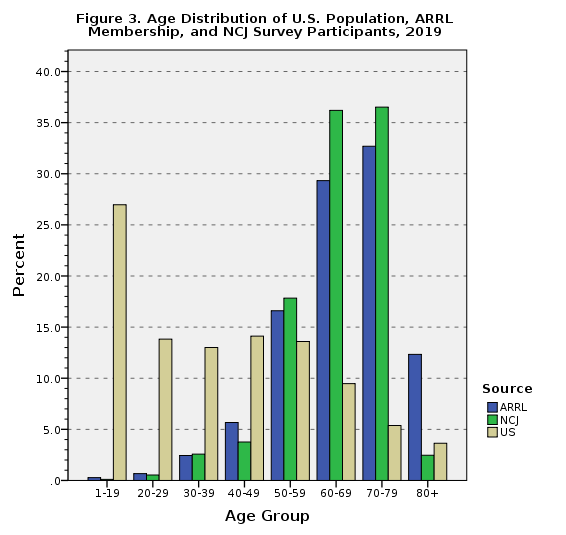
Hams, as indicated by the proxy of ARRL membership and in the NCJ past and present subscriber data, are sorely under-represented in the pre-50 age ranges. It’s not a close comparison either. More observantly, contest participants are even older in the aggregate than the League’s membership at large. This doesn’t mean that there are not contesters in the younger age groups, just that they are smaller in number. Why? There are some sound demographic reasons that have little to do with amateur radio itself. It’s important to understand non-amateur radio factors about the life course—the trajectory in which modern societies are organized around age-graded activities, positions and transitions. Sounds like gobbledygook? But so does many of the subjects we hams pride ourselves in to the uninitiated. Let’s get up to speed here.
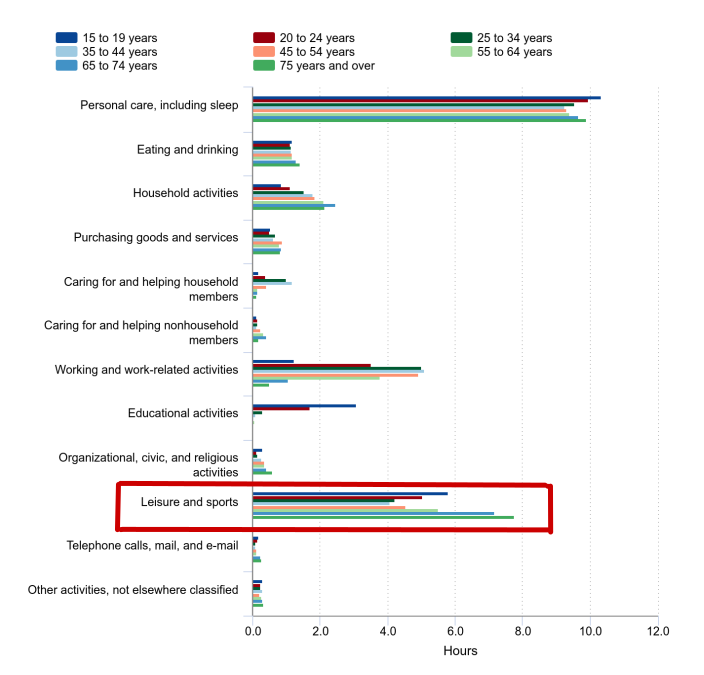
The American Time Use Survey, conducted regularly by the Bureau of Labor Statistics, is a very high quality data series. It is the standard for measuring how teenagers to adults in the U.S. spend their time. The chart above captures a picture in 2018 for time use, reflecting time spent per day on each activity group. The data are compared by age groups. I have put a red box around a key category. Where does amateur radio as a hobby fall there? In Leisure and sports (note the use of radio “sport” by contest participants).
What is the general age pattern? Leisure pursuits are highest during youth and young adulthood but dramatically taper off about ages 25-34 until age 55 and over. This hollowing out of leisure and sport time is a predictable outcome of competing and more important activities. It has little to do with amateur radio per se outside of it being a leisure activity. Note that personal care (including sleep!) follows a similar age-graded pattern. A converse age pattern of increasing time spent is observed for work and related activities, moving from less time while young toward peeks at mid-career and a tapering off later in the life cycle. On average, age is linked to more household activities and fewer educational ones. So the conventional wisdom about “losing” hams after they enter middle age is all about doing things to keep them focused on the hobby within the context of these competing obligations. But is that both reasonable and consistent with the long-celebrated Amateur Radio Code? Should we really want hams to forsake family or work for a hobby?
BALANCED…Radio is a hobby, never interfering with duties owed to family, job, school or community.
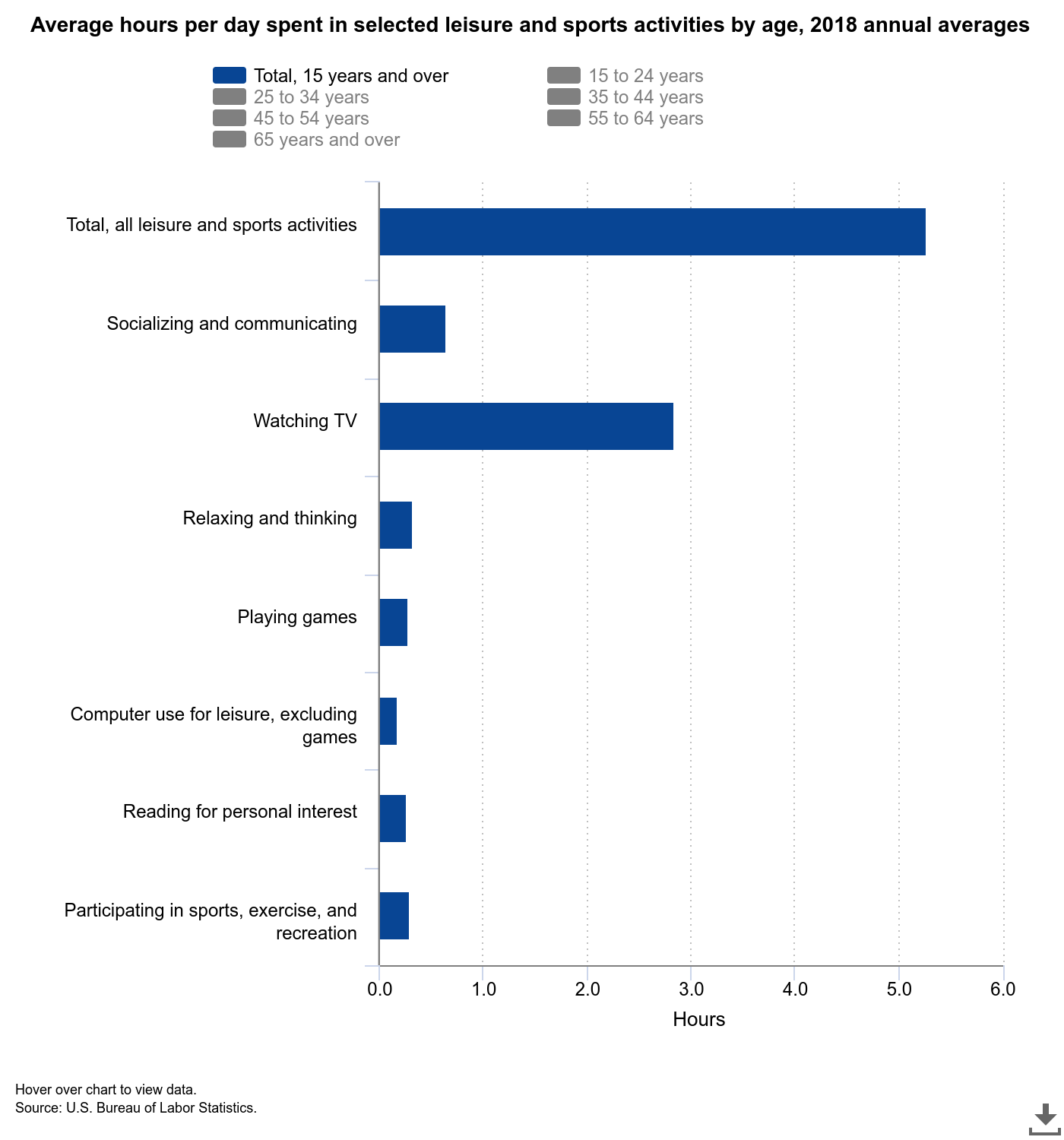
Let’s delve into another demographic pattern within the 6-8 hours per week spent on Leisure and Sports activities. From the TUS for everyone over age 15, here are sub-categories of leisure and sports activity. Of the weekly average of just over 5 hours, there is one clear time allocation: watching TV. It captures 60 percent (or about 3 hours) of all daily leisure/sport time. Socializing and communicating (ostensibly where amateur radio might fit in) is a pale second to television. (In the NCJ articles, I presented data from the Delta Division Surveys in 2011 and 2013 about time spent on the air per week.)
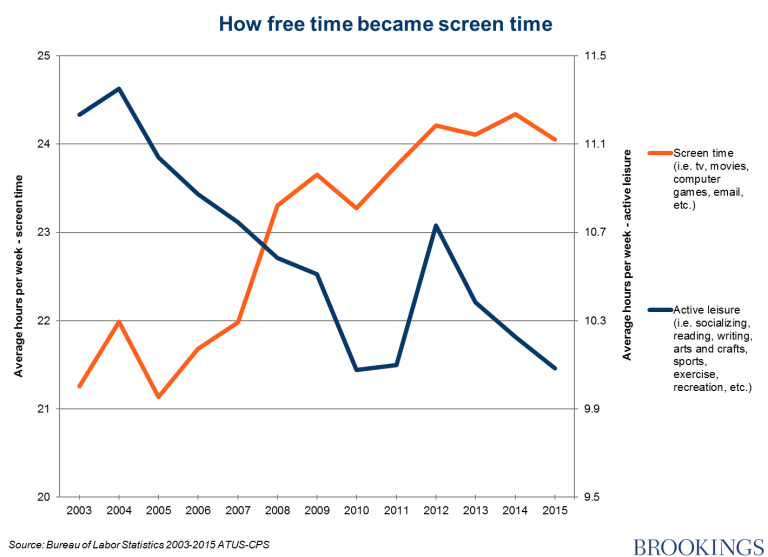
So what’s the demographic upshot of this? The main competitor to engagement of amateur radio operators to being on the air or at their workbench or (name your favorite ham activity) is…Television! This is not shocking to those social scientists who study time use. The Brookings Institution published a study on this using the Time Use Survey covering 2005-2015. They document how “free time became screen time” in the following trend chart, expressed as hours per week instead of day. About 2007, screen time (not just TV) surpassed other active leisure activities in average time spent. By 2015, the gap favoring screen time was over an hour, reflecting over 11 hours per week—on average with some much more and much less—of activity. Sound familiar in your household?
The demographic picture presented here continues to illuminate our understanding of the dynamics of what is a social behavior—amateur radio operation. But there is a demonstrable demographic partition in the time use data, fostered by the social roles and responsibilities typically embedded in U.S. households. Gender, employment, and weekday vs. weekend days interact in sociologically predictable ways as shown in this chart, again from the TUS in daily averages.
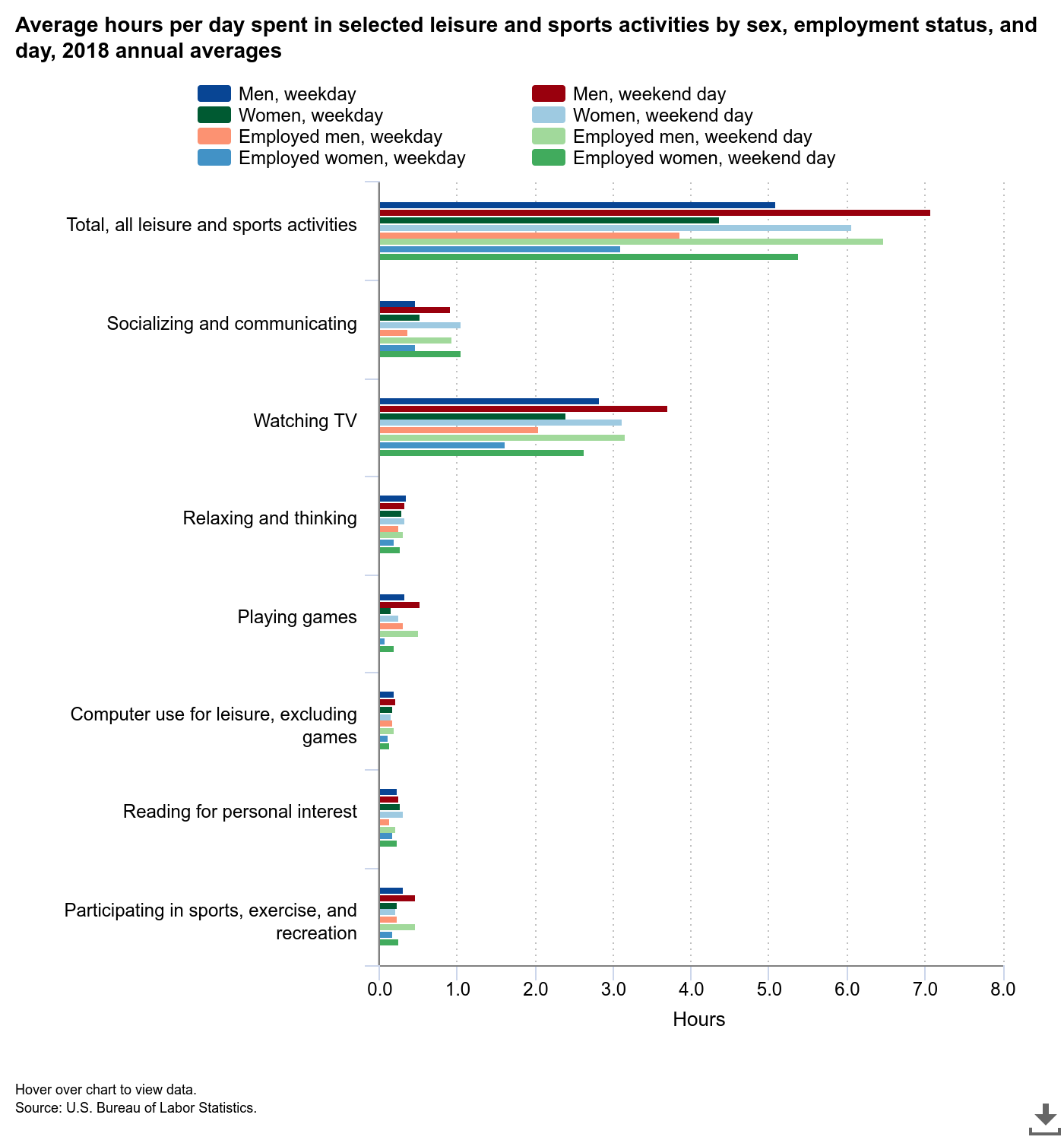
The clearest differential among men and women is in TV watching and socializing/communicating. Whether it’s the weekday or weekend, men systematically spend more time watching TV than women who tend to communicate and socialize more than similar men. Hmm. Women tend to spend more time communicating. Isn’t that promising for amateur radio?
Lemmings and the Demographic Cliff
Tradition and change are terrible bedfellows
One can simply ask after seeing these data: So what? But here’s the deal. Traditional radio sport is facing a demographic cliff of aging ham contesters. Those highly invested in the status quo won’t be around (by becoming SKs) to experience the diminishing participants. They now have the political clout to direct strategic actions. Is this demographic cliff inevitable? It reminds me of the famous IBM-focused Macintosh announcement in 1984, followed up by the Lemmings video in Apple’s 1985 Super Bowl commercial to announce the Macintosh!
I don’t think so, as I stated in the NCJ article series. There are two clear actions that leading organizations can take, which do not suggest that other existing programs should be curtailed or stopped. But is there the political will among decision-makers to take such actions by stepping out of line among the Lemmings?
The ability to make group decisions that often fly in the face of individual power brokers’ individual interests is called social capital. Whether those actors who drive the organization and practice of amateur radio contesting are willing to share resources (e.g., allow newcomers into the circle) and identify as contesting new forms of such competition is how social capital would be manifested in amateur radio. Trust and reciprocity in the common good is the key element for this example.
Social capital, however, is more than simply having social connections and networks. Social capital is exhibited in individuals who have a well-developed sense of mutual trust and “give-and-take” or “reciprocity” in their social networks. Moreover, it is exhibited in individuals who are actively engaged in civic and political life. This trust, reciprocity, and civic and political engagement then enriches the communities where these individuals reside.”
One programmatic change is to actively invite change in the types of amateur radio contests so as to engage a wider variety of hams into contesting activities. This will upset the apple cart of the extant contest culture who currently are invested in the existing models of contesting. Sometimes, hundreds of thousands of dollars are invested. Competition over band frequencies and calendar space is legion as any reading of website such as eHam.net, QRZ.com, and others will reveal. Try launching a new contest for even more direct evidence! But strategic conflict is a necessary evil for social change in many, many cases. No group owns a frequency or calendar dates. We must share them—through active cooperative efforts. But it is also very clear that “tradition” begets a sense of ownership which is anathema to vibrant change for the greater good. Many of the power brokers in the contesting niche in amateur radio here in the U.S. are also significant donors to the ARRL. Some are seated on the Board of Directors. That adds to the ability to have sway over official efforts to move their cheese. Will enough members of that conventional contesting group be willing to change for the good of that part of the hobby? Perhaps not. Nonetheless, I’m optimistic in that the famous Lemmings commercial did have one member of the landed gentry who stopped short of the cliff’s edge to take off his blinders and see the future!
A second is to fish where the fish are and with the most effective bait, recognizing the demographics that shape the potential for recruitment. The ARRL and many local clubs have focused on getting amateur radio into schools. Like the screwdriver antenna example, if you can get the owner(s) to agree to mounting that antenna, it will work. It just won’t work as efficiently as some others. But it does work. I noted in the TUS results above that women spend more time socializing and communicating per week than do men, whether either are employed or whether it’s a weekday or weekend. While it’s not a large distinction, it bodes well for amateur radio educational outreach programs to fish where the fish are. Where are women (and youth)? I’ve written previously that the local public library is strategic.
The average 10.5 trips to the library U.S. adults report taking in 2019 exceeds their participation in eight other common leisure activities.…it’s the most common cultural activity Americans engage in, by far. [emphasis mine]Gallup Survey Organization
Don’t stop working schools for recruitment, if you can get into the increasingly burdened school day and night, but add public libraries as a new “served agency” for educational outreach. The Plant the Seed, Sow the Future initiative launched in the Delta Division by Director David Norris K5UZ is a model for doing so. Some other clubs around the U.S. have begun to practice that model already. Get radio sport as one strategic element to convey amateur radio to young people and women at public libraries. The Covid-19 pandemic, however, has short-circuited most libraries in the short run in terms of physical walk-in programs. But this model clearly has legs for the future, if the ARRL’s other Divisions and the League office itself view the data objectively and be willing to adopt something “not invented here” in Newington.
It is often attributed to the social thinker August Comte to have said, Demography is Destiny. But it does not have to be so. (see my talk to the Sutton & Cheam Society in London) It does require taking the blinders off of tradition and evaluate it for what it is today and what it means for the future. This almost always requires those in power to make such decisions to forsake their own vested interests in favor of change. Like the famous Lemmings advertisement by Apple, not everyone has to walk off this demographic cliff. We just have to take the blinders of tradition off our eyes, wake up, act for the common good, and smell the demographic coffee. Because it’s brewing…
Frank Howell, K4FMH, is a regular contributor to AmateurRadio.com and writes from Mississippi, USA. Contact him at [email protected].
LHS Episode #393: DUDE-Star Deep Dive
Hello and welcome to Episode 393 of Linux in the Ham Shack. In this episode, the hosts interview Doug, AD8DP, the author and primary coder of the DUDE-Star project. This project allows someone to use most of the VHF and UHF digital radio modes that have become all the rage: YSF, D-Star, DMR, P.25, NXDN and more. In the process, we learn much more about the M17 Project than we thought we would so stay tuned for an upcoming deep dive on that subject. If you want to dive into digital and not spend a lot of money, then DUDE-Star is for you!
73 de The LHS Crew
Russ Woodman, K5TUX, co-hosts the Linux in the Ham Shack podcast which is available for download in both MP3 and OGG audio format. Contact him at [email protected].
 Ham Radio Deluxe |
 W5SWL Electronics |
 Ham Radio Prep |
 KB3IFH QSL Cards  Hip Ham Shirts  HamRadioAuctions HamRadioAuctions Reliance Antennas Reliance Antennas Enigma Shop Enigma Shop |  morseDX  Ni4L Antennas  R&L Electronics R&L Electronics antennas.us antennas.us Ears to Our World Ears to Our World |
- Matt W1MST, Managing Editor
