 |
 Amateur Radio License Plates
 4 March 2021 | by
 Since the pandemic started up over a year ago, I haven’t done any air travel and have been driving to all business functions. Luckily all my work has been in The Northeast and within a reasonable driving distance of my home, though I often have six to eight hours of driving in a day. So, needless to say, I’ve had a lot of windshield time on interstates the last 12 months.
In this past year, I think I’ve counted perhaps three or four amateur radio license plates on vehicles, total. I’ve identified maybe three other vehicles that didn’t have amateur radio license plates, but looking at the antennas on the vehicles and deducing from bumper stickers and the driver, it was an amateur radio operator.
A decade or two ago I can remember seeing perhaps four or five amateur radio plates on a single eight hour trip alone. I know some people don’t get amateur radio license plates these days because of the relative ease of identifying the owner using a web search. I think you see this with the younger generation who is very Internet savvy and aware of the dangers of self-doxing by providing to much identifying information to the public. We still have a majority of older radio amateurs and with increasing numbers of licensees one would think we would see more amateur radio license plates on the road today.
Has anyone else noticed a decline in amateur radio plates in their neck of the woods?
This article was originally posted on Radio Artisan.
Anthony, K3NG, is a regular contributor to AmateurRadio.com.
Amateur Radio License Plates
Since the pandemic started up over a year ago, I haven’t done any air travel and have been driving to all business functions. Luckily all my work has been in The Northeast and within a reasonable driving distance of my home, though I often have six to eight hours of driving in a day. So, needless to say, I’ve had a lot of windshield time on interstates the last 12 months.
In this past year, I think I’ve counted perhaps three or four amateur radio license plates on vehicles, total. I’ve identified maybe three other vehicles that didn’t have amateur radio license plates, but looking at the antennas on the vehicles and deducing from bumper stickers and the driver, it was an amateur radio operator.
A decade or two ago I can remember seeing perhaps four or five amateur radio plates on a single eight hour trip alone. I know some people don’t get amateur radio license plates these days because of the relative ease of identifying the owner using a web search. I think you see this with the younger generation who is very Internet savvy and aware of the dangers of self-doxing by providing to much identifying information to the public. We still have a majority of older radio amateurs and with increasing numbers of licensees one would think we would see more amateur radio license plates on the road today.
Has anyone else noticed a decline in amateur radio plates in their neck of the woods?
This article was originally posted on Radio Artisan.
Anthony, K3NG, is a regular contributor to AmateurRadio.com.
Modernizing the DY-88 Power Supply
Go with a Modern Vibe
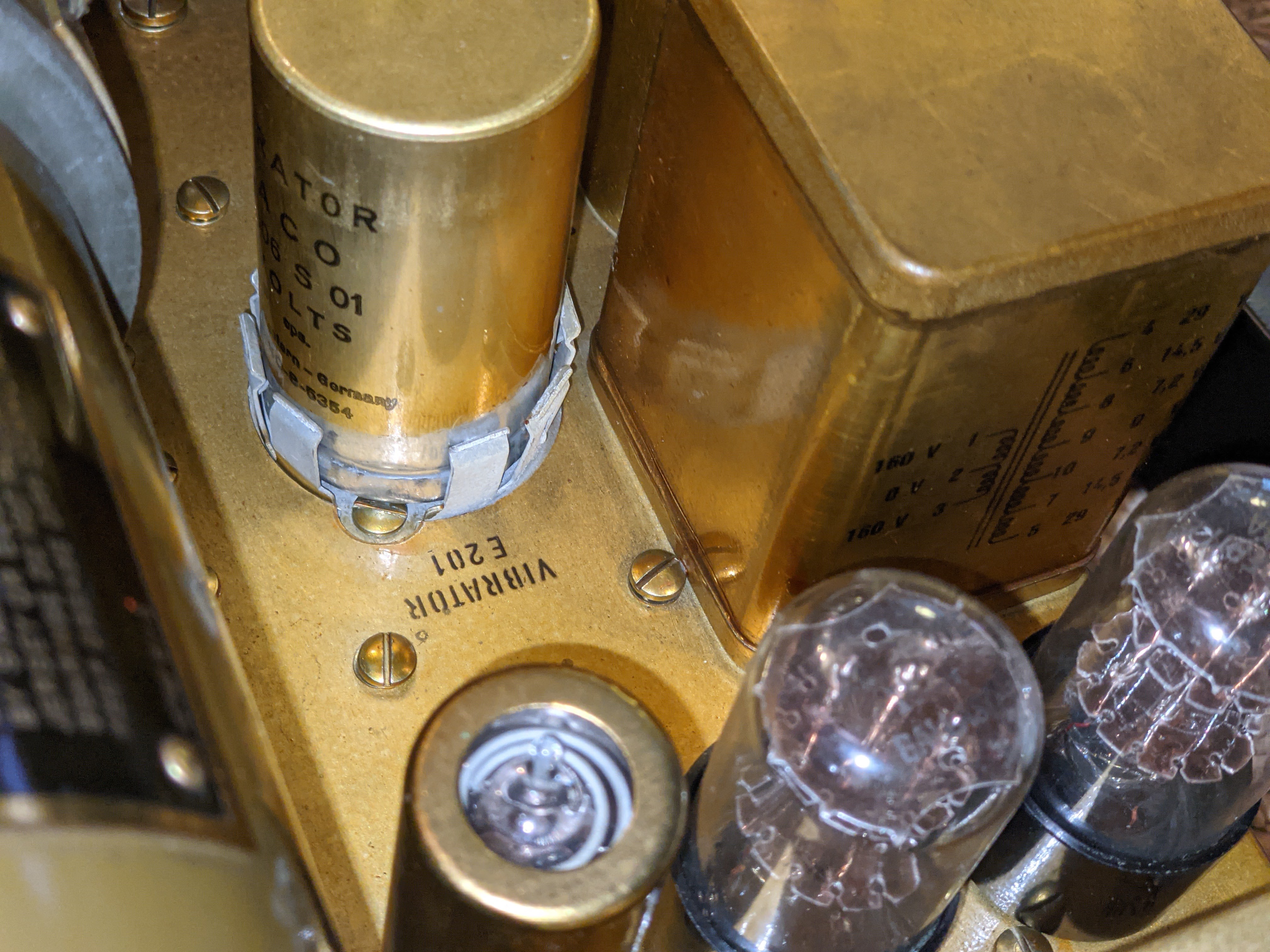
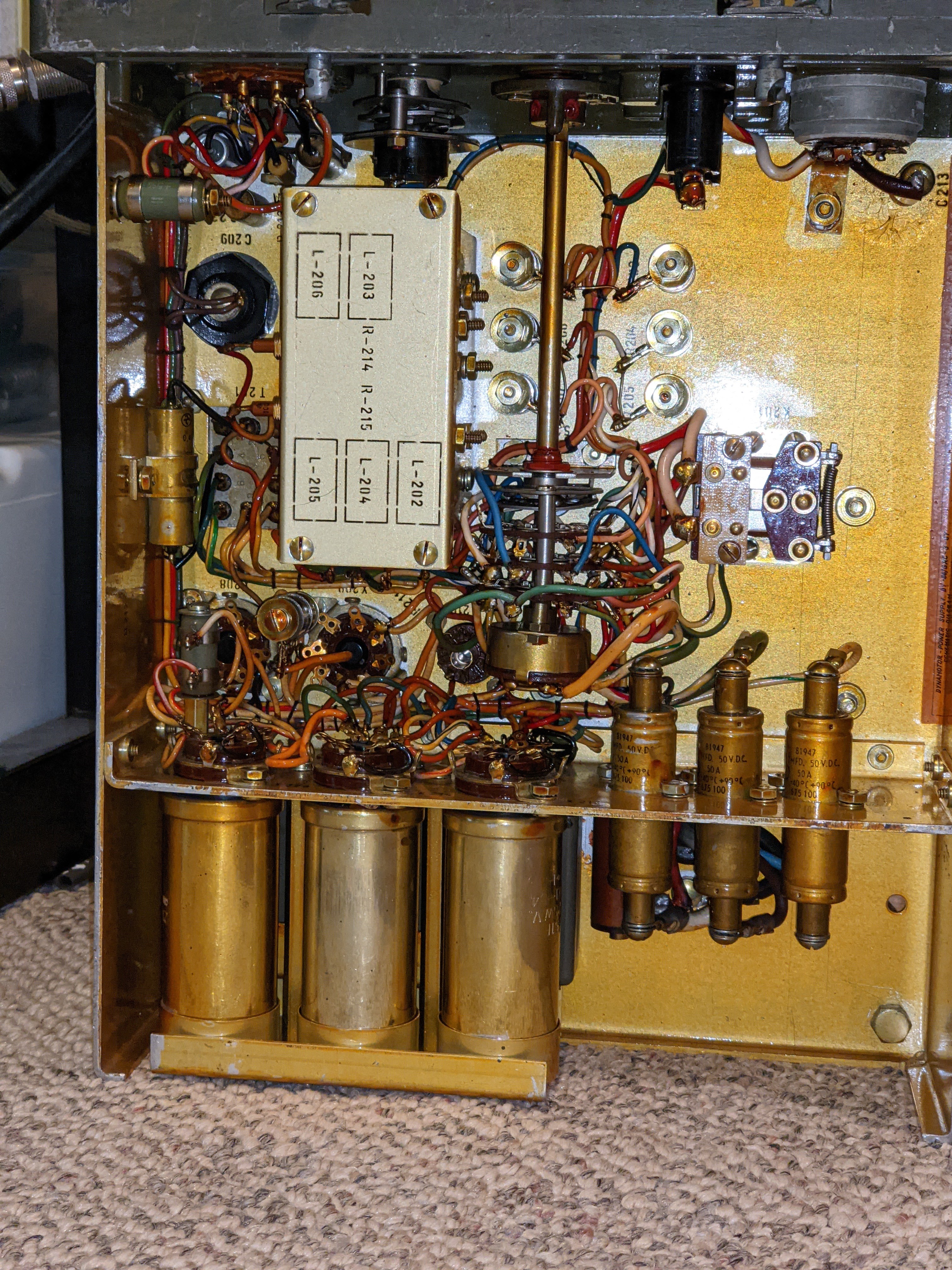
Turning low voltage to high voltage
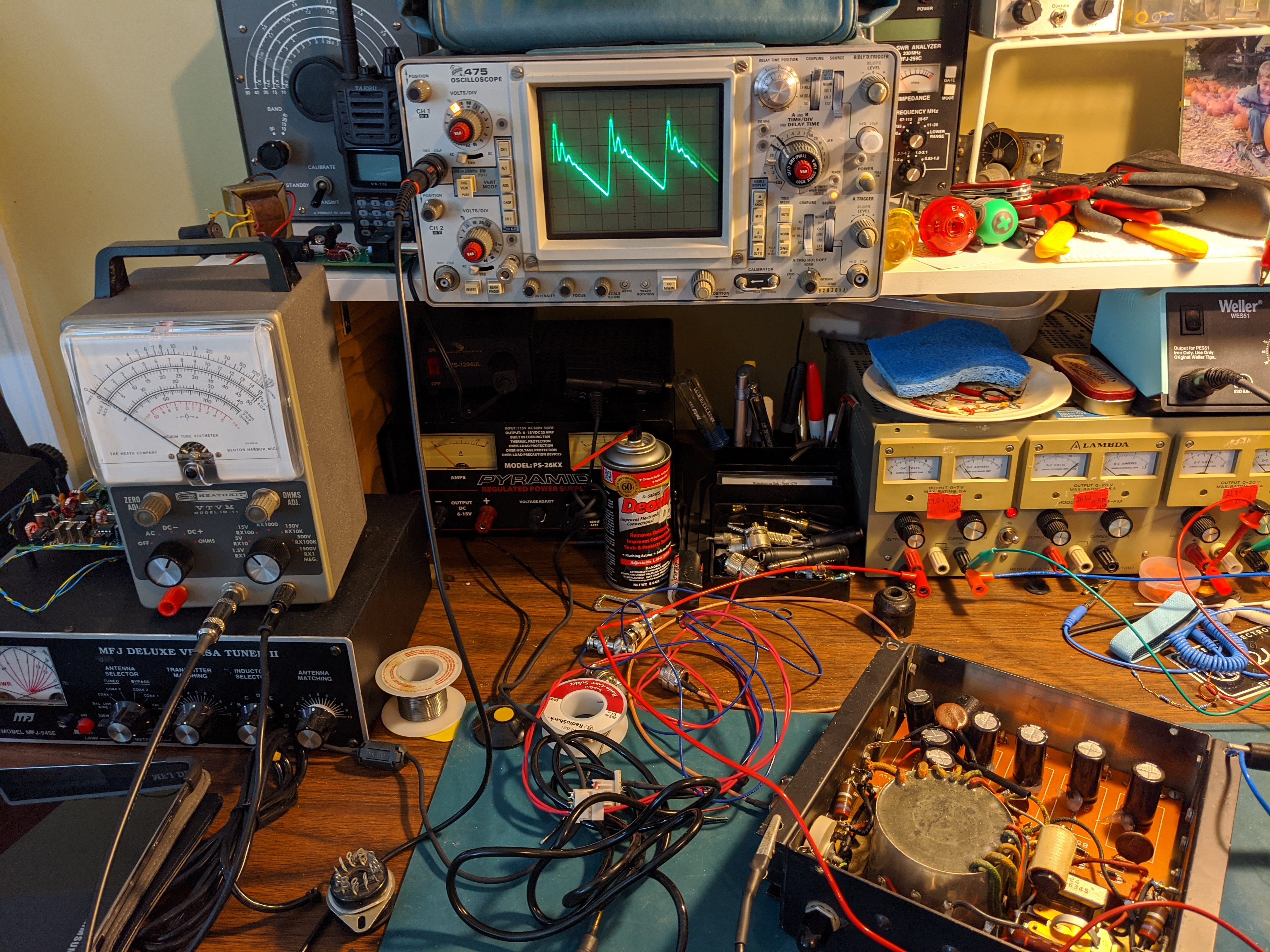
Bad Vibrations
Solid State

Note
. . . The pins are numbered 1 to 7, pin 1 is the large diameter pin on the right, and pins are counted clockwise from that pin. . . .
Results

Richard Carpenter, AA4OO, is a regular contributor to AmateurRadio.com and writes from North Carolina, USA. Contact him at [email protected].
LHS Episode #396: M17 Deep Dive
Hello and welcome to the 396th installment of Linux in the Ham Shack. In this episode we interview Steve Miller, KC1AWV, one of the major contributors to the M17 amateur radio project. In the interview, Steve tells us the history of the M17 project, how to build and use it, the level of current development and what the future holds. We hope you enjoy this in-depth look at M17 and have a great week.
73 de The LHS Crew
Russ Woodman, K5TUX, co-hosts the Linux in the Ham Shack podcast which is available for download in both MP3 and OGG audio format. Contact him at [email protected].
ICQ Podcast Episode 345 – Progressive Changes at ARRL
In this episode, Martin (M1MRB) is joined by Leslie Butterfield G0CIB, Dan Romanchik KB6NU and Edmund Spicer M0MNG to discuss the latest Amateur / Ham Radio news. Colin (M6BOY) rounds up the news in brief and in this episode’s features is in an interview with ARRL David Minster NA2AA, and the President, Rick Roderick K5UR as they discuss changes for the ARRL with Frank Howell K4FMH.
ICQ AMATEUR/HAM RADIO PODCAST DONORS
We would like to thank Tony Hickson (M5OTA), Mark Fairchild (2E0MFZ) and Richard Dalton and our monthly and annual subscription donors for keeping the podcast advert free. To donate, please visit - http://www.icqpodcast.com/donate
- Concord Student Wins Congressional App Challenge - ARRL Reject Additional VEC's - ARRL to consider covering young members license fee - German Radio Hams Tackling RF Noise Pollution - UK Amateur Radio Operator Celebrates 100th Birthday - The Royal Australian Air Force - 100 Year Centenary. VK100AF & VI100AF - Light Up 2 Meters Night, an FM Simplex Event - ARRL CEO David Minster (NA2AA) to keynote QSO Today Virtual Ham Expo
Colin Butler, M6BOY, is the host of the ICQ Podcast, a weekly radio show about Amateur Radio. Contact him at [email protected].
Here Comes The 2021 Novice Rig Roundup (NRR)!
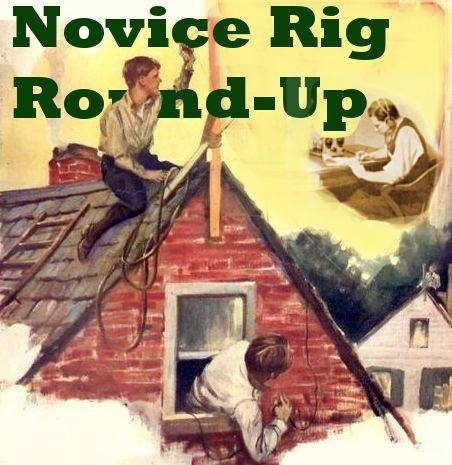
One of the most enjoyable operating events of the year is fast approaching -- the Novice Rig Roundup or 'NRR'. This year, the activity is dedicated to NRR founder and long-time participant, Bry, AF4K, who sadly became a silent-key last year.
 |
| Bry - AF4K |
Technically, the NRR is a contest, but I have the feeling that most participants think of it as just a lot of fun and a nice opportunity to hear and work some of the great old 'classics' of the past -- rigs that were used when they were teenage Novices or rigs that they could only drool about owning, back in those formative years when they each discovered the magic of radio.
The dates to remember are 0000 UTC March 6 to 2359 UTC March 14 and this multi-day opportunity is, for me, what makes the NRR so enjoyable. With a nice diversion from the usual 'contest frenzy' associated with standard weekend operating events, the NRR can be enjoyed throughout the week, whenever you choose to participate. If last year's operating patterns continue, you should find activity at any time of the day ... and even more as sunset arrives.
With the early growth of Cycle 25, we will likely be treated to some transcon opportunities on 15m or even 10m, as many 15m transcon contacts were made during last year's event thanks to some well-timed solar activity!
Although technically not required, if you plan to participate it's best to obtain your own NRR number, which is an easy 30-second process.
Additionally, there is an online logger where participants can post their daily log. The nifty logger also keeps track and figures out your score as it goes and no 'after contest' log needs to be submitted. If you plan on submitting a log, the logger is a requirement. The logger will also require you to set up a 'log-in' and once again, a simple 30-second process will take care of that from here. If you used the logger last year, you will have to set it up again for this year as the old system has been changed.
Stations may run either crystal-control or VFO or can switch between either method ... the online logger will keep track and score things appropriately.
All of the rules and information can be found on the NRR's excellent website. As well, the soapbox comments and station pictures from last year's NRR may provide the inspiration that you need to spark-up your own activity in this year's event ... from what I can tell, this year will be bigger and busier than ever!
There is also a dedicated NRR Group, often the source of much valuable discussion but there is a now HUGE group of great NRR chat and activity now on Facebook's NRR Group here. I avoided Facebook for many years and have now discovered that it is an excellent forum for real time chat and information exchange ... one can still choose to maintain a very low profile and avoid unwanted interaction if set up correctly.
If you have access to the web while operating, be sure to bookmark and check into the NRR's realtime chat page. Many ops that are crystal controlled will announce their operating frequencies, making it easier for you to find them ... sometimes way up or down from the normal NRR watering holes of ~ 3550 - 3650 kHz, 7100 -7125 kHz, 21.100 - 21.150 MHz and 28.114, 28.120 MHz ... and don't forget to check the colorburst crystal frequency of 3579!
'CQ'ers should always remember to tune up and down the watering hole for replies from other NRR stations that may be crystal controlled and not able to answer you on your own frequency!! This is extremely important and a real reminder of what was common practice back in the Novice days.
 |
| courtesy: Harry - VE7AIJ |
You still have time to get that old clunker on the air but if that's not possible, you can join the fun with your modern rig as well ... all are welcome to jump in and have a great week of radio-fun. I think you will be surprised, just as I was last year, how good some of these old classics can sound ... and you'll hear some great bug-fists as well.
***********************
The NRR once again provided many notable highlights over the nine day event.
Almost topping the list was just experiencing the variety of old classics and hearing how well almost all of them sounded. Numerous Knight T-60s, Drake 2NTs, Heath DX-40s, Johnson Adventurers and Eico 720s, along with a nice variety of homebrew MOPAs and one-tube power oscillators graced the nightly airwaves. These oft-forgotten shelf-queens always seem to develop super-powers, far beyond their expectations, when the NRR rolls around!
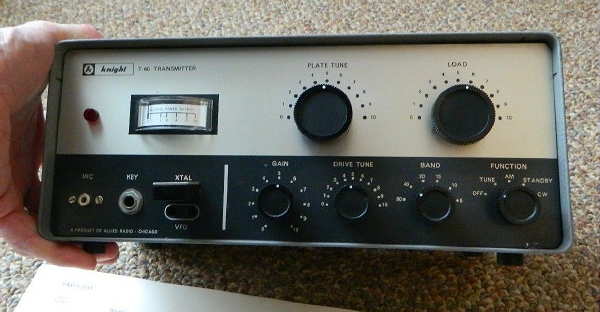
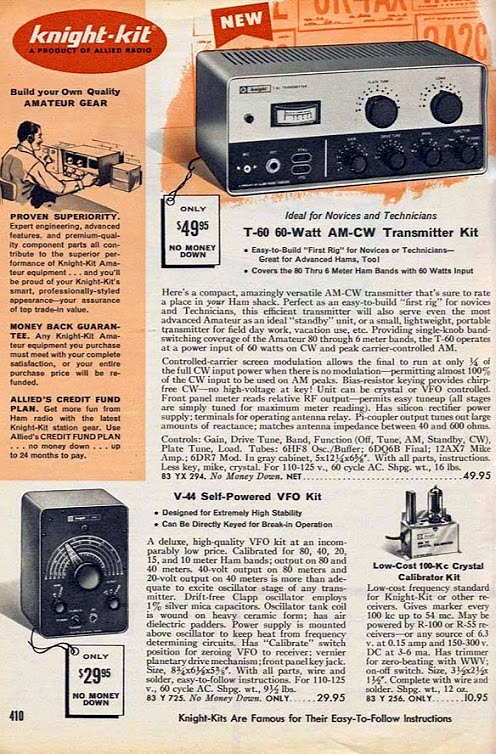
I was really surprised to work so many T-60s, a small and inexpensive 60 watt transmitter kit from 1962 using a popular 6DQ6 television sweep tube ... one never expected to achieve such RF greatness! I was very impressed with every one that I heard.
What radio-struck pre-Novice teen, dreaming about getting on the air, could resist a clever ad like this.
Scott, KA9P's 80m T-60 signal sounded as sweet as it looks in his NRR setup, paired with his Heathkit HR-10B inhaler.
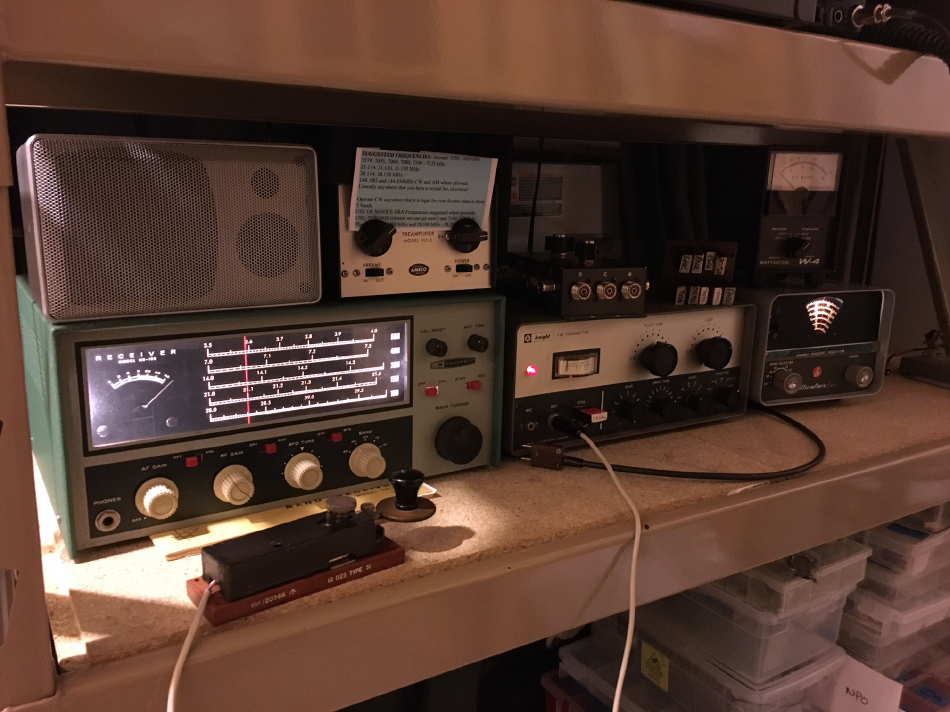 |
| KA9P NRR station with RAF Vulcan bomber Type 51 hand pump |
Right up there with the plethora of T-60s was the Drake 2NT, another great sounding radio and also my choice for this year's event. My summer refurbishing project, described here, proved a worthy companion, although my much-treasured VF-1 VFO's short term drift probably had my 2NT getting red in the face whenever I took her off of crystal control to scurry around the band, seeking out the CQ'ers. I've had a love-hate relationship with the VF-1 ever since buying my first one back in '63!
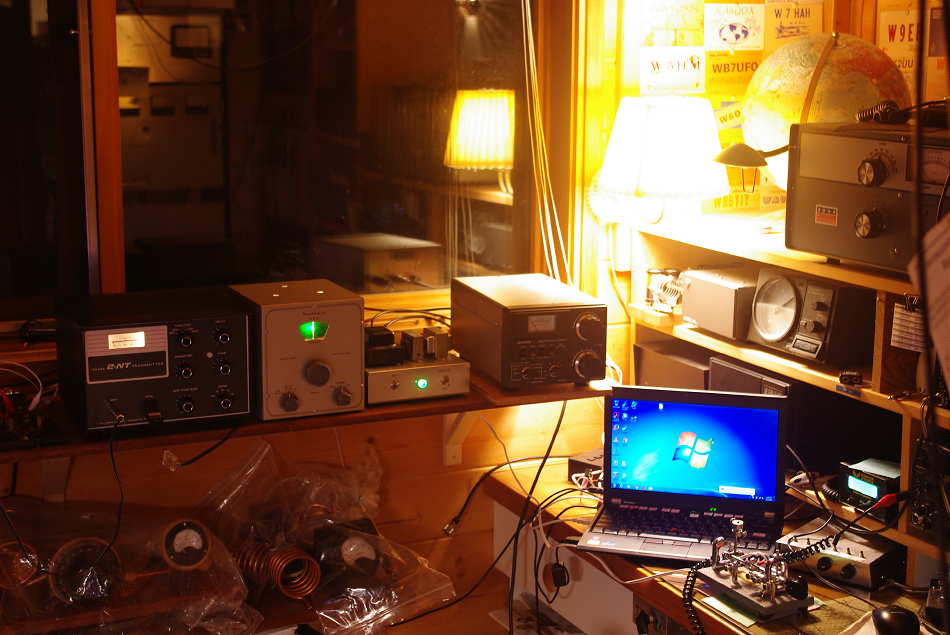 |
| VE7SL NRR with 2NT, VF-1 and my Original '63 Vibroplex |
Yet another 2NT packed a powerful punch from West Virginia, keyed by Dave, W3NP, when we exchanged 579 reports on 40m, 45 minutes before sunset.
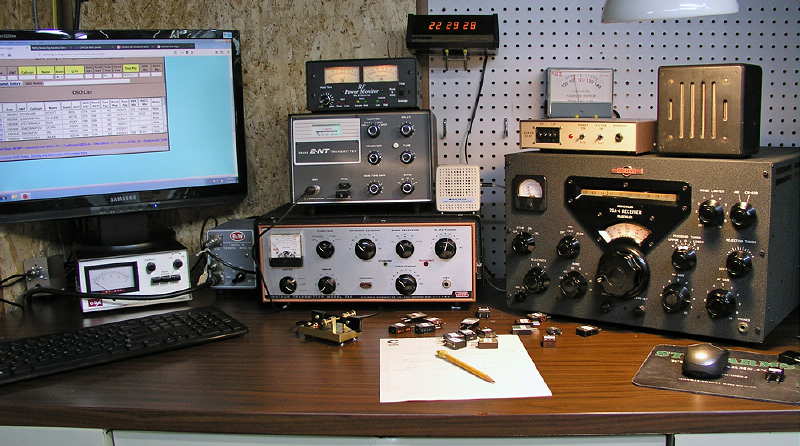 | |
| W3NP - NRR setup |
 |
| K2YWE's Globe Scout and Adventurer were worked on all three bands! |
My NRR exchanges with George, N3GJ (KA3JWJ) in Pennsylvania, truly demonstrated just how well the low bands were performing. More than an hour before my local sunset, I responded to his 569 40m 'CQ NRR' only to learn that his signal, now reaching a solid 579, was coming from an original Ameco AC-1! This one-tube crystal-controlled power oscillator has, over the years, reached Holy Grail status among many amateurs. Originals are guarded like precious jewels and handed down from father to son ... or in George's case, from uncle to nephew!
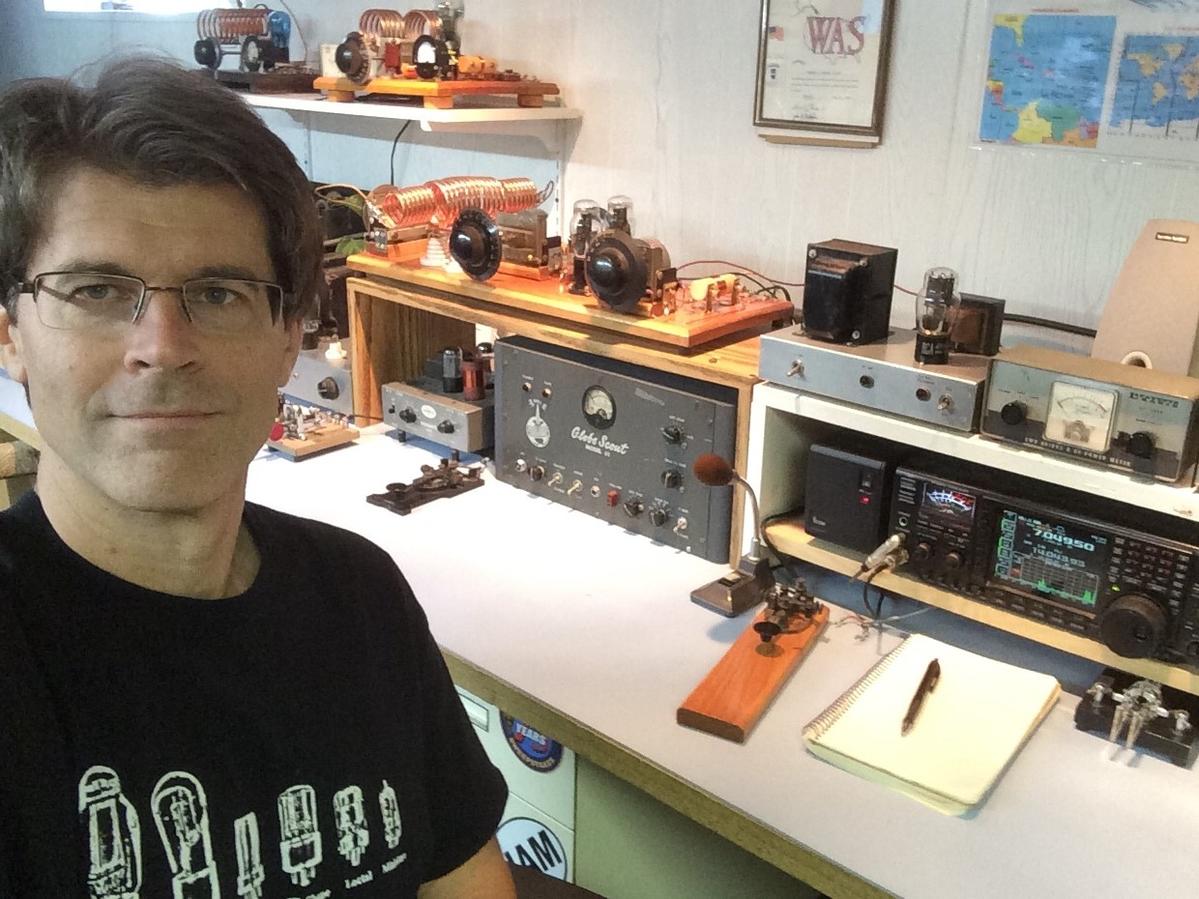 | |
| N3GJ and his all powerful original AC-1 |
I was astounded at the strength of George's signal and before exchanging '73's added 'CUL on 80', not really thinking how low the chances of that might really be. Two hours later, his even stronger 'CQ NRR' was heard on 80m, as his 579 signal flirted with reaching S8 ... all emanating from just a low hanging inverted-V. It's nights like this that remind me how I was bitten by the radio bug so many years ago and to have them coincide with the NRR was an added bonus. I've rated my contacts with George's AC-1 the highlight of this year's NRR for me!
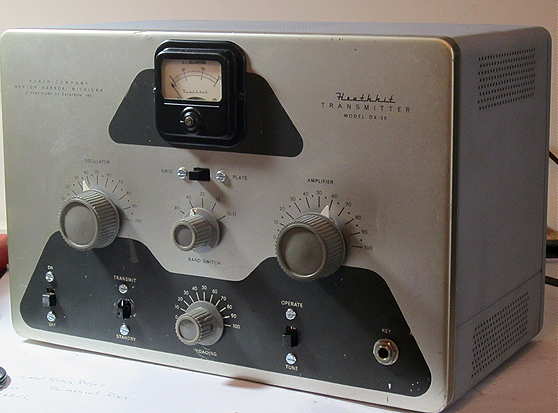
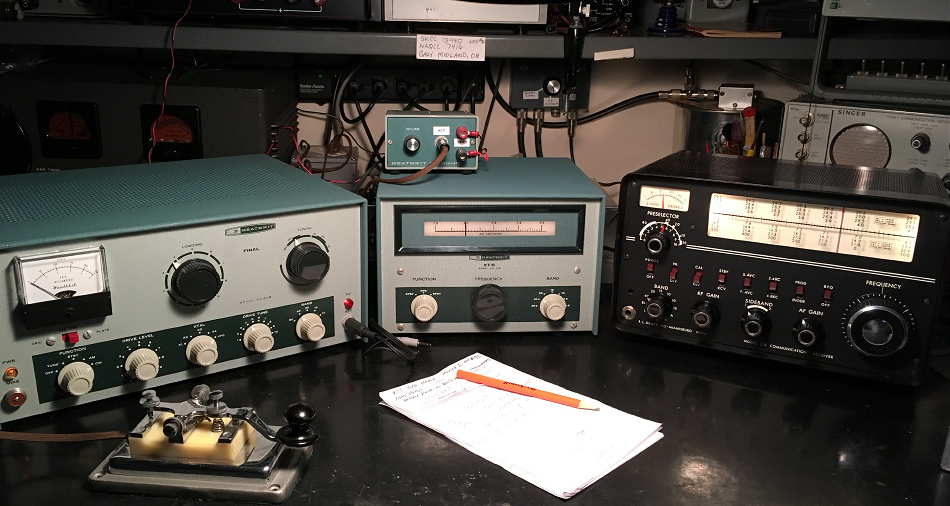
Heathkits were plentiful too, with the DX-60 seeming to be the rig of choice, often paired with the matching HG-10 VFO. Both Mark, VA7MM and Gary, W8PU, packed a wallop with these fine examples.
 |
| VA7MM - NRR |
 |
| W8PU - NRR set-up |
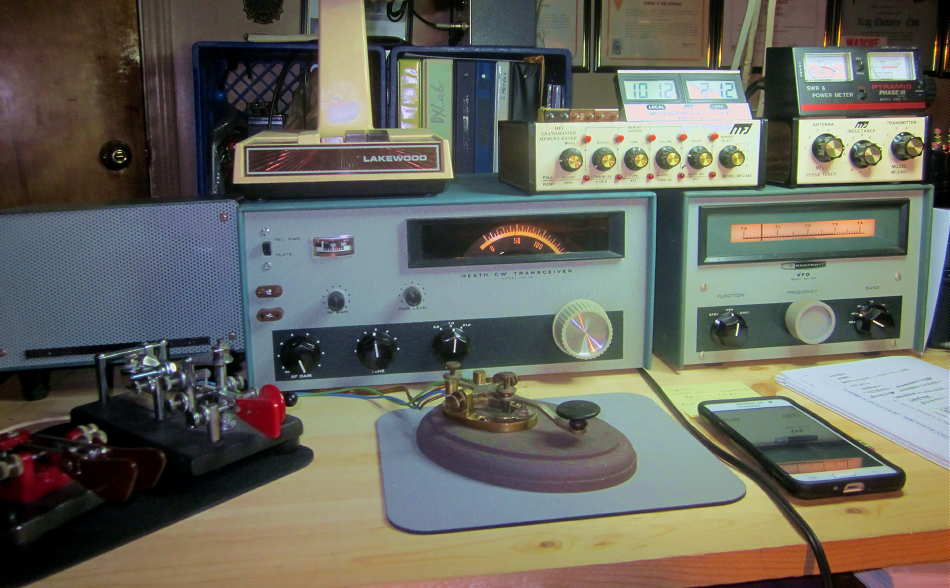
But it wasn't just DX-60s representing Benton Harbor engineering in the NRR. All of these neat old Heaths made it out to the west coast, sometimes on both 40 and 80. KN8RHM's (Rick) HW-16 made it here on 40m with a solid signal almost every night, while KE4OH (Steve) sported a modernized DX-20 in the form of Heath's HX-11. Steve even received the highly-treasured 'OO' report for his NRR chirp ... good job!
 |
| KN8RHM - HW-16 NRR set-up |
 |
| KE4OH - HX-11 NRR station |
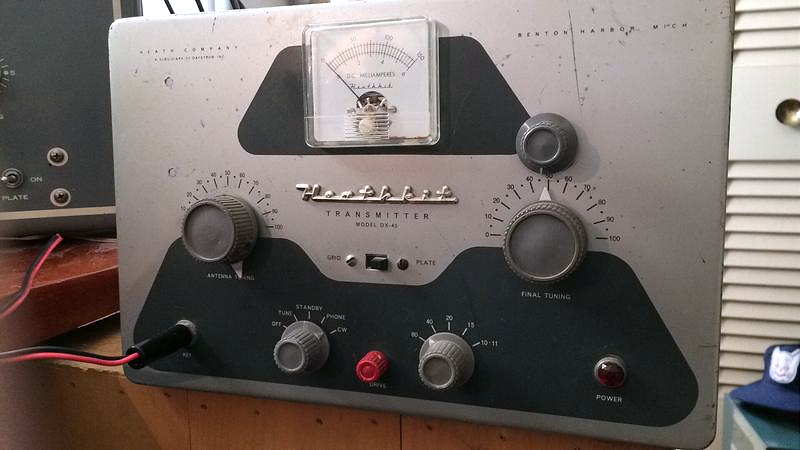
Not to be forgotten was the ubiquitous DX-40, used by several, including this proud old warhorse, lovingly keyed by Doug, N3PDT.
 |
| N3PDT - DX-40 NRR transmitter |
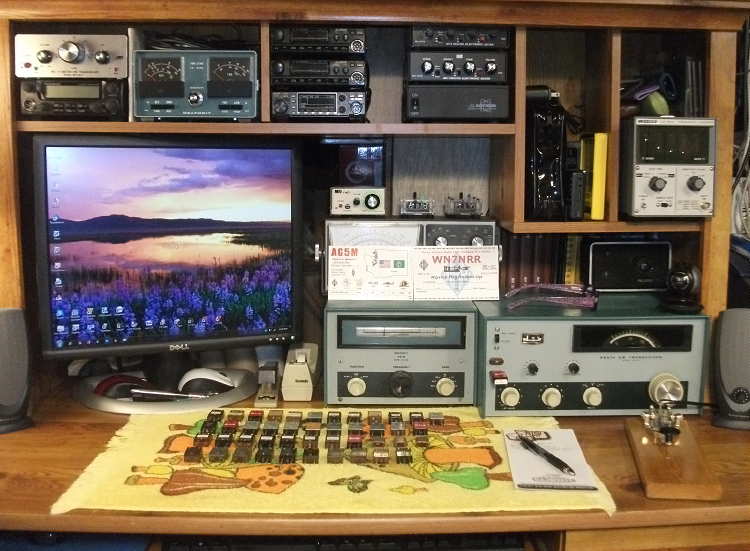
Rich, WN7NRR / AG5M operating in nearby Washington state put some of his 44 crystals to work with his HW-16 ... that's some collection!
 |
| WN7NRR - HW-16 NTT set-up |
It seems that many NRRers are as adept with a soldering iron as they are with a hand key, as several homebrew transmitters were worked from here as well.
Howie, WB2AWQ in Reno, was using his homebrew pair of 807s, driven with a Millen 90700 swing-arm VFO from 1945. Most shacks worldwide, including the Novices, found plenty of use for the 807 as they were dirt-cheap in the post war surplus market. The filament has a beautiful illumination and if a bit gassy as most are by now, emit a wonderous blue glow with each press of the key.
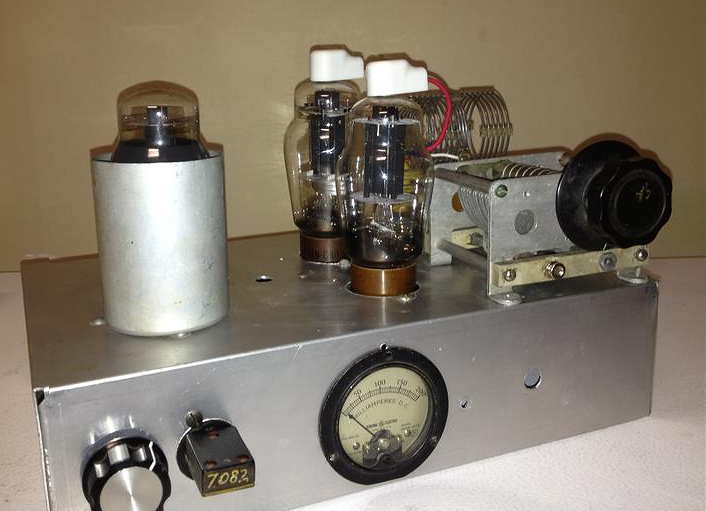 |
| WB2AWQ - 807s |
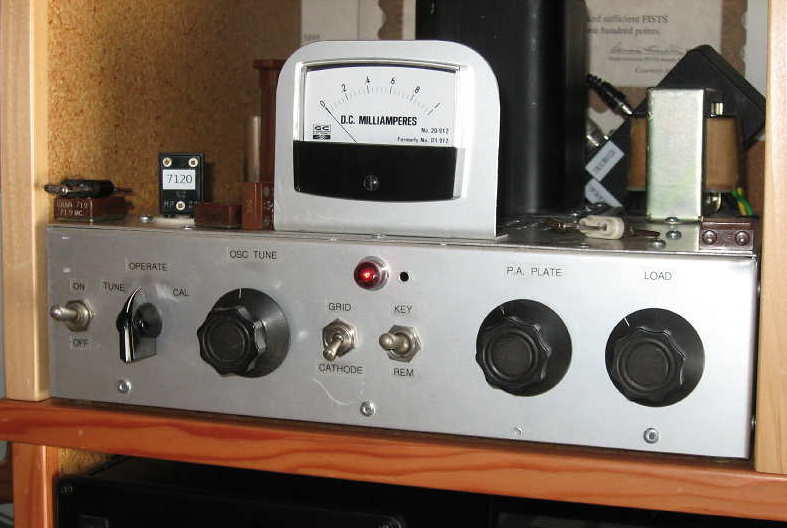 |
| KD7JG's 1625 NRR mainstay |
K4IBZ down in Florida also utilized the magical 6DQ6 sweep tube in his homebrew rig for 80 and 40m. Bill was worked on both bands from here with his 10 watts receiving a 569 on both contacts.
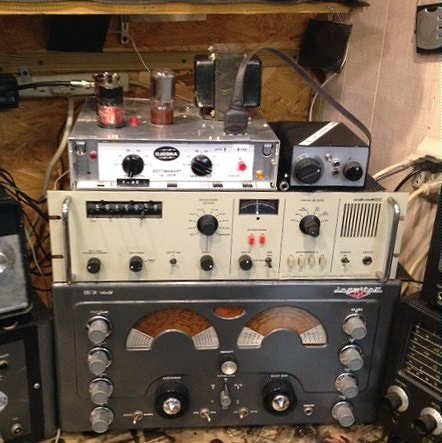 |
| K4IBZ's 10 watter |
AA8V, Greg in Maryland, used an LM-13 war surplus frequency meter to drive a popular Novice pairing of the 6AG7 / 6146 at 90W input ... good enough for a 579 report on 40m, 30 minutes before my sunset.
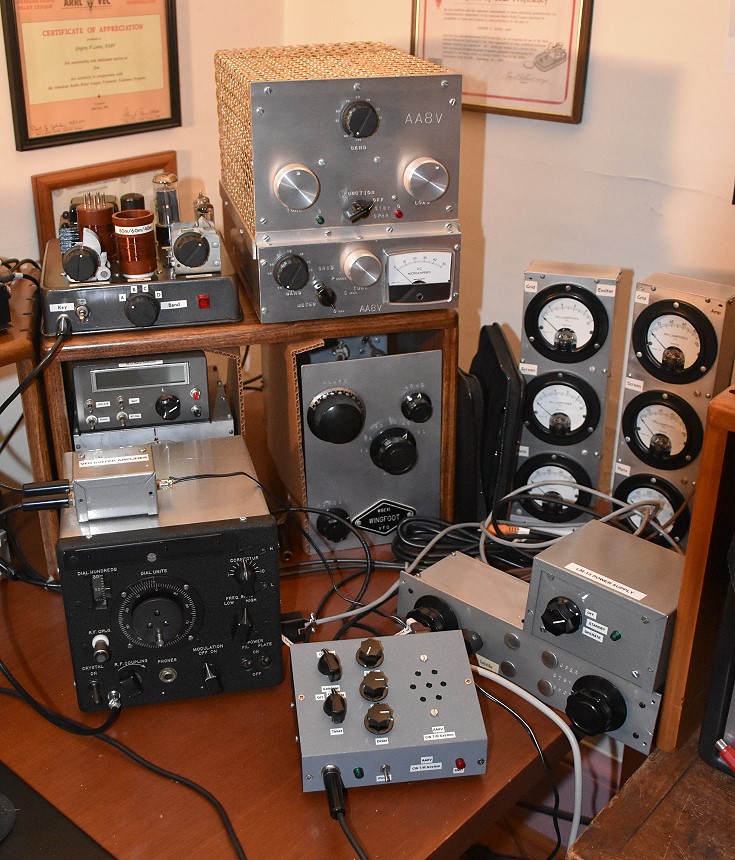 |
| AA8V's homebrew NRR stack |
 |
| VE3BDV / VE3AWA - 50C5 Bare - Essentials power oscillator |
As indicated on the NRR website, this is "more of an EVENT than just a typical contest ... once again taking our OLD ham radios off the shelf and putting them to use again! "
Steve McDonald, VE7SL, is a regular contributor to AmateurRadio.com and writes from British Columbia, Canada. Contact him at [email protected].
Ham College 74
Ham College episode 74 is now available for download.
Extra Class Exam Questions – Part 12.
E3A Electromagnetic waves: Earth-Moon-Earth communications, meteor scatter, microwave tropospheric and scatter propagation, aurora propagation, ionospheric propagation changes over the day, circular polarization.
55:43
George Thomas, W5JDX, is co-host of AmateurLogic.TV, an original amateur radio video program hosted by George Thomas (W5JDX), Tommy Martin (N5ZNO), Peter Berrett (VK3PB), and Emile Diodene (KE5QKR). Contact him at [email protected].
 Ham Radio Deluxe |
 W5SWL Electronics |
 Ham Radio Prep |
 KB3IFH QSL Cards  Hip Ham Shirts  HamRadioAuctions HamRadioAuctions Reliance Antennas Reliance Antennas Enigma Shop Enigma Shop |  morseDX  Ni4L Antennas  R&L Electronics R&L Electronics antennas.us antennas.us Ears to Our World Ears to Our World |
- Matt W1MST, Managing Editor
