 |
 Handiham World for 28 October 2009
 28 October 2009 | by
 Welcome to Handiham World!

The first order of business is the upcoming time change in November: Sunday, 1 November 2009, we move to standard time in the USA. The Handiham daily EchoLink net remains true to local time, so if you use local time to check in you will not notice any difference. However, if you use GMT, the net time appears to shift by 1 hour. Instead of beginning at 16:00 GMT, the net begins at 17:00 GMT. The first net affected by this change will be the Monday, 2 November EchoLink net.
For net managers, the time change means making sure that net control stations are aware of the plan to shift net times by one hour relative to Universal Time. The problem is certainly one for amateur radio nets that have worldwide participation, since different parts of the world may elect to follow a seasonal time shift. About 70 countries have at least some form of daylight saving time. Three notable exceptions are China, India, and Japan. A station checking in to the Handiham EchoLink net via the N0BVE repeater system in Minnesota would observe no difference next Monday, as the net would begin at what appears to that station to be normal local time, 11:00 in the morning. However, relative to GMT (which never shifts by the season), the net will now begin an hour later, at 17:00 hours GMT instead of 16:00 hours GMT.
An easy way to remember the difference is to know the “normal” number of hours between your local time and GMT. In Minnesota, where I live, the difference between local time and GMT is +6 hours. That means if the net is on at 11:00 hours in Minnesota, I add 6 hours to 11 hours and the total is 17:00 hours GMT. That is the same as 5:00 in the afternoon Universal Time.
In the summer, when Daylight Time is in effect, the difference between Minnesota time and GMT is only 5 hours.
So, to set forth a practical example, a station checking in from Japan will notice that the net now begins at 2:00 a.m. during the winter, when we shift to standard time. All summer, when Minnesota was on Daylight Time, that same station in Japan would see the net starting at 1:00 a.m., so you can see that it might be more difficult for Asian stations to keep the net schedule at such an inconvenient hour. We also get check ins from India, and since, like Japan, India does not shift times from Daylight to Standard, those stations will also observe that the net begins an hour later.
The Handiham Monday HF nets also remain true to local time, the only problem being whether or not we are even going to bother keeping these nets on the books, so to speak. The nets, other than the CW net, have fallen into disuse and might as well be abandoned. The relentless sunspot minimum with its poor band conditions has taken a toll on participation, and the RFI that prevented us from using our old station at Courage Center meant that we could not pick up the net if there was no other net control station available. We had a number of dedicated phone operators who stuck it out as long as they could on the 20 meter net, 14.265 MHz, but when stations just don’t show up, there really isn’t much of a net. A perennial problem with the 14.265 frequency is that the Salvation Army Net backs up against our net time and does not always change with the season.
It is time to decide what to do with these HF nets. The CW net stays in place on 40 meters, but the HF phone nets need a complete re-thinking. Let’s hear your ideas, now that the sun is again showing signs of life and solar cycle 24 will begin bringing us better HF band conditions. Oh, and let’s not assume that all the activity will be on 14 MHz and above. Maybe you would like to have a 75 meter net, or perhaps a 160 meter net, either of which would allow for fairly wide geographic coverage during the upcoming northern hemisphere winter. While nets are normally discouraged on 17 meters, we used to have an informal gathering on that band during cycle 23, when the band was open often. Alan, K2WS, started that “informal non-net get-together”. When band conditions became so bad that we just couldn’t keep the 17 meter non-net going, it simply died out. Maybe conditions will improve and we can get together informally on that band, or perhaps have a more formal net on a higher frequency band like 10 or 15 meters.
Think of the advantages of a 10 meter net:
Novices and Technicians can operate SSB phone between 28.3 and 28.5 MHz.
A quarter wave vertical antenna for the 10 meter band is only about eight and a quarter feet (2.5 meters) long. It is much easier to fit a 10 meter band antenna into a apartment or condo living situation than it is to fit a 20 meter antenna into that same space.
Band conditions will soon favor 10 meters with the solar cycle producing higher sunspot numbers. That means that smaller antenna systems and lower transmitter power will become practical for working HF again.
There is a lot of spectrum space on the 10 meter band. It is not crowded with stations as the 20 meter band is.
Modern multiband rigs cover the 10 meter band, so many of us already have the equipment we need.
The Handiham Remote Base station at Courage North operates on the 10 meter band, offering another way to get on the air.
Look, all I’m asking is that we mull this idea over and think about the HF nets. I hate to drop the 20 meter net altogether, but 14.265 MHz is just a very crowded frequency. We could consider running the net in a less crowded part of the band, but that would mean moving to the Advanced or Extra portions of 20 meters. Do you have any ideas about that? Perhaps it would offer even more incentive for some of our Generals to upgrade, but even if they don’t want to upgrade, there would be other nets that they could join on bands like 10 meters.
I guess we have to admit that every station is not going to be able to get on every net. The secret to building a successful on the air community is to have enough choices, alternatives that serve as many Handiham members as possible.
For Handiham World, I’m…
Patrick Tice, [email protected]
Handiham Manager

Pat Tice, WA0TDA, is the manager of HANDI-HAM and a regular contributor to AmateurRadio.com. Contact him at [email protected].
CQ WWDX SSB 2009
Things started out rough Saturday morning (UTC) on 40m. Worked TO7M on my first call then spent a frustrating hour or so with no contacts. After a break things started to improve a little. Stayed at the mic until around 0600 UTC (2 am local) and landed 12 countries/7 zones on 40m, plus Canada (zone 3) on 80m. Worked 20m and 15m for about an hour and a half in the morning before going out and about, and again early Saturday evening (UTC Sunday) for about a half hour. Worked 13 countries/9 zones on 20m, and 3 countries/3 zones on 15m. Sunday saw fairly good conditions on 15m (14 countries/7 zones) and 20m (9 countries/7 zones).


Paul Lannuier, WW2PT, is a regular contributor to AmateurRadio.com and writes from Texas, USA. Contact him at [email protected].
ICQ Podcast Series Two Episode Twenty-Two (25 October 2009) – Jota 2009
- School DSTAR linkup UK to USA
- High-speed D-STAR replaces AX.25 Packet
- New version of Airlink Express
- Early amateur television reception
- Mark M0IEO - CARS Amateur of the Year
- Greedy PLT
- Columbus antennas to take to the skies
- Family electrocuted erecting antenna
- Antenna dangers online tool
- GB7MBC DXCluster for mobile phones
- 161 km voice-powered QSO
- Winter Olympics Special Event
Your feedback, Martin, Jota 2009 and the latest series, hint, tips and tricks.
Colin Butler, M6BOY, is the host of the ICQ Podcast, a weekly radio show about Amateur Radio. Contact him at [email protected].
Remembering the C6APR team
In case you haven’t already heard, four of the operators of the C6APR station were tragically killed this week in a plane crash on their way to the station. Ward Silver, N0AX posted the following message to the CQ-CONTEST reflector, which I’m going to reprint here.
There have been several suggestions for on-the-air actions to remember the four ops lost on their way to C6APR yesterday. Perhaps a moment of radio silence – at the beginning of the contest or perhaps around the time of their flight. Or look back in your log to find the time of your most recent contact with them and take that moment out then. Maybe call C6APR at some appropriate time and wait for their signal. Putting a C6APR QSO in your log with a zone of 00 is another idea – I know that K7RA used show up in logs from the Pac NW for years after Homer’s untimely demise. Whatever seems appropriate to you, take some time out during the contest to not only remember the team, but to appreciate the other competitors. Let’s try to treat each other with a little extra respect this coming weekend as we’ve all just been reminded of how quickly a log can close.
73, Ward N0AX

David Kozinn, K2DBK, is a regular contributor to AmateurRadio.com and writes from New Jersey, USA. Contact him at [email protected].
Handiham World for 21 October 2009
Well, as we have been reporting, the Handiham headquarters station and offices are moving to Camp Courage. Most of the move has been completed, and now we begin the process of getting things organized. Most of our contact information remains the same. The Handiham.org website will be maintained and will have the latest news.
Thursday, October 15 was the “official” moving day, but as anyone who has ever moved an office or household knows, the movers get the boxes and furniture off the truck and into the new space, and then they leave and there you are with the feeling that the real work is about to begin.
And so it is: You have to get things situated, and with a ham station that means you have to plan for antennas and power. Fortunately, we already had a station and antenna in place at Camp Courage, and even though it is really not up to the standards we would like, it is a functional installation. When I arrived to meet the movers, I determined that the station would stay in its current location, near some windows with good lighting and proximity to antenna cabling and power outlets.
The antenna is a GAP vertical, and the station transceiver already in place was an old Kenwood TS-430. I quickly decided that a rig without a built-in voice module for our blind users was simply not acceptable. I unpacked and installed a Kenwood TS-570SAT and a Kenwood power supply in short order and situated it on a desktop immediately to the right of our station cabinet, one that is similar to those at Courage St. Croix and Courage North. The TS-570SAT tuned the GAP vertical immediately on 75 meters, which was quite a relief – after all, it was raining and around 45 degrees outside, and I didn’t feel like stringing up another antenna!
My first contact from W0ZSW at Camp Courage was with Lyle Koehler, K0LR, who was net control for the popular regional net called “PICONET”. The net meets mornings and afternoons on 3.925 MHz, and has a long history of collaboration with the Handiham System. Lyle, you may recall, is our volunteer engineer in charge of the remote base station at Courage North. Lyle might have been just a little generous in reporting an S-9 signal from W0ZSW, but at least we are able to get out on the GAP, so the station is usable.
There is no VHF/UHF antenna at Camp Courage, so that is definitely something that needs work. Our location at the Camp Courage Reception Center is a good one, because there is already a TV antenna mast on the building, and we could probably get an antenna on that mast without too much trouble. In the meantime, I was able to check in to the daily EchoLink net using a computer. Since Camp Courage is located about 40 miles west of the Twin Cities, the VHF/UHF situation is completely different than it was for us in the metro area.
There is also a working tribander for 20, 15, and 10 meters on a 50 foot tower. The rotor and coax leads are terminated in a different (but nearby) building. This means that a second station can easily be set up in that second building during radio camp, and it would likely not interfere with operations on the main station in the headquarters office.
Boxes are stacked on the floor and there’s a lot to do. Bear with us while we whittle this job down bit by bit. In the meantime, we will keep up our Wednesday e-letter, tape production, and Friday audio lectures as usual.
Questions may be directed to Handiham Manager Patrick Tice, WA0TDA, anytime at [email protected].
For Handiham World, I’m…
Patrick Tice, [email protected]
Handiham Manager

Pat Tice, WA0TDA, is the manager of HANDI-HAM and a regular contributor to AmateurRadio.com. Contact him at [email protected].
IOTA 2009 Contest Results – Seriously?


Paul Lannuier, WW2PT, is a regular contributor to AmateurRadio.com and writes from Texas, USA. Contact him at [email protected].
Handiham World for 14 October 2009
Welcome to Handiham World!
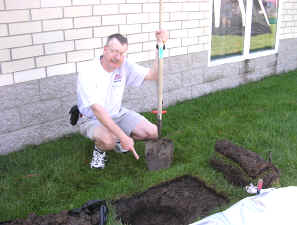
Photo: Here I am pointing to the spot we had to excavate for repairs after putting a ground rod directly through an irrigation system pipe during Field Day one year.
A story you will be hearing about in the weekly amateur radio news is a tragic one. ARRL and commercial media are reporting the deaths of three family members by electrocution during an antenna project. Says ARRL, “At approximately 8:40 PM on Monday, October 12, a man, woman and their 15 year old son were killed while trying to erect a 50 foot vertical antenna at the home of the man’s mother, Barbara Tenn, KJ4KFF, in Palm Bay, Florida. The deceased were not licensed amateurs.”
You can read the rest of the story on the ARRL site, and you should, because one of the best ways to follow up on a serious accident like this one is to take a look at the facts and begin a serious discussion about what went wrong and how to prevent another accident in the future. I will let you read the ARRL story and watch the TV news report for the details, but this story did serve to remind me of the days long ago, when Don, W0DN, now a silent key, and I started the little antenna company in Butternut Township, Blue earth County, Minnesota. Don lived in an old, rural schoolhouse, and the property was actually pretty good for an antenna business because even back in the mid-1970’s it was served by underground power lines. There was no chance at all to inadvertently swing a piece of aluminum tubing up into a power line while you were busy thinking about running another SWR check and trying to be as quick about it as possible so as to get as many tests in as possible. Of course there were always other things to be careful about, but the “work area” was clear of overhead hazards, and it needed to be, because in the day in, day out routine of putting up antennas, complacency would inevitably set in and one would lift a vertical antenna up without looking skyward first.
Complacency. It’s a phenomenon that is well understood and respected by trainers in aviation, driving, firearms, law enforcement… The list is endless. The way it works is that you learn about procedures that ensure the highest level of safety in whatever endeavor in which you engage, and you follow these “best practices” faithfully many times until they become routine. Nothing bad has ever happened, so you become a bit complacent – maybe you don’t really need to go through that checklist each time. After all, you have never had an accident, and you know what you are doing.
Than, without warning, it happens. An “accident” that causes property damage, injury, or even death. In firearms training, it is the time even an experienced range instructor, a fellow who had given me instruction, leaves a loaded weapon within reach of a toddler – I will never forget the tragedy that his family had to live through when distracted, he left for only a moment, and one of his twins picked up a pistol and shot the other twin. In ham radio, it happens when someone works on powered up equipment or rushes to put up an antenna without looking for wires.
I doubt that it is even possible to buy a commercial antenna designed to be installed outdoors that does not carry a hazard warning about looking up and avoiding powerlines. We put them on our products way back then, but manufacturers cannot control the installation of their antennas. Amateur antennas are certainly safe enough to install and use, but they are likely to be put up in places that are full of compromises. Unlike commercial antenna installations, amateur antennas are usually not at a site designed for antennas. There might be a need to mount the antenna on a residential roof. There could be power lines running along one side of the property and a “drop” from the power pole to the house. Neighboring houses might be relatively close by. There may be vegetation or trees. All of these things are potential hazards that must be considered before you even decide what kind of antenna to install.
Starting with a plan is a good idea. If you cannot see the proposed installation yourself because you are blind or cannot access the site for some other reason, you need to get some help from your radio club. I like to take a look at a proposed site and sketch a rough drawing that includes the house, the dimensions of the property, the locations of overhead powerlines and underground utilities, and any trees, other buildings, or possible obstructions. Although there is usually a “one call” service that a homeowner can phone to get a free location assessment of underground powerlines, water pipes, and natural gas lines, you are still on your own when it comes to underground lawn sprinkler systems. Since those will not be located by the “one call” service, you will likely not have them on your sketch and will have to dig carefully.
It is always a good idea to plan antenna work for a time when you will have at least one “spotter” to help you out. A spotter is a person who does not necessarily climb towers or pull coax, but who will be there for you if you have an accident and help needs to be summoned.
Be sure you begin a big project early enough to assure that you will have daylight to complete it. If Murphy intervenes and you fall behind schedule, stop working before darkness falls and continue your project another day. In the tragic story that opened this piece, the antenna crew had run out of daylight and were working in the dark.
Be aware of the limitations your work crew might have. The people helping with a project may be enthusiastic and well-intentioned, but they may not know the safety basics. In this case, the crew were family members who were not licensed amateurs.
There is a fine line between “Monday morning quarterbacking” and a thoughtful discussion of what went wrong in the Florida story. One thing I do have control over is what happens the next time I put up an antenna myself. I can take charge of the project and have a plan. While that won’t necessarily ward off every possible accident, it will certainly make the project safer – hopefully as safe as it can be.
For Handiham World, I’m…
Patrick Tice, [email protected]
Handiham Manager

Pat Tice, WA0TDA, is the manager of HANDI-HAM and a regular contributor to AmateurRadio.com. Contact him at [email protected].
 Ham Radio Deluxe |
 W5SWL Electronics |
 Ham Radio Prep |
 KB3IFH QSL Cards  Hip Ham Shirts  HamRadioAuctions HamRadioAuctions Reliance Antennas Reliance Antennas Enigma Shop Enigma Shop |  morseDX  Ni4L Antennas  R&L Electronics R&L Electronics antennas.us antennas.us QRV QRV |
- Matt W1MST, Managing Editor
