 |
 3830 Claimed Scores | 2010 Russian DX Contest | Low Power
 24 March 2010 | by
 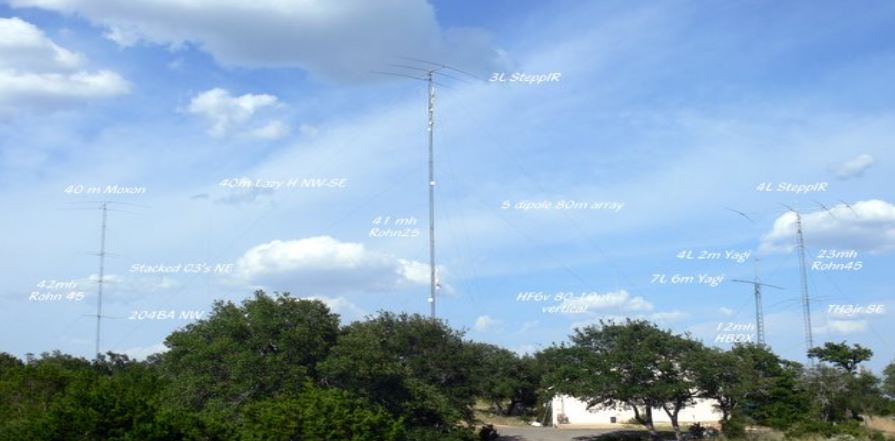 Multi Single.
- N5AW | 678 CW | 158 SSB | 197 DXCC | 76 Oblast | 22hr | 1,185,093 Points.
n = 1 score submitted in this category.
Single Operator.
- YT3M (YU2FG) | 1543 CW | 220 DXCC | 232 Oblast | 24hrs | 4,124,952 Points [SKY CC].
- US0HZ | 1270 CW | 174 DXCC | 206 Oblast | 20hrs | 2,967,800 Points.
- S56A | 817 CW | 216 DXCC | 185 Oblast | 18hrs | 2,286,502 Points.
n = 32 scores submitted in this category.
Single Operator Mixed.
- XU7ACY | 865 CW | 60 SSB | 130 DXCC | 157 Oblast | 10hrs | 1,910,846 Points [FRC].
- EI4CF | 296 CW | 449 SSB | 185 DXCC | 140 Oblast | 17hrs | 1,552,984 Points.
- PY2NY | 450 CW | 225 SSB | 130 DXCC | 81 Oblast | 14hrs | 844,844 Points [Araucaria DX].
n = 9 scores submitted in this category.
Congratulations YT3M for leading Club SKY to a first place finish while Team N5AW scored a top slot with heavy metal in the aire! An accomplishment well done from both sides of the Atlantic while XU7ACY rocked the Asian multiplier grid with his stellar CW effort.
Contest on!

Scot Morrison, KA3DRR, is a regular contributor to AmateurRadio.com and writes from California, USA.
Handiham World for 24 March 2010
Welcome to Handiham World!

Recently we talked a bit about how to put some logic into your decision making when you are comparing equipment or antenna performance. The topic was the venerable A-B test, using a two-way switch that could be connect first one antenna, then another. The idea behind this kind of testing is to eliminate as many variables as possible so that we are really just comparing the two things that we want to compare. After all, using separate transceivers (each one connected to its own antenna) puts into play the extra variable of radio performance when what we really want to do is compare one antenna to another one. It makes much more sense to use a single radio and an A-B switch with the common side connected to a single radio and the switched outputs each connected to separate antennas.
Now I would like to introduce you to another related concept to help you work your way through troubleshooting. It is called a “decision tree”. A decision tree gets its name because it branches out much like a tree. From the main trunk, let’s say there are two large branches. From each of those branches there are two more, and so on. At the base of the tree it is easy to see just the trunk, but high up in the air atop the tree there are thousands of branches. The concept of the branching tree can help us to solve problems with our electronic equipment. Decisions must be made logically and empirically, beginning at one point where the symptom of the problem presents itself and is easy to see, much like the trunk of the tree. Sometimes there may be many, many possible causes for that very same symptom — all of these possible causes are represented by the many branches at the top of the tree. If we look at the top of the tree, we will see a confusing collection of branches, or possible causes to our problem. The idea of the decision tree is to start at the trunk with the most obvious symptom and follow the branches outward and upward until we arrive at the single twig at the top of the tree that is the cause of our problem.
Now, let’s see how this works with a problem that most of us have encountered with our radios.
Let’s say that we go down to the ham shack in the basement and turn on the HF radio. Oddly enough, nothing seems to happen; no sound comes out of the speaker. Of course with a problem like this there can be many possible causes. Putting the idea of the decision tree to work for us can save time and effort as we work our way logically toward a solution to the problem.
1. Did the radio power up?
If the answer is yes, proceed to number two.
If the answer is no, we follow this branch:
Is the power switch in the on position?
If the answer is no, turn on the power switch and your problem is solved.
If the answer is yes, you now have another branch to follow:
Is the radio getting power from the power supply?
If the answer is no, you need to follow another branch:
Is the power supply is turned on?
If the answer is no, turn on the power supply and the power is now available to the radio and you may proceed to operate normally.
If the answer is yes, you are off to the next branch:
Is the power supply plugged into a live AC outlet?
If the answer is no, you need to plug it in or find another outlet that is live, then proceed to operate normally.
If the answer is yes, you need to check the fuse or circuit breaker in the power supply and proceed along a line of determining a problem with the supply rather than the radio.
2. Is the audio gain turned up high enough to hear sound?
If the answer is no, turn up the gain and proceed to operate normally.
If the answer is yes, you are off to the next branch:
Is there any sound at all when you listen closely, such as a weak hiss?
If the answer is no, you will want to follow a line of checking external speaker connections, whether headphones have been left plugged in by mistake, and so on. Several more branches can be followed here – you get the idea.
If the answer is yes, you will want to follow several other branches that will include checking the RF gain control, the antenna connection, any tuners or other accessories in the feedline, and so on.
As you can see, a decision tree can be quite long and branching, even for a simple problem. However, the idea is to begin logically with the things that are easiest to check and most likely to be the cause of the problem. It certainly wouldn’t do to immediately run outside and check the antenna if you didn’t hear sound from the radio. Audio gain controls that are turned down, squelch controls that are turned up too high, RF gain controls that have been turned way down, or an antenna switch that is in the wrong position are all more likely causes of the problem. Furthermore, you wouldn’t want to start working on repairing your transceiver if a circuit breaker in your house’s main breaker box has tripped, causing the outlet into which your power supply is plugged to be dead. It is all about following a logical, thoughtful path in problem solving.
Believe me, this is not something that new ham radio operators — and even some with extra class licenses — always know how to do. Logical troubleshooting is something that can be learned by experience. Sometimes equipment repair manuals include graphical decision trees to help technicians working at the service department proceed through the diagnostic process and a logical and efficient manner. These days, software can help us make decisions as well, but I would like to see our Handiham members be as independent and self-sufficient in troubleshooting basic problems as possible. At the upcoming Minnesota radio camp we will be considering how to solve basic problems in the ham shack. Practicing this skill makes us all more independent and ultimately better operators. After all, amateur radio is a technical activity, and we should be able to do some basic troubleshooting.
For Handiham World, I’m…
Patrick Tice, [email protected]

Pat Tice, WA0TDA, is the manager of HANDI-HAM and a regular contributor to AmateurRadio.com. Contact him at [email protected].
Amateur Radio Crucial to Healthcare Reform
"Today the Shortwave Intelligence Task Force, a part of the CIA, intercepted radio transmissions in what is known as '80 meters', an amateur radio communications band. Several amateur radio hams discussed the details in the healthcare reform package to harvest organs from aging ham radio operators." Upon hearing this the press corp chuckled but was interrupted by Obama who raised his hand and gave a serious look across the audience. "The claims are true. Amateur radio operators are crucial to healthcare reform. A large portion of healthcare costs are due to patients with failing organs and there just aren't enough organ donations to support the growing need. Nearly every other modern civilized country in the world has universal healthcare.... and they all harvest organs from their ham radio operators."
The media, understandably, was abuzz after the announcement. CNN reported last night that they attempted to determine the exact source of the amateur radio transmissions in order to interview the radio amateurs who discovered the sinister plan, but were unsuccessful, noting the amateurs were part of a secret organization known simply as "Four Land". On Fox "News", Glenn Beck spent the first half of his daily TV show explaining the difference between broadcast radio and ham radio and them proceeded to sob uncontrollably for the remaining half hour mumbling something about his kidneys. Rush Limbaugh, who has been off the air for the past week attempting to find a new home in a country that, in his words "has running water and electricity but not socialized medicine", didn't do a live radio show but I'm curious what he has to say.
ARRL praised the plan on their website but reminded amateurs that they could not receive renumeration for donating organs while on the air.

Anthony Good, K3NG, is a regular contributor to AmateurRadio.com and writes from Pennsylvania, USA. Contact him at [email protected].
Dead loss
One of the things I have long wanted to do in this hobby is build a hand-held transceiver. I tried once back in the 1970s but the receiver didn’t work and the project eventually ended up in the garbage. Many months ago while browsing Roger G3XBM’s website I came across an old project of his called the Fredbox, a small, low-power hand-held 2m transceiver. This rekindled my desire to try to make my own VHF handy transceiver so I started the process of accumulating the parts that would be needed to make my own Fredbox.
However there were two problems. Roger designed the Fredbox as an AM (amplitude modulation) transceiver, a mode that was probably still in common use back in the 1970s when he first made it. Here, the only chance of making a contact with such a radio is if it transmits on 145.500 in FM mode, so I would have to modify the transmitter to produce FM instead of AM.
The other problem is that the Fredbox transmitter is crystal controlled. The days when suppliers advertised crystals for popular FM frequencies in RadCom at reasonable cost have gone, along with the crystal controlled transceivers that used them. I didn’t know where to obtain the crystal I would need but hoped that someone might have crystals from an old 2m radio that they wanted to get rid of.
 My luck seemed to be in when, a couple of months ago, someone started selling batches of 2m crystals from old Japanese radios on eBay. I bid for and obtained three batches containing crystals for 145.450, 145.500 and 145.550MHz. I don’t know what radios these crystals were originally for or what oscillator circuit they were used in but by using the XBM80 as a test oscillator it appeared that most of the transmit crystals oscillated at around 12.1MHz.
I tried breadboarding the first oscillator stage of Roger’s Fredbox circuit in order to experiment with ways of FM-ing the signal but the crystal did not seem to be oscillating. I did some searching for other 2m FM transmitter circuits in the hope of getting some inspiration and came across one using an MC2833P IC – a complete FM transmitter on a chip. This seemed like the ideal solution, especially as the crystal used to get 144MHz output was 12MHz just like the crystals I had. Unfortunately I couldn’t find a supplier of this chip until on a whim I typed the part number into eBay. There was someone selling one chip! I ordered it and it arrived in the post this morning.
I built up the circuit from the application note on my breadboard (as you can see in the photo) but to my dismay I could not detect any signal when using any of my 2m TX crystals. It was very disheartening. I didn’t know if the chip was dead, whether I’d blown it by accidentally shorting together wires from components on the breadboard, or whether it was just a very fussy circuit. I experimented with different components and coils and got nowhere. I was just going for lunch when I had the idea to try one of my QRP CW frequency crystals. I had one for 10.106MHz and another for 14.060MHz. With both of those crystals I could detect not just a strong carrier on the fundamental frequency but also plenty of output in the 140MHz region. The chip is working, the problem is my eBay crystals!
The question is, what to do now? I guess the crystals I bought, being probably 35 years old, have deteriorated with age and are reluctant to oscillate. It appears that the only way to proceed with the project is to get a brand new 12.125MHz crystal custom made, if possible.

Julian Moss, G4ILO, is a regular contributor to AmateurRadio.com and writes from Cumbria, England. Contact him at [email protected].
Narrow minded
Due to having been banned from using the software I have not been keeping up with what is going on in the development of the ROS digital mode. However there have been a few interesting postings about it. In the digitalradio Yahoo group Skip KH6TY has posted the results of some tests conducted with ROS on 432MHz which appear to show that it suffers badly from the effect of doppler shift and flutter experienced at those frequencies, failing to decode over paths where Olivia was successful and even SSB was readable.
This has prompted a rebuttal from the ROS author, which however seems to overlook the problem of doppler distortion encountered by Skip. He has posted a series of comparisons between ROS 2250/8 and Olivia 32/1000 which purport to show that ROS holds up while Olivia prints garbage. He concludes: “The difference between both systems is about 5dbs (3.16 in natural units). This means that ROS8 need 3.16 times less power than OLIVIA 32/1000 to establish a QSO to 150 characters/minute.”
Assuming that this is true, I nevertheless feel that a tradeoff of bandwidth for power or speed is inappropriate in the context of the narrow HF band allocations for digital modes. Most amateur QSOs do not need to go at 150 characters/minute (most people can’t type that fast). On the other hand the 2250Hz wide ROS transmission blocks three channels that could be used for Olivia 32/1000, and even more channels that could be used for a narrower mode. The use of 2250Hz ROS effectively limits the number of people who can simultaneously hold a digital QSO.
Even if it is true that Olivia needs 3 times the power than ROS to get through, Olivia is still a better choice of mode in the real world, because it is easier to increase the power 3 times or to switch to a slower mode than to find extra space within the HF allocations to accommodate the use of such a wide mode.
ROS would be less of a problem if people used it only in circumstances where it would not be possible to communicate using a narrower mode. Unfortunately that discipline does not exist among today’s radio amateurs. People are using ROS to make contacts with others whose signals are strong enough that 30Hz wide PSK31 could be used. This is just selfish, and it is the reason why I feel that such a wide digital mode should not be permitted on HF at all.

Julian Moss, G4ILO, is a regular contributor to AmateurRadio.com and writes from Cumbria, England. Contact him at [email protected].
GroundWave

 I removed my Rip Curl 4×3 wetsuit from storage and discovered some serious funk growth since my last session. My sabbatical from surfing was more of a sabbatical from physical fitness in general. I was seriously burnt out from my military years in the Air Force however something happened between then and now.
It’s called middle age and those calories do not burn away like those invincible years of youth. My waist line has grown substantially since the days of the battle dress uniform. Likewise, I have things to consider like blood pressure, cholesterol levels, and relaxation.
I have surfed up and down the central coast of California although age brings on a different perspective. The urge to chase big waves has since retired itself instead I’m looking for the soulful, don’t harsh my mellow, surfing experience. Relaxation out in the ocean searching for the perfect Old Man wave is the goal.
I’m introducing GroundWave with further copy to follow at Jeff, K1NSS’s DashToons as well.
I want to promote in addition to ham radio, a healthy lifestyle, and surfing is a perfect fit at achieving this goal. Afterall, blogging is a personal journal, one that is shared with a community of friends. I hope you will enjoy the life and times of a middle aged surfer who happens to love ham radio.
Surf to live, live to surf.
P.S. The serious funky mold was cleaned from the wetsuit including my rash guard and booties as seen in photograph number two.

Scot Morrison, KA3DRR, is a regular contributor to AmateurRadio.com and writes from California, USA.
Giving up the fight
Back in December I wrote that the RSGB had set up a Spectrum Defence Fund to enable radio amateurs to contribute towards the cost of a legal challenge to the UK spectrum management authority’s failure to take action over the interference caused by power line networking devices. Pleased to see some positive action being taken I made a donation and also posted links on my blog and website to encourage others to do the same.
Today I noticed, at the end of the RSGB Annual Report, the statement that “following advice from the Society’s solicitors … it was decided not to proceed at this time with any legal action.” So the RSGB has given up the fight and I have removed the links to the Spectrum Defence Fund from my website so that no-one else wastes any money on it.
 Although PLT devices are a killer for any radio amateur unfortunate enough to live next door to one, it is clear from the noise at my own station and the comments I received from others with a similar problem that PLT is just the thick end of the wedge. A far greater number of short wave enthusiasts are having their enjoyment of HF ruined because of rising noise levels from a multiplicity of devices that individually would not be particularly intrusive. Whilst it is possible to track down and do something about a PLT installation, eliminating the noise that most of us in urban areas now experience from all directions would require the willingness of all neighbours to co-operate with finding the interference-generating devices and agreeing to replace them. This isn’t likely to happen. I fear the battle to keep the short wave bands free of interference is over and ham radio is a lost cause.
The only place to enjoy HF radio nowadays is out in the country, which unless you happen to live there means operating portable or mobile. The question is whether only being able to operate portable or mobile is enough to maintain most people’s enthusiasm? Although I recently enjoyed operating from my car on a couple of fine afternoons, it is no substitute for being able to go into the shack on a wet day or a winter evening and have a tune around and make a few contacts. I find I am turning on my K3 less and less often these days and when I do I often turn it off again soon afterwards without making any QSOs.
Will ham radio will still exist in ten years’ time? Many former short wave and FM radio stations now broadcast over the internet rather than the airwaves and I suspect that an increasing number of ham radio operators will end up doing the same. They will get worn down by the losing battle against electrical noise and antenna restrictions and be forced to swallow their objections and switch to online “virtual ionospheres” like QSONet and HamSphere (shown above) where there is no QRN. You only need to visit the HamSphere site to see the number of amateur license holders that have taken this step already.
The RSGB’s apparent acceptance that it can’t fight even a clear case of interference to short waves is clear evidence that this is a war we can’t win. Final surrender is just a matter of time.

Julian Moss, G4ILO, is a regular contributor to AmateurRadio.com and writes from Cumbria, England. Contact him at [email protected].
 Ham Radio Deluxe |
 W5SWL Electronics |
 Ham Radio Prep |
 KB3IFH QSL Cards  Hip Ham Shirts  HamRadioAuctions HamRadioAuctions Reliance Antennas Reliance Antennas Enigma Shop Enigma Shop |  morseDX  Ni4L Antennas  R&L Electronics R&L Electronics antennas.us antennas.us QRV QRV |
- Matt W1MST, Managing Editor
