 |
 Ham Radio Odyssey | XR0Y’s 21st Century Journal | Part Seven
 11 April 2010 | by
 XR0Y Videoblog part 7 from SQ8X on Vimeo.
Team work leads to success.
Obstacles whatever they maybe either strengthen a team or creates cliquish-like behavior ultimately diminishing team potential. In the previous installment, Stan faced his deepest challenge through the darkest of the night. Instead, when everything from weather to human nature seemed against him, SQ8X followed the team’s mission and goal statement.
Zbig, SP7HOV tied in the entire experience while Stan questioned him about the RTTY swarm on 17 meters, “Beautiful.”
Believe in your signal.

Scot Morrison, KA3DRR, is a regular contributor to AmateurRadio.com and writes from California, USA.
ICQ Podcast Series Three Episode Eight (11 April 2010) – Test Equipment Review
Series Three Episode Eight of the ICQ Amateur / Ham Radio Podcast. News Stories include:-
- DRM minimum receiver requirements
- The Birth of British Broadcasting
- UK CubeSail satellite (Joke?)
- Calls on Iran to stop jamming
- Peers fear backlash over radio
- 760–780 MHz Experimental License
- GB3GJ online by end of May
- 9kHz Receiving Equipment
- Revival of Worked All Ireland
- Understanding SDR
- Lottery award for ARC
- Ham makes Great Smoky Mountains rescue
- New version of ROS released
- Improvements to licences in Bahrain
- Copper Wire (Joke)
Your feedback, upcoming events and Martin (M1MRB) reviews Peak Electronics test equipment.
Colin Butler, M6BOY, is the host of the ICQ Podcast, a weekly radio show about Amateur Radio. Contact him at [email protected].
Ham Radio Odyssey | XR0Y’s 21st Century Journal | Part Six
XR0Y – part 6 – we are at Rapa Nui! from SQ8X on Vimeo.
Stan, SQ8X’s positive attitude reflects an ability to bring together like minded team members. A successful team, in most cases, will mirror the attitude of its leadership.
Leadership is exemplified by one’s ability to connect with zeitgeist or the spirit of the times. SQ8X demonstrates essential qualities like empathy in addition to persevering against adversity. Perseverance is a quality of leadership that I admire. Life is not always a silver spoon and how one deals with adversity is a good measure of character.
73 from the shack relaxation zone.

Scot Morrison, KA3DRR, is a regular contributor to AmateurRadio.com and writes from California, USA.
Snag
The diode I ordered yesterday to do the mod on the TH-205E came this morning, but it is a bit big.
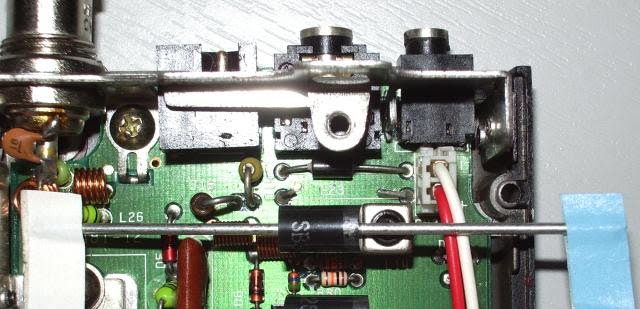 It looks as if I might have to use a thin wire link after all.
The diodes I ordered have a rating of 3A whereas the one specified by Kenwood – part number ERB83-004 – is rated at 2A. You can see an ERB83-004 which is used as a reverse polarity protection diode mounted vertically just to the left of where I hoped to put this one in. It is much smaller.
There is room for the big diode but it will not be easy to get a soldering iron bit in and trying to solder such heavy leads to the thin leftovers of the old one could result in more problems.
Back to the drawing board.

Julian Moss, G4ILO, is a regular contributor to AmateurRadio.com and writes from Cumbria, England. Contact him at [email protected].
This Weekend In RadioSport | Cosmic Fun
 RadioSport Russia | Yuri Gagarin International DX.
Building a successful franchise is a patient endeavor and RadioSport Russia is on the way toward that goal. There is an interesting twist to this event — satellite contacts are permissible. Additionally, there are few locations on the globe actually launching space vehicles and one can log the following…
- RT3F — Cosmonaut Training Center.
- RS3A — Laboratory of Space Engineering.
- R3K — Russian Space Flight Control Center.
- UP7Z — Expedition of Kazakhstan amateur radio operators to Soyuz 17 landing site.
Rules (link).
 RadioSport Asia | Japan International DX.
Fun for the west coast of the United States and an opportunity to pass out needed -Qs to those supporting our RadioSport results.
Rules (link).
 RadioSport USA | Georgia QSO Party.
Splitting an event into two time periods is an excellent idea and the Georgia QSO Party provides such an opportunity. One can relax in the shack and have time enough for family through the weekend.
Rules (link).
SFI = 76 | A-index = 11 | K-index = 2 | Sunspot Count is 23 @ 1211UTC.

Scot Morrison, KA3DRR, is a regular contributor to AmateurRadio.com and writes from California, USA.
Ham Radio Odyssey | XR0Y’s 21st Century Journal | Part Five
XR0Y Videoblog – Part 5 from SQ8X on Vimeo.
Imagine first. Create vision. Develop plan. Build team. Delegate objectives. Lead with positive attitude. Fulfill dream. Repeat process.
Departure day arrives and one observes Stan’s anticipation after months of planning, sleepless nights, and countless hours of coordination. His reaction to this moment is priceless.
73 from the shack relaxation zone.

Scot Morrison, KA3DRR, is a regular contributor to AmateurRadio.com and writes from California, USA.
Blown fuse
My hopes that the TH-205E I bought on eBay would be fully operational after connecting the fully-charged new battery were dashed last night when I attached the battery, switched the radio on and got … precisely nothing. However I already had a suspicion as to what was wrong. Whilst searching for information about the radio I had found information about a design fault in early models of the TH-205 that was corrected by a modification in later versions.
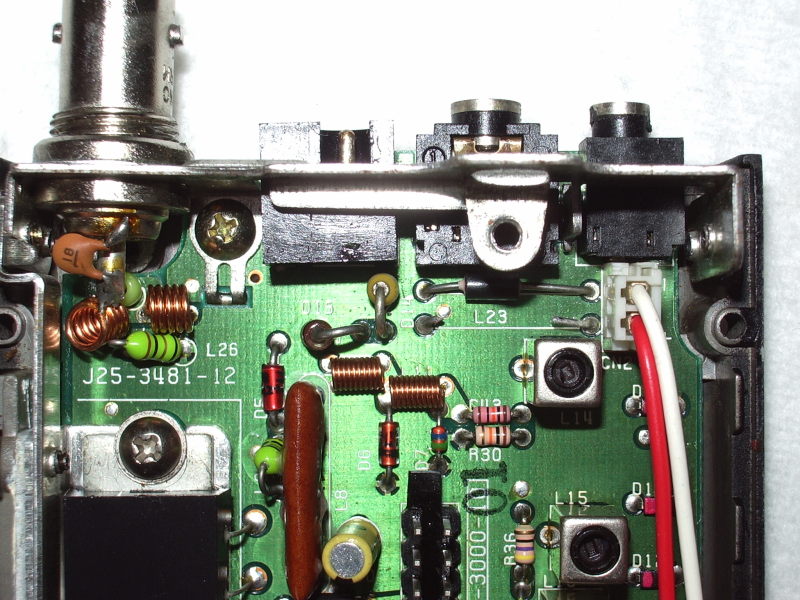 The original TH-205s had a miniature 4A fuse in line between the battery and the power switch. However if external power was applied using an incorrect type of DC plug, the battery was not disconnected from the supply line. The external power could overheat the battery and blow the 4A fuse. I suspected that the fuse had blown.
In fact, I’m afraid it was probably me that blew the fuse. When I first plugged in external power from my shack GSV3000 power supply I noticed the current meter quickly blip as contact was made before the power jack disconnected the battery from the circuit. I didn’t know at that time about the fault, or that the original battery was a dead short. It probably isn’t a good idea to plug in DC power leads while the power is on, but I expect I had other radios on at the time and didn’t want to turn the power off.
I opened the TH-205E up again. I could see the wires from the battery went to a jack on the RF board which is underneath the IF board, so I had to remove the IF board to get to it. This really is a nicely made radio and it is easy to take apart. The fuse, with a ferrite bead on one of the leads, was in the obvious position next to the red wire from the battery. In the picture you can see its position marked L23 after I had snipped the fuse out (I didn’t want to remove the RF board from the chassis to unsolder it completely, so I will solder the replacement to the lead ends that are left.)
I didn’t have a miniature 4A fuse to replace it with. The official Kenwood modification is to replace the fuse with a blocking diode to prevent DC power reaching the battery pack. But they use not just any old diode, but a Schottky barrier rectifier diode which has a low voltage drop of about 0.4V. (A regular silicon diode would cause a voltage drop of about 0.9V.) Of course, I didn’t have a 2A Schottky barrier rectifier diode in my parts drawer either.
I did consider simply replacing the fuse with a thin strand of wire. Since I only have the low voltage 7.2V battery pack I don’t really want any additional voltage drop. I know about the problem so I could simply avoid it by not hot-plugging external power into the power jack. But there is always the risk I might forget and I don’t want to do the repair again, so I decided to do the proper modification.
I ordered the diode from eBay supplier PIC-Projects. I have to say that eBay has become my main source of electronic components and is a major salvation when you need an odd part like this. There is no minimum order charge or handling fee that makes it uneconomic to order less than £30 worth of stuff, and the prices of both parts and postage are very reasonable. Sometimes you have to order cheaper parts in quantities of 10 or 50, just like the “professional” suppliers like Farnell, but the prices make it worth while and it helps to build up a stock of parts for future projects. I ordered 5 of these Schottky diodes because they were only 35p each, and I’m sure I’ll find a use for the other 4 eventually.
Hopefully the diodes will arrive in tomorrow’s post and I’ll finally be able to put the TH-205E on the air with its new battery!

Julian Moss, G4ILO, is a regular contributor to AmateurRadio.com and writes from Cumbria, England. Contact him at [email protected].
 Ham Radio Deluxe |
 W5SWL Electronics |
 Ham Radio Prep |
 KB3IFH QSL Cards  Hip Ham Shirts  HamRadioAuctions HamRadioAuctions Reliance Antennas Reliance Antennas Enigma Shop Enigma Shop |  morseDX  Ni4L Antennas  R&L Electronics R&L Electronics antennas.us antennas.us QRV QRV |
- Matt W1MST, Managing Editor
