 |
 Ham Radio Odyssey | XR0Y’s 21st Century Journal | Part One
 6 April 2010 | by
 XR0Y – Rapa Nui 2009 Videoblog – part 1 [ENG] from SQ8X on Vimeo.
Unlike explorers of yesterday, Stan, SQ8X fully comprehends today’s paradigm. He has circumnavigated legacy media channels instead he delivers his narrative to a wide audience beyond that of ham radio. Fundamentally, he is shaping a future for those considering DXpeditions because SQ8X talks about his connecting experience with the local culture in addition to searching out its mysteries.
The Making Of Remarkable.
Ham radio is a subset of his personal experience, and, in broader terms, Stan creates a robust storyline that demonstrates in visual terms, the team connecting with the world using airwaves.
Stan mentioned an important piece in his previous video and it is why SQ8X stands out from the noise.
What Makes Extraordinary.
I paraphrase although I hope the point is understood when Stan mentioned in the previous video, “I did not tune into the station when listening with my Safari II receiver. I was interested instead in the odd tones, strange noises, and irregularities off of the zero beat frequency.”
Additionally, has one taken note of Stan rotating those things that are rotatable, in turn, mimicking the tuning knob of one’s radio? I was thoroughly impressed that SQ8X’s editing team created parallels between nature and technology. It is attention to creative detail mixed with imagination that makes Stan, SQ8X and his cinematographers, a cut above.
Conclusion.
I’m convinced that ham radio has received a gift in the person who is Stan, SQ8X. The kind of gift that only arrives once in a generation.
73 from the shack relaxation zone.

Scot Morrison, KA3DRR, is a regular contributor to AmateurRadio.com and writes from California, USA.
G4ILO-L EchoLink hotspot
 If you’re a regular reader of this blog you’ll probably have observed my comments about the lack of activity on VHF hereabouts. Even though I can raise three 2m repeaters there is next to no activity on any of them. And although there are several active amateurs in West Cumbria most are “over the hill” from me so I never hear them.
Some time ago I thought about setting up an EchoLink node to make it possible to have some contacts on VHF. But when I realized how much trouble I would have to go to in order to get permission for this I went off the idea pretty fast.
My interest in this basic idea was rekindled when I read recently about the D-Star Digital Voice Access Point. Personally I’m not going to be interested in D-Star until the prices of compatible radios come down and you can buy them from other manufacturers than Icom. Besides, I like my little TH-F7E with its wideband AM/FM/SSB/CW receiver and don’t want to change it for one that doesn’t have that facility. But why shouldn’t I set up a very low power EchoLink node for my personal use so I could make some contacts using my TH-F7E hand-held from round and about the house?
I put in an online application for a Notice of Variation (NoV) to my license to run an attended simplex node – which so far hasn’t made any progress. However, fellow blogger Tim G4VXE writing about his experience with the DVAP mentioned that he made some quick enquiries via the RSGB’s ETCC as to the legality of using the DVAP without an NoV and they were not concerned about DVAPs or hotspots as long as there is no third party traffic.
I presume that D-Star, being digital, knows who is calling in to the system so you can set it so only you have access. With EchoLink you can really only have security by obscurity, using low power, a poor antenna and an obscure frequency so that it won’t pick up transmissions from anyone else. I’m not sure if this meets the official standards for not allowing third party traffic, but my enquiry to the ETCC has also gone unanswered (so far.) I got fed up with waiting and decided to go ahead.
I first tried EchoLink many years ago when it first was announced. At the time I had no way to access the system except direct from my computer. After making a few contacts that way I found that talking to hams without using any radio wasn’t very interesting, so I didn’t use it again.
Even though I am only using RF to make the link of a few metres to the radio connected to the computer, because I am using an actual radio it really feels like I am making a radio contact. I have set up the G4ILO-L node so that it doesn’t allow connections from computer-connected users. There may be disadvantages to this and perhaps some will consider it a bit unsociable but I still feel that using amateur radio at each end of the link is an important distinction that differentiates EchoLink from internet chat. I can still join EchoLink conferences and conferences may include directly connected users so talking to people who aren’t using a radio isn’t completely ruled out.
I dare say there are some who will still consider that making contacts in this way isn’t amateur radio. But the fact that my RF is not going directly from my radio to his is of no great importance as far as I am concerned. This isn’t meant to be a way to explore propagation or work DX. It really isn’t much different from using a repeater.
If I find that it is worthwhile keeping my EchoLink node running then it will create a couple of new radio projects to work on. I will need to make a new computer/radio interface and either build or modify a radio that I can dedicate to the link so that the equipment I am currently using for it can be released for other uses.
Because I signed up for EchoLink soon after it was announced I have a coveted low node ID number: 3098. I have swapped this number over to use for the link. The G4ILO-L node is running low power to a leaky dummy load so it can only be used to contact me. If you have access to the EchoLink network by radio, please give me a call. It would be great to talk to you.

Julian Moss, G4ILO, is a regular contributor to AmateurRadio.com and writes from Cumbria, England. Contact him at [email protected].
LHS Episode #037: Riders on the Storm
 There are good things coming up in the world of GNOME and Linux in the Ham Shack has some of the scoop. In this episode we had the good fortune to interview Stormy Peters, the executive director over at the GNOME Foundation. We’d love to tell you all the stuff she told us, but that’s what downloading the episode is all about. We wouldn’t want to spoil any surprises.
We are currently in migration from Hostican to our new hosting, which includes a mix of BlueCows Technical Services and GoDaddy. During this process, some of the Web site features may come and go, but rest assured everything will be back online eventually. I believe most everything is working now except for the OGG feed and I am working on that. It is very important that everyone switch over to the new RSS feeds in your podcatcher of choice. We wouldn’t want you to miss a single episode. Click or hover over the RSS Feed links on the left-hand side of the main Web page for the correct new URLs. And remember, our new e-mail address is info at lhspodcast dot info. That will go to both of us.
Don’t forget about the current contests. Don’t forget to show up at the Texas Linux Fest in April, the Southeast Linux Fest in June and the Ohio Linux Fest in September. Don’t forget to tell 200 of your closest friends about the podcast. Don’t forget to donate to the noise gate fund. And don’t forget to have fun listening to the show!
73,
The LHS Guys
Russ Woodman, K5TUX, co-hosts the Linux in the Ham Shack podcast which is available for download in both MP3 and OGG audio format. Contact him at [email protected].
The NA-034 operation that almost wasn’t: Epilogue
Well, I was wrong. Or was I?
When I got home after my NA-034 operation, I wanted to try to understand what happened. I was sure that I’d operated solely off a car battery in the past and as long as I was connected directly to the battery I hadn’t had any problems. Based on some testing that I did, I discovered that I may have been mistaken. The short version is that I discovered that by using the battery in my car without the engine running, I was able to reproduce the “strange noise in headset” that I recently wrote about, and that by running the car engine, that problem went away. There’s a bit more to it though. Read on if you’re interested.
I needed to have some way to measure the voltage from the battery and the amount of current  that it was drawing while the radio was transmitting. While I could do this with a couple of meters when I was home, based on some recommendations that I got from W3FF, K8EAB, and NE1RD, I picked up a Super Whattmeter from Astroflight for around $50 plus shipping. These devices are used by folks who fly electric model airplanes because you really don’t want your battery to die when it’s up in the air. As it turns out, they are well-suited for monitoring your power when operating portable. Of course, they work fine too in the home shack, though my power supply has meters so it’s not needed. The picture here shows it hooked up that way for testing, and you can see that the Astron supply is supplying 13.8v.
 As a side note, I started using quick-disconnect connectors made by Workman Electronic quite a number of years ago, before Anderson Powerpoles became popular. I was looking for some kind of quick disconnect power connector and found patch cables similar to the ones in the picture at a hamfest. I typically cut them in half and crimp them onto whatever I need to, be it battery clamps, the power cord for a radio, and so on. The good part is that I’ve been able to find them surplus at hamfests (though I’ve seen from a number of places online that they are now discontinued) but the bad news is that they don’t match what most other folks use. I keep meaning to make myself a set of adapters to connect to Powerpoles.
I crimped a set of the quick disconnects onto the Whattmeter and did a test with the power supply and radio in the shack to ensure that the meter was working and found that it worked perfectly. The shack power supply was putting out just over 13.8 volts with the Icom 756 Pro II drawing around 3 amps while receiving. (Interestingly, this is about 0.6A below what the ARRL reported in their testing, but I’ve had some repair work done on the radio and it’s possible that some of the newer components draw less than the originals.) The next step was to reproduce what I’d set up while in Florida.
As luck would have it, the weather was beautiful this weekend, and as we had no plans on Sunday, I took the 706, the Buddistick, the Whattmeter, the antenna analyzer, and a length of coax outside. I set up the Buddistick on the front lawn (I just had it on the mini-tripod sitting on the lawn, though I did put the radial over a couple of plastic lawn chairs to keep it off the ground) which while not optimal for DX, took me all of 5 minutes to set up with a good match to the radio, as verified by the antenna analyzer. I connected the radio to the antenna then connected the power cables to the car battery, with the Whattmeter in-line. My thoughts were to do a few tests with the engine off, fully expecting that I wouldn’t have any issues, then turn the engine on to see what kind of difference it made. I found an empty frequency on 20m and started testing. As soon as I transmitted, without looking at the meter, I knew that, to my surprise, I’d reproduced the problem: That nasty noise in the headphones was back.
What I figured I’d do was to collect data using various levels of transmit power to see the effect on the voltage and current draw. The meter itself also shows power in watts, though of course that’s trivial to calculate if you already have current and voltage. (From Ohm’s law, P=I×E). I quickly discovered that the car battery wasn’t able to supply sufficient voltage unless I was transmitting with about 10 watts or less. The specification for the 706 MkIIG is that it requires 13.8vdc ± 15% meaning the minimum allowable voltage is 11.73vdc. With the car engine turned off, I measured 11.68v with the radio drawing 5.79A when transmitting using 10w. At 40w (the next step I measured; when I was in Florida I was able to “get away” with 40w when testing with KH6ITY), I measured 11.52v while drawing 8.23A. At 60w transmit power and up, the voltage dropped to about 11.4v but the radio was simply unable to draw the current needed.
 With the car running, it was a completely different situation. Even at full transmit power (100w), the voltage supplied to the radio was 13.24volts at 14.77A. (I’m not sure why my current draw measurement at that power was different from the specifications for the radio, which were also pretty close to what the ARRL measured). I took the results and plotted it out in transmit power vs. watts consumed for both the case with the engine on and the engine off, and it’s pretty clear that with the engine off, the battery simply isn’t able to supply the required power. (You may need to click on that chart to have it display in a readable size. If you’re reading this via email and that doesn’t work for you, go to the web version of this post at k2dbk.blogspot.com and it should work from there.)
You can see from the chart that not only couldn’t the battery supply sufficient power for the transmit needs, it was only able to supply less as the radio tried to use more, presumably because the battery simply couldn’t “keep up”. So all my empirical testing seemed to prove that with the setup that I was using, I simply couldn’t operation at full power using just a car battery with the engine running.
However, similar to bees who simply don’t know that they can’t fly, so they do, apparently my radio didn’t know that it didn’t have enough power to operate, at least during my 2004 and 2006 operations from NA-034, so it worked just fine. During those operations I know that I did not have the car running, yet I had no issues with power. The key for me know will be to find out what has changed. I am using the same power cables and the same radio (the antenna was different, but that shouldn’t matter), yet something has changed. The next thing I am going to do is to see if perhaps there is a problem with the power cables that may have occurred over the years.
Although I attempted to measure the resistance in the power cables and came up with a measured 0.1 Ohms, my meter is probably fairly inaccurate at such low resistance, so I did a calculation instead assuming that I’ve got all 12 AWG wire in place. (Part of it is actually 10AWG, but I’m using 12 to account for any losses due to connectors and splices.) Using a 12v supply with a load of 15A (matching what I saw when the engine was running) and a length of 20 feet, the voltage drop calculator that I used shows an estimated voltage drop of around 8%. Allowing a bit of wiggle room for the length, it appears that the voltage drop would be somewhere between around 6% and 10% which corresponds to a voltage at the load (radio) of between 11.3v and 10.8v. Even the highest end of that range is too low for the radio to operate properly. Dropping the transmit power to 40w results in the voltage to the radio of about 11.5v which is a bit below spec but probably would allow operation, with some minor distortion. That seems to match what I had experienced.
The other factor that I haven’t played around with much is temperature, and I’ll leave that as an exercise for the reader. At this point, I think the best thing to do is to shorten the power cable as much as I reasonably can, replacing the section that is currently 12AWG wire with 10AWG wire. I suspect that will help ensure sufficient current flow while minimizing voltage drop.
I would be very interested in any feedback from anyone who can shed a bit more light on these issues, as I know that there are other factors that may come into play, such as the battery chemistry and perhaps other parts of the car’s electrical system.

David Kozinn, K2DBK, is a regular contributor to AmateurRadio.com and writes from New Jersey, USA. Contact him at [email protected].
Ham Radio Odyssey | XR0Y The Journey Begins…
Unfolding Of An Odyssey?
A journey is an explanation of one’s imagination, perhaps Stan, SQ8X has embarked on something extraordinary that is more than a journey? His DXpedition to Rapa Nui with another planned in the distant future to a distant land is moreso reminiscent of an odyssey that is a long, eventful wandering.
Perhaps, it is not unlike Homer’s Illiad, a timeless mythological story where spirit and character is tested again, again?
Rapa Nui evoked powerful images from our distant past as well Jan Mayen a volcanic island located 950km west of Norway in the cold Atlantic tantalizes the adventuresome spirit that speaks too many of us.
His Odyssey Begins.
Take a moment, while reading the sub-titles, and imagine adventurers past and future who dared the odds. Stan’s story is compelling like many DXpeditions who risk much in the face of danger.
It is why, given SQ8X’s youth, that something extraordinary is underway, one that I believe, is an odyssey for ham radio.
Believe in your signal.

Scot Morrison, KA3DRR, is a regular contributor to AmateurRadio.com and writes from California, USA.
Hontoon Island Qualification Report
Great weather, great site, and despite so-so band conditions but we made over 25 contacts to be able to submit our qualification of Hontoon Island, Deland, Florida as an official island to be listed and activated as a US Island On the Air.

The main picnic area near the ferry landing
The team consisted of Wally Crew, KG4LAL, Jim Diggs, K4AHO and Kelly, K4UPG. We used the special event callsign K4T on operated on 20m cw and ssb, 30m cw and a few unsuccessful attempts at 40m & 15m cw. Jim was our secret weapon on 20m with his good cw, K-1 and a Par End Fed antenna in vertical configuration on a 33 ft MFJ telescoping mast. Without his contribution we would not have been successful! So a big thank you Jim for your good operating skills and equipment that made it happen in less than 8 hours at QRP levels.
FL481 is ready for future activations!
Thanks to the Polar Bear QRP group, QRP-L members, 4 States QRP Group, GORC, QRP Spots, US Islands organization and HF Packers that helped out by listening and attempting to connect with our effort on Hontoon Island. It was fun to work as a team!


Kelly McClelland, K4UPG, is a regular contributor to AmateurRadio.com and writes from Florida, USA. Contact him at [email protected].
Tallentire Hill
By the time I had finished repairing the TH-205E the sky had cleared and the sun had come out so after tea I thought I should go for a bit of fresh air and exercise. Olga is still suffering from a chesty cough and didn’t want to come so I decided to drive over to Tallentire village and walk to the top of Tallentire Hill. A couple of weeks ago I had spent a couple of hours parked near the top making some contacts from my HF mobile station. But it isn’t possible to get right to the top by car unless you have a 4 wheel drive vehicle, because the track is rather stony. Even if you had a 4×4, there is nowhere to park off the road right at the top. The actual summit is in a small field and accessible through an unlocked gate from the track, but it is presumably private land so whilst walkers enjoying the view may be welcome, hams setting up a portable station would probably be accused of trespassing.
 But on a day like today it is worth going just for the view. The picture above shows the trigonometrical point (a reference point for measuring height used by the Ordnance Survey) looking south east towards the Skiddaw range. On the larger version (click on the small one to see it) you can see snow-covered mountains beyond Keswick in the background.
 The next picture shows the view south west and on the large version you can see some of the buildings of Cockermouth nestling in its valley. The big mountain on the left is Grasmoor with its steep drop towards Crummock Water. In the distance you can see the Buttermere fells.
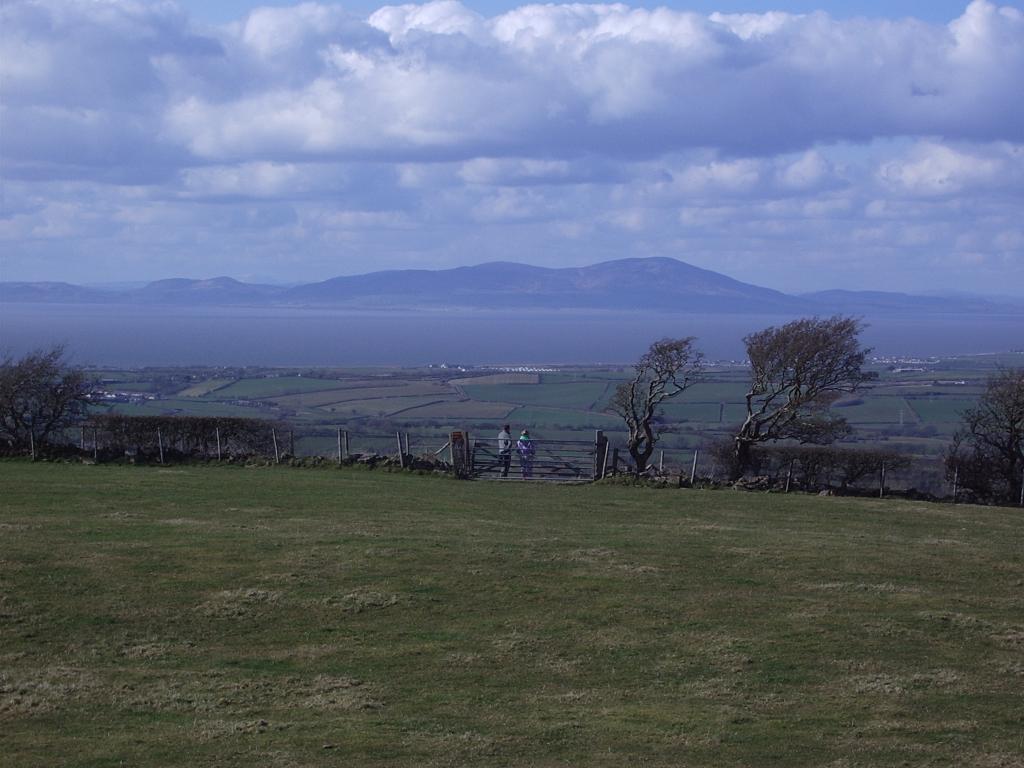 The last picture shows the view north across the Solway to Dumfries and Galloway in Scotland. I don’t know the names of the Scottish mountains.
I would love to own the field containing this summit so I could use it as a portable site whenever I wanted, even if it meant buying a 4×4 vehicle! With the take-offs shown in the pictures the site might be quite good for VHF, so I will have to take the MFD and the FT-817 up there one day when there is a 2m contest in progress.
Today I didn’t manage to raise anyone with the TH-F7E I took with me. But despite the sun it was pretty cold up there with a stiff breeze so after a few calls on 145.500 I headed back down again.

Julian Moss, G4ILO, is a regular contributor to AmateurRadio.com and writes from Cumbria, England. Contact him at [email protected].
 Ham Radio Deluxe |
 W5SWL Electronics |
 Ham Radio Prep |
 KB3IFH QSL Cards  Hip Ham Shirts  HamRadioAuctions HamRadioAuctions Reliance Antennas Reliance Antennas Enigma Shop Enigma Shop |  morseDX  Ni4L Antennas  R&L Electronics R&L Electronics antennas.us antennas.us QRV QRV |
- Matt W1MST, Managing Editor
