 |
 RAC Winter contest.
 19 December 2021 | by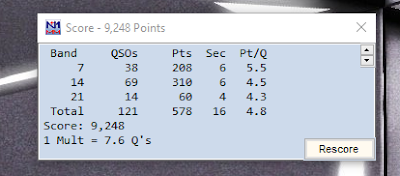
The RAC Winter contest is in the books and my second contest where I was running and not S&P. The propagation numbers took a big leap in the right direction before and during the contest. I did find that even with the good conditions there was steep QSB on 20 and 40m.
I find this more of a relaxed contest compared to the international contests. Most of the time, CW speeds were a bit slower. When someone you know makes contact, there is time to say thanks and 73. Speaking of someone you know, I had the pleasure of John AE5X a blogger I follow contact me, and we had the opportunity to send pleasantries to each other. Thanks for the contact John.
I found there was the early contest jitters, but I did settle in a bit sooner compared to the other contest. One take away was to NEVER try drinking coffee while calling CQ! Thought I had this calling CQ thing down, I decided to have a drink of coffee as the PC was belting out RAC DE VE9KK. While in mid-sip of coffee, the radio went to receive and a nice multiplier station was coming back to me! In a rush to put the coffee down my elbow was banged, coffee all over the keyboard and multi station gone!
Overall, a great time was had.
Mike Weir, VE9KK, is a regular contributor to AmateurRadio.com and writes from New Brunswick, Canada. Contact him at [email protected].
RAC Winter contest.
The RAC Winter contest is in the books and my second contest where I was running and not S&P. The propagation numbers took a big leap in the right direction before and during the contest. I did find that even with the good conditions there was steep QSB on 20 and 40m.
I find this more of a relaxed contest compared to the international contests. Most of the time, CW speeds were a bit slower. When someone you know makes contact, there is time to say thanks and 73. Speaking of someone you know, I had the pleasure of John AE5X a blogger I follow contact me, and we had the opportunity to send pleasantries to each other. Thanks for the contact John.
I found there was the early contest jitters, but I did settle in a bit sooner compared to the other contest. One take away was to NEVER try drinking coffee while calling CQ! Thought I had this calling CQ thing down, I decided to have a drink of coffee as the PC was belting out RAC DE VE9KK. While in mid-sip of coffee, the radio went to receive and a nice multiplier station was coming back to me! In a rush to put the coffee down my elbow was banged, coffee all over the keyboard and multi station gone!
Overall, a great time was had.
Mike Weir, VE9KK, is a regular contributor to AmateurRadio.com and writes from New Brunswick, Canada. Contact him at [email protected].
ICQ Podcast Episode 366 – Seasonal Radio Fun
In this episode, Martin Butler (M1MRB) is joined by Chris Howard (M0TCH), Martin Rothwell (M0SGL) and Frank Howell (K4FMH) to discuss the latest Amateur / Ham Radio news. Colin (M6BOY) rounds up the news in brief and in the episode's feature Seasonal Radio Fun.
We would like to thank David Bowie (ZL4DRB) and our monthly and annual subscription donors for keeping the podcast advert free. To donate, please visit - http://www.icqpodcast.com/donate
- Storm Arwen - Why Power Cuts Left People Unable to Phone for Help
- World’s Smallest Moon Lander will Put Ham Radio Transmitter on the Moon
- Senator Blumenthal Supports Amateur Radio at Senate Confirmation Hearing
- 60th Anniversary of Launch of First Ham Radio Satellite
- RSGB National Radio Centre to Close Temporarily
- First GI-QRP Convention
- Monaco Special Event
Colin Butler, M6BOY, is the host of the ICQ Podcast, a weekly radio show about Amateur Radio. Contact him at [email protected].
Cycle 25 … On The Move?
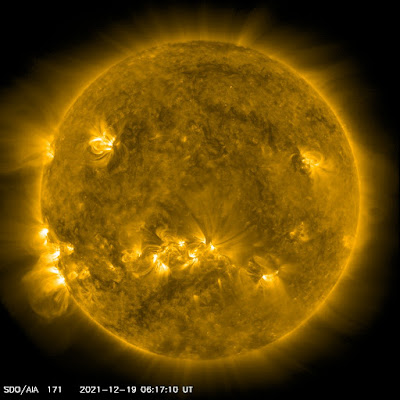
Anyone looking at the Sun this week has to be impressed with its sudden reawakening over the past few days. From its recent somewhat troubling slumber, with flux numbers in the high 70s, these values have quickly risen to a Cycle 25 high in the 120s as of early Saturday. With at least two more active regions about to rotate into view shortly, it seems as though these numbers might continue to grow.
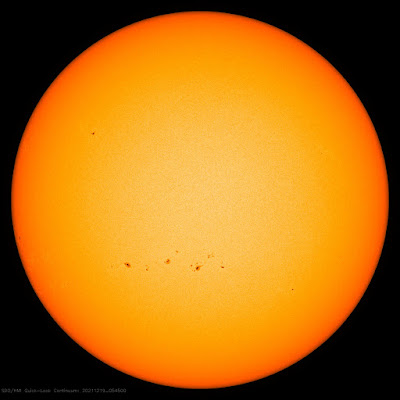
What is interesting is the suddenness with which these groups formed as this is a keystone marker for the long awaited ‘terminator’ event … the point at which cycle growth starts to increase rapidly. Is this it or will the Sun go back to sleep as it has in the past few excursions into the 90’s?
If this rapid increase does indeed herald the terminator's arrival, it’s a sign that Cycle 25 should be one of above average strength. Wouldn’t that be nice after Cycle 24’s weak showing over the past 11 years.
With the present asymmetry of the Sun's two hemisphere, we are guaranteed a cycle with a double hump in the peak years. The first peak is usually the strongest but not always. Let's see how Cycle 25 plays out in this department.
I’ve yet to do any comparisons with past progress of strong cycles at this same point into their upward climb but let’s cross our fingers and hope the present numbers continue for some time. There will always be drops of course but if recovery is quick, we may still be in for a good ride in Cycle 25.
Steve McDonald, VE7SL, is a regular contributor to AmateurRadio.com and writes from British Columbia, Canada. Contact him at [email protected].
Top Five K0NR Blog Posts for 2021

Closing out 2021, here are the top five blog posts at k0nr.com during the year. Some people may see this as a lazy way of creating one more blog post for the year without much work. This is definitely true. I hope you enjoy it anyway.
Leading the list is this blog post…a perennial favorite that seems to make the top five each year:
This is another popular article that explains some of the details behind the 2-meter band plan. This particular article is tuned for Colorado but it also provides a link to an article that covers the topic for the USA.
New this year, is the post about the North America Adventure Frequency, which was promoted by the ARRL Contest Update newsletter:
This post is my attempt at humor concerning the SOTA obsession of small transceivers:
Once again, coming in at fifth place is one of my personal favorites that talks about proper kerchunking of repeaters. It even introduced a new Q-signal for kerchunking, although I must admit it may not be catching on.
Editors Choice
Just for good measure, I am including one more post that I think is notable. I wrote this one after looking around the web for a good explanation of what is a valid QSO? I never did find a good, up-to-date definition of a QSO, so I wrote one. This one may turn out to be an evergreen article but so far it has not gotten a lot of hits.
Merry Christmas and Happy New Year!
73 Bob K0NR
The post Top Five K0NR Blog Posts for 2021 appeared first on The KØNR Radio Site.
Bob Witte, KØNR, is a regular contributor to AmateurRadio.com and writes from Colorado, USA. Contact him at [email protected].
AmateurLogic 163: Cheapmunks Christmas
AmateurLogic.TV Episode 163 is now available for download.
Tommy completes the LiFePO4 battery build and begins load testing. Emile runs Multi-applications on his shack Pi. The Cheapmunks drop by for a high frequency Christmas. Canadian and Creole holiday Food tasting.
George Thomas, W5JDX, is co-host of AmateurLogic.TV, an original amateur radio video program hosted by George Thomas (W5JDX), Tommy Martin (N5ZNO), Peter Berrett (VK3PB), and Emile Diodene (KE5QKR). Contact him at [email protected].
Checking Out The KT-WP12 Transceiver
I’ve been interested in the idea of a microphone-centric radio and wrote about it here: How About a Mic-Centric Mobile Transceiver? Shortly thereafter, I discovered that QYT has introduced a VHF/UHF ham rig that has the display and controls in the microphone (Model KT-WP12).
You may want to watch the video by Tech Minds, which does a good job of introducing the radio.
I was very keen on trying this radio out, so I purchased one, paying about $110.
On the Bench
First, I did some bench tests to check the basic performance of the radio. The receiver sensitivity, transmit frequency and FM deviation all looked very good. The one specification that was disappointing was the RF power output. On the 2m band, the output power was 20.6 W, while the 70cm band was 15 W. The specification for the radio is 25 W. The power was measured using an HP 8920A RF Communications Test
I’ve noticed this on other radios from Chinese manufacturers: the basic specs of the radio check out, except the RF power level is low.
User Interface
As you might expect, cramming all of the controls into the microphone is a challenging user interface design. I spend quite a bit of time playing with the radio at home before actually using it on the air. Overall, I found the user interface to be acceptable, but several areas that should be improved.
QYT relies on the menu system to provide control of many of the settings. This is similar to the various Chinese handhelds where you push the MENU button to access the menus, followed by UP/DOWN to sequence through the menus, followed by MENU to access the specific setting. Then the UP/DOWN buttons choose the value of the setting and another push on MENU to accept it. The volume control setting is buried in this menu system, which seems like a poor choice. Fortunately, Mick/M0VMK pointed out that the volume can also be set by enabling the monitor feature (big button on the top of the mic) and hitting UP/DOWN.

This design depends too much on the menu system. A few user-defined buttons would be a real help. This radio could benefit from a serious redesign using User-Centered Design.
This radio has one receiver but allows for three independent frequencies to be displayed simultaneously. There is a scanning mode that tries to emulate a multi-receiver radio. This too is all too common with the Chinese radios…somehow they have it in their heads that this adds value for the user. My experience is that it mostly confuses the user. Most users would be better served with a single frequency display, supplemented with dual-watch and scanning capability.
You probably won’t be surprised that the user manual is terrible, also common with Chinese manufacturers, but this one is particularly bad. Same with the programming software…it mostly works (I had a few crashes) but it is poorly written.
On The Air (SOTA)
I was very interested in trying out this radio for Summits On The Air (SOTA) use. The idea is that the radio can be stuffed into a fanny pack, with the microphone, speaker, display, and controls in your hand.

The basic concept of holding everything in the palm of my hand worked out quite well. The display was visible in bright sunlight, the speaker audio was clear, and the microphone worked great. I made a number of SOTA contacts and received good signal reports. I held the microphone in one hand and pointed the 3-element Yagi antenna with the other hand. (Joyce/K0JJW assisted with logging and we took turns working the SOTA chasers.)
As soon as I fired up the radio, I heard interference on the 2m band, not very strong but noticable. It sounded like it was coming from an FM broadcast station. Pointing the Yagi antenna in the direction of the FM station on the adjacent mountain seemed to confirm the source. I did not hear any interference on the 70cm band. I’ve operated from this SOTA summit before and have not noticed any interference with other equipment, including Yaesu handhelds. Also, I switched to my Yaesu FT-90 and the broadcast station was not heard. As various people have suspected, this indicates that the receiver in the QYT is not very robust in terms of rejecting off-channel signals. Of course, this is an anecdotal report, not based on bench measurements.

I also encountered an anomaly where after my transmission, the radio did not revert back to receive quickly. There was a few seconds where no audio was coming out of the transceiver. This caused me to miss a few responses to my CQ call. This issue requires some additional investigation. It may have just been operator error on my part. However, I suspect that the radio was probably locking onto another frequency but I am not sure (see previous comments about the three frequency scanning mode). So file this issue under “stay tuned for more information.”
Note that I did not use the radio very much on repeaters, focusing on SOTA simplex operating with no transmit offset or CTCSS.
Conclusion
On the positive side, I really like the microphone-centric approach that this radio uses. The user interface can be improved but it is good enough.
The two big limitations of this radio are 1) low RF power output and 2) weak off-channel receiver performance. Now you might say that the RF power is not off by that much but my interest is having a SOTA radio that greatly exceeds the power of a typical 5 W handheld. On the 70 cm band, this radio only put out 15 W, so only 4.7 dB better than a handheld. The poor receiver performance will tend be an issue on summits that have radio installations nearby. In some cases, this can completely prevent a VHF SOTA activation.
I will probably use this radio again for SOTA activations but I’ll be bringing along a backup rig, just in case.
The post Checking Out The KT-WP12 Transceiver appeared first on The KØNR Radio Site.
Bob Witte, KØNR, is a regular contributor to AmateurRadio.com and writes from Colorado, USA. Contact him at [email protected].
 Ham Radio Deluxe |
 W5SWL Electronics |
 Ham Radio Prep |
 KB3IFH QSL Cards  Hip Ham Shirts  HamRadioAuctions HamRadioAuctions Reliance Antennas Reliance Antennas Enigma Shop Enigma Shop |  morseDX  Ni4L Antennas  R&L Electronics R&L Electronics antennas.us antennas.us Ears to Our World Ears to Our World |
- Matt W1MST, Managing Editor
