 |
 No service
 12 May 2010 | by
 I phoned up Radioworld this afternoon to ask why I hadn’t received the 2m 5/8 vertical I ordered a week ago. After looking up the order the girl told me that the stock hadn’t come in yet. “We sent you an email yesterday” she said. That was presumably in response to my shirty enquiry yesterday. I checked through my Spam folder and I didn’t receive any email from Radioworld. I mentioned twice that I had received an email saying the item was despatched on the day I ordered it, but there wasn’t the slightest hint of an apology, just a repetition of the fact that the stock hadn’t come in yet. Radioworld goes on my list of dealers to avoid.
 LAM Communications by contrast has been a pleasure to deal with. After failing to win any VHF multimodes on eBay I decided that rather than gamble my money on the stock markets or leave it in the back at an almost zero rate of interest I might as well buy any radio gear I want, so I treated myself to an Icom IC-901H. LAM had a used one for sale so I phoned up to ask about it. I was told it was in really nice condition but when I asked its age the salesman (Dave) didn’t know, so he promised to phone Icom UK to find out when the guarantee ran out and call me back.
This he did after a few hours. He was a bit apologetic, saying that it was made in 2003 so there was “a bit of age behind it” and in view of that he would knock an extra £50 off the price and throw in carriage for free. I decided to go for it and he then warned me that the FedEx courier had already called so it wouldn’t go out until the following day. Fine, so it would arrive today. It did, well-packed (the Icom box was bubble wrapped and inside a larger box) and was exactly as described. Better, in fact, I can’t see a single mark on it. I am well pleased, and would be more than happy to buy from LAM Communications again.
The worst offenders in my experience for service have been Waters and Stanton. I forget the details of all the times I had to hassle them to send things I ordered, such as when I bought a rig advertised as with a free desk mic in RadCom and they didn’t send the free desk mic. A classic example of dealing with W&S was when I ordered the MFJ magnetic loop a few years ago. I didn’t receive any email or acknowledgement and no money was taken from my account so I decided that the online order hadn’t gone through. I started to have second thoughts about needing the antenna so I decided to forget about it, which I did until one day, more than three months later, without any prior warning, a courier knocked at the door with a very large box…

Julian Moss, G4ILO, is a regular contributor to AmateurRadio.com and writes from Cumbria, England. Contact him at [email protected].
Things I Wish I Knew When I Was A Young Radio Artisan
Don't worry about the orientation of a dipole when it's less than a half wavelength above ground.
In multi-multi contesting and big gun DXing it's often more a battle of bank accounts than operator skill.
You're going to go through several phases in your radio artisan career. Don't spend too much money until you're sure you like the phase you're in.
Don't gauge your success by the number of awards you have on the wall.
Don't get your start on 2 meter repeaters.
Don't be nervous.
Your money is better spent in antennas than amplifiers.
There are good CBers and bad CBers. More amateurs than you think got started on CB.
There are jackasses in amateur radio. You cannot identify them by license class, age, years licensed, call area, operating mode, education, or income.
When the bands are open any goofy antenna will make contacts. People will think this makes a goofy little antenna a good antenna. Not so.
The perception of amateur radio that the general public holds is much different from the perception within amateur radio. We're in a strange, esoteric and sometimes archaic hobby that most of the world doesn't understand. Welcome to our secret society.
It's not that extra one or two dB that makes the difference, it's the first 50 dB that really matters.
Girls actually dig letters written in Morse code while you're dating.
Save your money and buy a crank up or tilt-down tower.
Six meters.
You can operate anywhere you live, no matter what the restrictions. About any piece of metal can be loaded up with a tuner.
You buy an HF quad only once.
Low SWR doesn't mean it's a good antenna.
Ladder line.
Homebrew it, even if you're not some master electronics designer. When building equipment, don't worry about not being a EE or building the perfect circuit. Don't bother making printed circuit boards, you can build just about anything you want Manhattan style. Experiment. You will learn more from your building failures than your successes.
Don't fall in love with one brand of radio.
Don't limit yourself to one mode.
Join a club. Do what is fun and what you want to do in the club. As soon as others tell you what you should be doing, it's time to leave. When being involved in a club feels more like a chore, get out. If the club is on life support and you can't revive it in three years, pull the plug. Move on. Don't look back.
QRP isn't difficult. It requires persistence and patience....and knowing when to go QRO or when to QSY.
If you are in a club you don't like and you want to leave that club to create a new or rival club, list on a piece of paper why you don't like that club. This list is why you shouldn't start a new club.
Don't do CW because you want to impress others.
Get a ARRL life membership as soon as you can afford it. Don't worry, you will get angry at ARRL at some point, but you'll save money on the magazine subscription. And ARRL is about the only reason amateur radio is still around.
It's never what you don't know that bites you, it's what you don't know you don't know that gets you into trouble.
Walk away when you need to.
In amateur radio do what you like, like what you do.
You're in a great hobby for life.

Anthony Good, K3NG, is a regular contributor to AmateurRadio.com and writes from Pennsylvania, USA. Contact him at [email protected].
Poor show, Radioworld
How’s this for poor service? I ordered a 2m 5/8 vertical online from Radioworld on Wednesday May 5th. That afternoon I received an email updating the order status to “Despatched.” I paid £10.00 for next day courier. We have ensured that someone has been in all the time every day since then and no-one has tried to deliver an antenna.
I sent an email at lunchtime asking why I hadn’t received it yet. As of now, I have had no reply. Why is buying ham radio equipment always such a hassle?

Julian Moss, G4ILO, is a regular contributor to AmateurRadio.com and writes from Cumbria, England. Contact him at [email protected].
Sporadic-E action
The screengrab below, from WSPR at 0815 this morning, shows just how selective Sporadic-E propagation can be. For a change, G4ILO is hearing and being heard by all the European stations while those in the south of England aren’t getting anything.
 Look, too, at all those lines going off the top of the map to OY1OF. I wish I could understand the propagation. It appears that if you like the 10m band, the best place to live is the Faroe Islands!

Julian Moss, G4ILO, is a regular contributor to AmateurRadio.com and writes from Cumbria, England. Contact him at [email protected].
Ash scatter?
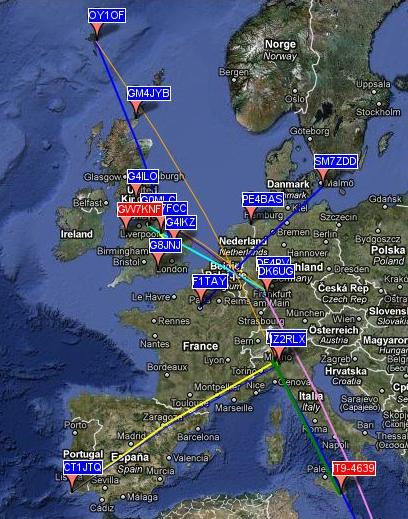 For the last week or so I have been using the K3 for WSPR on 10m to detect the signs of any Sporadic-E openings. Since the opening of May 3rd there has been nothing very exciting to report, though it has been interesting to see spots of stations previously never heard suddenly appear, often at good strength, as a patch of ionization materializes in just the right place.
What has been intriguing over the last few days is the consistent appearance of spots involving OY1OF throughout the day, often with stations in the UK but also with those in Holland, France or Germany.
The distance is too far, obviously, for the ground wave propagation that is often the only propagation reported between closely located stations. The spots are too frequent and too widespread to be Sporadic-E. And they surely cannot be regular F2 layer reflections, as the MUF in this part of the world at this point in the solar cycle is still far too low (the F2 critical frequency is around 4MHz according to the IPS Radiowave Propagation Center.)

Could it be scatter from the ash of the Icelandic volcano?

Julian Moss, G4ILO, is a regular contributor to AmateurRadio.com and writes from Cumbria, England. Contact him at [email protected].
RadioSport Webinar
 Thank you Potomac Valley Radio Club for sponsoring Contesting 101: Maximize Your Score and Your Fun webinar. The schedule time was right on and, for this mid-40 something, ideal for a Friday night.
Kirk, K4RO hit all the function buttons with his informative presentation. Well done!
I especially enjoyed his insight into station construction, component selection, brief yet important mention of antenna systems, and calling CQ even when one is low power, low profile like myself.
Calling CQ more often is a target going into CQ WPX CW at the end of the month.
Contest on.
P.S. Ham radio has moved to a new level of passion with Ham Radio Deluxe and Digital Mode 780 in the shack relaxation zone. Wow factor nine point nine!

Scot Morrison, KA3DRR, is a regular contributor to AmateurRadio.com and writes from California, USA.
Fellbarrow
The objective of today’s walk was Fellbarrow, a minor Wainwright fell WOTA number LDW-199 in the North Western Fells. It had never been activated before and I thought it would be an easy walk, so off I went.
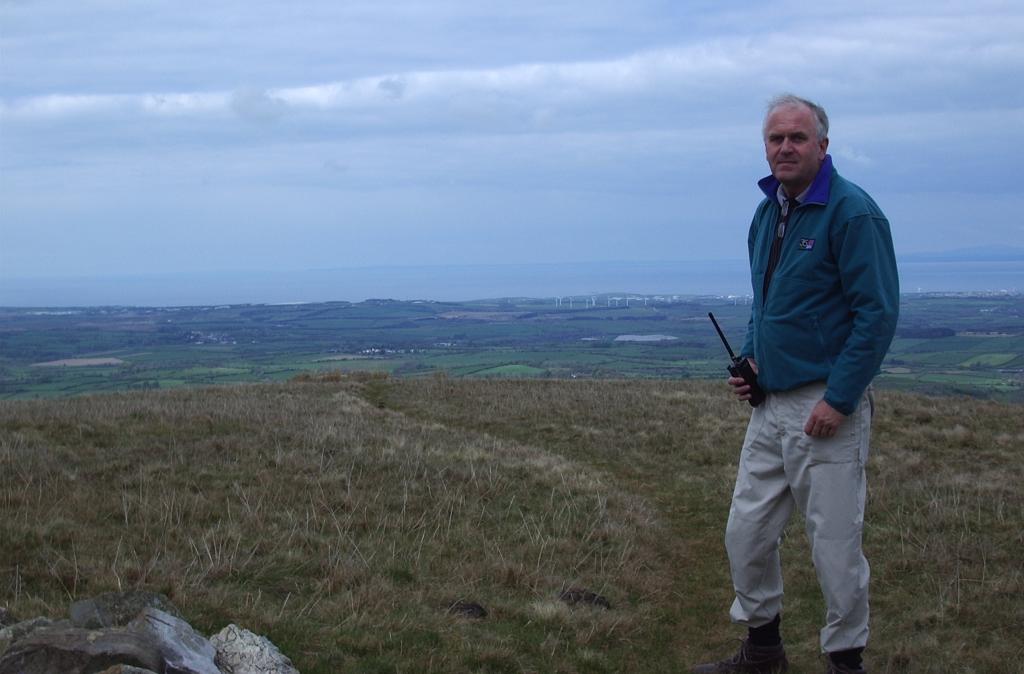 I set off along the lane that goes behind Whin Fell. By a field gate I was checking the map to see if this was where I turned off the lane to go up on to the fells, and someone walked by and asked if I was lost. I said I was just checking to see if this was the way to Fellbarrow and he said yes, you can go that way, so I did. After about 15 or 20 minutes of walking I found that I was at the far end of a large field surrounded by a dry stone wall with barbed wire on either side and no way I could see to go any further.
Eventually I did find a place where the wall had fallen down and it was possible to negotiate the barbed wire, only tearing my walking trousers a little bit. I carried on but found the directions I thought I needed to go blocked by walls and gates.
The trouble with these grassy minor fells is that they don’t look very distinctive so they aren’t obvious targets to aim for, and they are infrequently walked so there is no obvious path to follow. Basically, I was lost. APRSISCE on my mobile phone was no help as the mapping it uses contains no topographical detail at all. I tried Google Maps but it informed me that there was no network coverage so it couldn’t download any maps. I plodded on until I saw a path that descended into the valley and I decided to stop, have my lunch and go back.
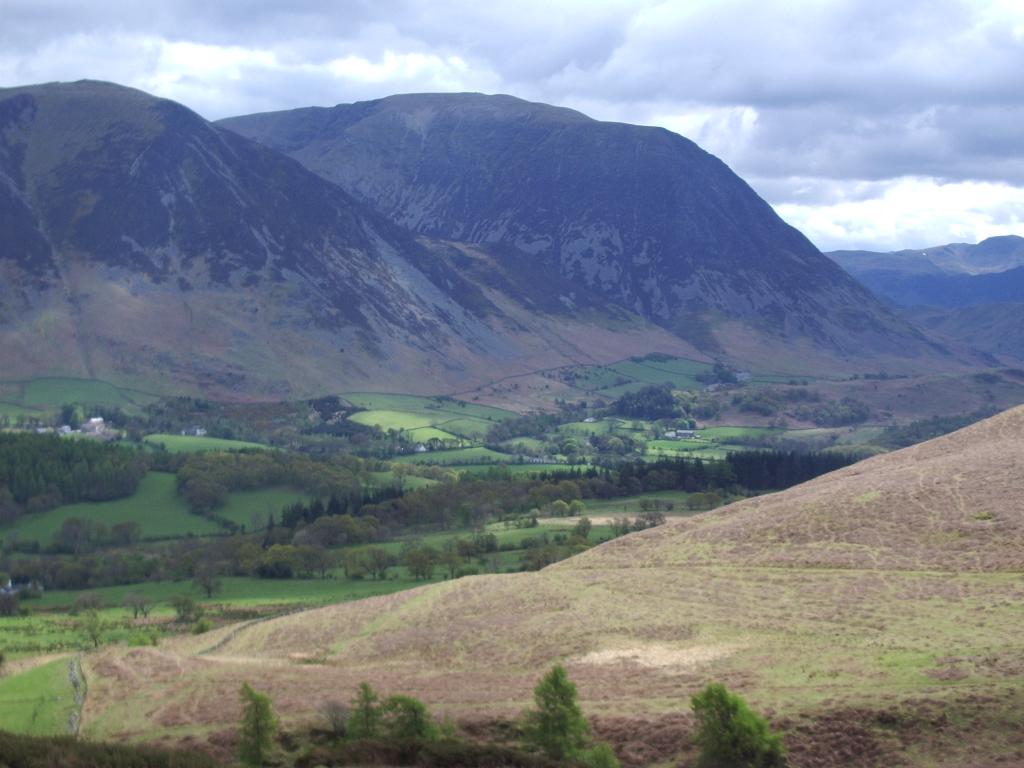 After lunch I decided I would follow some tyre tracks up hill just to see where they went. After about 5 minutes I saw a stile in the fence and a path. I followed this and after a couple more stiles found myself on the top of Fellbarrow with its Ordnance Survey trig point.
I got out the Motorola GP300, made a couple of calls on 145.500 FM and was answered by Colin 2E0XSD. However despite a take-off that covered Whitehaven, the Isle of Man, Workington, Cockermouth and the Dumfries and Galloway area of Scotland I got no other responses. I checked the repeaters and heard Richard MI6BJG/P putting a call into the GB3GI repeater. He was walking into Belfast with a hand held radio and we had a chat for a few minutes until he started dropping out of the repeater. I also heard a repeater GB3BT on the channel marked for GB3EV, which I later found is at Berwick on the north-east coast.
I still couldn’t raise anyone on FM simplex, so I decided to come back. The return route was a bit easier and used the path I should have taken if I had walked for another 5 minutes beyond the point that I was misdirected. I think I need GPS software with OS maps on my HTC Touch.

Julian Moss, G4ILO, is a regular contributor to AmateurRadio.com and writes from Cumbria, England. Contact him at [email protected].
 Ham Radio Deluxe |
 W5SWL Electronics |
 Ham Radio Prep |
 KB3IFH QSL Cards  Hip Ham Shirts  HamRadioAuctions HamRadioAuctions Reliance Antennas Reliance Antennas Enigma Shop Enigma Shop |  morseDX  Ni4L Antennas  R&L Electronics R&L Electronics antennas.us antennas.us QRV QRV |
- Matt W1MST, Managing Editor
