 |
 ICQ Podcast Series Three Episode Ten (9 May 2010) – Holiday Emergency Antenna
 9 May 2010 | by
 Series Three Episode Ten of the ICQ Amateur / Ham Radio Podcast. News Stories include:
- Caister Marconi station contacts 29 countries
- Government will kill off FM
- Radio Kuwait cleared from amateur band
- Morse practice via Echolink
- WebSDR Remote Radio in Virginia
- Hamvention D-STAR linking announcement
- Gigabit Powerline Adaptor interference video
- GB3YR now live on internet
- The future of amateur radio is youth
- Global Simulated Emergency Tests 2010
- Retro 75 AM Transceiver kit group formed
- Caiguaran - low-cost Cuban transceiver
- GB3VHF back on the air
- Tyco offers free electronics courses
Your feedback, upcoming events and Martin (M1MRB) tells us about Holiday Emergency Antenna.
Colin Butler, M6BOY, is the host of the ICQ Podcast, a weekly radio show about Amateur Radio. Contact him at [email protected].
Whispered contacts?
A recent discussion on the WSPRnet website concerns whether one should log WSPR contacts. It was pointed out that normal WSPR “spots” are not contacts. However it appears that some operators consider that if two stations spot each others’ signals within a short interval of time then they treat it as a contact and QSL it.
In my opinion WSPR spots, even if they occur both ways within a short time, are not contacts because you have no way of knowing if someone else received your transmission (or what signal report you got) without using the internet. It would be nice if the WSPR protocol provided a way to discover who is hearing your signals without using the internet but it doesn’t. I have no issue with QSLing WSPR “spots” as SWL reports. But they are not contacts, and if anyone uses eQSL to send a QSL to me for a WSPR spot it will be rejected as “not in log.”

Julian Moss, G4ILO, is a regular contributor to AmateurRadio.com and writes from Cumbria, England. Contact him at [email protected].
Our Social Media Revolution
The message is clear and it is social media. A cluster of ham radio operators understood a few years ago that a wave, no more like a tsunami, would crash against the shores of culture and it is here. It is not a fad. Social media is transforming our daily lives from inter-personal relationships to business-to-business transactions.
Perhaps, one might say as Alvin Toffler did, this is a power shift.
Failure to realize this transformation, most likely, will leave institutions, organizations, and individuals on the boondocks of the 20th Century.
73 from the shack relaxation zone and thank you FRRL for the content.

Scot Morrison, KA3DRR, is a regular contributor to AmateurRadio.com and writes from California, USA.
It’s SuperMoxon!
Today I replaced the home made 2m Moxon Rectangle with a Vine Antennas SuperMoxon. As you can see from the picture of it installed in my attic it is a Moxon Rectangle with two directors that are also folded into a rectangle.
 My attic, like my house, is very small. As is usual with modern British houses, the roof trusses are made of thin wood with cross-bracing for strength, so the attic area isn’t open to allow the free rotation of antennas. I have crammed rather a lot of antennas into this space to try to cover the maximum number of bands, so the VHF antennas have been forced into odd corners. Using a conventional small beam is not possible as there is insufficient space to allow rotation.
Vine Antennas claim that no other antenna gives so much gain in such a small turning circle, so it seemed like an ideal design for this situation. They claim that the directors add an extra 3dB of gain to the Moxon Rectangle design – about 9dBi which is more than a three element Yagi.
The antenna was quite expensive to buy. It is quite rugged and heavy but looks a bit home made. While the driven element and reflector made use of Jubilee clamps to tighten the main elements on to the smaller tubing used to form the corners, the directors used self tapping screws which had worked loose in transit (and probably would work loose in use due to wind vibration) and which stripped the inner hole when I tried to tighten them. You are left to your own devices to find a way to weather proof the feeder connection. Since my antenna is going to live a cosseted life away from the wind and rain I was not bothered by these issues.
The antenna presents a 50 ohm load but needs a balun to prevent feeder radiation. Vine Antennas offers a choke balun (apparently several turns of coaxial cable held in a loop using cable ties) for an extra £15. I decided to do without this, but I placed a clamp-on RFI ferrite over the cable close to the feed point which will hopefully achieve the same result.
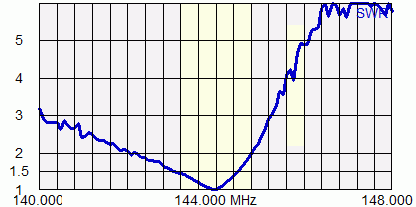
The SWR is almost 1.0:1 at 144.0 MHz, as the plot from my AA-200 antenna analyzer shows, but it rises steeply to 1.4:1 at 144.4MHz and 2:1 at 144.8MHz. Clearly I had better not use this antenna to work satellites.
 It’s a bit early to say how performance compares with my old Moxon Rectangle. The beam width does seem sharper and the front to back ratio seems quite noticeable. I heard the GB3VHF beacon for the first time since it moved to its new location, but it is in and out of the noise on slow fading as it always used to be. I can clearly hear the Northern Ireland beacon GB3NGI, which curiously is the same strength on the SuperMoxon as it is on the ribbon cable Slim Jim (which is also due for replacement with a commercial antenna.)
This antenna is probably as good as I am going to get given the restricted space available. The SuperMoxon design is copyright Vine Antennas and commercial reproduction is prohibited, which should be borne in mind if you try to make your own version.


Julian Moss, G4ILO, is a regular contributor to AmateurRadio.com and writes from Cumbria, England. Contact him at [email protected].
FCC Proposes 60 Meter Band Changes

The proposed changes in a nutshell are:
- Swap one channel with another frequency due to federal licensee digital traffic which often on this channel
- Increase the power limit from 50 watts PEP to 100 watts PEP
- Allow CW, PSK31, and PACTOR-III modes

Anthony Good, K3NG, is a regular contributor to AmateurRadio.com and writes from Pennsylvania, USA. Contact him at [email protected].
Daft contest exchanges
I just got round to checking the Sport Radio page of the May RadCom so as to transfer to my wall calendar the dates and details of any contests I might be interested in making some contacts in this month. I happened to notice that the exchange for the 144MHz Contest on 15/16 May is RS(T), serial number, grid locator and post code.
Post Code??? What’s the point of that? And what if you are operating portable from a hill somewhere and don’t have a post code? Daft idea if ever I saw one.

Julian Moss, G4ILO, is a regular contributor to AmateurRadio.com and writes from Cumbria, England. Contact him at [email protected].
More eBay purchase woes
I’m not paranoid, but I think everyone is out to get me!
I ordered some connectors from eBay seller m0jpm and, because I have been thinking about getting a radio that has N type connectors on it, I decided to order a couple of BNC to N-type adapters so I could use the much easier to obtain BNC plugs on my antenna cables. The listing I ordered from is shown below.
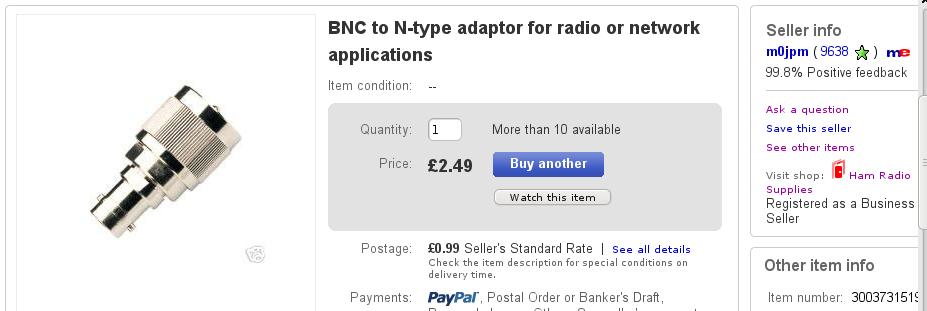 The package arrived this morning and when I opened it, to my dismay I found that the adapters were the reverse of what I wanted. As you can see, they are for attaching N-type plugs to BNC sockets.
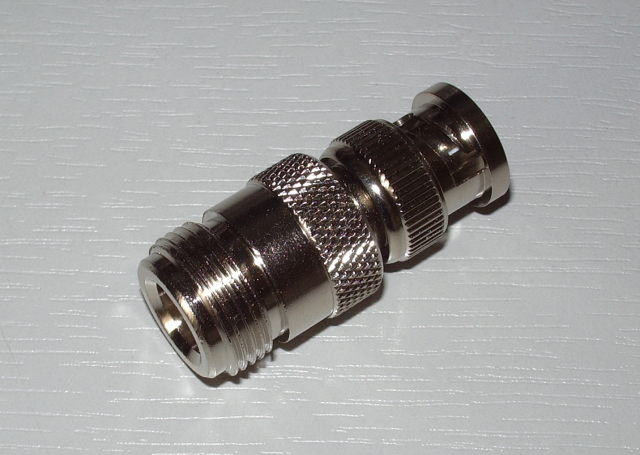 It has sometimes happened that I ordered the wrong thing by mistake, so I was relieved when I checked the eBay listing and saw that this time it was the seller’s mistake not mine. But my relief turned to anger when I emailed the seller to inform him of the error and received the reply: Dear g4ilo, Hi we have send you what you have ordered, as this is the only n-type to bnc we have listed. but if you not happy send it back for a refund.
Is it really necessary to insult my intelligence by telling me “we have send (sic) you what you have ordered”? I will send the adapters back for a refund (and no doubt be out of pocket for the postage) because they are no use to me. But I shan’t be buying anything from m0jpm again.
In a comment to my previous post Ricardo CT2GQV said that I should give up buying on the Internet. I wish I could, but if I did I would have to give up the hobby because it is not possible to buy radio stuff round here.

Julian Moss, G4ILO, is a regular contributor to AmateurRadio.com and writes from Cumbria, England. Contact him at [email protected].
 Ham Radio Deluxe |
 W5SWL Electronics |
 Ham Radio Prep |
 KB3IFH QSL Cards  Hip Ham Shirts  HamRadioAuctions HamRadioAuctions Reliance Antennas Reliance Antennas Enigma Shop Enigma Shop |  morseDX  Ni4L Antennas  R&L Electronics R&L Electronics antennas.us antennas.us QRV QRV |
- Matt W1MST, Managing Editor
