 |
 More numbers stations/espionage information from Simon Mason
 6 June 2010 | by
  As mentioned previously, since I was a kid (long before being a radio amateur) I’ve been fascinated by numbers stations. Every now and then I go on a search online to find more sites to satisfy my curiosities – there’s tons of ‘em out there.
This time, let me take you to the URL of Simon Mason, but he has a disclaimer about the material on his site:
The information presented in this section is for entertainment purposes only and does not disclose any information not already in the public domain. No assassination attempts are required! Thank you.
Rather tongue and cheek, but…… one can never be too sure!
His site looks rather old, but don’t let that discourage you – there is a TON of stuff here (and it’s updated). Not only are there plenty of pages devoted to various numbers stations, but a plethora of videos and radio shows devoted to the subject.
Simon has written a small book that is freely downloadable on his website called “Secret Signals: A Euronumbers Mystery” (available in HTML and MS Word format).
I can go on and on about the site, but just go check it out! If you like this sort of thing, you’ll be there for hours!
http://www.simonmason.karoo.net/page30.html
Jonathan Hardy, KB1KIX, is a regular contributor to AmateurRadio.com and writes from Connecticut, USA. Contact him at [email protected].
My 10,000 Hour RadioSport Challenge | 9,803 – 24 = 9,779 Hours To Go
I enjoyed CQ WPX CW despite storm conditions that drove the A-index into double digits. It was a first for my low power, low profile station and I suffered through a deplorable Saturday afternoon. Propagation really matters in the game of RadioSport in addition location, antenna systems, station engineering, operator skill set, and strategy.
There is a lot to learn and accomplish within the art and science of RadioSport.
Friday Night Lights.
I did not settle into the chair until mid-evening after returning home from work then deployed my wire antenna system for the low bands. The south leg of the wire antenna goes up later in the evening after 20m shuts down. I stow the vertical when operating on the low bands in the evening because the wire is too close to the second antenna.
Friday night rocked between 0200 – 0500UTC as 39 -Qs went into the log. I jumped a little early from 20m to 40m and it is a habit of mine. I need to pay attention to the play book knowing 40m is generally noisy at this time of the year.
Storm.
I keep notes on propagation and the receiver floor literally dropped out when the A-index spiked at 28 through Saturday afternoon. I was simply not heard through the noise deciding instead that napping through the day was a better idea. I could not compete against a double digit number.
Sunday Is Different.
I’m noticing a trend that Friday night and all day Sunday really makes a difference in my log. Historically, I have not scored as many -Qs on Saturday however, neither have I experienced a zen-like event when propagation produces epic conditions. It is like surfing, one continues returning to waves time and time again, when all of a sudden the cosmos falls into place.
I know that event is somewhere out there on the time line!
The Bands.
I scored double digits across four bands for the first time ever and called CQ more times than not on the low bands. I did not use memory functions when sending the exchange as well. My biggest surprise was a 10m opening into Oceania and South America late Sunday afternoon. I was thrilled when LU1HF ignited my cans with his stellar signal.
The high bands were fun and 20m produced the best results with 50 -Qs in the log.
I managed a pair of excellent hours on 40m that is 0500UTC (13 -Qs) and 1300UTC (11 -Qs). I was pleasantly surprised on 80m late Sunday morning but my timing on this band was totally off.
Conclusion.
Overall, I logged 116 -Qs and 73 prefixes, totalling 15,549 points effectively beating my score from last year. The storm did not help the low bands where I wanted to log as many JA-stations as possible on Saturday morning. They are excellent operators and the noise was too much for low power, low profile into Asia.
There is more fun work inside the shack relaxation zone and many thanks to all who pulled out my signal through CQ WPX CW weekend!
Contest on.

Scot Morrison, KA3DRR, is a regular contributor to AmateurRadio.com and writes from California, USA.
3830 Claimed Scores | NS Summer Ladder VIII | Low Power
 Atlantic Single Operator.
- N4AF | 50 Qs | 32 Mults | 1,600 Points [PVRC].
- N1LN | 44 Qs | 34 Mults | 1,496 Points [PVRC].
- NO3M | 44 Qs | 32 Mults | 1,408 Points [NCC].
n = 7 scores submitted in this division.
East Central Single Operator.
- N4OGW | 50 Qs | 36 Mults | 1,800 Points [ACG].
- K9BGL | 51 Qs | 34 Mults | 1,734 Points [SMC].
- K8MM | 48 Qs | 34 Mults | 1,632 Points [MRRC].
n = 13 scores submitted in this division.
West Central Single Operator.
- N3BB | 54 Qs | 40 Mults | 2,160 Points [CTDXCC].
- W5JAW | 52 Qs | 39 Mults | 2,028 Points [CTDXCC].
- WD0T (@KD0S) | 54 Qs | 35 Mults | 1,890 Points.
n = 6 scores submitted in this division.
West Single Operator.
- K7SS | 57 Qs | 33 Mults | 1,881 Points [WWDXC].
- W7OM | 44 Qs | 27 Mults | 1,188 Points [WWDXC].
- W7WHY | 41 Qs | 22 Mults | 902 Points [WVDXC].
n = 3 scores submitted in this division.
NCCC in CA/NV Single Operator.
- N6RO | 45 Qs | 29 Mults | 1,305 Points.
- K6VVA | 43 Qs | 30 Mults | 1,290 Points.
- W0YK | 42 Qs | 30 Mults | 1,260 Points [Loma Prieta Contest].
n = 6 scores submitted in this division.
Our 100 foot tower whom looms large in Central Texas continues dominating the fastest 30 minutes in RadioSport. Congratulations, Jim, N3BB for turning in another fine performance and leading the Central Texas DX and Contest Club (CTDXCC) to its fourth banner position!
73 from the shack relaxation zone.

Scot Morrison, KA3DRR, is a regular contributor to AmateurRadio.com and writes from California, USA.
888 miles using a hand-held
This afternoon 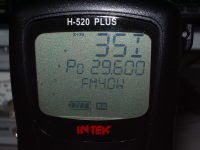 I made my first DX contact using a hand-held radio. It was a fine, warm day, so after lunch I left Olga doing things in the garden and went for a stroll with the H-520 10m FM radio. I took a footpath through fields to the north of the town that led up to the Carlisle road. It’s quite high up there, with great views down into the town and to the mountains beyond. However I was only carrying what would fit in my pockets, so the camera got left behind.
I used to take a 2m radio up there but I don’t think I ever made a contact so I lost interest. The other problem with that path is that you sometimes have to run the gauntlet of a herd of cattle. In the UK it’s illegal to put a bull into a field through which is a public right of way. However there is no such restriction on cows. They can be quite inquisitive, and there have been a few cases recently of people being knocked down and injured while walking through a field of cattle. It is quite frightening being followed across a field at less than the safe stopping distance by a couple of hundred tons of beefburgers in the making, as happened to Olga and I a couple of years ago. Shouting “horseradish sauce” at them has no effect at all!
Today, fortunately, the bovine creatures kept out of my way. I found a suitable operating spot, put the whip antenna on the Intek and started calling CQ. After a few minutes I had a call from Zdenek OK1AQW, coincidentally the same station that got away from me yesterday. Today he was strength 9 on the S meter, the same as Roger G0MWE had been from just a few miles away. We moved off the calling frequency and completed a solid 5 minute QSO, kept short only because Zdenek was receiving a lot of interference from other stations on the same frequency.
My report was initially 57, but was amended to 59 dropping to 51. At one point Zdenek informed me that I was coming over another British station that was calling on the frequency. He was running 100W to a quarter wave vertical and I think he was a bit surprised to hear I was running only 2.5W to a 140cm telescopic whip!
Incidentally it turns out OK1AQW doesn’t live near Prague at all as I wrote yesterday. His QRZ.com page is wrong. He is actually more than 100km east of Prague, about 10km from the Polish border, in locator JO80eb. I calculate that to be a distance of 888 miles or 1,430km. Not bad for a voice contact using a battery powered hand-held radio and whip antenna. Don’t you just love Sporadic E?
I didn’t manage any other contacts. I heard DO5DGH calling CQ repeatedly but he didn’t hear me. But this was a nice taste of what is possible. Some people might wonder why someone who owns nice radios like a K3 and even an FT-817 should put so much effort into trying to make contacts using a modified hand-held CB but I think to talk to someone direct using a battery powered self contained hand-held radio, without the aid of a satellite, a repeater or internet linking, is the ultimate challenge and far more exciting than anything I could achieve even if I had the full legal power, a tower and a beam!

Julian Moss, G4ILO, is a regular contributor to AmateurRadio.com and writes from Cumbria, England. Contact him at [email protected].
Heard in Prague
I came a little closer to my objective of trying to make a DX contact using only a hand-held radio this afternoon. After dropping Olga off in town for a hair appointment I went up to my usual haunt Watch Hill accompanied my my 2m and 10m hand-helds. I had just stopped on the top when I heard Geoff G4WHA/P calling CQ WOTA from Kidsty Pike on the GP300 which was on my belt. He was a bit noisy as the radio only had the rubber duck on it so I foolishly decided to swap it for the 5/8 telescopic before calling him. Unfortunately in the minute or so it took to swap over the antennas I lost him and didn’t hear him call again.
 Colin 2E0XSD called me and we had a brief chat, then I made several other calls hoping to catch Geoff or anyone else who happened to be listening. After about five minutes Colin called again to say that he was hearing activity on 10m FM. I got out the Intek with the 4 foot whip and started listening around. I did hear some activity, including what sounded like a French station down in the noise on 29.600 who was not clearing the FM calling channel. I also heard what sounded like Russian on 29.620.
After numerous calls on 29.600 I heard a CQ from OK1AQW near Prague in the Czech Republic, loud and clear. I called him but he replied that I was too weak to copy. A couple of minutes later I started calling again and OK1AQW came back to me with my full callsign! I replied “OK1AQW this is G4ILO/P you are 55 in IO84 QSL?” but got no response from him. I repeated his report several times but heard nothing. I don’t know if a full 4W would have made a difference, but a couple of days ago I adjusted the full power level of the H-520 back to 2.5W to try to mitigate the problem of high current draw when the SWR is less than perfect. So that was a gotaway, unfortunately.
I didn’t hear any more DX on 10m, but I did have a QSO with Roger G0MWE from Dearham who was using a new FT-897D and pleased to hear some activity on 10m. Roger suggested I should use a better antenna which would certainly be possible to erect up there but that would defeat the object of using the hand-held. But I’m sure with perseverance I will eventually achieve my objective.

Julian Moss, G4ILO, is a regular contributor to AmateurRadio.com and writes from Cumbria, England. Contact him at [email protected].
A community in mourning
Once again our quiet English backwater of West Cumbria is in the news for the wrong reasons, this time after hitherto mild mannered taxi driver Derrick Bird went on the rampage with a sniper rifle killing 12 people and injuring 11 others – many apparently for no reason other than being in the wrong place at the wrong time – before killing himself. This kind of event is traumatic at the best of times, but in a sparsely populated area there are few people who don’t know, or know someone who knows, someone who witnessed or has been affected by the atrocity.
Britain has very strict gun control rules. Gun owners have to give good reason why they need to own a weapon and confidential enquiries are made as to their soundness of mind before granting permission. Derrick Bird had apparently legally owned his weapons for 20 years. But understandably questions are now being asked as to why people who have no professional need to own weapons capable of such carnage should be allowed to keep them in their house.
The sporting guns lobby has reacted with, it seems to me, rather disrespectful haste, to stem cries for even tighter controls, using arguments such as banning guns would make it impossible for Britain to host the Olympics. I doubt if the relatives of the 12 innocent people who were killed could give a damn about the Olympics at this moment.
There are many other silly arguments being raised against tighter controls. It is argued that much gun crime is carried out with illegally owned weapons, so making it harder to legally own one wouldn’t make a difference. But if Derrick Bird and others who use guns in crimes of rage or passion had to obtain them illegally first they would probably just resort to shouting or using their fists like the rest of us.
Another daft argument is that cars can kill and no-one advocates banning the use of cars. But quite apart from the fact that cars are useful to almost everybody whilst guns aren’t, it is also true that serious road accidents are examined to see if road safety legislation could be improved in order to try to prevent such accidents in the future. So I think that examining the laws regarding gun ownership is entirely appropriate.
If people own guns solely for sporting reasons, do they need to keep these weapons at home? Perhaps they should be securely kept at a licensed gun club or a police station and signed out for a specific period of time and purpose.
If Derrick Bird had not been able to get his hands on his weapons whilst he was thinking murderous thoughts, 13 people would still be alive today and 11 more would not be in hospital. Can anyone seriously argue that their sporting freedom is more important than that?

Julian Moss, G4ILO, is a regular contributor to AmateurRadio.com and writes from Cumbria, England. Contact him at [email protected].
Handiham World for 2 June 2010
Welcome to Handiham World!
June is here, and that means Field Day planning

As you know, we have been at Handiham radio camp last week, and because the camp session ended just as the long Memorial Day holiday weekend began, today is our first day back for routine office duties. We hope you had a pleasant and thoughtful Memorial Day weekend and were able to set some time aside to remember those who have gone before us, serving to protect our freedom.
Memorial Day seems to be the unofficial start to the summer season here in North America. Yes, I know that the official beginning of the season begins later this month at the summer solstice on June 21. In fact, in the Northern Hemisphere, summer solstice begins on Jun 21 2010 at 7:28 AM EDT. Nonetheless, nothing flips the switch to summer quite as well as a long holiday weekend, and once people get into the mood of summer, they tend to forget about spending time with indoor activities and look to the great outdoors for fun in the sun.
That doesn’t mean that ham radio will not be an important part of the summer. To the contrary, June is an excellent month for ham radio. Amateur Radio Field Day is coming up on the first full weekend in June, as it always does. ARRL Field Day is June 26-27, 2010. If you have never operated during a Field Day, you are in for a pleasant surprise: Field Day is the largest on-the-air operating event in Amateur Radio. Combining elements of a contest with setting up portable stations is a brilliant strategy. Field Day provides an opportunity to practice setting up for emergency situations, learning new and better operating skills, participating in a competitive event as a group or as an individual operator, really learning how your equipment works, and — in the case of a radio club Field Day event — being able to socialize with your friends and just have a lot of fun sharing this operating event. Some radio clubs have a family picnic to make sure that spouses and children can share in the fun. Others are in it for the contest and run stations day and night, focusing on that all-important point count.
If you are a person with a disability, you can participate in Field Day, but you may have to do just a little advance planning to make sure that you are able to operate effectively and safely, either as an individual or in a group. Here are some things to consider:
Field Day has many different options. You can operate from your home station without setting up any portable antennas and portable radios. You do not need to operate using power from a generator or batteries. In fact, you can operate your existing station just as you always do and still participate and have a great deal of fun on Field Day. The object of the exercise is to work as many stations as possible on any amateur radio band except 60, 30, 17, and 12 m. If your disability requires that you stick close to home, you may want to simply participate using your own station.
You don’t have to operate during the entire Field Day exercise. Even if you participate for a couple of hours, you can have fun and gain experience. So, even if your disability makes it inconvenient to be away from home for long periods of time, you will be welcome at most radio club Field Day sites during the time it is practical for you to be part of the group effort.
Check out the Field Day site in advance for accessibility, especially if you are using a wheelchair or electric scooter to get around. Some sites are truly rugged and not accessible. Others may be the ultimate in accessibility, with wheelchair ramps and accessible restrooms. Since several radio clubs in your area may be participating in Field Day, now is the time to start shopping around for an accessible site. Don’t be afraid to call the contact person listed on the club website and discuss accessibility. It is better to find out in advance what is and what is not available.
Sometimes special needs can be accommodated at the operating positions of a club Field Day site. For example, if it is known in advance that a blind operator will be participating, a radio or radios equipped with voice frequency output might be made available. Again, this is something that needs to be planned in advance, so now is the time to speak up.
If you are a ham radio operator with a disability, I certainly hope that you are part of a local radio club already. But if you aren’t, a club Field Day is sometimes the perfect opportunity to meet club members and find out if a particular club will meet your needs. Don’t forget that as a club member you will be expected to participate and take on some club duties as well.
Sometimes we concentrate on accessible radios and wheelchair ramps when we think about Field Day, forgetting that it will be necessary to take care of life’s normal requirements. Since the contest goes on for at least 24 hours, if you expect to stay at the Field Day site for long periods of time or even for the entire length of the contest, you will have to consider whether the restrooms are accessible, if the food and beverages meet your dietary needs, whether it will be possible for you to stay on your medication schedule if you must take medicine on a daily basis, and what kind of shelter is available on site in the event of inclement weather.
If you stay overnight, you will need to determine where you will sleep and how you will stay warm since it can get quite cool in the night and early morning. Generally speaking, if you are comfortable with camping and already do so on a regular basis, you will have no problem managing a Field Day where the crew is “roughing it”. On the other hand, if you would rather fill out 100 tax forms than go camping, you should look for a club that has its Field Day indoors with lots of amenities. Either one will be a great experience, but you have to be sure you pick the right one for you!
Field Day rules change a bit from year to year as new ideas take shape and technology changes. If you have never been to a Field Day or if you have been away from Field Day for a number of years, take some time to check out the ARRL website and find out more about this excellent operating event.
My radio club, the Handiham-affiliated Stillwater Amateur Radio Association, is holding its Field Day indoors in a completely accessible modern city park building. SARA goes the extra mile to serve Handiham members and is an ARRL Special Service Club.
I hope to hear you on the air during Field Day 2010.
Patrick Tice, Handiham Manager
[email protected]

Pat Tice, WA0TDA, is the manager of HANDI-HAM and a regular contributor to AmateurRadio.com. Contact him at [email protected].
 Ham Radio Deluxe |
 W5SWL Electronics |
 Ham Radio Prep |
 KB3IFH QSL Cards  Hip Ham Shirts  HamRadioAuctions HamRadioAuctions Reliance Antennas Reliance Antennas Enigma Shop Enigma Shop |  morseDX  Ni4L Antennas  R&L Electronics R&L Electronics antennas.us antennas.us QRV QRV |
- Matt W1MST, Managing Editor
