 |
 RadioSport History | CQ World Wide DX CW 1981
 12 June 2010 | by
 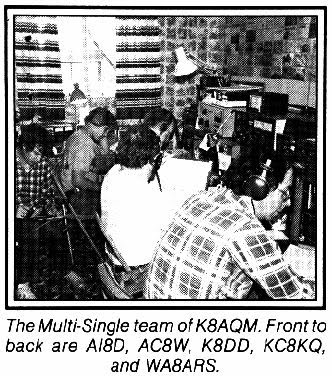 There are many ways to enter RadioSport and one of them is finding a group of operators who share the competitive spirit. One may not want to spend an entire weekend in the pilot’s chair or other commitments may compete for attention. A multi-single entry is an excellent opportunity to share resources, time, and establish new friendships.
Participating in this category made a significant difference in my attitude about RadioSport as a teenager. I spent hours inside the cans learning how-to listen for needed multipliers. A day existed, when paper dupe sheets tracked the log, and I learned precision and orderliness. A mistake in the dupe sheet would result in a significant point penalty.
Additionally, competing in this category set my personal future standard in terms of operating skill, station engineering, and sportsmanship. I modeled those who sat in the pilot’s chair and admired their operating skill especially when rate met or exceeded one’s capacity to write with a pencil.
Cox and Brockman stated, “In the battle of the Goliaths, W2PV captured the top world Multi-Multi score, no easy feat for a USA station.” (1982)
Furthermore, “The contest community around the world will remember this fall when the signals are strong and clear that a few of our friends are not present. W2PV, UI8LAG, and W3KT have become silent keys. Each one contributed to what the contest stands for: enjoyment and excellence.” (Cox & Brockman, 1982)
I want to remember their words as the technological wave rolls into the future of ham radio. Has competitive pursuit finally crossed the border where enjoyment and excellence does not exist or even count anymore? Is RadioSport beginning to miss the forest for the trees?
There exists somewhere in the future, conditions like 1981, when the cosmos fell into place and records fell like dominoes. Cox and Brockman stated, “The top USA All Band score was decided by less than a minute’s operating time on a good band.” (1982)
The North California Contest Club in the same year went from 9 million in 1980 to 160 million. One day the west coast will again stake its claim inside the club box.
Multi-Multi titans in 1981 were W2PV, N2AA, and W3LPL.
Single Operator All Band in the USA was K1GQ.
Single Operator All Band World was 9Y4VT (N6AA).
Top Three Clubs in the United States were Northern California Contest Club, Yankee Clipper Contest Club, and Frankford Radio Club.
Top Three International Clubs were Lithuanian Contest Group, Voroshilovgrad Radio Club, and Kaunas Polytechnic Institute R.C.
If one wants to enter RadioSport think about creating a team of like-minded operators who enjoy the game while pursuing excellence.
73 from shack relaxation zone.
Reference: Cox, B. K3EST, Brockman, L. N6AR (1982, October). CQ Magazine: 1981 CQ World Wide DX Contest: C.W. Results. pp. 20 – 34.

Scot Morrison, KA3DRR, is a regular contributor to AmateurRadio.com and writes from California, USA.
RadioSport History | CQ World Wide DX CW 1981
There are many ways to enter RadioSport and one of them is finding a group of operators who share the competitive spirit. One may not want to spend an entire weekend in the pilot’s chair or other commitments may compete for attention. A multi-single entry is an excellent opportunity to share resources, time, and establish new friendships.
Participating in this category made a significant difference in my attitude about RadioSport as a teenager. I spent hours inside the cans learning how-to listen for needed multipliers. A day existed, when paper dupe sheets tracked the log, and I learned precision and orderliness. A mistake in the dupe sheet would result in a significant point penalty.
Additionally, competing in this category set my personal future standard in terms of operating skill, station engineering, and sportsmanship. I modeled those who sat in the pilot’s chair and admired their operating skill especially when rate met or exceeded one’s capacity to write with a pencil.
Cox and Brockman stated, “In the battle of the Goliaths, W2PV captured the top world Multi-Multi score, no easy feat for a USA station.” (1982)
Furthermore, “The contest community around the world will remember this fall when the signals are strong and clear that a few of our friends are not present. W2PV, UI8LAG, and W3KT have become silent keys. Each one contributed to what the contest stands for: enjoyment and excellence.” (Cox & Brockman, 1982)
I want to remember their words as the technological wave rolls into the future of ham radio. Has competitive pursuit finally crossed the border where enjoyment and excellence does not exist or even count anymore? Is RadioSport beginning to miss the forest for the trees?
There exists somewhere in the future, conditions like 1981, when the cosmos fell into place and records fell like dominoes. Cox and Brockman stated, “The top USA All Band score was decided by less than a minute’s operating time on a good band.” (1982)
The North California Contest Club in the same year went from 9 million in 1980 to 160 million. One day the west coast will again stake its claim inside the club box.
Multi-Multi titans in 1981 were W2PV, N2AA, and W3LPL.
Single Operator All Band in the USA was K1GQ.
Single Operator All Band World was 9Y4VT (N6AA).
Top Three Clubs in the United States were Northern California Contest Club, Yankee Clipper Contest Club, and Frankford Radio Club.
Top Three International Clubs were Lithuanian Contest Group, Voroshilovgrad Radio Club, and Kaunas Polytechnic Institute R.C.
If one wants to enter RadioSport think about creating a team of like-minded operators who enjoy the game while pursuing excellence.
73 from shack relaxation zone.
Reference: Cox, B. K3EST, Brockman, L. N6AR (1982, October). CQ Magazine: 1981 CQ World Wide DX Contest: C.W. Results. pp. 20 – 34.
Scot Morrison, KA3DRR, is a regular contributor to AmateurRadio.com and writes from California, USA.
QRP antenna
I bought a copy of Practical Wireless today and noticed the following in the Waters and Stanton ad inside the front page.
 It isn’t often words fail me, but three hundred quid delivered for a hand held QRP antenna?!? I guess it would perform about as well as my home-made Wonder Loop.

Julian Moss, G4ILO, is a regular contributor to AmateurRadio.com and writes from Cumbria, England. Contact him at [email protected].
Avoiding the Microsoft Tax
I need a new office notebook. Yesterday, while working on something a thin bright blue vertical line appeared on the screen. It’s still there this morning. I guess the TFT display is going on the fritz. Well, this Toshiba Satellite M60 is 4 1/2 years old and has been in heavy use 10 hours a day 5 days a week for nearly all that time, so I can’t complain. Time for a replacement. The trouble is, I use Linux on my work PC and it doesn’t seem to be possible to buy a high-spec laptop with Linux ready installed and working on it.
 Obviously, I’d like to avoid paying for a copy of Windows I’m not going to use. If you’ve ever seen it on sale, you’ll know that the cost of a copy of Windows is quite substantial. Since, thanks to Microsoft’s obsessive copy protection, it will be an OEM copy locked to the hardware and without installation media I won’t even be able to install and use this copy under VirtualBox if I want to.
But also, as it’s a work machine, I’d like to buy one on which the operating system is supported and all the hardware works with it. I’ve installed operating systems far too many times in my life to have any enthusiasm for doing it one more time, and I know from experience that laptops often contain hardware that isn’t supported out of the box by Linux.
When we bought a new laptop for Olga a couple of years ago I bought a budget HP laptop that came with Windows Vista – which ran so slowly it took two hours just to finish it’s automated initial setup routine. I installed Linux but had an anxious couple of hours as I couldn’t get the wi-fi adapter to be recognized. I did in the end, and the chances are that any problems with whatever system I got this time could be resolved after hours of ferreting through support forums. But that long ago ceased being fun and I would really prefer to avoid it.
However, it is virtually impossible to buy a PC or laptop with Linux installed and supported. Dell appears to offer a small selection of laptops preinstalled with a long superseded version of Ubuntu. There is also a firm called The Linux Emporium that offers a limited range of Lenovo laptops with Ubuntu installed on them. But they have nothing that meets my spec. This old Toshiba has a 17in display with WGXA+ 1440×900 resolution and I’m not going to settle for anything smaller. So it seems the only way I am going to get what I want is to buy the laptop I want, pay the Microsoft Tax, throw away Windows and do my own Linux installation.
Is it any wonder that Microsoft enjoys such a virtual monopoly when people who buy PCs don’t even know there is an alternative? Why hasn’t the EU done something about this? It has taken months and cost millions to force Microsoft to install a screen that lets people choose what web browser to use, despite the fact that a) the browser market already has healthy competition and b) switching browsers later on if you want to isn’t a problem. But it has done nothing about a situation that forces people to pay for a Microsoft operating system even if they know enough not to want one. Even if computer manufacturers don’t want to offer Linux because they don’t wish to support it, they should at least be required to offer the OS as an optional extra so those who don’t want it don’t have to pay for it.

Julian Moss, G4ILO, is a regular contributor to AmateurRadio.com and writes from Cumbria, England. Contact him at [email protected].
KREF3 let-down
I often use WSPR, the very narrow band, low power, automatically reported beacon mode, which operates in a 200Hz wide band and reports the frequencies of received stations to 1Hz accuracy. I also sometimes use other digital modes where I want to be able to set my transceiver to a specific frequency with confidence. So one Elecraft K3 add-on that I had been eagerly awaiting was the KREF3 board that was supposed to allow you to lock the K3 reference oscillator to an external frequency standard. In fact, readers of this blog may recall that only a couple of weeks ago I posted an item about rubidium frequency standards being sold on eBay.
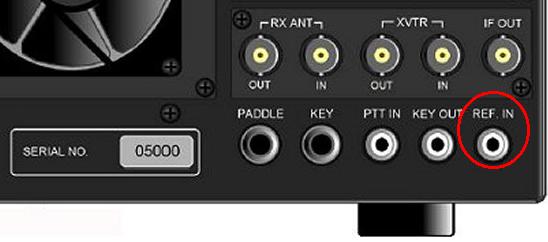 A few days ago Trevor G0KTN, who is actually the person responsible for turning me on to WSPR in the first place, posted a question to the Elecraft reflector asking for a comment from Elecraft as to when the KREF3 might be available. When no answer was received he asked again, and eventually received this reply from Eric WA6HHQ: The KREF3 is not in current planned development. I thought we had removed the references to it in all of our docs. Is it still showing up somewhere?
It is still showing up in the copies of the manuals I have. There is still a labelled, blanked-off hole for it on the back of my radio. More importantly, it showed up in the specification and brochure that Elecraft produced at the time I ordered the radio.
In the past I have been flamed quite harshly by members of the Elecraft fan club for suggesting that Elecraft had broken promises or even acted dishonestly by failing to provide advertised features. But is it being honest, when deciding not to provide a feature that was initially advertised and promised, to quietly delete all references to it and hope no-one notices? Perhaps Elecraft figured that since most hams are in their 60s or later we all have Alzheimer’s and will have forgotten the KREF3 was ever offered.

Julian Moss, G4ILO, is a regular contributor to AmateurRadio.com and writes from Cumbria, England. Contact him at [email protected].
PLT DX Contest
For someone as plagued with HF band interference as me this sounds like a sick joke or an April 1 spoof that passed it’s read-by date. The Electromagnetic Compatibility Industry Association (bet you didn’t even know there was one) has announced a contest to see who can detect interference furthest from a power line adapter installation. Yes, really. There are two prizes: the Long Distance Award (LDX) for the person who detects interference the greatest distance from the installation, and the Most Typical prize (MTY) for the entrant whose detection distance is closest to the median value.
Well I suppose when interference blots out HF entirely we need to use our radios for something. I believe a CQ WW Wi-Fi contest in the offing. You collect SSIDs for multipliers. Double points if the network is unencrypted.

Julian Moss, G4ILO, is a regular contributor to AmateurRadio.com and writes from Cumbria, England. Contact him at [email protected].
Handiham World for 9 June 2010
Welcome to Handiham World!
We are definitely in the summer ham radio doldrums. I can tell that we have reached this time of year by some of the comments I hear, usually by word of mouth or by e-mail:
| “What is wrong with the bands?” | |
| “When will the bands get better? I don’t hear anything on HF.” | |
| “I never hear anything on the repeater.” | |
| “My radio club doesn’t meet during the summer.” | |
| “No one is around to help me with my station/antenna projects.” | |
| “When I went to check into the net, there was no net control station and no one ran the net.” |
Does any of this sound familiar? I hear most of this same kind of discussion every year about this time. As summer arrives here in Minnesota, people start thinking seriously about outdoor activities and taking vacation. Of course we have ARRL Field Day in June each year, but the overall disconnect from many ham radio activities really begins in mid-Spring, generally following Dayton HAMVENTION.
Mother Nature contributes to the problem of HF operation by throwing thunderstorms at us all summer long. The resulting radio interference pretty much makes operation on the lower HF frequencies something that would try any operator’s patience. Then there is the onset of spring and summer jobs waiting for everyone when the snow finally melts here in central North America. I have noticed that radio club attendance usually starts to decline in March. Many radio clubs don’t even meet during the summer because everyone has so much going on that it is difficult to find a quorum for a meeting.
When I hear questions about the HF bands, I know that they are usually coming from newbies who don’t have too much experience and have never learned about the seasonal fluctuations in HF and VHF propagation. Old timers know that the 6 m band comes alive in the late spring and early summer, just as the lower HF bands start to get plagued by thunderstorm static. If these newbies haven’t learned about seasonal fluctuations, they certainly don’t know about or understand solar weather or the sunspot cycle either. Oh, well… I look upon it as a teaching opportunity.
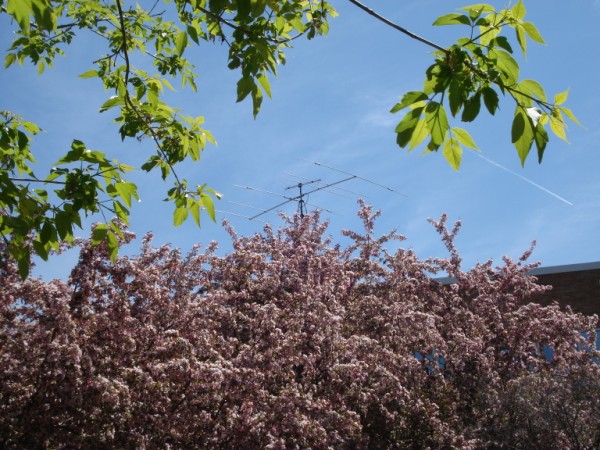
Last week we reminded you to get ready for Field Day. As long as band conditions aren’t too good, now is the time to head out to the backyard for an antenna inspection. Those of you listening to the podcast can hear me as I go through my usual checklist to make sure that my antennas are going to keep working all right. An antenna inspection should be done several times each year, or even more often if you have experienced severe weather in your area.
What to look for:
Are the antennas still up in the air?
Don’t laugh — I have heard from people who didn’t even know half of their antenna was lying on the ground someplace after one of the supports broke. A visual inspection will include making sure that any wire antennas are still in position and that tree branches are not impinging on the radiating element or feedline. Other types of antennas, like vertical or beam antennas, should be visually inspected just to see that all of the elements are in place. If an antenna is designed to rotate, you should look to see that trees have not grown so close to the antenna that they enter the turning radius. So far, all of this can be done by simply walking outside and looking around. If you are blind or have low vision, you will want to get a helper to do this part of the job with your direction.
What about the feedline?
Next, you are going to pay particular attention to the feedline or feedlines, and if the antenna is really high in the air, a pair of binoculars can bring the feed point (center insulator) into focus so that you can see if everything is connected properly. This antenna inspection is a pretty simple one and it does not include any tower climbing. You can follow the feedline down to the point where you can do a close inspection, being sure to include where the feedline enters the building. Since you can actually feel and manipulate the feedline at that point, you can check for any deterioration that might indicate a need for replacement. You will also want to check to make sure that where the line enters through the wall that water or insects cannot get into the building. If coax connectors are covered with a sealant, check to make sure that they are still being protected from the elements. I hope you have some kind of lightning arrestor and grounding system where the feedline enters the house. Check to make sure the connections are solid. If you do any actual work on the antenna or feedline, all of the radios inside should be disconnected from the AC mains to avoid any possibility of electric shock. Remember, at this point we are just doing a visual inspection.
Have animals damaged the coax?
Since one of my antennas is a ground mounted Butternut vertical, I will need to do a close up inspection of the feed point to make sure that the coaxial cable is connected at the base, both the center conductor to the vertical radiating element and the coax braid to the grounding system and radial field. Since this particular antenna model has several capacitors that I can reach from the ground, I can also check to make sure that they have not come loose or broken over the winter. My antenna has a small fence around it to protect the base, and even the fence deserves a quick look over to make sure that it is still structurally sound. The vertical is fed underground, so I will need to inspect the parts that are visible in the feedline system, looking for signs of deterioration or damage caused by rodents or rabbits. (I once looked out the back window and saw a squirrel happily eating away at a plastic lawn chair. Animals can cause similar damage to coaxial cable.)
Towers need special attention.
If you are lucky enough to have a tower, you should also include it in your periodic inspection to make sure that it is structurally sound, and that includes a close-up inspection of at least some of the hardware that holds the tower together and the tower base to make sure that corrosion has not compromised its integrity. Naturally you want to inspect as much of the feedline as you can easily reach around the base of the tower and take a look at the grounding system as well.
A checklist can help. Pilots use them before takeoff – you can use checklists, too.
Every antenna installation is different, so I can’t get overly specific about a check list. However, I can say that it is my responsibility to know and understand the design and layout of my own antenna system so that I can make sure that it remains safe and effective. You have that same responsibility for your station, whether you have a disability or not. Perhaps you cannot easily get outside or see the antenna system yourself, but you should still have a complete understanding of where things are and how they work and how they should be inspected so that you can direct your helper or helpers during a routine inspection. Of course it helps to have amateur radio operators — hopefully friends from your local radio club — to help you with your antenna inspections. But if you don’t, you may have to call on friends who know very little if anything about amateur radio and antennas. In that case, you really have to be able to take charge of the inspection and give good directions so that the inspection can be done properly and your helpers can be safe as they are following your directions. You may want to make a checklist of basic items so that you don’t forget anything.
Yes, summer may be the ham radio doldrums, but it is a lot easier to do an antenna inspection on a nice summer day than it is in the middle of winter. So if you can’t hear anything on the bands it might be time to think about an antenna inspection followed by iced tea on the veranda.
For Handiham World, I’m…
Patrick Tice
[email protected]

Pat Tice, WA0TDA, is the manager of HANDI-HAM and a regular contributor to AmateurRadio.com. Contact him at [email protected].
 Ham Radio Deluxe |
 W5SWL Electronics |
 Ham Radio Prep |
 KB3IFH QSL Cards  Hip Ham Shirts  HamRadioAuctions HamRadioAuctions Reliance Antennas Reliance Antennas Enigma Shop Enigma Shop |  morseDX  Ni4L Antennas  R&L Electronics R&L Electronics antennas.us antennas.us QRV QRV |
- Matt W1MST, Managing Editor
