 |
 Antenna analyzer from China
 14 June 2010 | by
 An antenna analyzer is a very useful piece of equipment and I have never regretted buying my AA-200, though I probably wouldn’t get one now with the current model priced at £410.00. Even the basic MFJ-259B which is not exactly renowned for its quality construction will set you back £260.00. So I was interested to discover that the Chinese have entered the market with the Feature Tech AW07A which can be bought on eBay for a much more reasonable £160.00.
 The unit can measure RF impedance and SWR from 1.8 to 490MHz (making it more directly comparable to the MFJ-269B model) as well as measuring capacitance and inductance. It may be used as a non-precision signal source and frequency counter, and with the addition of an inductor may be used as a dip meter. It looks like a nice addition to any amateur’s toolkit.

Julian Moss, G4ILO, is a regular contributor to AmateurRadio.com and writes from Cumbria, England. Contact him at [email protected].
50-MHz Progress
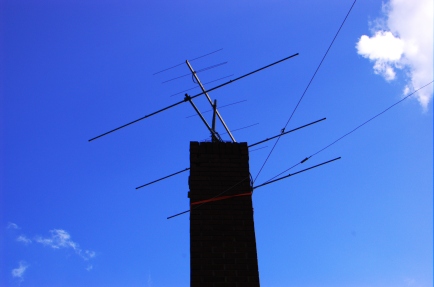
As I mentioned in the previous post, I’ve made some strides toward getting on 6 meters over the weekend. I assembled the 3-element Yagi last weekend. It was leaning against a post in our back yard pointing skyward for a few days. I told Sarah that I was thinking of adding 18,431 more of these antennas so I could compete with the 50-MHz radar at Jicamarca. She was not amused. I hadn’t even mentioned anything about megawatts. Yes, Virginia, the mast in the photo is not square. The top portion of the mast is a little skewed in the rotor and it’s attached with rusty U-bolts that I’ve never loosened. I’m still turning the antenna with the TR-2, even though I have a T2X out here now. I will do that swap eventually. But, for right now, the TR-2 is doing fine.
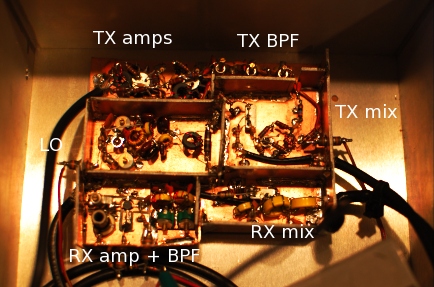
In order to start moving the transverter toward its new home in a beautiful rack-mount enclosure that previously housed a 900-MHz digital repeater (not included when I obtained the box, unfortunately), I had to “re-arrange its internal organs”, as a menacing extraterrestrial used to say in Space Quest. Sarah wonders why I schlep all of this crap from place to place with us. I’ve had that rack-mount box longer than we’ve been married! It was just waiting for a chance to serve in my shack. Anyhow. You can see the layout above. Sarah says it looks like a doll house. Pretty sweet house, if I say so myself.
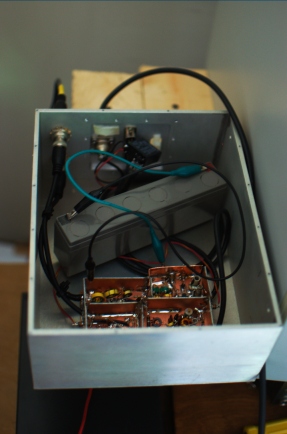
Here’s another view of the partially-integrated box. I’m running it off a battery because I don’t have the power supply subsystem installed in the box, yet. It’s really just a PA and some control circuitry away from operational. Although, I would like to align the TX side with a spectrum analyzer at some point.
I heard quite a few signals in the ARRL contest over the weekend. W5ZN comes to mind, as well as a couple of locals like N4QQ, who lives just a stone’s throw away on the other side of the Beltway (aka the wrong side of the tracks). I suspect that the locals would move the S-meter a little more (like past S9) if I put an IF amplifier in after the RX mixer. But, I’m not really keen to do that unless I have to.
Schematics will come once I’m finished. But, nothing about this so far has been rocket science (or brain surgery, as the rocket scientists say). I’ve just been following the Handbook.
Ethan Miller, K8GU, is a regular contributor to AmateurRadio.com and writes from Maryland, USA. Contact him at [email protected].
Cutting off your head to cure a cold
 I received an email from a German CB operator named Dieter (I presume he is a CB operator from the callsign) asking if I knew of a program to design a SuperMoxon antenna for 27 or 28MHz. I replied, as I would have done to a licensed amateur who had asked the same question, that I didn’t. The SuperMoxon was designed and made by Ron, GW3YDX. Only he knows how he designed it.
My reply to Dieter’s gmx.de email address bounced back with the message: “Sorry, your envelope sender has been denied: The recipient 550 5.1.1 does not want to receive mail from your address.”
Dieter wouldn’t have known, since he contacted me through the form on my website, that I use a Gmail email address. So if I understand correctly, the German ISP gmx.de is blocking all mail from the largest email service in the world (though I suppose it’s possible that it is only blocking email from me.)
I guess this has something to do with preventing spam, since I read recently that a lot of spam comes from fake Gmail addresses. But if gmx.de can’t distinguish spam from real email – something Gmail does extremely well, and one reason why I’ve been very happy to use this free email service – then perhaps it should stop using half measures and turn off email altogether rather than leave its customers wondering why they don’t receive replies from some of the people they contact?

Julian Moss, G4ILO, is a regular contributor to AmateurRadio.com and writes from Cumbria, England. Contact him at [email protected].
Uranus to blame for poor propagation
 A recently published paper suggests that the peaks of the next two solar cycles are likely to have greatly reduced sunspot activity similar to solar cycles 5 & 6 during the Dalton Minimum of 1790 to 1830. Solar records going back over 11,000 years have been correlated with planetary ephemeris and the results appear to show that solar cycles are affected by the position of the solar system’s outer gas giants Uranus and Neptune.
However I’m not sure what is more depressing: the thought that I’m unlikely to see a solar maximum in which ten metres is wide open for worldwide propagation during my lifetime, or the reaction of some of our fellow amateurs to the news on QRZ.com. “WHY CRY about it? Buy a BIGGER antenna & amp for the bands you enjoy & have FUN!” read one comment. “All the whiners about hams using kilowatt amps will be crying constantly. Life is too short for QRP.” went another.
QRPers have been having fun throughout the extended solar minimum of the last few years and will no doubt continue to do so despite the dearth of sunspots. What is sadder, in my opinion, is the passing of an era when radio amateurs were all thoughtful, intelligent, articulate, considerate and gentlemanly individuals who treated their fellow enthusiasts, whatever their interests, with respect.

Julian Moss, G4ILO, is a regular contributor to AmateurRadio.com and writes from Cumbria, England. Contact him at [email protected].
Magic: right place, right time
I put the 3-element 50-MHz Yagi (Cushcraft A50-3S) up yesterday morning with the 6-element 144-MHz Yagi (WA5VJB design) above it—just in time for the ARRL June VHF contest! The 50-MHz transverter is not yet complete, although I have the RX side done and the TX side makes about 250 mW. It’s not integrated and I haven’t started building the PA. Bummer because yesterday was a pretty good Es day from what N3OX told me last night.
With 10 watts from a TS-700S to a 6-element Yagi at 30 feet, there’s not a whole lot you can work on 144 MHz. Plus, everybody was on 50 MHz, so I could only hear the multi-operator and serious single-operator stations on 144 MHz locally. Around 21:00 local time, Sarah and I had just returned from a walk. I had pointed the beams WSW (my best shot from here is SW) and was slowly tuning up and down the band hoping for some tropo enhancement or something…and after a few passes, I heard on 144.210 MHz…
“CQ contest, CQ contest, looking for sporadic-E on two meters, CQ contest, Kilo Five Quebec Echo…”
That’s something alright! I figured the beam was in approximately the right place and gave him a call. He came right back and we exchanged grids. He was there for a few minutes and then disappeared as suddenly as he had appeared. I know he made at least one other QSO, but he was starting to fade by that point and I couldn’t hear the other side. Cool!
My logging software calculated the great circle distance as 1037 miles (1669 km) between FM19 (me) and EM31 (him). Either it was one heck of big meteor or (more likely) one heck of a sporadic-E opening. Either way, I’m pleased. Want more of that!
Ethan Miller, K8GU, is a regular contributor to AmateurRadio.com and writes from Maryland, USA. Contact him at [email protected].
IARU HF World Championship
 The IARU HF World Championship is one of my favorite summer RadioSport events. The game is well positioned for phenomenal success given new media tools and its global reach perhaps might I say, this is the World Cup for RadioSport?
However, has leadership recognized its potential for publicizing ham radio while creating a venue for the world to watch? Instead, a world wide network of headquarter stations, cannot compete. What good is competition without results?
Meet A Challenge With Vision.
I do not agree with the elimination of headquarter scores. RadioSport at the international level has a problem in need of a reasonable solution. Elimination is a one-sided, arbitrary decision and the consequences reach far into the future. Perhaps, it is time for our international RadioSport community, to see this as an opportunity and meet the challenge with all its resources?
My favorite comment and one that is most reasonable was written by John Crovelli, W2GD/P40W who stated, “Eliminating national cheerleading and bring the HQ stations back into the competition, can be accomplished easily. Assign ZERO points to in-country QSOs made by HQ stations. The potential for abuse is eliminated.”
New Media Shaping Our World.
Toby, DH1TW examines the problem while demonstrating the reach of today’s new media and its capacity to shape our conversation. His campaign started with his blog, a tweet, then a survey…
If, the game is moving to the next level of elite competition, one for the elite competitor then meet this challenge with resources and bold vision. I’m looking forward to participating in the IARU HF World Championship this summer.
73 from the shack relaxation zone.

Scot Morrison, KA3DRR, is a regular contributor to AmateurRadio.com and writes from California, USA.
Noises off
Show me a tidy shack and I’ll show you the shack of someone who doesn’t spend much time tinkering with equipment, or someone who has been nagged by his XYL to make the shack tidy and curses every time he needs to connect or disconnect something – which at G4ILO seems to be several times a week.
 When I switched on the computer this morning there appeared to be a Sporadic-E opening building on 2m to the south east so I switched on the IC-910H and turned the SuperMoxon in that direction. Nothing was heard, so I switched to the vertical instead and was puzzled as to why the band noise was so much greater on the beam than the Slim Jim.
The opening passed, as all such openings have this year with nothing heard or worked, and I decided to investigate. I switched the computer off and the noise fell to the same level as on the vertical. Eventually, after much trial and error and cursing because the cables can only be reached by groping blind (with the aid of a shaving mirror or a picture of the back of the rig) behind the equipment I established that the problem was the serial cable providing PTT control to the interface connecting the 910H to the computer. Even when it was disconnected from the radio, plugging it in to the serial port on the computer caused the noise level to jump up.
This was a cheap interface I’d bought some time ago for the FT-817. The serial cable supplied wasn’t screened, but I’d shortened it to use with a USB to serial adapter without a lot of spare cable lying around. This had resulted in it being too short to use with a real serial port, so I had replaced the cable. I had used screened cable for the replacement, but although I had connected the copper shield to the GND pin of the RS-232 port, it wasn’t connected to the body or shell of the plug, which in any case was plastic.
I managed to solder to the metal flange of the plug, the bit that pushes on to the socket on the PC, and connect a short wire from that to the GND pin and the shield. That seemed to do the trick, and the noise level is now the same when the beam is pointing towards the shack as it is on the vertical. Problem solved, for once! Nevertheless I do sometimes wonder if computers are worth all the trouble they cause to us radio enthusiasts.

Julian Moss, G4ILO, is a regular contributor to AmateurRadio.com and writes from Cumbria, England. Contact him at [email protected].
 Ham Radio Deluxe |
 W5SWL Electronics |
 Ham Radio Prep |
 KB3IFH QSL Cards  Hip Ham Shirts  HamRadioAuctions HamRadioAuctions Reliance Antennas Reliance Antennas Enigma Shop Enigma Shop |  morseDX  Ni4L Antennas  R&L Electronics R&L Electronics antennas.us antennas.us QRV QRV |
- Matt W1MST, Managing Editor
