 |
 2010 World Radio Team Championship
 11 July 2010 | by
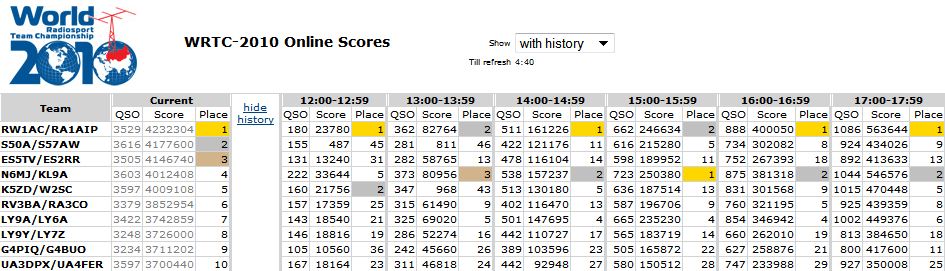 A monumental task well executed this weekend as competitors from all over the globe competed for the top slot in the game. Thank you RadioSport Russia for delivering an excellent interactive Internet product! The team of volunteers who labored behind the scenes certainly set the standard for the next global competition.
Admittedly, are there any plans to merchandise WRTC ball caps and t-shirts in the future? Each rate shackadelic right on in my logbook!
Please check out WRTC photo gallery because the spirit of ham radio and the intensity of competition is found within; note Tim, K3LR and Andy, N2NT.
From my perspective, ham radio operating inside tents beneath the ionospheric dome, really captured the essence of RadioSport. The photographs of tents illuminated by the glow of transceivers and liquid crystal displays against the canvass of sunset sparked a kilowatt worth of inspiration.
Contest on!

Scot Morrison, KA3DRR, is a regular contributor to AmateurRadio.com and writes from California, USA.
End Fed Tuner Success… sort of
Had a good day in the park with Jim K4AHO and Wally KG4LAL. Spent a good bit of time testing a couple tuners for End Fed Half Wave antennas using Jim’s AIM 4170. Wow is that thing a great tool for tweaking antennas! Info overload!
I built an antenna tuner based on AA5TB’s design for an end fed half wave antenna. I am using a 3 ft or so counterpoise on the ground as Steve suggests. On the analyzer in a test lashup it was a bit touchy to hand capacitance but tuned well even up to 21Mhz. Since I am not thinking of backpack size I used a pretty good sized enclosure for it. I am using an air variable 6-160pf cap instead of a polyvaricon like Steve used since space is not a big issue. I also used a T68-6 toroid instead of the T50-2 Steve used.
 When I mounted it in a plastic box the sensitivity seemed to increase. I have not put a LED SWR bridge in the box yet, as I was waiting to see how it worked before adding more variables. Today I was able to put an AIM 4170 analyzer on it and it did tune the antenna… seems that the air variable I used is perhaps a tad small. It is almost fully meshed on 40m cw and on 20m it acts like even at minimum capacitance the sweet spot is very narrow and hard to tune.

Here's the innards
My question(s) are:
1) Is the hand/body capacitance normal? If not, what might cause it to
be so touchy?
2) Would my parts layout be part of the issue?
3) Does the DPDT switch (mini toggle) I added for later use with the SWR
bridge add significant capacitance to the circuit? I was able to match a
21Mhz load on the raw test setup, but not once it is in the box.
4) I have a small bus wire for a ground, do I need to increase that?
5) Is the plastic box the problem? Would it be better in a metal enclosure?
6) Am I asking too many questions? Sorry, this is how I learn. Build,
test, ask… 

SWR bridge I want to use
Thanks for your wisdom and experience on this one.
72,
Kelly K4UPG
Kelly McClelland, K4UPG, is a regular contributor to AmateurRadio.com and writes from Florida, USA. Contact him at [email protected].
APRS on the Wainwrights
I noticed today that Richard G1JTD had a GPS-equipped VX-8R with him on his activation of several Wainwright summits in the Fairfield round. I spoke to Richard on his VX-8R a fortnight or so ago when I was out with my VX-8GR and he mentioned that he might get the GPS option so as to do some APRS. It’s good to see more APRS activity from the Lakeland fells.
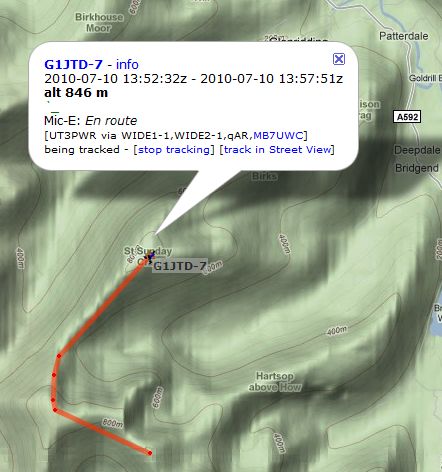 You can see Richard’s track captured from aprs.fi. As you can see, his position reports were only received when he was on the summits and a few other points on the highest parts of the ridge. This is inevitable given that the only digipeaters and iGates are situated around the edge of the mountains located at the homes of amateurs and not at any great height.
From my experience it’s quite common to lose cellular data coverage once you get off the beaten track so smartphone based APRS isn’t really much better in this situation. Running the GPS drastically shortens the phone’s battery life so you are also likely to end up with a dead phone just when you might need it. I think RF based tracking is the best solution for taking APRS into the wilds.
It’s a pity that the power requirement and antenna size for HF operation would make it impractical to use HF for portable APRS operation.

Julian Moss, G4ILO, is a regular contributor to AmateurRadio.com and writes from Cumbria, England. Contact him at [email protected].
My 10,000 Hour RadioSport Challenge | 9,779 – 20 = 9,759 To Go
I’m scanning 20m spectrum space this morning while the event of the summer season is underway. The IARU HF World Championship in addition to the World Radio Team Championship (WRTC) guarantees a lot ham radio fun. I’m waiting for conditions to improve through the morning with a cup of coffee in one hand and my ears inside the cans listening to the music of Morse code.
My thought turns to the competitors in and around Moscow. Conditions are nowhere near epic however reflector chatter suggests heightened sporadic-e activity and not to ignore 15 or 10m this weekend. Likewise, competing with 100 watts against what one might call flat conditions, will certainly push the skill sets of all WRTC competitors.
Signals are beginning to rise above the receiver noise floor and my cup of coffee is nearly drained — first contact is logged!
An Idea.
My field day experience was a great teacher. Our operation, under the umbrella of emergency communications, provided insight into planning an expedition. It is not an easy task assembling equipment, antenna systems, power systems, and operators then operate in the field. The challenge was rewarding and field day opened a new path of ideas.
6m.
The charm of 50 MHz presents new opportunities and possibilities to consider over the summer season. Its portfolio of modes, fascinating conditions, and wide open frequency vistas is a relief from the doldrums of the current cycle and spectrum space gridlock. Likewise, 6m does not require a lot of aluminum or power, to enjoy ham radio at its finest.
I prefer the challenge of this frequency allocation because of propagation specifically sporadic-e, back scatter, and meteor scatter. Basically, one sends signal report and grid square, as measure against a fading signal. Potentially, every grid square is a rare grid square, and I enjoy logging each one as well.
Try 6m this summer season and consider CQ WW VHF next weekend because the magic band is waiting.
Meanwhile, teams are competing for the top slot in RadioSport this weekend in conjunction with the IARU HF World Championship, and I’m ready for another cup of coffee.
73 from the shack relaxation zone.

Scot Morrison, KA3DRR, is a regular contributor to AmateurRadio.com and writes from California, USA.
Rumors of my death have been greatly exaggerated…
I’ve been QRT (both radio- and blog-wise) for quite some time as the XYL and I have been planning and, over the past week, executing a move from Robinson to the charming little town of West, TX — that’s West (comma) Texas, population 2,690, which despite the name is nowhere near “West Texas” but just a dozen miles or so north of Waco in the central part of the Republic. According to the FCC database there are 18 licensed amateurs in West, including your faithful correspondent.
The new QTH is an old but freshly renovated 3 bedroom house with a detached garage and (praise Jesus!) trees, giving me antenna possibilities that did not exist at our suburban-hell duplex in Robinson. There’s a tripod already on the roof; it’s not exactly heavy-duty but it should be adequate for a vertical. Whether I’ll put the Cushcraft R7000 back into service or simply mount the Tarheel on the roof remains to be decided. One of my priorities is to at least get a dipole strung up for 6/10/12 meters. Not yet sure if there’s room for an 80m wire.
The shack/office is about the same size and layout as at the last QTH. There’s a large walk-in closet that I will use as a library to store some of the 8.6 million books that I seem to have acquired over the years and which I hope to have moved for the last time. I no longer have a loud central air conditioning unit outside the window of the office; however, I now live across the street from the main Union Pacific train line that runs through the middle of the state. Being a lifelong fan of model railroading but never having the room, tools or skills to build the N-scale layout of my dreams, I can now enjoy a 1:1 scale road with regular trains that shake the entire house about a dozen times a day like a coin-operated bed in a cheap motel. Must remember turn the VOX off when I’m not at the radio.
Since we’re still living out of boxes it may be some time yet before I can get the shack reassembled, antennas installed, and return to the bands — needless to say, the IARU HF contest is going to have to get along without WW2PT’s big signal, and the IOTA test in a couple of weeks will be a long shot, but I fully intend to be up and running in time for NAQP in August.
Rumors of my death have been greatly exaggerated…
I’ve been QRT (both radio- and blog-wise) for quite some time as the XYL and I have been planning and, over the past week, executing a move from Robinson to the charming little town of West, TX — that’s West (comma) Texas, population 2,690, which despite the name is nowhere near “West Texas” but just a dozen miles or so north of Waco in the central part of the Republic. According to the FCC database there are 18 licensed amateurs in West, including your faithful correspondent.
The new QTH is an old but freshly renovated 3 bedroom house with a detached garage and (praise Jesus!) trees, giving me antenna possibilities that did not exist at our suburban-hell duplex in Robinson. There’s a tripod already on the roof; it’s not exactly heavy-duty but it should be adequate for a vertical. Whether I’ll put the Cushcraft R7000 back into service or simply mount the Tarheel on the roof remains to be decided. One of my priorities is to at least get a dipole strung up for 6/10/12 meters. Not yet sure if there’s room for an 80m wire.
The shack/office is about the same size and layout as at the last QTH. There’s a large walk-in closet that I will use as a library to store some of the 8.6 million books that I seem to have acquired over the years and which I hope to have moved for the last time. I no longer have a loud central air conditioning unit outside the window of the office; however, I now live across the street from the main Union Pacific train line that runs through the middle of the state. Being a lifelong fan of model railroading but never having the room, tools or skills to build the N-scale layout of my dreams, I can now enjoy a 1:1 scale road with regular trains that shake the entire house about a dozen times a day like a coin-operated bed in a cheap motel. Must remember turn the VOX off when I’m not at the radio.
Since we’re still living out of boxes it may be some time yet before I can get the shack reassembled, antennas installed, and return to the bands — needless to say, the IARU HF contest is going to have to get along without WW2PT’s big signal, and the IOTA test in a couple of weeks will be a long shot, but I fully intend to be up and running in time for NAQP in August.
LHS Episode #043: My Own Private Ohio
 The Dayton Hamvention was a little while ago and we’ve just now been able to get around to talking about it. In this episode, we bring in Bill, KA9WKA, our right-hand man, to help us out with discussion of the event and a number of other topics as well.
Don’t be alarmed, however. We keep the dated material to a minimum and move directly into things that are much more current and much more interesting, including questions about the “lightness” of distributions, how to install Ubuntu on a USB stick, a super geeky radio question and much more. Not only that, this may have been the most fun episode we’ve recorded so far. For those who want to brave the unedited version of this one, there are belly laughs aplenty. Check out the stream feed in the right column for that. Just remember, unedited means just what it says.
We haven’t been pushing donations lately so here’s a small tug on your subconscious: If you have a spare few dollars, please consider helping us with our hosting expenses so we can continue to bring you the show long into the future.
73 de The LHS Guys and Bill
Russ Woodman, K5TUX, co-hosts the Linux in the Ham Shack podcast which is available for download in both MP3 and OGG audio format. Contact him at [email protected].
 Ham Radio Deluxe |
 W5SWL Electronics |
 Ham Radio Prep |
 KB3IFH QSL Cards  Hip Ham Shirts  HamRadioAuctions HamRadioAuctions Reliance Antennas Reliance Antennas Enigma Shop Enigma Shop |  morseDX  Ni4L Antennas  R&L Electronics R&L Electronics antennas.us antennas.us QRV QRV |
- Matt W1MST, Managing Editor
