 |
 Special event station N2H at hacker convention
 14 July 2010 | by
Ed Piskor's QSL card for N2H
The station has a great QSL card (above) which was drawn by Ed Piskor of Wizzywig Comics. Ed shows on his blog how he created the QSL card. I will have to try and catch N2H on the air to get one of those cards.
Great to see amateur radio involved in the hacker scene.
For above image note: Ed Piskor / CC BY-NC-ND 3.0


Alan Steele, VA3STL, is a regular contributor to AmateurRadio.com and writes from Ottawa, Ontario. Contact him at [email protected].
One day: Two different types of QSO
Last Saturday, I made two QSOs (a quiet day, then!) but what interested me was the difference between them. Both highly enjoyable, but of very different natures.
Sitting out in the sun, before breakfast I was listening to my IC-E92ED handheld, monitoring the local 2m repeater, GB3WH and the D-STAR reflector REF005A. Tyler, WX4TX from Knoxville, TN popped up on D-STAR and we had a great chat. Tyler was some distance from his local D-STAR gateway, but was running 50W and a beam antenna pointing at the gateway. The connection was solid, with a few moments of R2-D2 audio as the propagation went up and down. We had a good relaxed chat about the different styles of breakfast in our respective countries – Tyler was planning a Buttermilk and Cornbread breakfast!
A few hours later, I was briefly in the shack, doing some work on the computer – monitoring 70.200. I heard a little SSB a little LF of the calling frequency. It turned out to be a Spanish station operating from the coastal area near Alicante. He was using 10w to a small beam and I was surprised to work him with my small station. Interestingly it sounded like propagation was favouring the Oxfordshire area as he was hearing the GB3RAL beacon at Harwell, me and not much else! Shortly after our QSO he faded out and I’m sure that the propagation moved to favour another area of the country.
Two different types of contact – but both very enjoyable. Diversity is one of amateur radio’s strengths!

Tim Kirby, G4VXE, is a regular contributor to AmateurRadio.com and writes from Oxfordshire, England. Contact him at [email protected].
Android envy
I’m suffering from a severe case of Android envy. I was just checking the latest post in Jeff KE9V’s excellent blog (glad you haven’t forsaken the blogosphere in favour of podcasts, Jeff) which mentions in passing that Google has just released AppInventor, a free simple application builder for the Android platform.
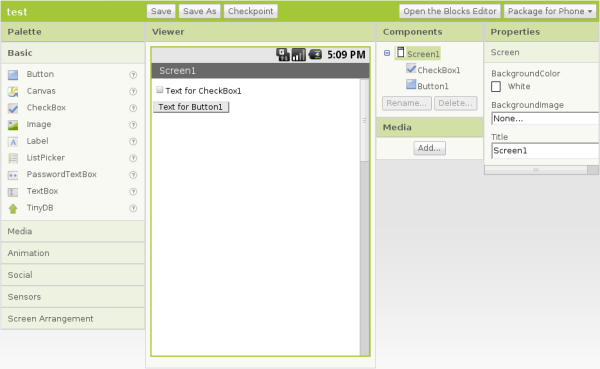 What piques my interest particularly is that AppInventor includes building blocks that allow you to talk to things like the GPS, so you can write location-aware apps, perhaps even apps that are APRS related.
I own a Windows Mobile smartphone. I also own a currently uninstalled copy of Microsoft Visual Studio, which can create apps for the phone. I once wrote an app to sync the clock to an internet time server. But like everything to do with Windows it’s all just too darn complicated and my ageing brain doesn’t feel like getting to grips with it.
The AppInventor approach looks much easier and more fun. I see an Android in my life before too long.

Julian Moss, G4ILO, is a regular contributor to AmateurRadio.com and writes from Cumbria, England. Contact him at [email protected].
Inspirational
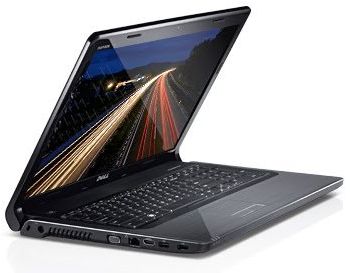 My new work laptop came this morning. It’s a Dell Inspiron 1764 with an Intel i3-350M(2.26GHz) Mobile CPU, 3GB of RAM and a 250GB SATA hard drive. It isn’t the most portable laptop, having – like the Toshiba it replaces – a full-sized keyboard and a 17.3in. widescreen display. It looks and feels absolutely gorgeous, the screen is superb, the keyboard perfect for my fat fingers, and it’s blisteringly fast. Click on the Firefox icon and the browser is there in a second or two.
What’s more, the Dell doesn’t cause any RF interference that I’ve noticed. The old Toshiba caused an increased level of hash that broke the squelch on my 2m FM receiver unless I cranked the knob round quite a way. Since I started receiving HF APRS I noticed that the Tosh caused a 3 S-point noise level on 30m as well, which all but prevented reception of any packets. So I am delighted with the new PC for that reason as well. I can now leave my radio station running all day as a VHF and HF APRS gateway while I work.
The old Toshiba had Linux installed on it early on in its life for security reasons plus the fact that Linux has some good web development tools. I was going to buy a PC with Linux preinstalled but I couldn’t find what I wanted so I resigned myself to paying the Microsoft Tax. The Dell came with 64-bit Windows 7. I thought that I should try it under Windows for a few days just in case there was a fault and I had to send it back. But to be honest I think I may stick with Windows. It looks more polished than Linux, it’s fast and I’ve already started to find replacements for the Linux tools I used. Firefox, which I spend most of the day using, looks and works exactly the same on both platforms, of course.
I certainly wouldn’t choose Windows 7 64-bit for a shack PC as there are too many compatibility problems with popular hardware and ham radio applications. But for what I need to do to keep the business running it looks like being a good choice.

Julian Moss, G4ILO, is a regular contributor to AmateurRadio.com and writes from Cumbria, England. Contact him at [email protected].
2010 World Radio Team Championship

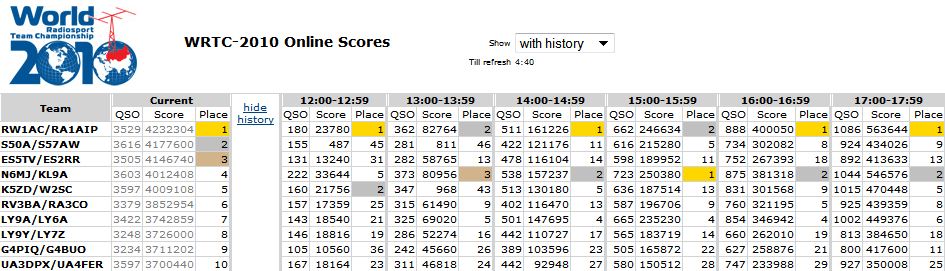 A monumental task well executed this weekend as competitors from all over the globe competed for the top slot in the game. Thank you RadioSport Russia for delivering an excellent interactive Internet product! The team of volunteers who labored behind the scenes certainly set the standard for the next global competition.
Admittedly, are there any plans to merchandise WRTC ball caps and t-shirts in the future? Each rate shackadelic right on in my logbook!
Please check out WRTC photo gallery because the spirit of ham radio and the intensity of competition is found within; note Tim, K3LR and Andy, N2NT.
From my perspective, ham radio operating inside tents beneath the ionospheric dome, really captured the essence of RadioSport. The photographs of tents illuminated by the glow of transceivers and liquid crystal displays against the canvass of sunset sparked a kilowatt worth of inspiration.
Contest on!

Scot Morrison, KA3DRR, is a regular contributor to AmateurRadio.com and writes from California, USA.
End Fed Tuner Success… sort of
Had a good day in the park with Jim K4AHO and Wally KG4LAL. Spent a good bit of time testing a couple tuners for End Fed Half Wave antennas using Jim’s AIM 4170. Wow is that thing a great tool for tweaking antennas! Info overload!
I built an antenna tuner based on AA5TB’s design for an end fed half wave antenna. I am using a 3 ft or so counterpoise on the ground as Steve suggests. On the analyzer in a test lashup it was a bit touchy to hand capacitance but tuned well even up to 21Mhz. Since I am not thinking of backpack size I used a pretty good sized enclosure for it. I am using an air variable 6-160pf cap instead of a polyvaricon like Steve used since space is not a big issue. I also used a T68-6 toroid instead of the T50-2 Steve used.
 When I mounted it in a plastic box the sensitivity seemed to increase. I have not put a LED SWR bridge in the box yet, as I was waiting to see how it worked before adding more variables. Today I was able to put an AIM 4170 analyzer on it and it did tune the antenna… seems that the air variable I used is perhaps a tad small. It is almost fully meshed on 40m cw and on 20m it acts like even at minimum capacitance the sweet spot is very narrow and hard to tune.

Here's the innards
My question(s) are:
1) Is the hand/body capacitance normal? If not, what might cause it to
be so touchy?
2) Would my parts layout be part of the issue?
3) Does the DPDT switch (mini toggle) I added for later use with the SWR
bridge add significant capacitance to the circuit? I was able to match a
21Mhz load on the raw test setup, but not once it is in the box.
4) I have a small bus wire for a ground, do I need to increase that?
5) Is the plastic box the problem? Would it be better in a metal enclosure?
6) Am I asking too many questions? Sorry, this is how I learn. Build,
test, ask… 

SWR bridge I want to use
Thanks for your wisdom and experience on this one.
72,
Kelly K4UPG
Kelly McClelland, K4UPG, is a regular contributor to AmateurRadio.com and writes from Florida, USA. Contact him at [email protected].
APRS on the Wainwrights
I noticed today that Richard G1JTD had a GPS-equipped VX-8R with him on his activation of several Wainwright summits in the Fairfield round. I spoke to Richard on his VX-8R a fortnight or so ago when I was out with my VX-8GR and he mentioned that he might get the GPS option so as to do some APRS. It’s good to see more APRS activity from the Lakeland fells.
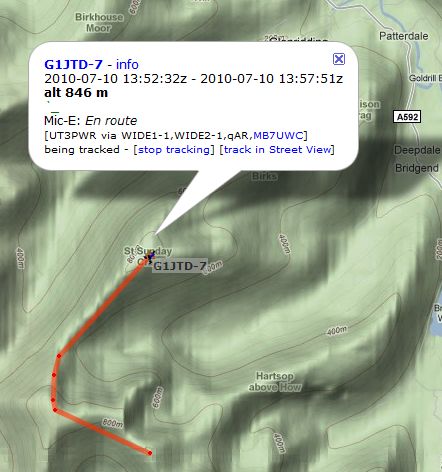 You can see Richard’s track captured from aprs.fi. As you can see, his position reports were only received when he was on the summits and a few other points on the highest parts of the ridge. This is inevitable given that the only digipeaters and iGates are situated around the edge of the mountains located at the homes of amateurs and not at any great height.
From my experience it’s quite common to lose cellular data coverage once you get off the beaten track so smartphone based APRS isn’t really much better in this situation. Running the GPS drastically shortens the phone’s battery life so you are also likely to end up with a dead phone just when you might need it. I think RF based tracking is the best solution for taking APRS into the wilds.
It’s a pity that the power requirement and antenna size for HF operation would make it impractical to use HF for portable APRS operation.

Julian Moss, G4ILO, is a regular contributor to AmateurRadio.com and writes from Cumbria, England. Contact him at [email protected].
 Ham Radio Deluxe |
 W5SWL Electronics |
 Ham Radio Prep |
 KB3IFH QSL Cards  Hip Ham Shirts  HamRadioAuctions HamRadioAuctions Reliance Antennas Reliance Antennas Enigma Shop Enigma Shop |  morseDX  Ni4L Antennas  R&L Electronics R&L Electronics antennas.us antennas.us QRV QRV |
- Matt W1MST, Managing Editor
