 |
 A Tale of Three Field Day Weekends
 25 July 2010 | by
 Since becoming licensed in the Fall of 2007, I’ve participated in every ARRL Field Day event since becoming licensed (2008, 2009 and 2010) and can honestly say I’ve had fun each and every year.
Let me explain, my three field day weekends mention above are not my only field day weekends. As a child I attended at least one FD with my Uncle, K5SOR perhaps more…But one I remember really well.
Anyway, in 2008 I was honored to have the opportunity to spend my first field day as a licensed ham with my Uncle. He and I went down to his childhood home of Cleveland, Texas and participated with the SHARK (Sam Houston Amateur Radio Club). Many of my Uncles friends belong to this club and just about all have been licensed for over 50 years. The 2008 FD event with the SHARK club was a lot of fun. We operated as N5AF, a 1A station in STX.
Last year in 2009 I spent Field Day weekend with my local club here in Denver. We operated as W0TX, a 6A station in CO. We setup out near Hudson, CO at an old AT&T site. The site is literally in the middle of nowhere. It was hot, it was dusty and dry. The Rocky Mountains just west of Denver teased us with every glance. But…it was fun.
As I began thinking about what I wanted to do for Field Day 2010, the thought of a hot, dusty location just didn’t appeal to me. After all, I live in one of the most beautiful states in the lower 48. I kept thinking of all the advantages to having Field Day in the mountains. First, the daytime temps could be anywhere from 10-20 degrees cooler than those down in the city. Second, the elevation difference sure wouldn’t hurt from an operating position. Third, the smell of pine is just incredible. It was decided….my third Field Day….Field Day 2010 would be in the mountains.
I discussed the idea with a few friends and back in the March/April timeframe all thought it was a great idea and everyone was in. At that time there would be three operators. Our number one goal was to have fun. We weren’t out to win anything…just have fun and prove to ourselves we could pull something like this off. We stayed in touch via email and every couple of weeks we would update logistics and add more to the overall planning checklist. We would keep things simple and operate as a class 1 station. The decision of power was yet to be determined.
As we got closer and closer to Field Day weekend, more and more issues began popping up for the three of us. It was pretty clear we would only be able to operate on Saturday as we all started having scheduling issues with Sunday. But that was OK. We planned to operate for 6 hours or so and break down our operation and be back home before dark. Remember, our number one goal was to have fun.
Just a few days prior to Field Day I got the call. One friend had to bail on the plans. And then there were two. But….no sooner as I even thought that….the second friend sent me an email saying he would be unavailable. And then there was one…..ME! Well I wasn’t going to let this ruin my plans and I wasn’t going to change my plans either. I wanted to operate Field Day in the mountains….I wanted to have fun and I wanted to smell pine trees while doing all this.
Now my wife is THE BEST wife a ham can have. She supports me and my hobby and all that goes along with it. She agreed to go with me. Give her a picnic lunch, a comfy chair and a good book and she’s very happy. We’ve gone on picnics before where I take my Yaesu FT-817 and Buddipole and she takes a book and we’re both happy doing what we enjoy for 2-3 hours. I figured the same could be true for Field Day.
All was set, the car was loaded and it was time to head up the hill. We have a favorite little park just up from Evergreen, Colorado. It’s a great site because there is almost no one there and it sits up overlooking the town of Evergreen. We arrived just before 11 AM local time (1700 UTC) and I had an hour to get my station setup. Field Day would start at High Noon.
My wife the day before encouraged me to leave the generator at home and try operating “green” for field day. Now understand, we’re not tree huggers or anything like that. By the way….there is nothing wrong with being a tree hugger. Yes we care about the environment and we do our part to make a difference. I have batteries and I have solar panels. What else do I need?
So we arrived and I began setting up. The forecast was calling for a beautiful day. Of course, I checked the forecast the day before and didn’t bother checking again that morning. Like other places….In Colorado, wait 5 minutes…the weather is sure to change and change it did. We quickly had our meal just before noon and I was setup. About 5 minutes before noon the clouds began to roll in. Hmmmmm, solar panels not working. No worries….this will blow over and as long as it doesn’t rain……
I managed to work about 5 stations and then I felt it. Yep….one single, tiny little rain drop. But you know….where there’s one. Possibly the one piece of equipment I did not take with me (other than a portable sun) was a canopy. So the rain drops turned from one to many and so the gear needed to be packed away. Saint Maximilan Kolbe (the Patron Saint of ham radio operators) was truly looking out for me because no sooner did I close the back of the Ford Escape, the bottom fell out. It rained and it rained some more. Knowing the weather would not clear up for the next few hours, we decided to start heading back to Denver. I finished out my Field Day fun for Saturday afternoon and even a few hours on Sunday morning from a local park with just my buddipole and my Yaesu FT-897.
So….do I have a favorite Field Day weekend from the three? Well…certainly nothing will ever top sharing field day with my Uncle. But I still managed to have fun and as with the two years previous, I did learn a few things. As for Field Day 2011, I’m not sure where or how it will turn out. Field Day in the Rocky Mountains??? It will happen some day.
Until next time,
73 de KD0BIK
Jerry
Jerry Taylor, KD0BIK, is a regular contributor to AmateurRadio.com and writes from Colorado, USA. He is the host of the Practical Amateur Radio Podcast. Contact him at [email protected].
Practical Wireless author, Gordon King, G4VFV dies…
I heard from my ‘boss’, Rob Mannion, G3XFD, the editor of Practical Wireless the sad news that well-known PW author, Gordon King, G4VFV died yesterday, 24th July. Gordon had been suffering from stomach cancer.
I’d known Gordon on the air ever since we got our Class A licences around the same time. Of course I knew his call as even then he was a prolific author! We had many a good chat, often when I was at my parents’ then house in Cornwall, which was a good distance to Gordon’s Brixham station on 80m.
I’m sorry that I didn’t get the chance to say goodbye to him. A full obituary will appear in Practical Wireless shortly.

Tim Kirby, G4VXE, is a regular contributor to AmateurRadio.com and writes from Oxfordshire, England. Contact him at [email protected].
Where’s he been? D-STAR and Echolink from a hotel in Madrid

I’ve been in Madrid for a few days, on business. I didn’t have any radios with me, though I did have the laptop and a decent internet connection. I had a couple of QSOs using the DV-Dongle on D-STAR – which of course is great fun if you’re stuck in a hotelroom. Not that I was stuck, as such… but anyway it was nice to work Mark, KJ4VO and a few others from time to time and just to listen to some of the reflectors.
Incidentally, I noticed someone the other day lament that there were a lot of reflectors on D-STAR but not so much activity. I’m not sure that’s entirely fair, but I’ve found that rather than operating ‘blind’, I tend to keep an eye on http://www.dstarusers.org and see who’s on and what repeaters / reflectors they’re on. That way, you can easily work out the best place to listen to catch up with activity or a particular person.
I also had Echolink on my PC and I was hoping to try and make some QSOs through the Swindon 70cms repeater, GB3TD with it. However the router configuration of the hotel did not permit the UDP ports required to pass. It wasn’t until later on that I realised that I could have remotely setup an Echolink proxy on my PC at home and used that. Find the Echolink proxy software on the Downloads section of http://www.echolink.org

Tim Kirby, G4VXE, is a regular contributor to AmateurRadio.com and writes from Oxfordshire, England. Contact him at [email protected].
TV series invites amateur radio enthusiasts to take part
Call me cynical, but I had a feeling I wasn’t going to like reading this story on the excellent Southgate ARC News site.
So, the producers want to invite amateur radio enthusiasts onto a doubledecker bus for some sort of dating show.
What could possibly go wrong in terms of publicity for amateur radio!
Wouldn’t. Touch. It. With. A. Bargepole.

Tim Kirby, G4VXE, is a regular contributor to AmateurRadio.com and writes from Oxfordshire, England. Contact him at [email protected].
Travel with Radios and Antennas
Every now and then, there is a question on one of the e-mail lists or forums about traveling by air with radios and antennas. In my experience, most travel headaches can be minimized by adhering to a couple of simple rules:
- Make it easy for the security (and Customs, if international) inspectors. Pack everything neatly so it’s easy to search, even if you’re not present (checked baggage). Label everything. Include documentation and instructions on how to quickly disassemble things if needed. Be courteous if searched. This is not the time to “educate” inspectors about amateur radio.
- Carry your radio and computer as hand luggage. I think everyone knows this by now.
- Put antennas into a sensible container and check them. I’ve heard of golf club carriers, ski bags, fishing rod carriers, and cardboard boxes. I use a 4-inch thin-wall PVC drain pipe that’s about 48 inches long. It has a black rubber cap on one and a drain plug on the other. This may have problems in the automatic baggage-handling systems of some airports like O’Hare. The sporting equipment bags are better because the airlines know how to handle them. It makes sense to use a carrier that might be similar to other baggage going to your destination. But, in reality if you just call it your “ski bag” or “golf bag” at the counter, the agent will never ask what’s in it (aside from the usual security questions). Also ensure that this bag is acceptable on all your flights, including island hoppers.
- Keep as low a profile as possible, but don’t be weird or break the law. Practice moving fluidly with all of your gear. Expect to be questioned and prepare for it.
If the trip is international, every country is different. So, it’s helpful to have either a resourceful, intelligent local fixer or at least to discuss your plans with someone who has been there before. However, most countries that receive a lot of tourists and have relatively easy reciprocal licensing requirements will not pose any problems.
Ethan Miller, K8GU, is a regular contributor to AmateurRadio.com and writes from Maryland, USA. Contact him at [email protected].
CW DX pranks
One of the perpetual frustrations of being in a rare (in ham radio terms) location (or just having a big signal from an exotic location) is handling the ensuing “pile-up” of stations calling you, separating them so you can hear them and keeping them from interfering with your signal. The sought-after (“DX”) operator must maintain control of the pile-up or pandemonium breaks loose. A tried and true technique for controling a pile-up is to spread callers out in frequency above the DX operator’s frequency, which should remain clear, except when the DX is transmitting, of course. This is called “working split” and on CW (Morse code mode), the DX operator indicates this condition by appending “UP” to his calls.
For unknown reasons, this concept is lost on some operators, who call repeatedly on the DX’s frequency much to the consternation of everyone else who is trying to make contact. Sometimes, it’s an honest mistake and after some “helpful” operators send “UP UP UP UP” a few times (also on the DX’s frequency), the offender catches on. But, in just about every pile-up these days, there’s always one or two operators at the shallow end of the pool of clue. Tonight’s JT5DX pile-up on 20 CW (listening from the mobile on the way home from work) was no exception.
I’m never sure whether to laugh or hang my head in shame when this happens…but, now and then one of the other operators in the pile-up will answer the poor clueless soul impersonating the DX and give him a contact! It shuts them right up and is usually good for a laugh. I do feel a little bad every time I hear it…but, if they don’t get it when the pile-up police send “UP UP” and the DX sends “UP”, how can you explain it to them?!
Ethan Miller, K8GU, is a regular contributor to AmateurRadio.com and writes from Maryland, USA. Contact him at [email protected].
K8GU/M (or how convert your 1999 Ford Escort into a real head-turner)
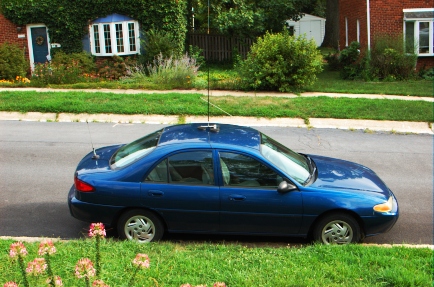
When we got married, the Escort I was driving had gone to my parents in exchange for a larger vehicle with an automatic transmission and a 6-cylinder engine (all three points nods to Sarah, although I admit that it was a much better ride for the kind of driving we did). With the transfer of the Escort, my HF mobiling days were on hold, although I kept the gear.
In order to finance a DSLR a couple of years ago, I sold-off some ham gear I wasn’t using, notably the HF mobile equipment. I didn’t manage to sell the tri-magnet mount I borrowed from N8ET for the 2004 MnQP and a rather dismal attempt at WiQP. This mount had an interesting life, which included being destroyed at 75 mph on I-94 north of the Wisconsin Dells. I drop-shipped a replacement to N8ET, but had the good fortune of finding similar donut-shaped magnets and some heavy adhesive vinyl at Ax-Man Surplus. So, with a little epoxy and elbow grease, I fixed the mount while I was still in Minnesota. It lived to ride again in several QSO parties before my futile efforts to sell it. I raised the requisite capital for the DSLR before the mount sold. So, I kept it.
When we moved the DC area, it quickly became apparent that we were going to have to relinquish our delightful position as a one-car couple and the Escort returned to our lives, probably to the chagrin of my father and delight of my mother. Dad later passed along a Yaesu FT-5100 and mag-mount VHF/UHF mobile antenna which I promptly installed. But, I really longed for HF CW in the car like the good old days. So, a few weeks ago, I plunked-down $30 for some knock-off Hamstick-type HF antennas for 20 and 40 and put the Yaesu FT-840 back in the car. (Astute observers will note that I have a 100% Kenwood fixed station and a 100% Yaesu mobile station. The IC-290H and the DJ-580T are anomalies that I permit to persist in my life for various reasons.)
There is nothing like listening to JAs via long-path on the way to work…and getting funny looks from the other commuters at the same time. A car full of teenagers waved once. Friends and relatives have called it everything from “a space ship” to “a hunk of junk” (thanks, Rachel).
Ethan Miller, K8GU, is a regular contributor to AmateurRadio.com and writes from Maryland, USA. Contact him at [email protected].
 Ham Radio Deluxe |
 W5SWL Electronics |
 Ham Radio Prep |
 KB3IFH QSL Cards  Hip Ham Shirts  HamRadioAuctions HamRadioAuctions Reliance Antennas Reliance Antennas Enigma Shop Enigma Shop |  morseDX  Ni4L Antennas  R&L Electronics R&L Electronics antennas.us antennas.us QRV QRV |
- Matt W1MST, Managing Editor
