 |
 New world record on 10GHz: 2696km
 2 August 2010 | by
 According to the ‘Hyperatlantica’ website a new world record has been set for a terrestrial contact on 10GHz.
On the 10th July, the team made a 10GHz QSO between the Cape Verde islands and Southern Portugal.
Take a look around the website – it’s not extensive, so if you understand a little French, you’ll be fine. If not, then Google Translate (http://translate.google.com) is your friend.
Well done Team Hyperatlantica!

Tim Kirby, G4VXE, is a regular contributor to AmateurRadio.com and writes from Oxfordshire, England. Contact him at [email protected].
2010 WRTC MP3s Are Hot
Thanks to Randy, K5ZD and his Internet team for providing the hottest
playlist in RadioSport. One receives the full range of excitement and
intensity as heard in the cans of WRTC competitors. Their rate is an
education for those who want to dare the challenge of the Box. I
downloaded the entire collection of recordings to begin the pump prior
to NAQP CW weekend.
I spent the greater portion of the weekend working my logbook and
updating my award endeavors. My inventory of traditional cards arrived
earlier in the week prompting several SASE envelopes to stateside
managers.
Six meters needs a flare because the magic band remained quiet through
the weekend. It makes the Q all that sweeter when all the elements
converge for a whole lot of ham radio fun.
73 from the anywhere, anytime shack.

Scot Morrison, KA3DRR, is a regular contributor to AmateurRadio.com and writes from California, USA.
Antennas, Tomatoes, and Neighbors
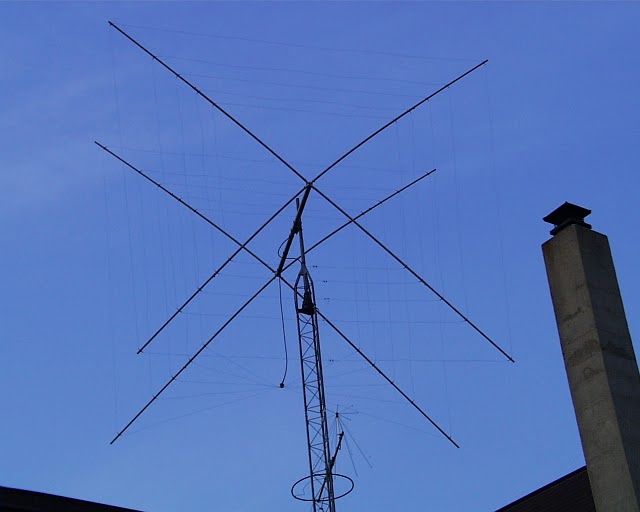
About six months later I had an antenna party and installed another ten foot of tower and a Lightning Bolt two element five band HF quad along with a Yaesu SDX-1000 rotator. The thing was a monster, a three-dimensional monstrosity measuring about 16' x 16' x 8' with a four inch diameter boom. Lightning Bolt, now a defunct company, must have been in a garage. The antenna went together well, but you could tell it was very homebrew. The element wire holders were made out of plastic brake line tubing and hose clamps. The balun was a PVC plumbing end cap with plastic poured in it. The boom end caps which held the fiberglass spreaders on to the boom were probably the most professional looking components as they were thick, welded aluminum.
I selected a quad at the time because I knew on this lot I wasn't going to be able to go much above 40'. I didn't have to get a building permit, but a township official told that the fall zone had to be within the property line, so I wasn't going to push the height issue. According my antenna modeling and articles I had read, the quad had a lower angle of radiation than a yagi at the same height. Today I know the difference is negligible but a quad requires much more maintenance than a yagi and it takes up too much vertical real estate, especially on a short tower like my 40 footer.
But the antenna was magical. Folks could have sworn my QRP signals, both phone and CW, were hundreds of watts. In contests I could really stack the multipliers on 20 meters. I got QRP DXCC in about two months after ARRL started the award. My best catch was Bhutan, netting a contact with the first call on CW running a barefoot 100 watts.
The first two weeks I had the antenna I would drive home from work and see the top of the quad peeking up out of the trees from a mile away. It made me somewhat sick seeing how big the antenna was behind my house, despite understanding its technical beauty as a radio artisan. People drove by and would rubber-neck looking at the huge antenna. I know some folks called the thing a big fly swatter. Eventually I got used to the appearance of it.
The neighbors on either side didn't seem to mind the antenna much. I was concerned about the ones behind us. It was their vacation home and they were usually there every other weekend. The antenna was almost right in the middle of their view of the lake. I would visit them maybe three or four times in the summer, bringing fresh vegetables from the garden. They were friendly couple, but I thought the antenna might change that.
The first weekend they were at their vacation home after the quad went up, I made a visit with some fresh tomatoes from the garden. We engaged in the normal conversational stuff: home projects, local news, and the weather. The man, in his mid 60s, brought up the topic of the antenna. Oh no, I thought, he's going to give me an earful about the quad.
"Does your new antenna do 40 meters?" he asked.
Slightly caught off guard I paused and said "Uh, no, it does 20, 17, 15, 12, and 10. Ummm, how do you know about 40 meters?"
"Oh, I got a novice license back when I was a teenager. I did it for a little while, but got into music and other things and let my license expire. Do people still do ham radio these days?" he inquired.
Needless to say I never had a problem with the neighbors :-)

Anthony Good, K3NG, is a regular contributor to AmateurRadio.com and writes from Pennsylvania, USA. Contact him at [email protected].
For The Love Of Droid
I’m writing my post off my Droid keyboard this evening after
activating the mobile features at my blog. The new world of mobile
blogging has taken hold afterall the world is our shack. Mobile
wireless is the frontier of today and likely tomorrow as well.
There is much to explore with this device held in the palm of my hand.
It is the power to transform and communicate ideas from anywhere,
anytime that makes this technology so compelling.
I caught up with my bureau QSLing this morning and have a shipment
ready for the League later this week. Six meters west of the great
propagation divide was rather quiet through the day. I maybe a little
impatient at the moment.
This is a Droid test message from the anywhere, anytime shack. 73.
Has anyone noticed a lot of broken links after Newington rolled out
its new website? There are a lot of dead ends on the digital highway
leading to headquarters.

Scot Morrison, KA3DRR, is a regular contributor to AmateurRadio.com and writes from California, USA.
ICQ Podcast Series Three Episode Sixteen (01 August 2010) – Cypriot Contester
Series Three Episode Sixteen of the ICQ Amateur / Ham Radio Podcast. News Stories include:
- Digital TV / Radio - What's Next?
- New callsigns for Ireland's Emergency Network
- ISS SSTV pictures received in Essex
- 2010 Amateur Radio Newsline Young Ham
- Youngest Portuguese radio amateur
- Surge in US Amateur Radio licenses
- Amateur Radio exam process streamlined
- MI5 endorse 'ring of steel' for BBC
- ARISS contact with Girl Guides
- Uncensored offshore Fiji news station
- 40m portable antenna shootout
- Amateur Radio contesting simplified
- Amateur radio in the classroom
- Update - D-STAR illegal in France
- Amateurs needed for TV
- 19411 km with 30W to dipole
Your feedback, upcoming events and Norman Bates (5B4AIE) joins Martin (M1MRB) to discuss contesting in Cyprus
Colin Butler, M6BOY, is the host of the ICQ Podcast, a weekly radio show about Amateur Radio. Contact him at [email protected].
Try some Cornbread Road

Image by permission from KE9V
Jeff, KE9V, has recently released a podcast called Cornbread Road. It is quite a different type of amateur radio podcast. It is not a commentary or discussion of amateur radio, it is a story with amateur radio involved in it. The production quality is high and I have found the story captivating. Jeff tells me the next episode, number 6, is out tomorrow (Sunday 1st Aug.). If you have not already sampled Cornbread Road give it a try, I recommend it.


Alan Steele, VA3STL, is a regular contributor to AmateurRadio.com and writes from Ottawa, Ontario. Contact him at [email protected].
Feeding the WA5VJB cheap Yagis
The WA5VJB cheap Yagis are a great way to get on VHF/UHF without spending a fortune on commercial antennas. While it is practical on the UHF/microwave bands to use a copper driven element, it is less practical on the 144 and 222 MHz bands. I know that McMaster carries copper and brass rods, too. But, I also like to have a coax connector at the feedpoint. Since I am in the process of building what amounts to a “super cheap Yagi” (note that’s not a “super-cheap Yagi,” the hyphen matters; will report on this in the future), I figured I would share my feedpoint for aluminum driven elements.
While wandering through the electrical aisle of the local big box hardware retailer about six months ago, I discovered the Thomas and Betts ADR6-B2 (try the ADR6 for a drawing of a similar part) grounding lug. This looked like a good candidate for the cheap Yagi feedpoint, especially costing only $1 for a pair. In order to fit an SO-239 flange-mount connector to the ADR6-B2, I cut off the portion of the lug with the bolt hole and drilled my own hole (#43) and tapped it 4-40. I did the same to the other piece. I did not cut off the lug on the second one, but I should. Then, I soldered a short piece of wire to the center conductor of the SO-239 jack and added a lug to it. Here are the parts so far:
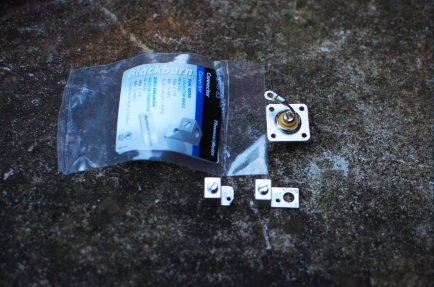
Then, I assembled the whole mess on the J-shaped driven element (dummy used for photos) using two 3/8″ 4-40 screws and a lock washer. Note that the ADR6 lugs are installed on opposite sides of the element.
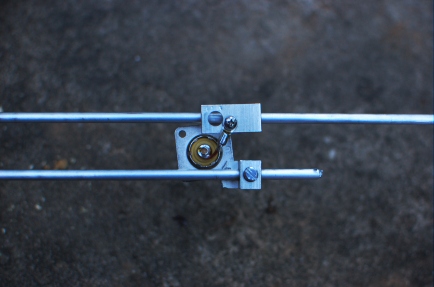
And, after installing on the wooden boom, it looks like this:
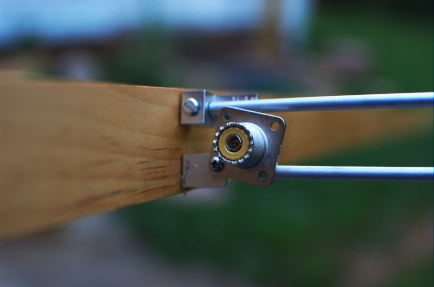
It’s not quite square and some mechanical strengthening is in order before it goes up in the air. But, this is a considerable improvement over what I’m using now. Ty-wraping the coax to the boom will provide considerable relief to the connector and it’s attachment. More details will be forthcoming on the antenna, if it works. Stay tuned!
Ethan Miller, K8GU, is a regular contributor to AmateurRadio.com and writes from Maryland, USA. Contact him at [email protected].
 Ham Radio Deluxe |
 W5SWL Electronics |
 Ham Radio Prep |
 KB3IFH QSL Cards  Hip Ham Shirts  HamRadioAuctions HamRadioAuctions Reliance Antennas Reliance Antennas Enigma Shop Enigma Shop |  morseDX  Ni4L Antennas  R&L Electronics R&L Electronics antennas.us antennas.us QRV QRV |
- Matt W1MST, Managing Editor
