 |
 August 2010 Prize Drawing
 10 August 2010 | by
  We are very pleased to announce the winner of
1,000 full-color photo QSL cards
from KB3IFH QSL Cards!
Thanks to Randy at KB3IFH QSL Cards for sponsoring this month’s drawing.
We had over 750 entries!
We’re giving away another great prize in September.
Stay tuned and get ready to enter.
OK, on to what you’ve all been waiting for!
The winner of our August 2010 prize giveaway is…
Matt Thomas, W1MST, is the managing editor of AmateurRadio.com. Contact him at [email protected].
An iPhone4, iBCNU and APRS
I picked up an iPhone4 when I got back from Madrid. I’ve been pleased with it. The much mentioned ‘antenna issue’ can be reproduced easily, but a case solves it easily and it doesn’t cause me any issues in day to day operation.
If you’ve been reading this blog for a while, you’ll have seen me mention iBCNU an APRS client for the iPhone. I hadn’t really tried it on the iPhone4 before today, other than swapping some quick messages at home.
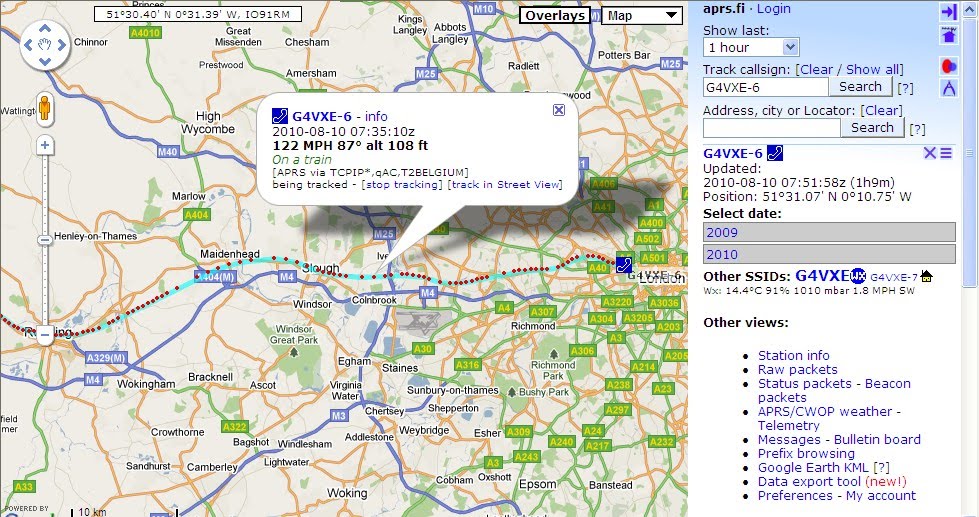
The GPS in the iPhone4 seems to lock up on a position much quicker and I found that in conjunction with iBCNU it worked really well from the train in tracking my position and displaying the speed. Top speed on the way in this morning was 125MPH (200KPH), just to the east of Slough. You can see the track on http://aprs.fi – just search for G4VXE-6 – or I did a screengrab a bit earlier.

Tim Kirby, G4VXE, is a regular contributor to AmateurRadio.com and writes from Oxfordshire, England. Contact him at [email protected].
APRS for Blackberry
Hot off the press. An APRS client for Blackberry smartphones is being developed. More information about it can be found here.

Julian Moss, G4ILO, is a regular contributor to AmateurRadio.com and writes from Cumbria, England. Contact him at [email protected].
Internet killed the radio chat
The unwillingness of many hams to chat or ragchew on the air is becoming a frequently raised topic on blogs and forums. One QRP blogger recently complained after one of his CQs received a “599 TU OM” type of reply.
It’s sad but, I think the disappearance of the ragchewer is inevitable. Thirty five years ago when I was first licensed, if I wanted advice on something I was doing I would call CQ and hope someone knowledgeable would reply. Much of what I learned about radio after getting my ticket I learned from on the air conversations. Today I would go on the internet where I can find out much more, much faster.
In the late 1980s I added my first modem to my home computer and discovered bulletin boards – the forerunner of today’s internet. There I could chat with fellow computer enthusiasts without any of the aggravations of QRM, QRN and QSB that afflicted ham radio communications. My ham radio usage fell right off to the extent that I eventually sold my gear and let my license lapse for several years.
Whilst playing with radio is fun, especially if you like building electronic things or are interested in propagation, the internet is a much better system for finding like-minded people to chat with and provides more reliable ways to communicate with them. We’re all guilty! Every mailing list or forum thread and every blog post with its follow-on comments is a conversation that once upon a time might have been conducted on the air. The internet has changed ham radio and there is nothing anyone can do about it.
That isn’t to say there is no point to ham radio any more. But the point is increasingly about how far (or where) your radio signals reach, not what you actually say. Contesting and award chasing with their “599 TU” exchanges are popular like never before. And there is lots of interest in modes like WSPR and QRSS beaconing that allow you to see how far your transmissions go without the bother of having to contact somebody and receive a report from them.
The art of on the air conversation is dying out. The reluctance of digital mode users to venture beyond sending their pre-prepared macros is one example of this. Making a ham radio contact no longer requires an exchange of personal information, you simply need to receive enough of someone’s signal for it to be identifiable as theirs. And digital modes have been developed that facilitate the exchange of just this minimum information.
The popularity of the JT65A mode on HF can be explained by the fact that it allows people to make “contacts” without having to speak or type anything, because the exchanges are all coded into the software. VHF enthusiasts now work each other using weak signal digital modes whilst they are in constant contact, not using radio, but via ON4KST Chat, an internet chat channel. When you need to keep in contact, it seems, radio is too unreliable. The same appears to be true for DX Cluster spots. How many people still receive them using packet radio?
The ham bands are becoming no more than a playground for those in which the unpredictable vagaries of propagation provide the key element that makes their activities a challenging and absorbing pastime. But as a serious communications medium, unless you’re half way up a mountain or in the middle of Africa where the internet and cellular networks aren’t available, radio is becoming somewhat redundant.
If you want to talk to somebody about your favourite ham radio topic why worry whether the propagation gods are feeling kind to you when you could just start a thread on Yahoo Groups or QRZ.com or go on Echolink?

Julian Moss, G4ILO, is a regular contributor to AmateurRadio.com and writes from Cumbria, England. Contact him at [email protected].
New digital mode for LF
A new narrow band digital mode optimized for MF and LF (160m and down) has just been released. Developed by Con, ZL2AFP the new mode is called CMSK.

CMSK uses Minimum Shift Keying (MSK). This is similar to Phase Shift Keying (PSK) but the frequency is shifted smoothly, achieving a 180 degree phase shift within one bit period, with the result that no amplitude variations occur, so the transmit amplifier need not be linear.
The mode has been designed specifically for use on the lower frequencies which provide good phase stability on received signals and low Doppler shift but can suffer from a high level of impulse interference. Four variants are available, ranging from CMSK8 which has a 12.5Hz bandwidth and supports a typing speed of 3.75wpm to CMSK125 which requires 200Hz and gives a typing speed of 60wpm. The default mode is CMSK63 which uses a 100Hz bandwidth and supports typing at up to 30wpm.
The software can be downloaded from Murray Greenman ZL1BPU’s website.

Julian Moss, G4ILO, is a regular contributor to AmateurRadio.com and writes from Cumbria, England. Contact him at [email protected].
Look, no antenna
If you are frustrated by the inability to put up as good an antenna as you would like, take a look at the experiments being conducted by Roger, G3XBM, using an antenna made in the ground using 20m spaced earth electrodes. The results are quite amazing.
Unfortunately many of us in the UK cursed with antenna restrictions also have postage stamp sized plots where achieving 20m separation would involve having one electrode in next-door-but-one’s garden. But if your only problem is awkward neighbours, not the size of your plot, this might be something to try.

Julian Moss, G4ILO, is a regular contributor to AmateurRadio.com and writes from Cumbria, England. Contact him at [email protected].
Toe Dipping & Antenna Modeling

I still think the tin foil does the magic!
After years of neglect, this analog era ham is willing to admit I only understand a bit about digital electronics. (Yep! Pun intended.) Well into the second week of my sabbatical leave, I have begun to plot out a course of study to get up to speed on the state of the art that I have so long neglected. Should be fun. There seems to be a good bit of open source help online these days and I have my trusty ARRL Handbook, Extra Class study guide, Antenna Handbook and assortment of other aids.
Any suggestions from the veteran techies out there will be greatly appreciated.
I am a learn by doing/hands-on sort of guy and find deep theory puts me into a semi-catatonic state after a few minutes. For me, it’s a whole lot more fun to take a stab at things and find out if they smoke, and it also makes a lot more sense when I can dink and tweak and see what that actually does. But since that is a bit expensive, perhaps I should learn how to use software like spice to do simulations? Any recommendations for how to learn this software?
Another area of toe dipping will be learning to do antenna modeling. For years I’ve looked at those charts and made little sense out of them. HA… I like to throw wire out and see what happens, but in the summer heat, maybe it is wiser to do a bit of modeling from my air conditioned den?

Thanks WX7S– Your site looks AWESOME for learning this stuff!
I’ll try to share some of the learning curve, but would love to hear from some of you that have gone before. Shortcuts are nice. WX7S your site looks like a great place for me to start! Thanks for the effort it takes to do that.
This weekend (Sat 14 Aug 2010) the Central Florida QRP Group will gather for breakfast at 0730 (Denny’s in Sanford, FL) and off to Sylvan Lake Park in Sanford, FL at 0900 EDT to operate. If you like cw and qrp or are just plain curious… come join us!
Kelly McClelland, K4UPG, is a regular contributor to AmateurRadio.com and writes from Florida, USA. Contact him at [email protected].
 Ham Radio Deluxe |
 W5SWL Electronics |
 Ham Radio Prep |
 KB3IFH QSL Cards  Hip Ham Shirts  HamRadioAuctions HamRadioAuctions Reliance Antennas Reliance Antennas Enigma Shop Enigma Shop |  morseDX  Ni4L Antennas  R&L Electronics R&L Electronics antennas.us antennas.us QRV QRV |
- Matt W1MST, Managing Editor
