 |
 TS-930S PA/PS Postscript
 12 August 2010 | by
 Long-time followers of the blog know that one of my TS-930S transceivers has been a money and time sink for about the past five years, fully 60% of the time I’ve owned it. So, if you haven’t been following the story over the past couple of months, I pretty much replaced (almost—get to this in a second) all of the electrolytic capacitors in the power supply and power amplifier, plus replaced the driver and final amplifier transistors. As I increased the drive past the point where I got 50 watts output, I started to get a lot of AC hum on the signal.
At first, I thought the hum might be associated with a low-frequency instability in the power amplifier. I read all the Helge Granberg articles I could find on the topic and tried all of the prescriptions he suggested. Last night, I even went so far as to tweak the feedback resistances in the PA stage to increase low-frequency stability. Still there. Finally, I measured the frequency of the AC hum—exactly 120 Hz—full-wave bridge rectifier leakage. Tonight, I pulled the power supply board out of the radio, which is a herculean task, by the way. There were still three small, insignificant-looking electrolytic capacitors that I hadn’t changed. I found two of them in my junk box and crossed my fingers on the third one (a 25 uF, 100-volt unit), leaving it in place. While I had it out, I also found and shunted a pair of dying PCB traces with pieces of wire.
After putting the board back into the radio, I disconnected the PA 28-volt line and powered it up. I checked the 28B voltage…right on 28.5 volts. So, I reconnected everything and it fired right up at 100 watts without the hum. Perseverance seems to have paid off. For now. I keep telling myself that the next time it breaks, I’m going to get a K3/100. But, I just can’t bear to buy a radio that’s worth more than my car.
Ethan Miller, K8GU, is a regular contributor to AmateurRadio.com and writes from Maryland, USA. Contact him at [email protected].
Signal Corps Training film for the SCR-694
Sorry for the delay….. the hazy days of summer yield to a LOT of amateur radio and public service events!!!!
Today, we take a trip back in history to the American Signal Corps. Here is a series I recently stumbled upon with training for the SCR-694. Interesting radio (kinda like one of the early “go-boxes”. I am amazed when I see these or similar at hamfests and people just pass them by – they’re interesting. Maybe I love the history behind our beloved hobby to much…… so I couldn’t resist.
Jonathan Hardy, KB1KIX, is a regular contributor to AmateurRadio.com and writes from Connecticut, USA. Contact him at [email protected].
Handiham World for 11 August 2010
Welcome to Handiham World!
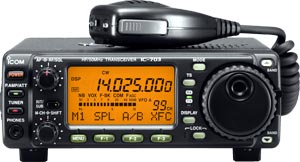
From time to time we will feature a special operating skills essay, a short discussion of a topic related to building better operating habits on the air. There has always been a need to learn operating skills in amateur radio, but a great deal has changed over the history of radio, so the skills necessary must also follow this changing technology.
Some operating skills are very basic and one might think that they have changed little over the years. But remember, all of you old timers out there, newcomers to amateur radio now enter the hobby in a much different way than you did — or I did, for that matter. When I got interested in radio as a teenager, the thing to do was listen to short-wave radio. Many hours were spent listening on the air and learning about how to operate by simply hearing stations use their call signs, make contacts with other stations local and distant, or using those new things called “repeaters” on the VHF band. A licensing exam for a “Novice” license included a five word per minute Morse code exam. You were expected to get on the air and operate, learning as you went, for a specified time, after which you had to take the General Class exam or else find yourself another hobby. The system promoted the learning of basic operating skills from the beginning.
That is not the case today.
Newcomers to amateur radio today generally don’t even own short-wave receivers. Some may have listened to repeater traffic on VHF/UHF scanning radios, but their listening experience doesn’t come close to being the same kind of experience many of us had on the short-wave bands decades ago. The Novice Class examination is long gone from the requirements, as is any kind of Morse code exam. Now, don’t get me wrong; I am not complaining about these changes at all. Change is a normal part of life and we all realize that technology, including amateur radio, must change and evolve over the years. Unfortunately, even though our licensing process and structure has changed and technology has evolved radically, we have really not managed to figure out a way to teach basic operating skills before our newly-licensed hams press the push to talk button for the first time. Furthermore, the experience most Technician Class operators will have on repeater systems will not adequately train them in operating skills suitable for the HF bands. This has resulted in a situation where General and even Extra Class operators can be very weak in what we once considered basic operating techniques.
Fortunately, today we have more resources than ever to teach operating skills. The personal computer and the Internet offer vast resources and great potential. We can produce audio and video lectures to train people in basic operating. Radio clubs can have websites with “how-to” links. Amateur radio websites around the world offer help if only you can figure out how to find it. Helpers and teachers (Elmers) can connect with a person needing help using many different Internet tools, including e-mail reflectors, social networking sites, and Echolink-enabled repeater systems. VoIP systems like Skype can connect a newcomer needing some personal help in operating skills with an experienced operator on a one on one basis. The problem is that the application of this technology is scattered and inconsistent. Some radio clubs might be quite aggressive in helping their new members learn how to operate, while others do not. Some newcomers to amateur radio are able to figure things out for themselves, while others start out with bad habits and never seem to change.
What can you or I do about this?
Training excellent amateur radio operators begins at home. I have a mirror, and I look at myself in it every day. Sometimes I don’t like what I see and I know that I have to make changes. The same is true with my own amateur radio operating skills. From time to time, I need to just think about how I am doing things and about how I might do them better. Listening on the air to operators who really know how to conduct a net or snag a DX contact can really show me how other operators with better skills in these areas than mine succeed where I might not be doing so well. Listen, listen, listen. Think to yourself about how you can change your operating technique to more closely match that of the best operator you hear on the air.
Clubs and organizations can help, too. Offer club programs or even small study groups that promote operating skills. Do tabletop exercises, simulating on the air operation. Recognize good operating with awards. Use the Internet to promote good operating by including operating articles and tips on the club website. Develop on the air opportunities like practice nets where club members can develop their skills. The key to helping other people learn is to be helpful but non-judgmental. Learning takes place best in a non-stressful situation, so beginning with tabletop exercises where the mistakes people might make will not go out over the repeater system is a good idea.
I would like to hear some ideas from our readers and listeners about what has worked for you and for your local radio club as you bring newcomers into the fold. From time to time, I will be writing one of these short essays about some kind of operating skill. We will do our best to make a good operator out of each and every Handiham member. Some of you may have an idea for a unique and creative way to run a small operating skills class. Please share those ideas with us so that we can help make amateur radio better.
73,
Patrick Tice, WA0TDA
Handiham Manager
[email protected]

Pat Tice, WA0TDA, is the manager of HANDI-HAM and a regular contributor to AmateurRadio.com. Contact him at [email protected].
Highest activation?
Steve WG0AT, Rich, AC7MA and Guy, N7UN recently returned from their expedition to activate Huron Peak in the Sawatch Range in Colorado, USA, for Summits On The Air (SOTA). Together with their “sherpa” goats Rooster and Peanut, they took a GPS-equipped Yaesu VX-8R so people could track their progress.
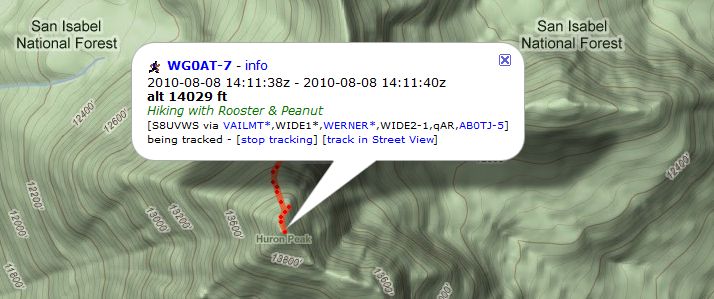
You can see a slide show of the expedition here.
I rather like the idea of using goats to carry the heavy equipment but I think you’d get some funny looks in the hills around here. This has made me wonder what has been the highest SOTA activation to date. Has anyone activated Mount Everest yet? I bet that would create a pile-up!

Julian Moss, G4ILO, is a regular contributor to AmateurRadio.com and writes from Cumbria, England. Contact him at [email protected].
Logging assistant
When you are out in the field, especially on a windy hilltop, logging the contacts you make can be a bit difficult. One hand holding the radio or microphone leaves only one hand free to hold down the log book and write in it. If you’re using a hand-held and standing up to get the maximum height gain, it’s even more awkward.

A few weeks ago I hit on the idea of using a personal digital voice recorder. Initial researches suggested that they were a bit expensive – many models sell for around £70 or more. But diligent searching on eBay revealed that it was possible to buy them for much less than this.
The one I got is an Olympus VN-100 Digital Voice Recorder and cost £15.99 including free postage. It was described as “refurbished to new condition by Olympus.” This might be an indicator of a product that tends to fail and has a high number of warranty returns. However, this particular one was indistinguishable from new, works fine and is simple to use. It isn’t the colour I’d have picked if I had a choice, but price and functionality were the principal considerations.
I don’t know what the differences are between the VN-100 and the more expensive models apart from colour, probably storage capacity. However this model has capacity for more than 13 hours of recording – more than adequate for my purposes.
I find the VN-100 easy to operate with the hand that isn’t holding the radio. You just press one button to start recording and another to stop. A bar meter shows the level of the audio input. You can either say the callsign, time and whatever else you are interested in logging, or just point the device at the radio and make an off-air recording. At home it could be a handy shack tool for recording unusual DX contacts.
The only problem I found is that the voice recorder is just as sensitive to wind noise as the microphone in the radio. More than once I have returned home to find a recording was unintelligible. However, mishaps like this can probably be avoided with practise.
I’m finding my digital voice recorder to be an indispensable companion on portable outings. It’s also handy for jotting down ideas for blog posts that occur whilst you’re out and about!

Julian Moss, G4ILO, is a regular contributor to AmateurRadio.com and writes from Cumbria, England. Contact him at [email protected].
August 2010 Prize Drawing
 We are very pleased to announce the winner of
1,000 full-color photo QSL cards
from KB3IFH QSL Cards!
Thanks to Randy at KB3IFH QSL Cards for sponsoring this month’s drawing.
We had over 750 entries!
We’re giving away another great prize in September.
Stay tuned and get ready to enter.
OK, on to what you’ve all been waiting for!
The winner of our August 2010 prize giveaway is…
Matt Thomas, W1MST, is the managing editor of AmateurRadio.com. Contact him at [email protected].
An iPhone4, iBCNU and APRS
I picked up an iPhone4 when I got back from Madrid. I’ve been pleased with it. The much mentioned ‘antenna issue’ can be reproduced easily, but a case solves it easily and it doesn’t cause me any issues in day to day operation.
If you’ve been reading this blog for a while, you’ll have seen me mention iBCNU an APRS client for the iPhone. I hadn’t really tried it on the iPhone4 before today, other than swapping some quick messages at home.
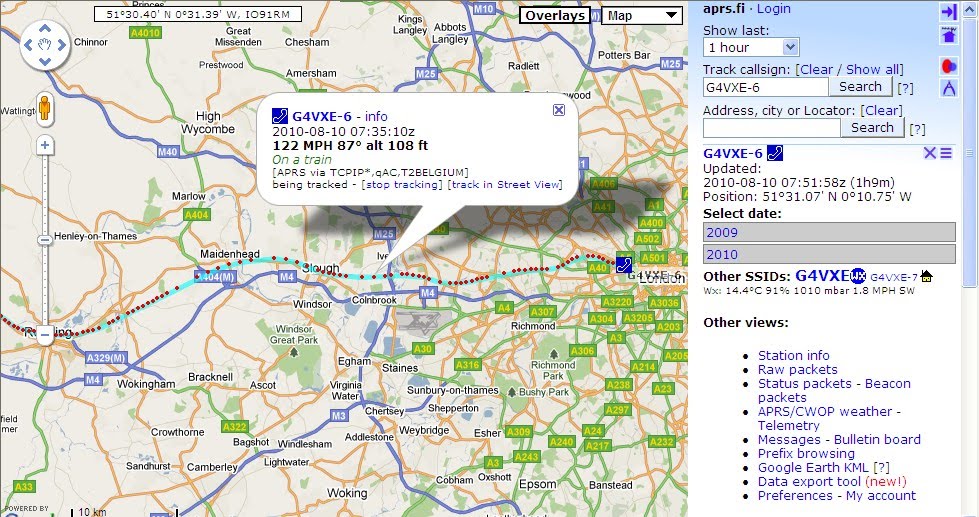
The GPS in the iPhone4 seems to lock up on a position much quicker and I found that in conjunction with iBCNU it worked really well from the train in tracking my position and displaying the speed. Top speed on the way in this morning was 125MPH (200KPH), just to the east of Slough. You can see the track on http://aprs.fi – just search for G4VXE-6 – or I did a screengrab a bit earlier.

Tim Kirby, G4VXE, is a regular contributor to AmateurRadio.com and writes from Oxfordshire, England. Contact him at [email protected].
 Ham Radio Deluxe |
 W5SWL Electronics |
 Ham Radio Prep |
 KB3IFH QSL Cards  Hip Ham Shirts  HamRadioAuctions HamRadioAuctions Reliance Antennas Reliance Antennas Enigma Shop Enigma Shop |  morseDX  Ni4L Antennas  R&L Electronics R&L Electronics antennas.us antennas.us QRV QRV |
- Matt W1MST, Managing Editor
