 |
 Broadcaster Praises Amateur Radio, Decries CB
 28 August 2010 | by

Beck went on to contrast CB radio with ham radio, calling CB a "failed big goverment experiment in socialism". President Carter, who raised taxes, gave away radio spectrum to all citizens, hence the name citizen's band. Hams on the other hand have to pay for their callsigns. Beck said the government should take the spectrum and auction it off to broadcasters in the free market, estimating that the frequencies could create as many as 2,000 new radio stations in the US (40 channels times 50 states), and the proceeds could support a tax cut which would reduce the deficit and big government. But this won't happen as it threatens liberal mainstream radio media, potentially increasing the number of conservative talk radio stations beyond its current 91% level. Beck ended the segment by calling CB "Communist Band" and pointing out that both "Carter" and "Communism" start with the letter C.
This is a parody. I only go to target practice once or twice before the big game hunting seasons start, everyday is a "freedom rally" here in the US, and I don't need to go to a seminar to understand the Constitution. Glenn Beck didn't say any of the above, though it's conceivable he would if he was involved in amateur radio. This is a hypothetical example of the fact-twisted, selective history supported, pseudo-intellectual punditry that is considered "edutainment" by some and unbiased news and information by others in the US . Unfortunately AM radio in the US is now dominated by this sort of programming, and it's become some of the most popular programming on TV. It's dividing our nation.
How about we restore honor to broadcasting?

Anthony Good, K3NG, is a regular contributor to AmateurRadio.com and writes from Pennsylvania, USA. Contact him at [email protected].
First Podcast – A conversation with Youkits
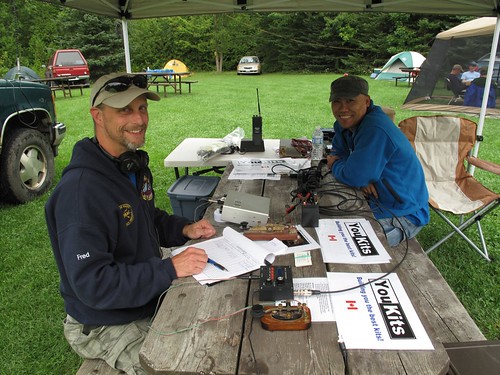
Fred and Yimin of Youkits
When I attended Maplecon I recorded at conversation I had with Yimin and Fred, VE3FAL, of Youkits. I have turned that recording into the first VA3STL podcast. I am making it only available here for the time being. If I make any more audio podcasts I will think about putting them on iTunes. Please click on the link that follows.
VA3STL Podcast#1 Conversation with Youkits
As the podcast is something new to me and an experiment, I would appreciate any feedback via a comment, or direct e-mail.
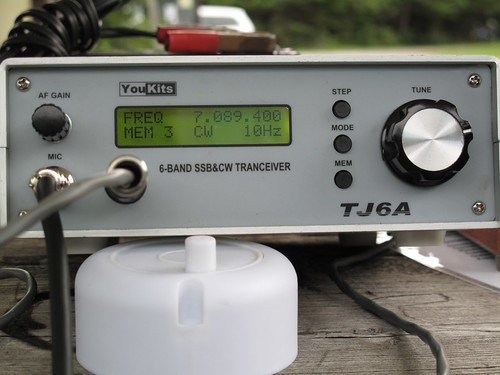
Youkits TJ6A transceiver


Alan Steele, VA3STL, is a regular contributor to AmateurRadio.com and writes from Ottawa, Ontario. Contact him at [email protected].
VHF Sporadic E season not over yet..
By the time August comes along, the Es openings on the VHF bands are generally dying down a bit. Certainly, I’ve been checking 50MHz less frequently from the car and I’ve even been thinking about what band I’m going to use the IC706/mobile for over the winter (more on that soon!).
However, chatting to Ken, G3LVP this morning about 70MHz, he told me that yesterday there had been an opening to Portugal on 70MHz. Ken had worked CT1FJC from the Algarve.
So, keep checking those bands!

Tim Kirby, G4VXE, is a regular contributor to AmateurRadio.com and writes from Oxfordshire, England. Contact him at [email protected].
More on the DX Code of Conduct (www.dx-code.org)
Paul, VP9KF (W4/G4BKI) has posted on his blog that the ‘DX Code of Conduct’ initiative appears to have drifted away from the originators of the concept, FOC
Either way, the DX Code of Conduct website which Paul is a little disparaging about DOES take the DX Code of Conduct to a new level and invites amateurs to sign up to it. If you sign up to it, your callsign is displayed as a mark of your commitment to reducing the level of poor behaviour on the DX bands.
Paul’s right – there are a few technical issues with the site – which I am sure can be resolved really quickly, but the intent and concept is great. It’s good to see the idea being developed and moved forward.
You can sign up and demonstrate your commitment here

Tim Kirby, G4VXE, is a regular contributor to AmateurRadio.com and writes from Oxfordshire, England. Contact him at [email protected].
NS Ladder (27 August 2010)
This score looks familiar, but the distribution by band is different. Need more practice!
NCCC Sprint Ladder - Aug 27

 Call: K8GU
 Operator(s): K8GU
 Station: K8GU

 Class: Single Op LP
 QTH: MD
 Operating Time (hrs): 0.5
 Radios: SO2R

 Summary:
 Band  QSOs  Mults
 -------------------
 160:
 80:  10     10
 40:   9      7
 20:  10      6
 15:
 10:
 -------------------
 Total:  29     23  Total Score = 667

 Club: Potomac Valley Radio Club
Ethan Miller, K8GU, is a regular contributor to AmateurRadio.com and writes from Maryland, USA. Contact him at [email protected].
Hacking a USB GPS
As regular readers will know, I’ve been playing about with APRS quite a lot in recent weeks and I’m starting to get the urge to build something APRS related. I’m planning to order one of the inexpensive FoxTrak kits, which lets you use a standard VHF FM radio to transmit position reports. To do that you also need a serial GPS and on searching eBay I became aware that serial GPSes seem to be rather more expensive than USB or even Bluetooth devices. This led me to wonder whether it would be possible to hack a USB GPS to use with a tracker like the FoxTrak. My investigations led me to this article by Primiano Tucci on GPS Hacking.
This post is basically an un-loseable bookmark to myself, since it will probably be a few weeks before I get around to working on this and by then I’ll have lost the article and never be able to find it again. But it might be of interest to someone else or provoke some interesting comments.
Although I’ll probably build the the FoxTrak as-is and test it with one of my 2m rigs I’m really interested in trying HF APRS on the move without having to buy an expensive TNC or lug a laptop around me so I can use AGWPE to generate the 300baud audio. So I’d also be interested to know whether anyone has modified the FoxTrak (or the TinyTrak which I believe is very similar) for the 300baud tones? I know the OpenTracker+ from Argent Data does 300baud “out of the box” but it’s quite a bit more expensive, enough more expensive to attract the punitive import fees that will almost double the price.

Julian Moss, G4ILO, is a regular contributor to AmateurRadio.com and writes from Cumbria, England. Contact him at [email protected].
Maplecon 2010 Report
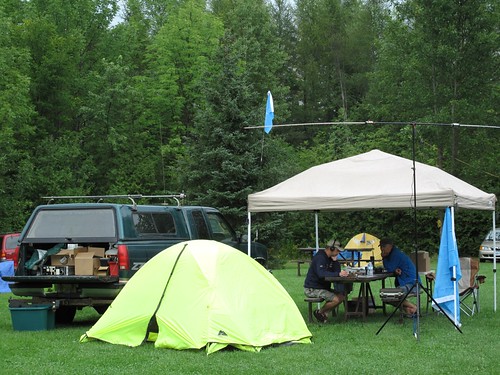
The Youkits' demonstration shelter
I attended the first Maplecon last weekend, which was a gathering of Canadian QRPers. The venue was Emily Provincial Park campground. Gerry, VA3GLT, and myself headed down on Saturday morning, despite the convention’s start on the Friday, as both of us had commitments in the afternoon and evening of Friday 20th Aug. We had an early start and drove down the 401 highway to Port Hope then turned off and travelled North to the park. By noon we arrived and had put up the tent and an antenna.
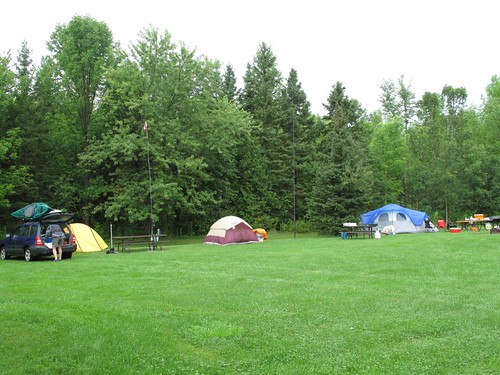
The campsite. Notice that vertical antennas on poles were popular
The antenna for this event was a freshly homebrewed doublet made from some TV twin-feed I bought a few years ago and now decided to use. It was split 16′ 7″ down to form two arms of the doublet, and the remaining 23′ or so of twin feed was the feedline. At the end of the twin feed we installed a homebrew 4:1 current balun, which I had built a few years ago. The antenna was raised between two trees high enough that the feedline dropped vertically down and just reached into the tent. A short run of coax was used from the balun to my Elecraft K2. It tuned on 40m, 20m, 17m, 15m and surprisingly 80m (given the length of the antenna is would be a pretty inefficient). I could not get a tune on 10m. Possibly if I took out the 4:1 balun I may have made it.
There was a just short of thirty attendees at the convention and we chatted with quite a few. There were three tables set out as stalls, one with QRP rigs, one with QRP-ARCI information and one with Youkits radios. I would have like to have spent more time looking at the QRP equipment table, but things felt a little rushed as we had arrived late. We had a lovely barbecue lunch prepared by Jeff, VE3JFF, and his family after which I had a chat with Yimin and Fred, VE3FAL from Youkits about their new line of QRP radios. That will be covered in a future post as I made a recording of that conversation.
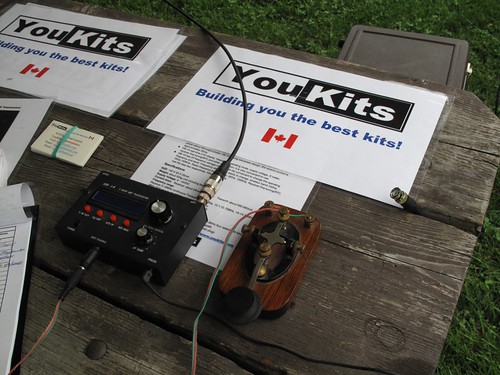
Youkits' HB1A
There was an antenna competition on so I spent a little time in the tent in the afternoon trying to make contacts on PSK31. Beside the antenna and the K2 I was using a little Asus notebook, a homebrew interface for digimodes and a large battery pack. It is so large that Martin, VA3SIE accused me of being a secret QRO operator! (That hurt Martin).
I had little success with contacting stations on 20m PSK until finally just before dinner when we made a contact with a weak station that was calling CQ. I replied and was acknowledged by Mirek, SP9ONC in Kozy, Poland. He was running QRP from a TS-2000 and and we exchanged details. I was really pleased that my first contact was DX and a QRP-QRP contact too. Soon after came my second contact Fred, KD8AQ in Mt Pleasant, TX and we had a nice chat. As the call for the chilli dinner had gone up earlier I had to break off that conversation.
Dinner was provided by the Ottawa Valley QRP Club and that was the second good meal. The chilli was tasty and Martin, VA3SIE, had brought some British delicacies for dessert, including Battenberg cake, which I had not eaten in many years as it does not often appear on shelves in Canadian stores.
After dinner there was the antenna competition, door prizes and a raffle for a ‘shack in a box’. For the antenna competition Michael, VE3WMB, won the prize for the best technical design with a folded over vertical antenna, and I won for the best performing antenna with the DX contact with SP9ONC. I was extremely pleased to find my prize was a Norcal BLT tuner which will very likely become the tuner for that doublet in future.
There were plenty of door prizes including several transceivers. Gerry, VA3GLT, was lucky to get the first of two HB1A transceivers that had been generously donated by Youkits. There were so many door prizes that I think all attendees went away with something. I won a set of pliers and a year’s subscription to QRP Quarterly, the QRP ARCI’s excellent magazine. So when my current subscription is up I can use that.
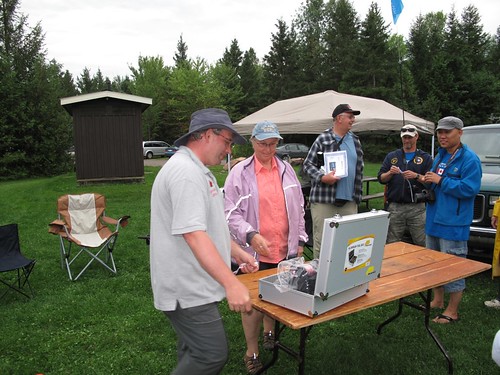
The 'shack in the box' prize is presented. The prize was a transceiver, battery pack and case.
After all the prizes had been given out there was chatting into the evening and then Gerry, Martin and myself went back to the tent and made two more contacts on 20m. These were Tom, KJ4QDZ , in Lillian, AL and Virgil, WA5TLP, in Willston, ND. Not too many contacts but enough to make me happy with the performance of the antenna.
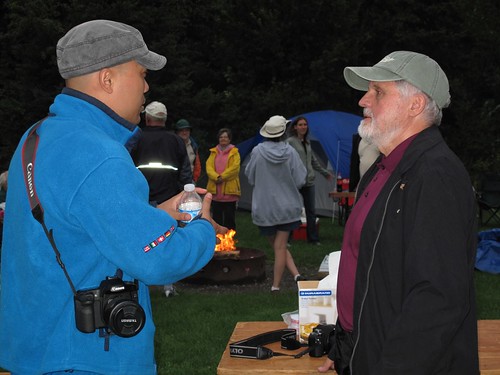
Yimin of Youkits chatting with Gerry, VA3GLT after the prizes were awarded
Over Saturday night and Sunday morning there was a lot of rain. So after breakfast next morning there were a lot of people leaving. Gerry and I thought it was prudent to take the tent down during a brief lull in the rain so there was no making contacts, just collapsing and packing a wet tent. We thanked Jeff, VE3JFF, for all his hard work that had resulted in a successful first Maplecon 2010, said goodbye to those that remained and we headed home before noon on Sunday.
Will there be another Maplecon next year? Well after the prize giving it was discussed by all and it was unanimous to have another. So here is looking forward to Maplecon 2011.


Alan Steele, VA3STL, is a regular contributor to AmateurRadio.com and writes from Ottawa, Ontario. Contact him at [email protected].
 Ham Radio Deluxe |
 W5SWL Electronics |
 Ham Radio Prep |
 KB3IFH QSL Cards  Hip Ham Shirts  HamRadioAuctions HamRadioAuctions Reliance Antennas Reliance Antennas Enigma Shop Enigma Shop |  morseDX  Ni4L Antennas  R&L Electronics R&L Electronics antennas.us antennas.us QRV QRV |
- Matt W1MST, Managing Editor
