 |
 On why not all mag mounts are created equal…
 1 September 2010 | by
 I use a magnetic mount to attach my relatively small VHF/UHF antennas onto the car for my daily activity on the commute to and from the station. I tend to need a new magmount every 12-15 months as repeated opening and closing of the hatchback eventually takes its toll on the coax!
The last but one magmount I had worked really well for the usual period on all the VHF/UHF bands I use from the car. It finally gave up and I replaced it, with one from the same retailer, with ostensibly the same spec. It certainly worked, but particularly on 70cms, the performance was considerably worse. Not catastrophically worse, more like ‘conditions aren’t very good today’ worse – so I just put up with it.
I had the opportunity this morning to try a different magmount – a slightly more expensive model (the original one I was using retail at around £16 and the newer one at about £25). On 433MHz the difference was enormous! GB3TD which had become unusable at the far end of my commute near Didcot, was just fine! I don’t think it was just conditions. but it will be interesting to see how the new mount affects the other bands.
So now I’m wondering what was ‘wrong’ with the old magmount. It’s not as if it really didn’t work, but perhaps it was just very lossy. Either way, I’m glad I tried the different mount. Your mileage may vary, but you may be well advised to spend slightly more on your next magmount!

Tim Kirby, G4VXE, is a regular contributor to AmateurRadio.com and writes from Oxfordshire, England. Contact him at [email protected].
The death of VHF
Olga and I have returned from a long weekend in London. I took my VX-8GR along, hoping to see some APRS activity or even make some contacts. But I heard absolutely nothing, nada, zilch, not a braap on the APRS frequency nor any signs of life on the simplex or repeater frequencies.
Twenty years ago I lived in London, in Charlton SE7 and I seem to recall that in those days there were four London repeaters on 2m and plenty of activity. I also seem to recall that some of the repeaters were plagued with abuse. Last weeked even a kerchunker or a pirate playing music would have been a welcome sign that someone was using the amateur frequencies.
I took a laptop with me – the small Eee PC running Ubuntu Linux, with APRSIS32 under wine – to monitor activity and see if my RF beacons were heard. I received a greeting from G5YC via the APRS-IS internet network and that was that. What a contrast to Prague, where I was a month ago, where the APRS activity just didn’t stop.
Tim, G4VXE, posted yesterday about creating APRS objects for repeaters using OpenAPRS.net. I commented that it was all very well, but these internet created objects are never transmitted on RF so they never fulfil the intended purpose of the mode which is to inform visiting mobiles of the local repeater frequencies. Unfortunately with the lack of radio activity here in the UK one cannot deny that APRS works much better as an internet application than it does over RF. Anyone who has a computer can call up aprs.fi and see the local picture – if anyone has taken the trouble to create the objects. If they were transmitted on RF, would anyone hear them?
I could say much the same about 2m FM. If I’d had an iPhone I could have made some contacts using the newly released Echolink app, which again is more than I was able to do using my Yaesu. What has happened to ham radio that one can’t find any activity even in the UK’s biggest city? It seems to me that we have all decided that cellphones are a much better tool for contacting our ham buddies. If we lost the use of the VHF and UHF bands would anyone actually notice?

Julian Moss, G4ILO, is a regular contributor to AmateurRadio.com and writes from Cumbria, England. Contact him at [email protected].
Duh: Learning Curve #2
Sunday I got the itch to get online. That means backyard portable when you live in an antenna restricted condo. So I put a card table up in the back porch and my 20 ft Jackite and 20m End Fed Half Wave in between the buildings.
Doggone noise and weak band conditions ruined the day so I decided to experiment with the new C Pole antenna that Neil W0VLZ had suggested. To get rid of a hunk of fiberglass gel inside the barrel of one of the Black Widow Crappie poles I used my cheapo Harbor Freight rotary tool which is a lame imitation of a Dremel tool but gets the job done. A few minutes of fitting and I was good to go.
I’m pretty impressed with it though conditions did not allow for any QSO’s yet. I cut the wire a bit longer than Niel’s directions but it tuned up 1:1 at 13.889 on my MFJ 207 Analyzer. At 14.060 it was a bit over 1.4:1 which is plenty usable. Next time out I’ll do a bit of trimming and be right on the money! Compared to the EFHW in a 20 ft L configuration, it did seem a bit noisier but with condx so difficult it would be hard to tell without some instrumentation.
LESSON: The C Pole is a pretty fine design. I need to work on the physical setup to improve the way the antenna hangs. The crappie poles I used were a bit too flimsy on the top section and leaned inward from the weight of the wire. A better tippy top support system is needed.
LESSON: Niel’s C Pole base design and specs worked very well. Lacking an empty plastic coffee can, I used a quart diet soda bottle of the same dimension and it worked very well for the balun section. With winds of approximately 15 mph and gusts to 20+ the antenna was stable and I did not use the spikes for the outriggers that I had prepared. Great work Niel. The weight of the base makes it a good choice for backyard or campground use.
LESSON: The C Pole would be a fantastic portable antenna sans the earth side supports. Chuck Carpenter W5USJ has posted a picture of this configuration. Take a look. One point hanger and spreaders at the top and bottom and simple stake to the ground for anchoring it and you are good to go. I will be testing this next time out by the lake. Winner!
LESSON: The off center fed dipole folded like this and deployed vertically is a good compact option for antenna restricted hams. I bit more work on the frame and support system may pay good dividends in stability and efficiency.
Hope to fly this new antenna in its tree configuration this weekend. I’ll update my results then.
72,
Kelly K4UPG PB #173
Kelly McClelland, K4UPG, is a regular contributor to AmateurRadio.com and writes from Florida, USA. Contact him at [email protected].
LHS Episode #047: OLF 2010
 In a rare promotional episode of Linux in the Ham Shack, we talk to four folks from the upcoming Ohio Linux Fest. Bear, Rob, Moose and Beth Lynn give our listeners the low down on everything that’s going to happen at this year’s event. Make no mistake, this time around it sounds like it’s going to be a lot of fun, even more fun than last year. Linux in the Ham Shack is going to be there, too, with new equipment, new demos and a lot more to make it worth stopping by. So if you’re going to be around Columbus, Ohio on September 10-12 or you have some free time and a little bit of extra cash, make sure to come by the show. It’s going to be KILLA.
73 de The LHS Guys
Russ Woodman, K5TUX, co-hosts the Linux in the Ham Shack podcast which is available for download in both MP3 and OGG audio format. Contact him at [email protected].
Creating APRS objects for repeaters using OpenAPRS.Net
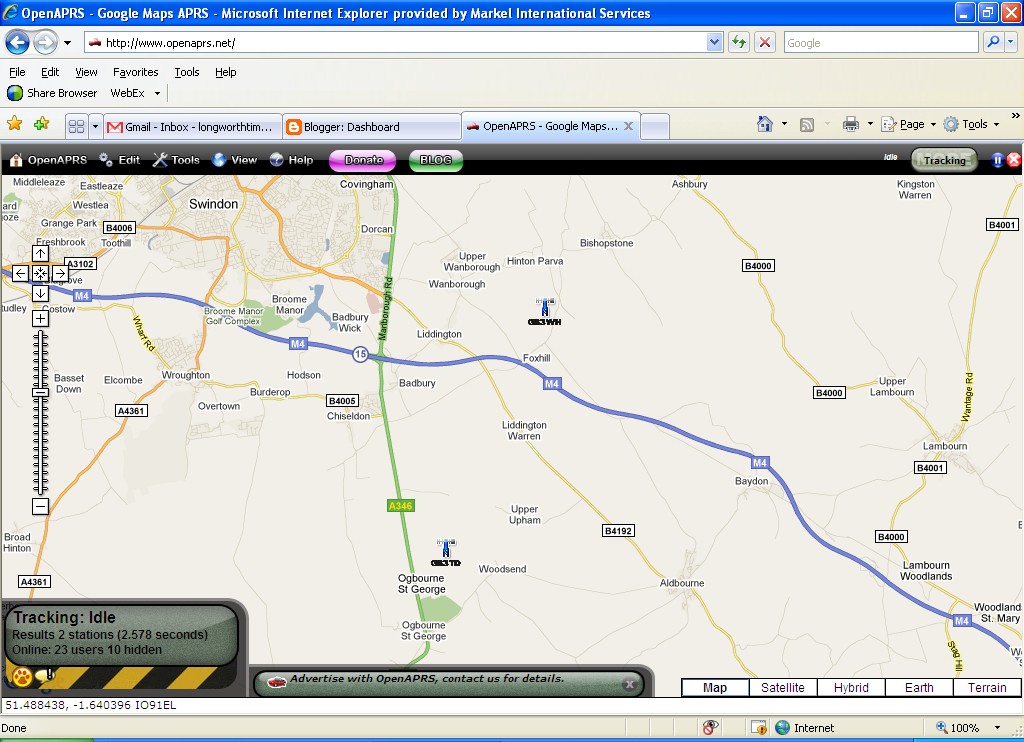
I’d wanted to create an APRS object for the Ridgeway Repeater Group‘s two voice repeaters, GB3TD and GB3WH for a while. In practice, this just means making sure that they show up on the map in the right place, when someone goes to http://aprs.fi and looks at the area.
I wanted to display an icon for them, showing the approximate position and their callsign, and some detail available, if someone clicks on the icon. I’d looked at various ways of doing it, but found OpenAPRS the best method.
I’d looked at doing this a few months ago, but had stalled, because OpenAPRS required me to verify my account using an ‘RF APRS client’ which I didn’t have – all my APRS interfacing is done through the Internet. Without verifying my account, I couldn’t create objects on the APRS map.
When I was looking at OpenAPRS the other day, I noticed that they were offering another method of verifying accounts, using Paypal and a small (dollar or so) donation. I was happy to pay this and sure enough the account was verified very speedily.
Having done this, it was straightforward to create an object for each of the repeaters using Tools/Create Objects and then clicking on the map in the appropriate place and entering the information. In some ways, rather than clicking on the map, I’d have preferred to manually enter the latitude and longitude, but this didn’t seem to be possible.
Either way, GB3TD and GB3WH are now represented on the APRS map. I like this – and it provides some useful information to people about where they may find activity in particular localities.

Tim Kirby, G4VXE, is a regular contributor to AmateurRadio.com and writes from Oxfordshire, England. Contact him at [email protected].
Ham Forums Becoming Passé?

Ham Forums Becoming Passé?
While we're waiting for better bands, enjoy this video:
Hmmmm. Maybe Youtube has something to do with this lack of activity....

Anthony Good, K3NG, is a regular contributor to AmateurRadio.com and writes from Pennsylvania, USA. Contact him at [email protected].
 Ham Radio Deluxe |
 W5SWL Electronics |
 Ham Radio Prep |
 KB3IFH QSL Cards  Hip Ham Shirts  HamRadioAuctions HamRadioAuctions Reliance Antennas Reliance Antennas Enigma Shop Enigma Shop |  morseDX  Ni4L Antennas  R&L Electronics R&L Electronics antennas.us antennas.us QRV QRV |
- Matt W1MST, Managing Editor
