 |
 New Open Source Rig Project? Dah Mini-Pig+
 27 September 2010 | by
 The QRP-L reflector has been buzzin’ with the news and chatter (positive and some negative btw) about a new project to design and build a new transceiver for QRP HF use. YAHOO!

K8IQY Style Test Setup
What I love the most about this is that the QRP community is able to contribute ideas, resources and participate much like the Open Source software community operates. This could really be a fun project for our Central Florida QRP group. After all, we are not that far from Diz W8DIZ who is facilitating and coordinating this project.
If you like to build, experiment and try some QRP operation with a new rig… you should tune in and join the fun.
This is the last week to vote in the poll on my blog for the best US QTH for ham radio… Here’s the standings as of Sunday at 2100 EDT:
- West Virginia (17%, 10 Votes)
- Kansas (16%, 9 Votes)
- Hawaii (7%, 4 Votes)
- Texas (7%, 4 Votes)
- New Hampshire (5%, 3 Votes)
You can cast your vote by following this link!
72,
Kelly K4UPG PB #173
Kelly McClelland, K4UPG, is a regular contributor to AmateurRadio.com and writes from Florida, USA. Contact him at [email protected].
SDR Cube
News via the NUE-PSK email list that over the weekend George N2APB presented and demonstrated a prototype of the SDR Cube project at the TAPR Digital Communications Conference in Vancouver, WA near Portland, Oregon.
The SRD Cube’s formal title is “A Portable Software Defined Radio Utilizing An Embedded DSP Engine for Quadrature Sampling Transceivers” and it was devised by George Heron, N2APB and Juha Niinikoski, OH2NLT.

N2APB's SDR Cube
A companion to his NUE-PSK modem, it’s designed to provide “a standalone SDR transceiver (no PC required) that is quite portable and trail friendly”.
“So far the most attention has come from the SDR Cube’s “live bandscope” showing a +/- 4 kHz spectrograph of band activity along the top of the graphic display. Some preliminary pics are on the start of the website … http://www.sdr-cube.com“.
From his earlier 11 September email where the SDR Cube was first announced:
“a totally self-contained embedded SDR transceiver using a Softrock for the RF front end and a pc board implementation of an HF modem that couples tightly with the NUE-PSK Digital Modem. The Cube is designed to fit into a 4” x 4” x 4” pre-cut black powder-coated aluminum enclosure containing all controls, blue graphic display showing the familiar band scope of spectrum signals, and the popular Softrock RXTX v6.3 board.”
The latest update this morning from George is that the pricing “is not yet established … but soon will be. I think the cost of the parts and pcbs is around $100, so you can guess what the corresponding price might be.”
They’re aiming for the range of offerings (bare PCB, kit, assembled & tested etc) to be available in about six weeks. As well the plan is for there to be a direct digital connection between the SDR Cube and the NUE-PSK by the shipping date. In the meantime check out the pics at http://www.sdr-cube.com. Also brief mention on WETNET.
UPDATE: George N2APB has posted some videos of the SDR Cube in action. There’s a 25′ overview and five shorter clips.
The sdr-cube.com website now (30 Sept 10) has much more information about the rig including hardware and software architecture diagrams, a photo gallery, a very detailed 26 page pdf of the TAPR DCC conference presentation (7.5MB) and this feature list.
- Standalone SDR transceiver … no PC, portable, compact
- Self-contained single band … based on the I/Q RF front end
- Softrock-compatible … designed to interface with SR v6.3 RXTX, etc.
- Low Power … 90ma (Cube), plus 100 ma (Softrock Rx) or 300 ma (Software Tx
- Add-on RF Amp & Attenuator … good control of incoming RF, optimize some SR features.
- Quadrature Sampling Clocking options … DDS, Si570, or I2C to target Softrock
- Built-in Keyer … 1-50 wpm, Iambic A, B, or straight key
- Popular HF modes … SSB, CW, AM, Digital (with special interface to NUE-PSK)
- Special interface to NUE-PSK Modem … digital interface provides best quality
- Graphic LCD Display … Provides clear indications of the many status and options
- Bandscope … provides +/- 4 kHz spectrum visibility for Rx, signal monitor for Tx
- Audio filtering … low corner 200Hz, high corners 700, 1500, 2400 or 3600Hz
- Audio Output … Headphones or amplified speaker, Binaural Audio
- Beeper … User interface clicks, code practice oscillator, and more
- Frequency agility … Fast/Med/Slo tune, dual VFOs, memories, RIT/XIT
- Menus … Calibration, all settings, system gain, sidetone frequency, etc
- Software Upgradeable … Bootloader enables user to load new software versions
- Open Source & Hardware
A new Yahoo Group has also been set up and info can be found at http://groups.yahoo.com/group/sdr-cube/.
LATER UPDATE: 14 Oct 2010 – Tobias DH1TW has posted a 75 minute interview with George N2APB on his website – complete with comprehensive ‘shownotes’.
Stephen Rapley, VK2RH, is a regular contributor to AmateurRadio.com and writes from New South Wales, Australia. Contact him at [email protected].
ICQ Podcast Series Three Episode Twenty – Microwaving (26 September 2010)
Series Three Episode Twenty of the ICQ Amateur / Ham Radio Podcast. News Stories include:
- Earth dodges another sun bullet
- Goodbye to Sunspots?
- Historic Chain Home Tower back on the air
- Take your hand-held to work day
- WSJT 9.0 released
- Frequency change for Scotland Morse Enthusiasts Group
- Digital radio switchover 'far too early'
- New type of antenna - Sea Water Antenna
- Ham Radio high-altitude balloon launch team opportunity
- Online radio course from DoC
- GB7MM back on the air
- Home electricity wiring antenna
Your feedback, upcoming events, and Martin (M1MRB) visits a Microwave Group.
Colin Butler, M6BOY, is the host of the ICQ Podcast, a weekly radio show about Amateur Radio. Contact him at [email protected].
GB7ML/GB7AU update – nodes off air
I hadn’t been on D-STAR for a few days, but popped on for a quick chat this morning. I was particularly sorry to hear that GB7ML from Tring, as well as GB7AU are now QRT. I’m not entirely sure what has happened, although someone mentioned ‘politics’, but the current expectation is that the nodes will not return.
What a shame – GB7ML in particular had such fabulous coverage.

Tim Kirby, G4VXE, is a regular contributor to AmateurRadio.com and writes from Oxfordshire, England. Contact him at [email protected].
Serial addition
I installed a four port RS-232 serial card in my shack PC today. When I bought the computer earlier in the year I purchased and installed a two port serial card, thinking that would be enough. But it wasn’t. You can never have enough serial ports if you want to interface with radios. With four, I can now have CAT control of both the K2 and the K3, the TNC connection to the Kenwood TM-D710 and one more which is currently controlling the PTT of the FT-817 for the EchoLink node but could be used for the control port of the Kenwood if I ever decided to use that for EchoLink. No more hassles with USB to serial adapters, and all my USB ports are free for things like sound cards. I don’t know why people use laptops for shack computers, they provide far fewer options.
Needless to say, things did not go as smoothly as they could have done. I thought I could have COM2 for the K2, COM3 for the K3 which would be easy to remember. But Windows gave the ports the designators COM3, 4, 10 and 11. There’s an option to reassign the port numbers but Windows claimed that everything from COM2 to COM9 was in use. By what, was my unanswered question.
In the end I decided to name the ports COM2 through COM5 as I wanted regardless of Windows’ protestations. They did work, but finding out which port was which was a matter of attaching a radio to one socket, loading a program and trying all possible COM port numbers until it worked, as there was no logical correspondence between the numbering and the sockets on the back of the computer. Who said it was meant to be easy anyway?
Despite all this I managed to make a few contacts using JT65A on 20m including DU1GM, N0OB and K1CF, using 25W to the dipole.
Although I now have computer control of the K2 I don’t have a sound card interface as I have cracked open the plastic case of the USB audio dongle and superglued the bottom half containing the PCB to the stripboard on which I will be building my homebrew SignaLink clone. Of course, now I have a serial cable connection between the computer and the K2 I don’t need a VOX controlled interface, never mind an isolated one because the serial cable will bypass the isolation anyway!

Julian Moss, G4ILO, is a regular contributor to AmateurRadio.com and writes from Cumbria, England. Contact him at [email protected].
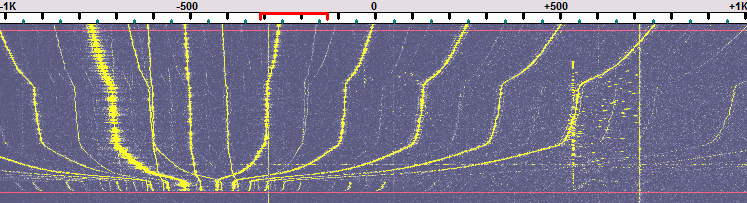
Interference on 14.077MHz
Anyone else seeing this diabolical interference on 20m?

Julian Moss, G4ILO, is a regular contributor to AmateurRadio.com and writes from Cumbria, England. Contact him at [email protected].
Flash in the pan
I’m not exactly a fan of Flash in websites but I think you’ll agree that that this example from the home page of the Dutch store HEMA is very amusing. When the page opens, don’t click on anything, just wait…

Julian Moss, G4ILO, is a regular contributor to AmateurRadio.com and writes from Cumbria, England. Contact him at [email protected].
 Ham Radio Deluxe |
 W5SWL Electronics |
 Ham Radio Prep |
 KB3IFH QSL Cards  Hip Ham Shirts  HamRadioAuctions HamRadioAuctions Reliance Antennas Reliance Antennas Enigma Shop Enigma Shop |  morseDX  Ni4L Antennas  R&L Electronics R&L Electronics antennas.us antennas.us QRV QRV |
- Matt W1MST, Managing Editor
