 |
 FT8900R returned to service
 29 September 2010 | by
 I was pleased to get my Yaesu FT8900 back from its service visit yesterday. You might remember that I’d had my suspicion that the 50MHz receiver had gone very deaf over the summer. It was odd, because the receiver was still working, but it seemed well down on gain.
It was well worth sending it away, because the receiver is now much more sensitive and it was good to be able to listen through the GB3FX, Farnham 50MHz repeater on the way to the station this morning.
Looking forward to getting back on 50MHz FM again! GB3FX works well around home and GB3ZY in Bristol works well when I travel towards the west. I noticed today, looking at the repeater maps for 50MHz, that GB3VI in the Birmingham area might be useable. I shall have to listen!

Tim Kirby, G4VXE, is a regular contributor to AmateurRadio.com and writes from Oxfordshire, England. Contact him at [email protected].
Videos of Akihabara
Tokyo Hackerspace has recently released these videos of a tour of Akihabara in Tokyo and they have done a viral tour of some of the major hacker blogs like Make and Hackaday. If you have not already seen them then they are worth the time watching as Akiba of Freaklabs gives a great tour of this part of Tokyo which is brimming with stores that sell tools, electronic components and everything else for the hobbyist, maker, hacker and engineer.
The full collection of 24 videos are on the Tokyo Hackerspace website. The video recording was made in HD so if you have a good bandwidth connection try the 1080 HD version on full screen. Here are a couple of the videos that I found particularly interesting. First an amateur radio store called ‘Rocket Radio’

This next video shows a collection of indoor stalls that sell a wide variety of hobbyist items. The location reminded me of a British indoor market, but instead of clothes and food here you can buy radios and enclosures. A collection of ‘candy stores’ for hobbyists.
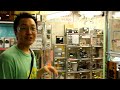
I had heard of Akihabara but was stunned watching these videos how many stores there are. I am sure it is unique in the density of electronics and construction retailers. I would be interested to hear from anyone if they know of a collection of electronic component stores similar to this elsewhere, particularly in North America. No doubt there were smaller collections of shops like this after World War II when the surplus gear hit the high street. I know in London, UK, Tottenham Court Road had a concentration of such stores and I remember my father taking the family there when we visited London in the 70′s when I was a kid. I believe that Shudehill in Manchester, UK, also had electronic component stores around that time (again I recall a visit with my father) but they had all gone except for a TV and Radio store in the 80′s when I was a student there.
Thanks to Akira of FreakLabs, Patrick of Work in Progress and Tokyo Hackerspace for bringing us these videos.


Alan Steele, VA3STL, is a regular contributor to AmateurRadio.com and writes from Ottawa, Ontario. Contact him at [email protected].
Indian tracker
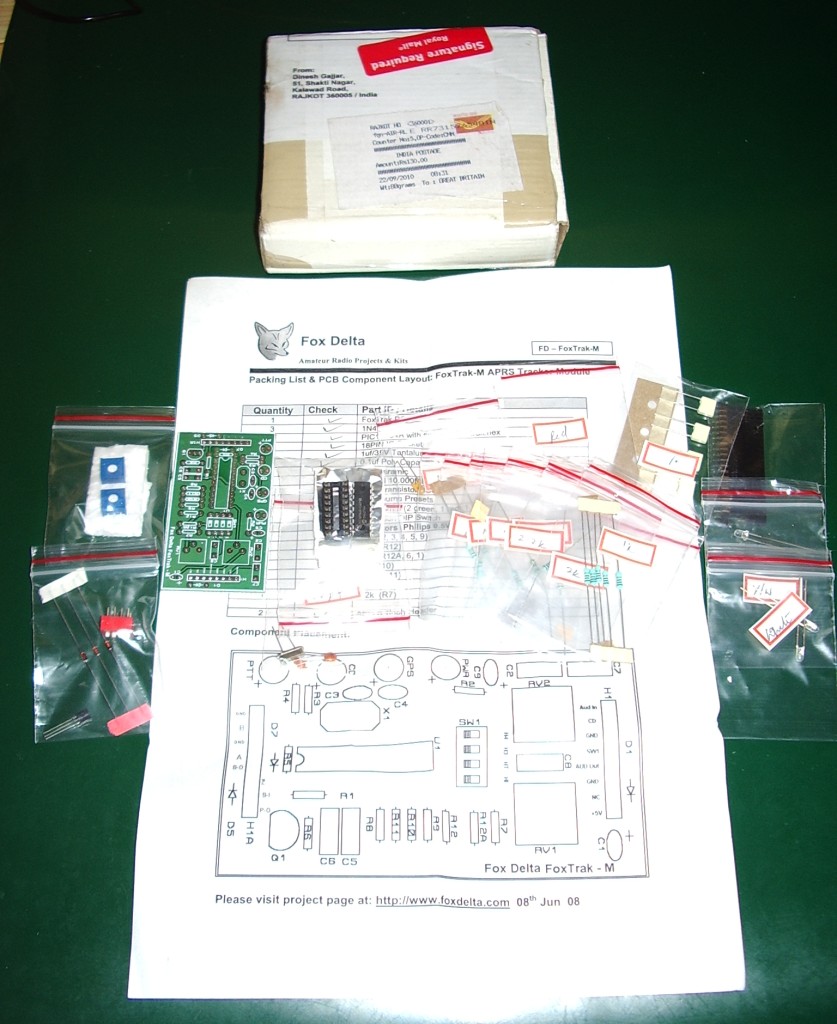
This morning a small package arrived from India. It is a FoxTrak-M APRS Tracker Module kit from Fox Delta.
Fox Delta has an interesting range of kits for anyone interested in APRS, packet radio, digital modes or EchoLink. They are all extremely good value – the website suggests that they are sold on a non-profit basis. A couple of weeks ago I asked about one of these kits in a forum somewhere and an American ham complained that the parts were of poor quality, the instructions were poor and it took a long time to come from India. I think that is just the biased nonsense one sometimes hears from US hams about anything from India or China. The PCB is screen printed and looks fine, all the components are standard components and have been packed into individual small polythene bags for each value, and it took a week to arrive which is a lot faster than anything coming from the US via the postal service. It’s true you don’t get Elecraft style step by step building instructions, but it really isn’t rocket science to work out which part goes where on the circuit board.
Hopefully this module will form a stand-alone GPS tracker that I can use with my other VHF radios. However, before I get started on it I have to finish my DIY SignaLink USB project.

Julian Moss, G4ILO, is a regular contributor to AmateurRadio.com and writes from Cumbria, England. Contact him at [email protected].
Groundhog Day
After installing the four port serial card in the shack PC which allowed me to have computer control of my Elecraft K2 I decided to borrow the USB sound card that was being used by my EchoLink hotspot and get my HF APRS gateway up and running again on transmit as well as receive. It is running very well and, although I suppose it may just be conditions, it seems to be receiving more stations than when I was using the K3. I am also surprised at how well my 10W output gets out. The experts are always saying how poor a mode FSK300 packet is, but I transmitted several test messages (into my stealth attic magnetic loop) and they were all received by other gateways.
However, something went very wrong on Sunday. Replies to a couple of messages I sent kept being received over and over again. I also kept receiving the same messages over and over again from a couple of stations. It was like the film Groundhog Day, except it was more like Groundhog Five Minutes. And it was very annoying as these damn messages kept generating pop-up balloons from APRSISCE’s new messaging system.
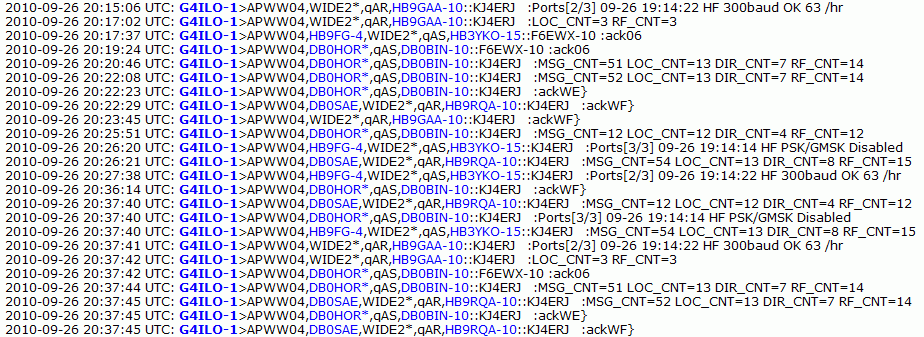
Eventually I became convinced there must be a problem with APRSISCE and I sent a bunch of logs over to Lynn, KJ4ERJ, the program’s developer. However I now think the problem is down to the configuration of some stations in Europe that are unnecessarily digipeating or gating traffic from the internet to RF and somehow managed to create an endless loop. Aprs.fi shows that some of the messages continued to circulate for more than 10 minutes after I had shut down all the computers and radios and gone downstairs in frustration. But even Lynn hasn’t manage to figure out who the culprit was.
The trouble with the APRS HF network in Europe is that there is no co-ordination at all. Anyone can connect some software or a TNC to a radio, configure it however they see fit (perhaps basing their settings on out-of-date books, obsolete web pages or nonsense thinking like “WIDE5-5 must be more than twice as good as than WIDE2-2”) and start digipeating or gating traffic regardless of whether there is a need for it. There are stations in France who are gatewaying information from VHF to HF that serves no useful purpose there. What use is it to me in the north of England to know the meeting date of a club in the south of France or the details of a repeater in the Pyrenees?
These days it is far too easy for people to get on the air without first having to properly understand what it is they are doing. And many hams seem to think it is their duty to radiate RF even if the most useful thing they could do in this particular case is simply to receive.
You can’t have a network without co-ordination of the stations that participate in it. But, no doubt in part because we all speak different languages, there is no online forum that everyone doing APRS on HF in Europe can join to discuss the issues and resolve the problems.

Julian Moss, G4ILO, is a regular contributor to AmateurRadio.com and writes from Cumbria, England. Contact him at [email protected].
QRP spot
 Now that I have my K2 connected again for computer control I have found that a few things in KComm that worked with the K3 don’t work with the K2 because the control commands, though they may look the same, don’t all work the same way on both radios. So I spent yesterday evening fixing the problems.
One of the things that didn’t work was the auto-repeat option for CQ calling. I was testing it by sending a CQ on 30m with just 1W output into the magnetic loop in the attic. I didn’t expect anyone to come back to me, and no-one did, but I was surprised that my signal was spotted in Northern Spain by EA1GFY. The effectiveness of that magnetic loop antenna never fails to amaze me.
I don’t think many people use as little as 1W on PSK31 but it would be interesting to see what you could work with such low power. It seems to me that 1000 miles per watt should be perfectly achievable. I’ve made a few contacts using the K2 and 4 or 5 watts over similar distances to what I’d expect using the K3 and 40 watts. I think conditions, more than power, determine how far you can work. More power just makes it easier.

Julian Moss, G4ILO, is a regular contributor to AmateurRadio.com and writes from Cumbria, England. Contact him at [email protected].
Rannerdale Knotts
On Sunday Olga and I went for a walk in the Lakes. As Olga doesn’t like climbing my Wainwright activation possibilities were limited so I decided to head for Rannerdale Knotts, LDW-209, the fifth from lowest Wainwright.
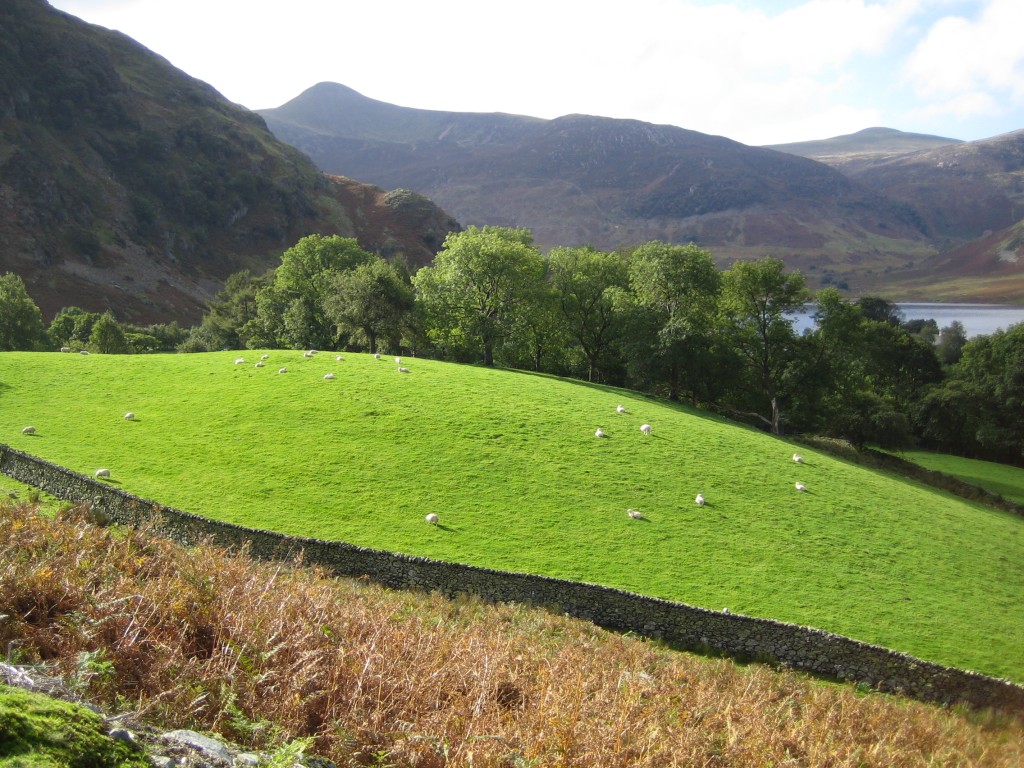
Despite its low height, Rannerdale Knotts looks quite forbidding. The most direct path is very steep. However the summit is also accessible by an easy walk up the valley named Rannerdale which brings you on to a ridge that leads directly to it. On the way there are great views back over Crummock Water and Loweswater out to the Solway estuary.

Just as we were about to climb on to the ridge I heard Phil G1OPV/P calling from the summit of Mellbreak (the hill on the left in the above picture.) Though only a couple of miles away I could only just hear him due to the steep ground between us. I hurried to the top to make contact and agree to work again when I reached the summit of Rannerdale Knott for a true summit-to-summit.
I had barely reached the summit and was still getting my breath back when I heard a “CQ WOTA” call and made contact with M0AYB/P (also Phil) who was on Dodd, another fairly low fell beside Bassenthwaite Lake. Anyone who knows the area was surprised that VHF signals could travel between two such low hills with a large mass of mountains in between. Olga captured me making the contact with Phil on her camera. I was using the Motorola GP300 on this occasion, with 4W out to a 5/8 wave telescopic “Black Whip” antenna. In my left hand you can see the Olympus personal voice recorder I use for logging.
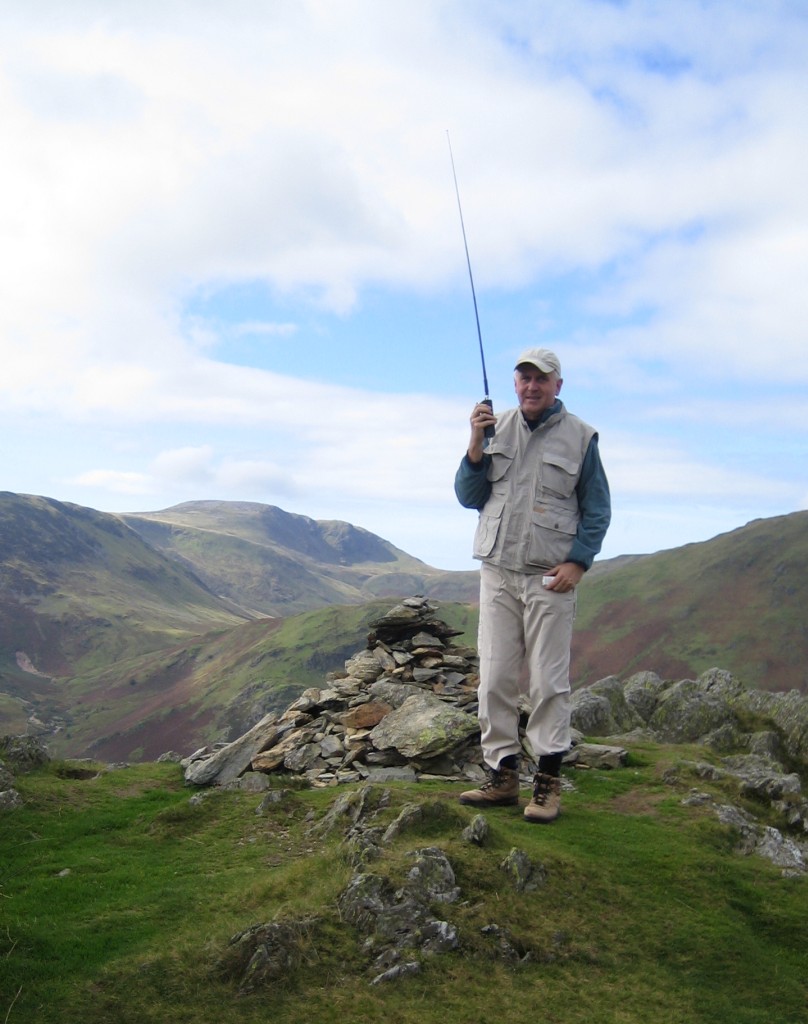
After signing with Phil I was immediately called by Geoff, G4WHA/P who had arrived on the Causey Pike, the summit I climbed a few weeks earlier and failed to recognize or activate! Whilst I sneaked up on it the back way making it easy to reach, Geoff tackled it by the direct route which he informed me had turned out to be tougher than he anticipated. Accompanying Geoff on his first Wainwright outing – a baptism of fire – was Mark M1MPB/P so I made two contacts with the same summit. Then I contacted Phil G1OPV/P again to make the summit to summit with Mellbreak. I suspect we could have made the contact by shouting if the wind had been in the right direction, in fact I think I could just see Phil silhouetted against the skyline on the summit.
After that I was called by Robert M3XJV/P who was on Birkhouse Moor, on his way to Helvellyn. This was a nice addition to my chaser total as the Helvellyn hills seem to be out of range of my home station in Cockermouth. Finally I made two contacts with home based stations: Roger G0MWE in Dearham and Ron G0UQC in Keswick before I was able to sit down and join Olga having our picnic lunch and enjoying the view over Buttermere.

We returned to the car via the precipitous direct descent down to the lake. It was a short walk but a successful one. Seven contacts including five summit to summits from a low fell that on previous visits (before WOTA) you would never expect to make a contact from. I think Wainwrights On The Air is transforming VHF activity in the Lake District and the comment from one activator that it is getting hard to find a clear frequency is proof of it.

Julian Moss, G4ILO, is a regular contributor to AmateurRadio.com and writes from Cumbria, England. Contact him at [email protected].
New Open Source Rig Project? Dah Mini-Pig+
The QRP-L reflector has been buzzin’ with the news and chatter (positive and some negative btw) about a new project to design and build a new transceiver for QRP HF use. YAHOO!

K8IQY Style Test Setup
What I love the most about this is that the QRP community is able to contribute ideas, resources and participate much like the Open Source software community operates. This could really be a fun project for our Central Florida QRP group. After all, we are not that far from Diz W8DIZ who is facilitating and coordinating this project.
If you like to build, experiment and try some QRP operation with a new rig… you should tune in and join the fun.
This is the last week to vote in the poll on my blog for the best US QTH for ham radio… Here’s the standings as of Sunday at 2100 EDT:
- West Virginia (17%, 10 Votes)
- Kansas (16%, 9 Votes)
- Hawaii (7%, 4 Votes)
- Texas (7%, 4 Votes)
- New Hampshire (5%, 3 Votes)
You can cast your vote by following this link!
72,
Kelly K4UPG PB #173
Kelly McClelland, K4UPG, is a regular contributor to AmateurRadio.com and writes from Florida, USA. Contact him at [email protected].
 Ham Radio Deluxe |
 W5SWL Electronics |
 Ham Radio Prep |
 KB3IFH QSL Cards  Hip Ham Shirts  HamRadioAuctions HamRadioAuctions Reliance Antennas Reliance Antennas Enigma Shop Enigma Shop |  morseDX  Ni4L Antennas  R&L Electronics R&L Electronics antennas.us antennas.us QRV QRV |
- Matt W1MST, Managing Editor
