 |
 Update on the DX code of conduct
 26 October 2010 | by
 I was pleased to receive the following e-mail from Randy, W6SJ this morning.
You were among the dedicated operators to show your support of the DX Code of Conduct project. You and the other respondents energized me to really get some effort behind a project to change things. We gradually attracted a committee of high profile people, many of whom you might know as dedicated HF operators.
The result is that the DX Code of Conduct has been translated into over two dozen languages. Many of the national societies have featured in in their magazines and have links at their websites.
We developed a section for DXpeditioners and have gotten incredible support from them. All have supported us and they are listed too. After all, they are the real beneficiaries of polite operating.
We also have spread the word through a number of clubs and we just developed a Power Point that is designed to be shown at club meetings.
Please take a look at our website www.dx-code.org and see our progress. Note that we have had over 5500 unique visitors.
Your enthusiasm was important to me and the others on the team and you should feel pride at having given us the courage to try to change the situation.
Please take this opportunity to tell the rest of your friends about the project and encourage them to support it as well..
Please let me know if your club would be interested in seeing the Power Point once it is ready for release.
Randy also goes on to say “PS – This site and the Power Point were developed with my pretty feeble HTML 3.0 skills and both it and the PPT could benefit from some enhancement by a person with “artistic website skills.” If that describes you, perhaps you might want to volunteer to help us create a 21st Century look. “
It’s great to see that the DX Code of Conduct is receiving plenty of support. I hope that will translate to plenty of support on the bands too. We can but hope. And if you can help Randy with the web presentation of his excellent ideas, then I hope you’ll get in touch.

Tim Kirby, G4VXE, is a regular contributor to AmateurRadio.com and writes from Oxfordshire, England. Contact him at [email protected].
Kenwood filter fault fix
As the owner of a Kenwood TM-D710 I was interested to see that Anastasios, SV8YM, has developed a mod to fix the problem of the failing IF filters which causes these radios to go deaf after a couple of years. As explained in admirable detail in his original article describing the problem, it is caused by electromigration due to the fact that Kenwood omitted DC blocking capacitors on the input and output of the ceramic filters. This issue affects the TS2000 as well.
As you can see from Anastasios’ excellent photographs, the mod involves cutting some tiny circuit board tracks, bridging between pairs of them with wire, then soldering 0.1uF SMD capacitors between the bridge and the filter input. The TM-D710 has two receivers, each with two filters (one for wide FM and one for narrow FM) each of which has both an input and an output that needs to be treated. So that is 16 tracks that need to be cut and 8 tiny capacitors inserted. I’m afraid working with these tiny components is beyond me, which is a shame as it is now, while my Kenwood is still only a few months old, that it needs to be treated.
Thanks to SV8YM for sharing the details of the modification.

Julian Moss, G4ILO, is a regular contributor to AmateurRadio.com and writes from Cumbria, England. Contact him at [email protected].
Xastir update is for geeks
Version 2.0 of Xastir, the open source APRS client, has just been released. The new version now supports OpenStreetMap mapping, the same as is used by APRSISCE. I was interested to see that the project web page claims it runs on Linux/FreeBSD/Solaris/MacOSX/Windows so I thought I would try it out on my shack PC which runs Windows. I was puzzled that there was only one download file instead of different versions for each platform, but thought that perhaps they had recoded it as a Java application. I downloaded the .tar.gz file. opened it in BitZipper and found a load of source code files but no .EXE.
There is a file called readme.W32 which contains a lengthy and complex explanation of how to install the program under Windows which involves compiling it yourself using free software development tools. I seem to recall trying this once with an earlier version and failing. Most other developers of popular free software ham radio apps, such as Fldigi, WSJT and WSPR, now produce ready to run compiled versions for Linux, Windows and any other platform their program runs on. Why can’t Xastir’s developers do this? Most APRS enthusiasts don’t possess a PhD in computing so it’s unrealistic to expect them to do it.

Julian Moss, G4ILO, is a regular contributor to AmateurRadio.com and writes from Cumbria, England. Contact him at [email protected].
Heathkit Genesis
Last week at the Waverley Amateur Radio Society monthly meeting there was a fascinating and well-prepared talk from Justin Lavery VK2CU on the history of the Heathkit company.
The scene at the front of the clubroom was not unlike this great shot from the website of Fred W1SKU.

Heathkit equipment on display at W1SKU
Only there were more pieces of equipment on display! Justin’s clearly been collecting for a while, specialising in valve gear and the SB series. He had a stash of catalogues dating back to the early 1960s which evoked memories for many of us there old enough for Heathkit – even on the other side of the Pacific Ocean – to have been a radio icon.
Justin filled in the deep history of the company, with its kit airplane beginnings through to its heyday when it actually made economic sense to build your own colour TV!
He also managed to evoke the history of the time – which is some achievement for someone who I don’t think was actually alive for most of it!
MAKE magazine beautifully evokes the times and the anticipation – those long painful delicious moments between posting the order and the kit arriving.

Heathkit times (MAKE Online)
I was especially interested in observations about how the fortunes of the company were in synch with a strong tradition of making it yourself – which seems to be a core part of both the US and Australia. We both have frontier experiences still in our recent folk memory.
I wonder what Heathkit would make of the kit market today if they were still around. They certainly set a benchmark. And they certainly sold a lot of kits over the years.
So it was an interesting coincidence for me at least that on the same day as I’m thinking about Heathkit and how I used to long to own an HR-10 and a DX-60, I received my Genesis G59 Mk2 SDR transceiver kit.
The Genesis G59 is a very exciting sounding project. I believe I’ll have a pretty impressive SDR transceiver once it’s complete.
While GenesisRadio is more cottage industry in scale than Heath – who grew so much they opened a factory in the UK – the quality is there where it counts. Part of the decision to take the plunge was an estimation of the support both from Nick Hacko VK2DX and the online community of builders on the Yahoogroup.

One step in phase 1 building the G59 SDR kit
The then and now comparison shows how much kit building has changed. Kits now can be delivered across the world in days. Speedy support from a global network of enthusiasts is available via email. Documentation is able to be kept up-to-date and builders alerted to important developments. And most amazing, of course, the firmware can easily be updated and improved.
The key to the success of all of this is the social glue of the builders online. That’s another reason not to delay the build and to glean maximum advantage of the communal energy available there.
The Genesis documentation is clear with excellent photos. Not the component by component style of Heathkit, but totally adequate.
So far I’ve completed phase 1 successfully (the power supply) and am in the middle of the second phase (the microcontroller circuit). I’m taking it slowly and really enjoying those moments at the end of the night when I can get to it. That lateness is the one reason I’m taking it slow. The other is – I really enjoy this part!
Stephen Rapley, VK2RH, is a regular contributor to AmateurRadio.com and writes from New South Wales, Australia. Contact him at [email protected].
Welcome to the New QTH!
Welcome to the new home of The K3NG Report. I’m still getting things in order, most noticeably the blogroll. I’m going to try to get all the blogs from the Blogger blogroll that are not covered at AmateurRadio.com in as RSS feeds. Unfortunately WordPress doesn’t seem to have a good blogroll widget like Blogger, but it’s a small price to pay.


W3LPL-inspired 160/80 RX splitter
In an earlier post, I described my K9AY loop system. QRX for an update on the outdoor portion. But, after returning from a short and much-needed vacation at the beach yesterday afternoon, I whipped-up this little guy:
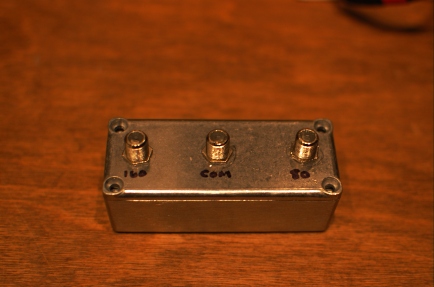
One of the big problems I have living in the city is overload from broadcast stations in the AM band. (This is especially true in the heavily-populated, full-of-hot-air DC area—Ed.) But, I digress. I also wanted to protect the preamp and receiver when I was transmitting on the higher bands into nearby antennas. So, some sort of filtering was in order.
I contemplated a number of topologies. But, the W3LPL filters were a good choice because they’re cheap and very good. A good reference on what I did is the NCJ article by K3NA and W2VJN about the VP6DX receiving antenna system. The Ducie Island system is considerably more complex than mine. But, they had more stringent requirements, more land for Beverages, and more money than I do.
Following the K3NA/W2VJN/W3LPL topology, I constructed a little diplexer filter for 160 and 80 meters that splits my K9AY to two receiver ports. This splitter is the first thing after the K9AY coax passes through the station ground bulkhead, requiring a preamp on each port. Since I don’t have a TX antenna for 160 yet, that port will go to the SoftRock-160.
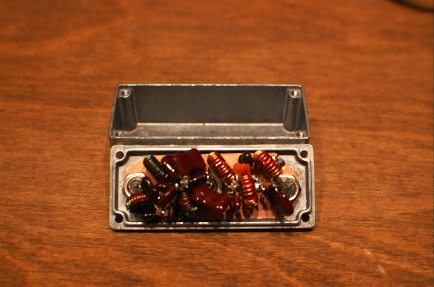
I’ve only tested the 80-meter portion (since I didn’t get the 160 portion done until this morning before work). But, it works like a champ and there is no overload from broadcast stations. Although there are some curious mixes coming from some of the big AM stations in the area that seem to be external to the receiver (this has been confirmed by N3OX—pretty amazing stuff); but, that might deserve its own post at a later date.
Ethan Miller, K8GU, is a regular contributor to AmateurRadio.com and writes from Maryland, USA. Contact him at [email protected].
I am CAD afflicted
Yep, it is confirmed now for sure. Compulsive Antenna Disorder has haunted me since I was first licensed and ran a coax fed 80 meter dipole on multiple bands without a tuner. The first time the symptoms were noticed by my family and friends was when I got a couple OO tickets for out of band harmonics. Hmmmm… what’s up with that? So a bit of reading and the antenna tweaking began and that’s when it all started.
Soon thereafter I tried to load up a nifty pin from my Junior Prom Boutonnière that reminded me of a triple stacked halo for 1296 Mc (MHz for the newer ones amongst us). Then it was the handheld yagis for 432 Mc that we used with some military surplus gear that used dynamos so we could chase tornadoes. (We thought if it bounced off the moon, it should bounce off of a tornado!) The saucer sled that became a parabolic for listening to satellite telemetry and on it goes… Compulsive Antenna Disorder has had a firm grip on me for some time now.

Am I dreaming? Thanks wiki images!
As a QRP operator, I am always looking for more antenna power. I know that somewhere out there simply MUST be a silver bullet, that magic QRM and pileup busting antenna that makes my 2 watts output sound like a full gallon.
I can say one thing for sure, I know a lot of non-silver bullet antennas, as I have a box full of them.
But they still make a few QSO’s at times and I’m having fun along with a bit of frustration and disappointment as I deal with my CAD affliction.
I’m told that much like telegraph key collectivitis there is no known cure or relief. I share in your grief brothers and sisters…
72,
Kelly K4UPG PB #173
Kelly McClelland, K4UPG, is a regular contributor to AmateurRadio.com and writes from Florida, USA. Contact him at [email protected].
 Ham Radio Deluxe |
 W5SWL Electronics |
 Ham Radio Prep |
 KB3IFH QSL Cards  Hip Ham Shirts  HamRadioAuctions HamRadioAuctions Reliance Antennas Reliance Antennas Enigma Shop Enigma Shop |  morseDX  Ni4L Antennas  R&L Electronics R&L Electronics antennas.us antennas.us QRV QRV |
- Matt W1MST, Managing Editor
