 |
 SDR needs more UX
 29 October 2010 | by
 Spotted a very interesting post from Tobias, DH1TW on his blog ‘Contesting & SDR‘ titled Does SDR really suck?. He wonders out loud if the performance, flexibility and cost of SDR is so excellent, why hasn’t it taken off? What possible barriers might there still be to it assuming a place matching its promise and achievement?
He identifies the missing link as adequate user interface. He mounts a case arguing for a similar level of investigation and development on the user experience front to match the investment and experimentation on RF and signal processing.
And he acknowledges that there may be more than one user interface solution. Contesting and HFPack have different UX demands as other experts understand. Look at Elecraft‘s K3 and KX1, or the Steve Weber, KD1JV designs, especially the ATS series. And now Tobias argues, SDR gives us the opportunity to re-think user interface design from the ground up.
Who says that the radio controls must be on the front of a black box and located perpendicular to your shacks desk? SDR allows us for the first time to completely redefine and optimize the radios User Interface! Are you serious into contesting? If so, you want to pay special attention to ergonomics. Why not having the control console directly next to your keyboard? Or do you prefer portable, backpack operations? Then your focus will lie on the limited physical dimensions. N2ABPs SDR-Cube is a nice example on this.
A very timely – and well illustrated – read.
Stephen Rapley, VK2RH, is a regular contributor to AmateurRadio.com and writes from New South Wales, Australia. Contact him at [email protected].
LHS Show Notes #051
Ubuntu 10.10 – Maverick Meerkat
Russ upgraded from 10.04 to 10.10, which isn’t particularly easy. as 10.04 is the long-term-support (LTS) version, but 10.10 isn’t.
There is a command line command to upgrade:
do-release-upgrade
which will work, but you must first make a change in the Ubuntu software center. Click Edit -> Software Sources -> Updates tab. At the bottom of the Updates tab, there are three options for the release upgrade: Never, Long-term Support Only, and Normal Releases. You must select “Normal Releases”. Russ then issued the do-release-upgrade command. Once the downloads were complete, the upgrade just took about 45 minutes. A reboot is necessary due to the newer kernel.
The desktop background is a bit different, but otherwise it looks and runs much the same as 10.04. Russ had some performance issues with 10.04 on some of his machines. He thinks 10.10 runs much better.
- GNOME updated to current 2.32 version.
- Gnome desktop manager (gdm) version 3. Russ thinks it looks more like OS-X.
- Evolution updated to version 2.30. Russ thinks they should drop Evolution entirely. There would be room for GIMP if Evolution were deleted.
- Shotwell replaces F-Spot as the default photo manager. F-Spot replaced GIMP in a previous release due to space issues, and now Shotwell replaces that. Isn’t this kind of silly?
- Gwibber updated to use Twitter’s new authentication scheme.
Kubuntu changes:
- More updates to KDE.
- Updates to Qt, and KDE (4.5.1).
- Switched to PulseAudio. Russ says: BOOOOO!, because he’s unhappy with all audio systems on Linux.
Ubuntu Server changes:
- Eucalyptus updated for cloud computing environments.
Kernel update:
- 2.6.35-22.33 Based on 2.6.35.4 upstream stable kernel.
- Support for i586 and older processors, and i686 processors without the conditional move opcode (CMOV), has been dropped. Bad news for older machines.
WSPR was highlighted in the November, 2010 issue of QST.
- What is WSPR? From the WSPR Users Guide:WSPR (pronounced “whisper”) stands for “Weak Signal Propagation Reporter.” The WSPR software is designed for probing potential radio propagation paths using low-power beacon-like transmissions. WSPR signals convey a callsign, Maidenhead grid locator, and power level using a compressed data format with strong forward error correction and narrow-band 4-FSK modulation. The protocol is effective at signal-to-noise ratios as low as –28 dB in a 2500 Hz bandwidth. Receiving stations with internet access may automatically upload reception reports to a central database. The WSPRnet web site http://wsprnet.org/drupal/ provides a simple user interface for querying the database, a mapping facility, and many other features.
- Developed by Joe Taylor, K1JT.
- System Requirements:
- SSB receiver or transceiver and antenna.
- Computer running the Windows, Linux, FreeBSD, or OS X operating system.
- 1.5 GHz or faster CPU and at least 100 MB of available RAM.
- Monitor with at least 800 x 600 resolution.
- Sound card supported by your operating system and capable of 48 kHz sample rate.
- If you will transmit as well as receive, an interface using a serial port to key your PTT line or a serial cable for CAT control. Linux and FreeBSD versions can also use a parallel port for PTT. Alternatively, you can use VOX control.
- Audio connection(s) between receiver/transceiver and sound card.
- A means for synchronizing your computer clock to UTC.
Richard’s setup:
- Yaesu FT-897D Transceiver.
- G5RV Antenna.
- Rascal GLX sound card interface.
- Ubuntu 9.10.
- 3 gigs of memory and an Intel 3.0 Ghz CPU.
- Onboard sound card.
Installation:
- Richard downloaded what looked like the .deb package from the web site.
- He used Gdebi to unpack and install it, but could not get it to stay running. Every time he tried to do anything it crashed.
- After reading the Linux installation instructions from the user guide, he attempted to install it in the manner described:
- Download the appropriate file from http://physics.princeton.edu/pulsar/K1JT/wspr.html, place it in your home directory, and run the following commands in a terminal
$ sudo dpkg --instdir=. -i wspr_2.00r1714_i386.deb
$ cd WSPR
$ ./wspr
- This resulted in a program that would receive after some fooling around with the sound card, but no rig control, and no transmit.
- As a last resort, Richard downloaded the Windows version and loaded it under Wine, which gave him rig control, transmit, and receive, without much of a problem.
- It did leave him with a few minor annoyances: he has to start it from the file manager with “Open with Wine” from the directory “.wine/Drive_c/Program Files/WSPR”. The menu bar at the top was only partially functional, but he thinks it has to do with his USB mouse, as keyboard control works fine.
- Richard was heard in Argentina on 40m running 5 watts and reported on the wsprnet site.
- WSPRNet website
- WSPR net offers a wide variety of information on the network in real time.
- Page of stations currently active on WSPR.
- Map of stations that can be filtered by callsign and/or band.
- Offers dicussion forums for Q and A, setting up schedules, and general WSPR discussion.
Donations
If you’d like to help the podcast, please consider making a donation. It’s easy! Just a click on the Donate button on the web site. Every dollar helps. Or purchase some LHS merchandise at the SHOP! link on Web site. Check out the Badgerwear or buy one of the other LHS-branded items at PrintFection.com/lhs or Cafe Press. Thanks!
Contact
- Contact Richard at [email protected], Russ at [email protected], or both at the same time at [email protected]
- Listen to the live stream every other Tuesday at 8:00pm Central time. Check the LHS web site for dates.Leave us a voice mail at 888-455-0305 or 417-200-4811, or record an introduction to the podcast.
- Sign up for the LHS mailing list.
- Thanks to Dave from Gamma Leonis for the theme music.
Music
- “Monument” by Shearer from the album “Monument,” courtesy of Jamendo.
- “This Love” by Spinous from the album “Empathy,” courtesy of Jamendo.
Russ Woodman, K5TUX, co-hosts the Linux in the Ham Shack podcast which is available for download in both MP3 and OGG audio format. Contact him at [email protected].
Foxed
My FoxTrak APRS tracker board is now installed in a plastic case, together with 4 x AA NiMH cells which provide near enough 5V to power both the tracker and the GPS. Two mini-DIN sockets on the side of the case allow connection to a PS/2 GPS or PC for configuration, and to the radio. Now I just have to make up interface cables to my radios and install the top half of the case after drilling it and installing the charger socket for the battery.
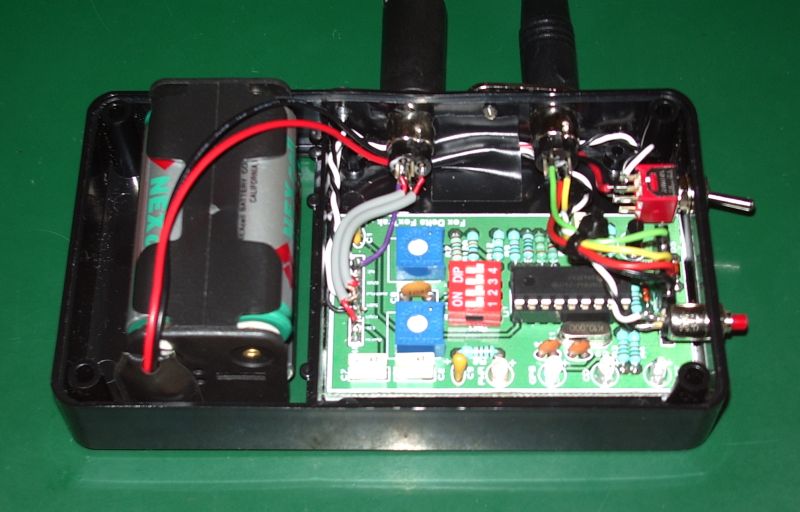
I purchased a GlobalSat BR-355 PS/2 GPS receiver on eBay and it works very well indeed with the FoxTrak, much better than the GPS in the Yaesu VX-8GR. It gets a fix within a couple of minutes when it is sitting on the shack window sill, unlike the VX-8GR which often never finds its position indoors at all, and the position remains rock steady unlike the Yaesu which tends to wander about.
I wanted to make a cable to use the tracker with my Motorola GP-300 hand-held. However I found that the jack plugs you can buy from component suppliers have too wide a body and can’t plug all the way in to the sockets on the top of the radio, which are a bit recessed. It appears that you need to use a proper moulded plug with the two pins. A cable for the Motorola GP-300 is available on eBay, so I’m waiting for one to arrive.
I was luckier with the old Kenwood TH-205E. The sockets for external mic, PTT and speaker are flush with the top of the case and the cable I made up using separate plugs works fine. Lacking a deviation meter I adjusted the audio output so the braaps sounded as loud as those from other APRS stations.
However, the TH-205E is a bit big and heavy for portable use, especially as it has a high capacity Ni-Cad battery pack (the original being as dead as a dodo.) I had expected the cable to work just as well with the little TH-F7E, because the Kenwood speaker-mic I have works with both radios. But although PTT works on the smaller Kenwood there is virtually no audio. I have to turn the audio up to maximum on the FoxTrak to get enough signal to be decoded by my gateway, and the deviation is still too low.
I am completely foxed by this problem. The only thing I can think of is that it is something to do with using two separate plugs and not the proper moulded two-pin connector used by the speaker-mic. Perhaps, as with the Motorola, the wide body of the plugs is preventing them from going far enough in to disconnect the internal microphone, which is shorting out the audio. Unfortunately the only way to prove this hypothesis would be to buy a cheap Kenwood speaker-mic or programming cable on eBay and cut the cable off. It’s a bit of a gamble, as I don’t know for sure if that’s the solution, and the cables in some of those cheap mics from China are very poorly screened so I could end up with an RF-induced problem.

Julian Moss, G4ILO, is a regular contributor to AmateurRadio.com and writes from Cumbria, England. Contact him at [email protected].
LHS Episode #051: Careless WSPR
 A short while ago, Canonical released the latest version of Ubuntu: the fabled Maverick Meerkat, 10.10. This is the latest in Ubuntu’s normal release cycle and is not LTS. I had occasion to upgrade a couple of my personal computers running Ubuntu to the wily Meerkat. Find out what’s new in 10.10, and what’s old, in the first segment of LHS #049.
After that, Richard and I tackle the WSPR protocol for ham radio again. When it was discussed the first time around, neither of us had much of an idea what it was or how it worked. Armed with a broader understanding and a lot more experience, we talk about what works and what doesn’t work with WSPR, how to get it up and running on your system and what we like and don’t like about it.
Following that it’s on to witty banter, a passel of badgers, some hijinks, censorship, feedback and more entertainment than you can shake a wet hedgehog at. Thanks for tuning in. We love you all.
73 de The LHS Guys
Russ Woodman, K5TUX, co-hosts the Linux in the Ham Shack podcast which is available for download in both MP3 and OGG audio format. Contact him at [email protected].
Handiham World for 27 October 2010
Welcome to Handiham World!
In this edition:
New net will be on 75 m
Band plan isn’t the same as frequency chart
Dip in the pool
NASA internships available for students with disabilities
Launch date set for Discovery mission
Putting in a speech module proves to be quite a chore
K1RFD puts in a guest appearance on TIPSnet
This week at HQ
It’s time for a new HF net – Part 3

Two weeks ago we said : We need at least consider moving our HF net to 160, 75, or 40 meters, and those bands are likely to be most useful in the evening. Because 160 requires a very long antenna, it is impractical for many users. 40 can get crowded, but requires the shortest antenna of the three. Of course we can consider reviving our 17 meter “non-net roundtable”, which was originally started by Alan, K2WS, but the sun will have to spit out a few more spots for that band to get where it needs to be. So what do you think? 160? 75? 40? Or something else? And what about the time and day?
Decision time is here! we really need to get moving on this new net, and the consensus seems to be building around 75 m as the best band. Therefore, we will proceed to the next step, which is choosing a net frequency. Most of the responses I have gotten indicate that users would prefer a frequency in the Extra or Advanced class portions of the phone band. We were reminded by one respondent about the “DX window” in the ARRL band plan, which is 3.790 to 3.800 MHz. The Extra portion of the band runs from 3.600 to 3.700 MHz. The Advanced portion runs from 3.700 to 3.800 MHz. The General portion runs from 3.800 MHz to the top of the band at 4.000 MHz. All General frequencies are available to Advanced and Extra licensees, of course.
So the next step is to start listening in the evening for clear frequencies. Please report the frequency and the time you listened along with the day of the week so that we can pick a mostly clear spot for a regular weekly net. By the way, the net does not have to be weekly – it could be daily, a couple of times a week, or whatever Handiham Radio Club members think is appropriate and reasonable. Send your reports to me over the coming week so that we can move on to the next step and get the word out about our new 75 m net.
By the way, there are no plans to make this a formal traffic net or anything like that. While I wouldn’t rule out the possibility of handling traffic, I think it would be fun to just have a nice social net on HF during the long winter evenings. As with the daily EchoLink net, we could enlist net control stations or simply have a more or less uncontrolled roundtable gathering. Maybe we will have some of both, depending on who shows up to join in the fun!
Please e-mail me this week with your frequency and time suggestions, frequency reports, and other suggestions about the net.
73,
Patrick Tice, WA0TDA
Handiham Manager
[email protected]

Pat Tice, WA0TDA, is the manager of HANDI-HAM and a regular contributor to AmateurRadio.com. Contact him at [email protected].
On whether it is more blessed to receive than transmit…
If you come from a DXing background like I do, then one of the lessons that will have been drummed into you is that you listen, listen some more and then listen again! The great DXer listens and makes his/her transmissions count. And that makes perfect sense if you’re combing the bands looking for new ones.
But how does that translate into our activity on the ‘day-to-day’ chat bands, like VHF/UHF or even some of the HF bands. Quite often you hear people saying, ‘I listen an awful lot but I don’t transmit very much’. And of course, I know that sometimes it isn’t convenient to transmit – it might be an RFI thing – you might not have time – you might not want to disturb the household…. these are all good momentary reasons.
But sometimes, I think we could all be a bit more active on the bands within the constraints of our day-to-day lives. It was Sunday afternoon and I was sat in the lounge entertaining the cats (if you have young cats, you’ll know how important this is to avoid curtains being swung on and bookcases scaled….). I had my iPhone with me and I dialled up a few interesting looking repeaters on Echolink and called through them. Perhaps no-one wanted to speak to me – but certainly no-one called. D-STAR was a bit more productive and I had a couple of nice chats. But even so, the systems I listened to were hardly buzzing with activity!
Perhaps we are spreading our activity too thinly across many bands/modes/repeater systems/digital modes? I think there’s some of that and I’ve certainly heard the view expressed that on D-STAR it’s easy to lose the activity with so many different reflectors (remember D-STARUSERS.ORG is your friend).
Sometimes though, I think there is a sense of wanting our leisure time activities to be laid on for us and for us just to ‘watch’. I get disheartened seeing people sitting in front of the TV apparently endlessly. They may well be watching informative programmes (or they may not). But what bugs me about it is that it’s a one way street. There’s no engagement or activity. I’ve seen a similar trend on Twitter with people who signup and look at other people’s tweets but never share what they are doing or thinking.
If there’s one thing I’ve learned about Social Media it’s that you must engage to make a success of it and get the best of it.
And so it is, I think, with amateur radio which was probably the world’s first social media platform. To me, just listening does not equal engagement.
So get out there. Call CQ and answer a few more calls through the repeater or on the bands. Have fun and I’ll see you on the air!

Tim Kirby, G4VXE, is a regular contributor to AmateurRadio.com and writes from Oxfordshire, England. Contact him at [email protected].
Update on the DX code of conduct
I was pleased to receive the following e-mail from Randy, W6SJ this morning.
You were among the dedicated operators to show your support of the DX Code of Conduct project. You and the other respondents energized me to really get some effort behind a project to change things. We gradually attracted a committee of high profile people, many of whom you might know as dedicated HF operators.
The result is that the DX Code of Conduct has been translated into over two dozen languages. Many of the national societies have featured in in their magazines and have links at their websites.
We developed a section for DXpeditioners and have gotten incredible support from them. All have supported us and they are listed too. After all, they are the real beneficiaries of polite operating.
We also have spread the word through a number of clubs and we just developed a Power Point that is designed to be shown at club meetings.
Please take a look at our website www.dx-code.org and see our progress. Note that we have had over 5500 unique visitors.
Your enthusiasm was important to me and the others on the team and you should feel pride at having given us the courage to try to change the situation.
Please take this opportunity to tell the rest of your friends about the project and encourage them to support it as well..
Please let me know if your club would be interested in seeing the Power Point once it is ready for release.
Randy also goes on to say “PS – This site and the Power Point were developed with my pretty feeble HTML 3.0 skills and both it and the PPT could benefit from some enhancement by a person with “artistic website skills.” If that describes you, perhaps you might want to volunteer to help us create a 21st Century look. “
It’s great to see that the DX Code of Conduct is receiving plenty of support. I hope that will translate to plenty of support on the bands too. We can but hope. And if you can help Randy with the web presentation of his excellent ideas, then I hope you’ll get in touch.

Tim Kirby, G4VXE, is a regular contributor to AmateurRadio.com and writes from Oxfordshire, England. Contact him at [email protected].
 Ham Radio Deluxe |
 W5SWL Electronics |
 Ham Radio Prep |
 KB3IFH QSL Cards  Hip Ham Shirts  HamRadioAuctions HamRadioAuctions Reliance Antennas Reliance Antennas Enigma Shop Enigma Shop |  morseDX  Ni4L Antennas  R&L Electronics R&L Electronics antennas.us antennas.us QRV QRV |
- Matt W1MST, Managing Editor
