 |
 Handiham World for 17 November 2010
 18 November 2010 | by
 Dr. Tom Linde, KZ0T, Silent Key

Dr. Tom Linde, KZ0T, long time Handiham member and volunteer, became a silent key on Monday 15 November 2010 at 1:30 AM. Tom died peacefully in his sleep at home with family members at his side.
As you might expect, Tom and I met each other through amateur radio. I’m not sure when Tom was first licensed, but his accomplishments in amateur radio were pretty amazing and included working all states on 6 meters, something I haven’t done and many of us will never do in our entire amateur radio careers. Yet Tom, whose speech was compromised by his disability, managed to train himself to speak the necessary amateur radio jargon and call signs clearly so that he could accomplish this feat. He made use of Morse code and always enjoyed the competitive and also the social aspects of amateur radio. When I started with the Handiham staff at Courage Center in 1992, it wasn’t long before Sister Alverna O’Laughlin, WA0SGJ, told me about “Dr. Tom”. He had been in Handihams since the late 1970s, and had made a name for himself on the amateur radio bands.
When I first met Dr. Tom, I had to listen up when he spoke. His CP made it difficult for him to form the words clearly, but he was never offended if I asked him to repeat something or say it in a different way so that I would understand. His accomplishments outside amateur radio included earning his PhD in psychology and having a full working life as a professional psychologist. Family was always important to Tom, and he raised his family in the heartland of Iowa with his wife Ann, who preceded him in death nine years ago.
I quickly learned from Tom that he was interested in helping others through the Handiham program. As a volunteer, he assisted at our radio camp sessions, teaching in operating skills so that he could share his experience with other Handiham members who had disabilities. He was also pretty darned good at inspiring those Handiham members who had trouble dealing with their disabilities. After all, as a psychologist he had heard every excuse in the book why the glass was half empty instead of half full, and he knew better from his own life experience. It was hard to complain that you couldn’t do something when Dr. Tom showed you by example that it could indeed be done and that even a severe disability would not stop you from reaching your goals.
Dr. Tom taught at a number of radio camps in both California and Minnesota. He joined the Stillwater Amateur Radio Association where he made many friends, and was active on the air, even trying new things like wheelchair mobile HF operation.
One of the most interesting things I have ever seen was not actually part of amateur radio at all. It was when Dr. Tom conducted the Minnesota Symphony Orchestra. Lyle Koehler, K0LR, built a robotic conducting system so that the members of the orchestra could see and follow flashing lights as Dr. Tom directed them. Tom was truly a renaissance man who loved music and art and would frequently catch you off guard with his wry and cerebral sense of humor. He published a book about his life that will carry on inspiring others to overcome their disabilities and accomplish their goals. “I Am Not What I Am: A Psychologist’s Memoir: Notes On Controlling and Managing Personal Misfortune” is available through Amazon.com in print and in spoken word audio from the Handiham system for our blind members. The ISBN-13 designation is: 978-1420867633. I strongly recommend this inspiring book.
His son Peter, N0EDI, in a touching tribute, remembers his father in his 80 years of life as all of these things:
A Son,
A Brother,
A Husband,
A Father,
A Grandfather,
A Student,
An Extra Class Ham Radio Operator,
A Ph.D. Psychologist,
A Published Author,
An Artist,
A Music Lover,
A Guest Conductor of the Minnesota Symphony Orchestra,
A Traveler,
A Teacher,
A man who pushed the boundaries of CP farther than anyone thought possible,
Ultimately, he was My Dad, without whom I would not be the person I am today.
Memorial services are currently being planned for Rapid City, SD and Sheboygan, WI. Tom, a generous spirit giving even in death, requested that his body be donated to help medical science. There will be a headstone in Knoxville, IA, next to his Wife (Ann) and youngest son (Matt), who preceded him in death.
We will miss the kind wisdom and positive outlook that KZ0T brought to Handihams and to the airwaves. I count myself privileged to have been his friend.
Patrick Tice, WA0TDA
Handiham System Manager

Pat Tice, WA0TDA, is the manager of HANDI-HAM and a regular contributor to AmateurRadio.com. Contact him at [email protected].
W1GHZ 903 MHz RX working!
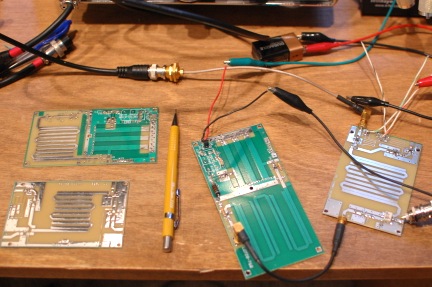
Although I built the W1GHZ 903-MHz transverter and 756-MHz LO boards last winter, I didn’t have time or inclination to test them until this week. These were purchased as a part of the first (October 2009) group buy orchestrated by W8ISS. Instead of the INA-10386 MMIC recommended by W1GHZ, the W8ISS kits featured a Sirenza SGA-3586Z MMIC as the LNA, as suggested by the 4s_microwave group. A better part (with NF < 2 dB), recommended to me by W9SZ, is the the SGA-4586Z, which I used on my 903 board and will use on my 1296 board. This requires the bias resistor (R3, 51 ohms, on the 1296 board) to be changed to 100 ohms.
Since there is a lot of foliage between me and the W3APL beacon, I took the liberty of carting the transverter and IF rig to the beacon site (sorry no photos) on my lunch break yesterday. Sure enough, it worked like a charm with the beacon pounding in on 147.0615 MHz. The nominal beacon frequency is 903.055 MHz, so I don’t know if the difference is in my LO or the not-GPS-locked beacon drifting around. At any rate, I’m pleased enough to continue the project…
The 1296RSU transverter and 1152-MHz LO boards are on the left in the photo above. They have not yet been populated, but that’s an evening’s work.
Ethan Miller, K8GU, is a regular contributor to AmateurRadio.com and writes from Maryland, USA. Contact him at [email protected].
DSP TNC
The winds of economic change are starting to have an effect on our online business. Because of that I am spending a lot more time on the computer trying to maintain our search engine positions and think of new revenue streams, with the consequence that I have less time or enthusiasm for blogging and other radio-related activities.
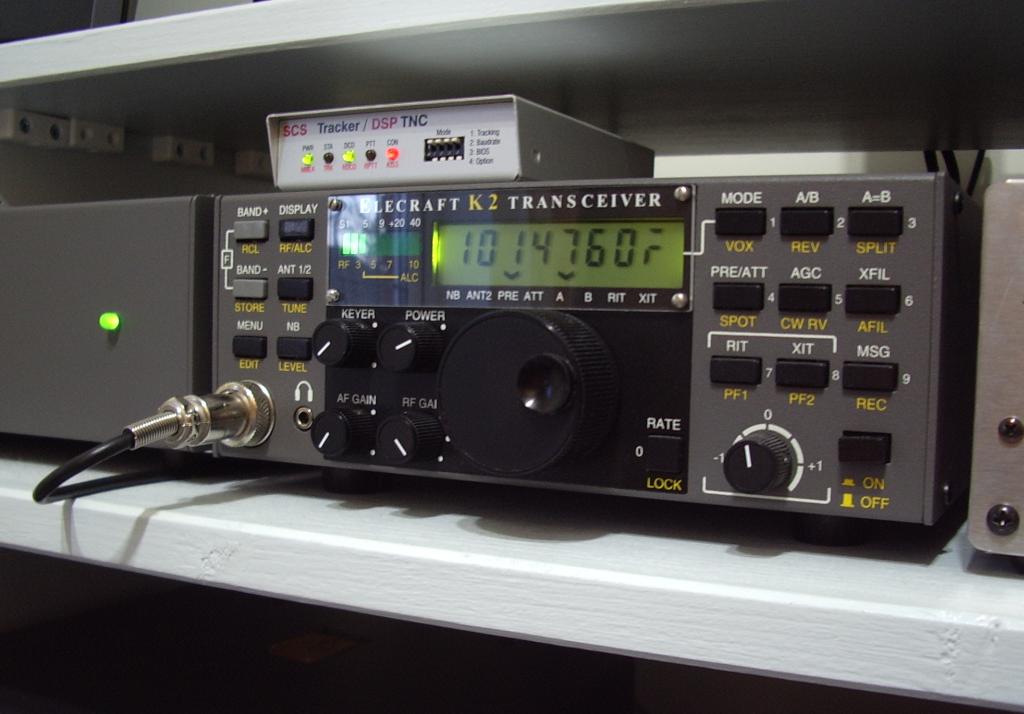
The only noteworthy item of radio news at G4ILO has been the acquisition of an SCS Tracker / DSP TNC for HF APRS packet. It is shown in the picture sitting atop my K2. When I find the time, I will write a review of this TNC for my main (non-blog) website. For the time being, all I will say is that I did a side by side comparison with the best of the PC sound card decoders and it was very quickly apparent that the SCS TNC decoded many stations the sound card software didn’t. Considering what it cost, I’d have been very disappointed if it hadn’t.

Julian Moss, G4ILO, is a regular contributor to AmateurRadio.com and writes from Cumbria, England. Contact him at [email protected].
A weekend WSPR
I should share with you that after my blog post about the Marconi Memorial CW contest last weekend, I had an e-mail from a friend who will remain nameless, who said ‘Nice to see you doing some real radio for a change’. I replied that it was nice to keep the ‘Wireless Preservation Society’ in business…
So this weekend I thought it would be nice to play around with some digital modes on HF. I didn’t know, but apparently it was the WAE RTTY contest taking place. I tuned across the digi bands and there was RTTY everywhere. Somehow, I didn’t fancy doing that, though I decoded a few for fun, using MMTTY. I’d read some things about the PSK Reporter network in the week, so I thought it might be fun to play some PSK. I set up Digital Master (DM780)’s Superbrowser, so I could sit my receiver on 14.070 and the Superbrowser would decode the streams of all the different QSOs going on. Quite interesting – but didn’t grab me as far as transmitting was concerned!
I decided I was more interested in playing with WSPR again. I had the software on my laptop from the last time I used it at the end of last year. I quickly set it going on 7.038MHz (this was mid afternoon) and was soon logging other WSPR users across the country, across Europe and as far away as UA3ARC (KO85). I couldn’t get it to transmit though. When it was time to transmit, the speaker emitted a click and that was it.
I couldn’t understand what was up – and frankly gave up for a while and just ran it on receive, as that was interesting enough anyway. But of course, curiosity got the better of me (must be the cats’ influence) and I tinkered around a bit, without success. I googled around and found that someone had similar issues solved by a reinstall of WSPR.
I removed the program directory, deleted all the files and reinstalled WSPR 2.11. It worked! I could hear tones on transmit! No idea why this had happened, but glad to be QRV again.
By the time all this had happened, 7MHz was starting to be swamped by the WAE contest stations, so a mere watt or so of WSPR wasn’t going to go far was it? To my surprise, my 1W signal was heard by a number of German stations as well as in northern Italy. Later on, I set the transmitter going for a period or two and was heard in Serbia at around 2000km.
With the contest out the way, I might try and run the 1W WSPR signal in the evenings this week and see how I get on. It ought to go a reasonable way…

Tim Kirby, G4VXE, is a regular contributor to AmateurRadio.com and writes from Oxfordshire, England. Contact him at [email protected].
New QSL card
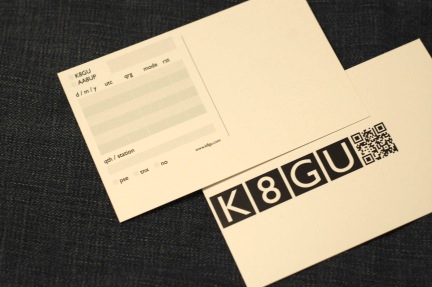
As I have bemoaned in the past, good QSL card designs are hard to come by. This is my attempt to remedy that situation. The front has my callsign, with a QR code linking the interested recipient to this web site. The reverse is postcard-friendly with space for six QSOs, corresponding to 1.8/3.5/7/14/21/28 or 50/144/222/432/903/1296 MHz. The address space can be used for a personal note if the card is mailed in an envelope. The card is also QTH-unaware. This means that I’ll have to write or sticker my way along, but I won’t be limited by my moves and travels. The font is Gil Sans everywhere. The cards were laid out using Adobe Illustrator CS4 and printed on 100-lb matte cover stock by Carlisle Printing, who printed my last cards as well.
One final note: one week after SS CW, I am already up to 43/50 states for my CW WAS from Maryland using LoTW. I’m not sure how many of these QSLs will actually make it into circulation at this rate. Be sure to work me so you can have your own copy of this rare collector’s item!
Ethan Miller, K8GU, is a regular contributor to AmateurRadio.com and writes from Maryland, USA. Contact him at [email protected].
2010 ARRL CW Sweepstakes
Last weekend I spent about 13 hours or so participating in the ARRL CW Sweepstakes contest. The last time I participated in this contest was in 2008, and although I started out slowly, I managed to finish with a final score just a bit higher than the 2008 effort. In 2008, I had 333 QSOs in about 15 1/2 hours with 79 out of the 80 possible multipliers, missing only NT (Northwest Territories in Canada) for a score of 52,614 points. This year, in 13 hours, I had 376 QSOs missing 3 multipliers (Nebraska, which I heard, but couldn’t work, South Bay, which I heard once, and didn’t work, and Newfoundland/Labrador, which I never heard), giving me a total of 57,904 points. Considering that I had fewer multipliers and a higher score in a shorter amount of time, I was pretty happy.
I didn’t try to “run” stations at all for the first day of the contest, there was just too much competition, but later on when things quieted down I was able to get run frequencies on 40m and 80m from time to time and really enjoyed working the stations calling. I did have a couple of things happen while running on 80m that I thought were noteworthy. First, in the middle of my run I got called by W1AW, the Hiram Percy Maxim Memorial station located at ARRL Headquarters. Although I’ve had contact with W1AW many times (they are not very far from here so are very easy to work on the lower bands), and have even operated from that station myself, it’s always fun to make contact with them, and even more special when they call me (rather than the other way around). The other thing that happened was that a bit later I was running on another 80m frequency at the bottom of the band (3.505mhz) and a station called and asked if I would QSY (change frequencies) because a DX station (5R8Z, I believe) was about to come on the air and that was the frequency that he’d announced he’d be moving to. I moved right away, because even though legally, since I was there first I could stay, it was in the “ham spirit” to move so that others could contact that DX station. (Frankly, I would have been very happy to make that contact myself, but I never heard him.) In any case, it was the right thing to do, and I was happy to do it.

David Kozinn, K2DBK, is a regular contributor to AmateurRadio.com and writes from New Jersey, USA. Contact him at [email protected].
Still Fine Tuning…
My apologies for the hideously long load times for this blog. I’ve been informed that the number of RSS feeds on the right is making the page take a long time to load. I’ve been trying to build something similar to the blogroll you get at Blogger, but unfortunately WordPress.com doesn’t offer a blogroll widget that sorts by last post date and shows the title of the last post. It’s either a full blown RSS feed for each blog you want to keep up with or a list of static links. So, most of the RSS feeds are deactivated for now until I can figure out another solution.
I consider blogrolls an important part of amateur radio blogademia. If you have me in your blogroll, thank you. I hope to get your blog back in mine soon….
(If anyone reading this has better WordPress fu than me, please give me some pointers!)
73
Goody


 Ham Radio Deluxe |
 W5SWL Electronics |
 Ham Radio Prep |
 KB3IFH QSL Cards  Hip Ham Shirts  HamRadioAuctions HamRadioAuctions Reliance Antennas Reliance Antennas Enigma Shop Enigma Shop |  morseDX  Ni4L Antennas  R&L Electronics R&L Electronics antennas.us antennas.us QRV QRV |
- Matt W1MST, Managing Editor
