 |
 ICQ Podcast Series Three Episode Twenty-Four – TenTec 1330 Completed
 21 November 2010 | by
 Series Three Episode Twenty-Four of the ICQ Amateur / Ham Radio Podcast. News Stories include:
- UK Space Agency starts CubeSat pilot programme
- World DX Club introduces e-membership
- Wi-Fi partners with mains networking tech
- UK Dreamer's Band first transmission (8.760kHz)
- Indy Officers under fire for radio chatter
- ARRL President makes final QSO WIA Centenary station
- Creation of a high-performance diode could change modern electronics
- Ofcom to automatically renew Short Contest Callsigns
- Caribbean DXpedition head back to St. Lucia
- WW2 activities of Radio Amateur G5HF
- Understanding LF and HF Propagation
- RAIBC amateur radio audio course discs
- Paper Aeroplane Released Into Space on 70cm
- Help the National Radio Centre
- Five Towns Repeater Group puts GB3WY on the air
- FM interference to amateur radio satellites
Your feedback, upcoming events and Martin (M1MRB) completes the TenTec1330.
Colin Butler, M6BOY, is the host of the ICQ Podcast, a weekly radio show about Amateur Radio. Contact him at [email protected].
ICQ Podcast Series Three Episode Twenty-Four – TenTec 1330 Completed
Series Three Episode Twenty-Four of the ICQ Amateur / Ham Radio Podcast. News Stories include:
- UK Space Agency starts CubeSat pilot programme
- World DX Club introduces e-membership
- Wi-Fi partners with mains networking tech
- UK Dreamer's Band first transmission (8.760kHz)
- Indy Officers under fire for radio chatter
- ARRL President makes final QSO WIA Centenary station
- Creation of a high-performance diode could change modern electronics
- Ofcom to automatically renew Short Contest Callsigns
- Caribbean DXpedition head back to St. Lucia
- WW2 activities of Radio Amateur G5HF
- Understanding LF and HF Propagation
- RAIBC amateur radio audio course discs
- Paper Aeroplane Released Into Space on 70cm
- Help the National Radio Centre
- Five Towns Repeater Group puts GB3WY on the air
- FM interference to amateur radio satellites
Your feedback, upcoming events and Martin (M1MRB) completes the TenTec1330.
Colin Butler, M6BOY, is the host of the ICQ Podcast, a weekly radio show about Amateur Radio. Contact him at [email protected].
Ottawa D-Star Symposium

The Ottawa Amateur Radio Digital Group are organizing the first Ottawa D-Star Symposium at Carleton University on Saturday 27th Nov. 2010. The will be a number of speakers and the the focus will be on some of the current developments such as the Freestar network, hotspots, DV and DVAP dongles and the D-RATs software. We are lucky to have Eric Meth, VE3EI, from Icom Canada as well as one speaker Andrew, M0GRU, who will be linking in from the UK.
The current talk plan is:
- Welcome and Introductions – VA3STL and VE3CVG
- D-STAR Past, Present, Future – VE3EI
- The VA3ODG System – VE3CVG – where we are and issues
- DVAPs, Dongles and HotSpots – M0GRU
- Break (5 min)
- The Spaghetti Bowl – FreeStar, USTrust, NI-STAR, ircDDB, G4ULF – VE3CVG, VA3OMP,others
- Lunch Break (30min)
- ID1 and High Speed Data – VA3YH
- D-RATs -VA3STL
- Break (5 min)
- About YMCA
- About Almonte VA3AAR
- Existing Projects
- Project Opportunities
- Where do we go from here?
Space is limited but if you are in the Ottawa area and would like to attend then please contact me.


Alan Steele, VA3STL, is a regular contributor to AmateurRadio.com and writes from Ottawa, Ontario. Contact him at [email protected].
WOTA day
What a day it has been for activity in the Lake District fells! Although the day isn’t over the light is beginning to fade as I write this and I’m guessing there won’t be any more activations today. But a quick count of the spots on the Wainwrights On The Air website shows there have been a total of 22 different fells activated by 6 different people which is probably a Wainwrights record.

At times the spots were coming so thick and fast that there was a danger of missing someone because you spent too long calling another station. And the fell-top stations had a hard job finding a clear frequency. Many had to QSY two or three times from their original chosen frequency because they landed on top of someone else’s contact. Perhaps we need to consider moving to 70cm for WOTA?
I myself made 16 contacts and added 7 new summits to my chaser total. I wish I could have been out on the fells myself to gain a bit of elevation and work some of the more distant ones. But this has still been my most productive day of WOTA chasing. Thanks to Phil G4OBK, Geoff GM4WHA, Phil M0AYB, Richard G1JTD and Colin G4UXH for the contacts. Visit Phil G4OBK’s Wainwrights blog where he will no doubt be posting an account of today’s activity with pictures shortly.

Julian Moss, G4ILO, is a regular contributor to AmateurRadio.com and writes from Cumbria, England. Contact him at [email protected].
W1GHZ 1296 MHz RX working!
I spent about two hours last night assembling the W1GHZ 1296RSU and 1152LO boards from his paper “Multiband Microwave Transverters for the Rover—Simple and Cheap.” Once again, I trekked over to W3APL beacon site at lunch and put the pair through their paces on RX with the IC-290H as the IF radio. It worked! Here’s a clip:
One of the interesting things about the 1296-MHz beacon is that it’s FSK, not CW. You’ll notice this after about 15 seconds when it starts sending its callsign. The higher pitch tone is “keyed” and the lower is “unkeyed.” Brian, ND3F, was at the beacon site with us last week to check out a problem (turned out to be a dead power supply fan). He told us that it’s common for microwave beacons to operate in FSK mode so you always have a carrier to tune across (and swing your antenna across). Who knew?!
Anyhow, it’s time to start building the other trappings, including enclosures, sequencers, filters, PAs, and T/R switches! Apart from the PA parts and some connectors, the other components are on-hand and ready.
Ethan Miller, K8GU, is a regular contributor to AmateurRadio.com and writes from Maryland, USA. Contact him at [email protected].
A little RF goes a long way
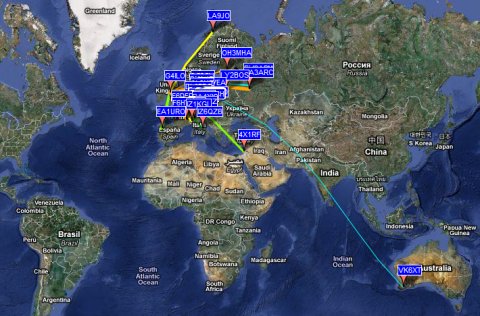
In this case, 5W of WSPR on 40m to a bent attic dipole. Not, perhaps, as impressive as M0XPD’s results with 50mW on 30m. But it’s still nice to be heard on the other side of the planet.

Julian Moss, G4ILO, is a regular contributor to AmateurRadio.com and writes from Cumbria, England. Contact him at [email protected].
Raytracing
Today we have a little bit of fun ham-related tinkering from work. This is two different frequencies transmitted from the same site.
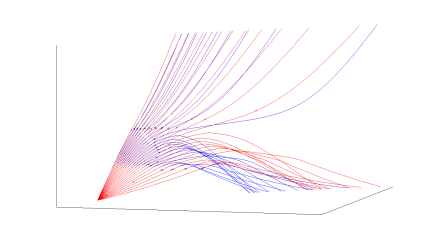
There are lots of neat details in a ray-trace: skip focusing, Pedersen rays, mode-splitting, … One thing that’s fun about writing your own models is that you can modify (intentionally or not) the model physics to do unphysical things…
The second run shows X and O modes for a single frequency and a failed attempt at modeling an MF signal into an E-F region duct. (The ducting, by the way, has nothing to do with my actual work. I was simulating it for ham purposes, although it helped me uncover a problem.) The signals do get to the duct, but they bend the wrong way. This has been fixed in the code, but it serves to remind that modelers have complete control. The background ionosphere is relatively unphysical in this one as well…
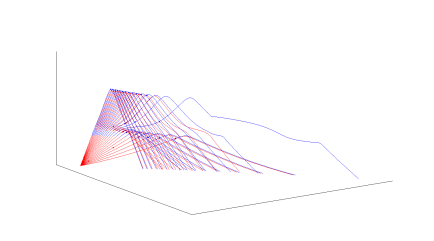
The raytrace code used above is small, simple, and written in MATLAB. I doubt that it will ever be released publicly, but if so I will note it here on the blog.
Ethan Miller, K8GU, is a regular contributor to AmateurRadio.com and writes from Maryland, USA. Contact him at [email protected].
 Ham Radio Deluxe |
 W5SWL Electronics |
 Ham Radio Prep |
 KB3IFH QSL Cards  Hip Ham Shirts  HamRadioAuctions HamRadioAuctions Reliance Antennas Reliance Antennas Enigma Shop Enigma Shop |  morseDX  Ni4L Antennas  R&L Electronics R&L Electronics antennas.us antennas.us QRV QRV |
- Matt W1MST, Managing Editor
