 |
 ICQ Podcast Series Three Episode Twenty-Five – Radio Books for Christmas
 5 December 2010 | by
 Series Three Episode Twenty-Five of the ICQ Amateur / Ham Radio Podcast. News Stories include:
- Celebrating Chilean mine rescue
- FASTRAC sats to be open to all Radio Amateurs
- W8ROG named Knight of the Legion of Honour
- RAC Volunteers honoured
- Network and RSGB announce new agreement
- MMANA-GAL Yagi designs
- Amateur Radio repeaters linked - FSTV beacon returns
- Baird's TV book to be auctioned
- MB7IWR gets antenna upgrade
- Smart Meters - WPC modem uses 2-4 MHz
- Foundation success in North Wales
- Ofcom act against pirate
- Lancashire radio repeater to close down
- WIA Centenary
Your feedback, upcoming events and Martin (M1MRB) reviews Radio Books for Christmas.
Colin Butler, M6BOY, is the host of the ICQ Podcast, a weekly radio show about Amateur Radio. Contact him at [email protected].
Coming Soon to a Summit Near You
As 2010 comes down the final stretch, I’ve been reflecting on the past year and thinking about 2011. This year I didn’t do as much operating as past years and I continue to struggle with keeping my interest going. I don’t think I had a casual CW QSO all year and I haven’t homebrewed a thing. I’m not sure why, but homebrewing just doesn’t hold the fascination it once did and it seems tedious. But on the positive side, 6 meters was fun this year during the sporadic E season, despite a rather abrupt ending in August. The Pennsylvania QSO Party was a blast as usual and I finally made a sweep of all 67 counties which was a new accomplishment. I participated in the best Field Day I’ve been involved in for several years and was pleased to operate with some folks I hadn’t seen for awhile. So perhaps while there may have been less quantity, 2010 was likely the year of higher quality.
Looking forward I’ve decided that a new activity and focus in 2011 is going to be activating summits in the Summits On the Air (SOTA) program. Most areas of the world have SOTA associations that designate the official summits with an identification number. You can both collect and activate summits and receive awards for both. My interest is mainly in activating summits. 
SOTA appeals to me for several reasons. I’ve always been interested in operating in remote and often desolate locations. There’s some satisfaction in being far away from civilization and establishing communications with a minimal amount of equipment. I love to combine hiking and amateur radio. Operating from the trail gives me yet another reason to hike and gives me goals to pursue.
I’ve also had a desire for some time to go on a DXpedition, like somewhere around Antarctica. I have just about all of the James Brooks 9V1YC DXpedition videos which have stirred up my desire for adventure. Unfortunately I don’t have six or eight weeks for a vacation at this point in my life nor I do I have the requisite $30K to $40K needed for a trip like this. But I can dream. While SOTA summits aren’t like Heard Island or Bouvet, I can make my own little DXpedition adventure.
I haven’t activated a summit yet, but I’ve heard that activations can amass sizable pileups as many people are hunting for SOTA summits, especially in Europe where the program originated and it appears to be quite popular and growing. It seems SOTA is just getting geared up here in the States, with four callsign area associations established just this past year and two others established in 2009.


Ottawa D-STAR symposium resources online
Earlier in the week, I noticed from Alan, VA3STL’s blog that the proceedings of the Ottawa D-STAR symposium were on-line.
Alsn did a nice write up on his blog and it’s great to see that the slides from many of the presentations are online too.
I’ve not really had a chance to look at the presentations fully yet, but at a first glance they look great – I’ve learned plenty in the few slides I’ve looked at so far.
Thanks to Alan, VA3STL and also to the Ottawa Amateur Radio D-STAR group for this interesting resource.

Tim Kirby, G4VXE, is a regular contributor to AmateurRadio.com and writes from Oxfordshire, England. Contact him at [email protected].
Propagation: one of the fascinations of amateur radio
For me, and I’m sure I’ve said this before, one of the fascinations of radio is how how signals travel from one place to another; how signals can be strong one day and almost inaudible another. I find this true at both VHF and HF.
One of the pleasures I find on HF is to listen to a band that you think should be closed and see what’s coming through. That’s what happened the other night. I’d had a quick spin around 28MHz which wasn’t doing anything at all (it was well after sunset) so I went down onto the bottom end of 14MHz.
The band was pretty quiet – but the great thing was that the only signals coming through were from several thousand miles away. First heard was a chirpy weak one, which turned out to be from Honduras, working into the USA. I listened to him for a while and tuned up and down the band a bit, only to find a Venezuelan station at good strength. He was also working into the USA.
Though I didn’t get a chance to call, I’ll bet a contact would have been possible and it’s often fun to surprise people with a call from far away.
Even when you think the band is closed – have a listen!

Tim Kirby, G4VXE, is a regular contributor to AmateurRadio.com and writes from Oxfordshire, England. Contact him at [email protected].
Win 1000 QSL cards!

This is PROBABLY the only time you’ll see QSL cards mentioned on this blog. It’s really not my thing. BUT, I know it’s important to a lot of radio amateurs and, as long as you don’t force me to send bits of cardboard around the globe, then that’s ok with me….
Over at amateurRadio.com where Matt, W1MST kindly syndicates my blog, you can win 1000 QSL cards from KB3IFH QSL cards. The cards look great!
So, why not enter the competition and try and win the QSLs? If you do, and you’ve worked me, you don’t need to send me one, though. Thanks all the same. Good luck!

Tim Kirby, G4VXE, is a regular contributor to AmateurRadio.com and writes from Oxfordshire, England. Contact him at [email protected].
Tree: 1 G5RV: 0
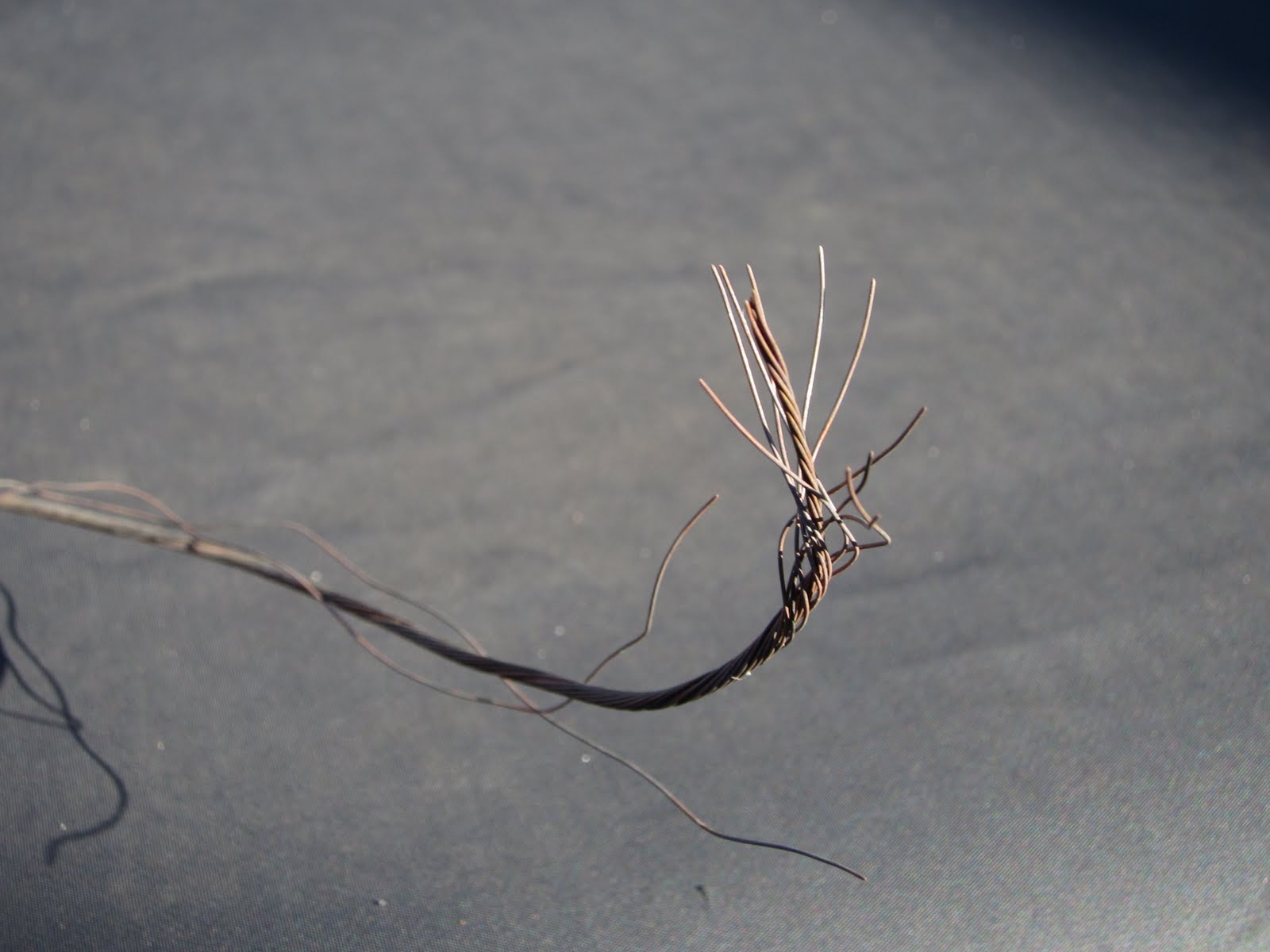 It was bound to happen sooner or later, but that doesn’t really make it feel any better. At the edge of my backyard there is a tree that I was pretty sure had died (given the lack of leaves through the past spring and summer), and I’d planned on having a tree service look at it next spring. A series of rainstorms with a lot of wind passed through my part of the world yesterday (I’ll bet you can guess where this is going). One of the three small trunks from that dead tree snapped off about 8 feet in the air and fortunately fell parallel to my house so the house was OK. Unfortunately, my G5RV antenna passed through the upper branches of the tree and unsurprisingly was unable to withstand the force of the falling tree. The image you see to the right is a piece of one of the wire legs that use to be up in the air. It is, alas, no longer up in the air.
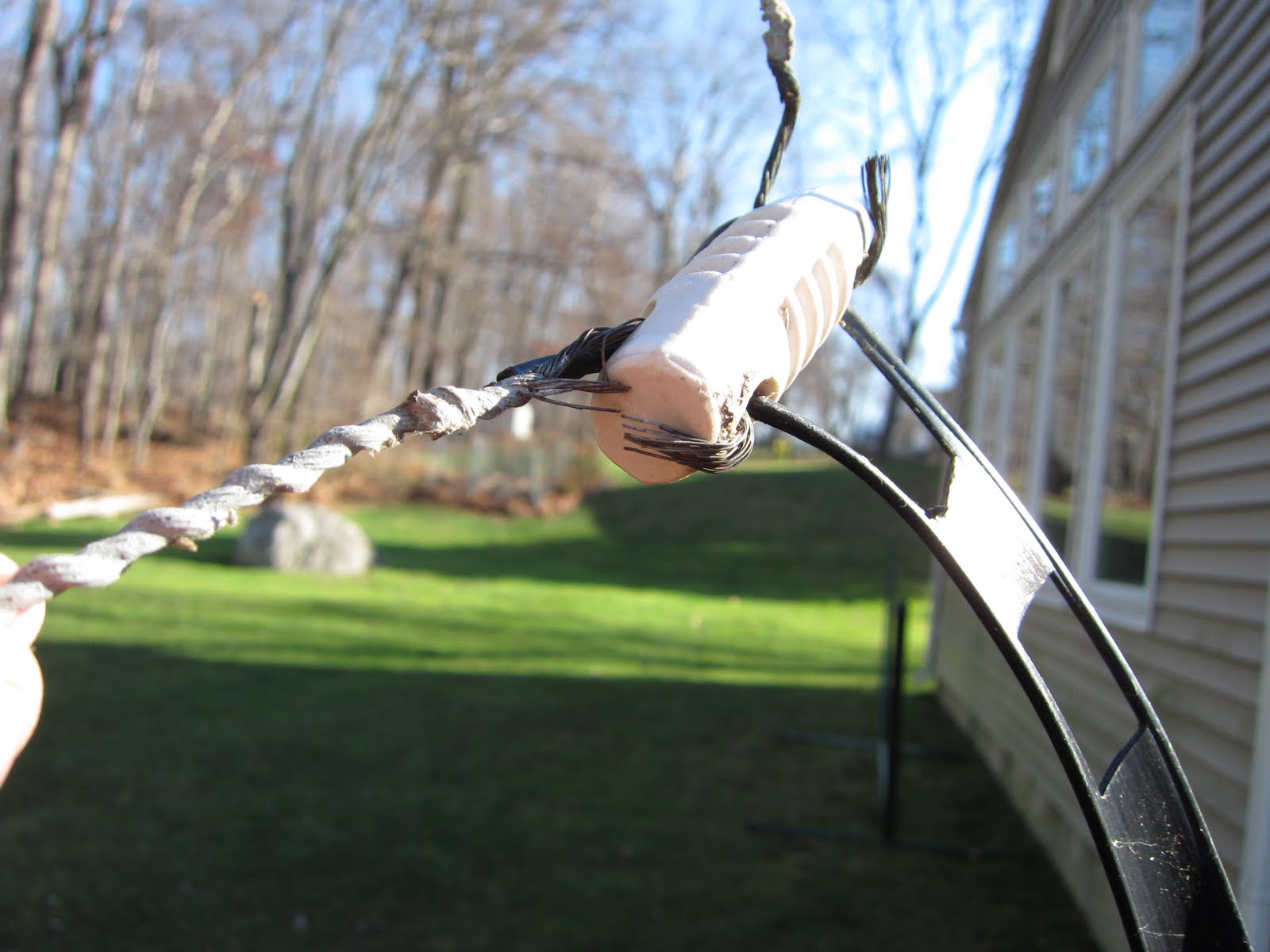
The force of the stress on the wire not only snapped one of the wire legs but also pulled hard enough to break the solder joints at the insulator where the bare wire connects to the ladder line, as you can see in the next photo. Both ends of the soldered joint were broken, but the non-broken wire leg appears to be OK otherwise and is still attached to the “near end” tree where it was originally attached. The remaining few feet of the other leg appear to have snapped back after breaking and look to be up in the branches of the other supporting tree at probably around 50 feet in the air. I’m hoping that I can get a line over that and pull it down, since that way I can use the existing rope (which is still over a nice high branch) to support the replacement.
For at least the short-term, I am going to try to salvage what’s there. Although this has been up in the air for over 10 years (I didn’t think it was that long, but I realized that every HF QSO that I’ve made from my home station starting in August 2000 has been on that antenna) the other parts of the antenna seem to be in fine shape. (And it was certainly working very well until it came down.) The G5RV is, without question, a compromise antenna, but in the 10 years that I’ve been using it I’ve managed to work all states, all zones, and gotten DXCC on all bands from 10m to 80m (I still need a few more confirmations for 30m) and on all three modes, and have worked 300+ DXCC entities using this compromise. Would I like a tower with a nice Steppir on it? Sure, but that’s not happening anytime soon, so I’ll stick to what I know works. I have another G5RV that a friend gave me before he moved out of the country, and while I need to verify that the wire is the correct length, it’s been sitting in my garage out of the elements and the wire legs look like perfect candidates for a “transplant”. The big advantage of repairing what’s there is that it will be zero cost and with a little luck, I should be able to get it done over the weekend.
If I can’t repair it for whatever reason, then most likely I’ll run over to KJI Electronics and pick up a new one and put it up in the same place. I have discussed with some friends the possibility of replacing this with something like an Alpha-Delta DX-CC or possibly even an Alpha-Delta DX-LB Plus (I have the horizontal room, the question is whether I can get it high up enough to function properly), but for now I think I’m going to stick with what I know works.
I hope to have an update with good news soon, stay tuned.

David Kozinn, K2DBK, is a regular contributor to AmateurRadio.com and writes from New Jersey, USA. Contact him at [email protected].
Tree: 1 G5RV: 0
It was bound to happen sooner or later, but that doesn’t really make it feel any better. At the edge of my backyard there is a tree that I was pretty sure had died (given the lack of leaves through the past spring and summer), and I’d planned on having a tree service look at it next spring. A series of rainstorms with a lot of wind passed through my part of the world yesterday (I’ll bet you can guess where this is going). One of the three small trunks from that dead tree snapped off about 8 feet in the air and fortunately fell parallel to my house so the house was OK. Unfortunately, my G5RV antenna passed through the upper branches of the tree and unsurprisingly was unable to withstand the force of the falling tree. The image you see to the right is a piece of one of the wire legs that use to be up in the air. It is, alas, no longer up in the air.
The force of the stress on the wire not only snapped one of the wire legs but also pulled hard enough to break the solder joints at the insulator where the bare wire connects to the ladder line, as you can see in the next photo. Both ends of the soldered joint were broken, but the non-broken wire leg appears to be OK otherwise and is still attached to the “near end” tree where it was originally attached. The remaining few feet of the other leg appear to have snapped back after breaking and look to be up in the branches of the other supporting tree at probably around 50 feet in the air. I’m hoping that I can get a line over that and pull it down, since that way I can use the existing rope (which is still over a nice high branch) to support the replacement.
For at least the short-term, I am going to try to salvage what’s there. Although this has been up in the air for over 10 years (I didn’t think it was that long, but I realized that every HF QSO that I’ve made from my home station starting in August 2000 has been on that antenna) the other parts of the antenna seem to be in fine shape. (And it was certainly working very well until it came down.) The G5RV is, without question, a compromise antenna, but in the 10 years that I’ve been using it I’ve managed to work all states, all zones, and gotten DXCC on all bands from 10m to 80m (I still need a few more confirmations for 30m) and on all three modes, and have worked 300+ DXCC entities using this compromise. Would I like a tower with a nice Steppir on it? Sure, but that’s not happening anytime soon, so I’ll stick to what I know works. I have another G5RV that a friend gave me before he moved out of the country, and while I need to verify that the wire is the correct length, it’s been sitting in my garage out of the elements and the wire legs look like perfect candidates for a “transplant”. The big advantage of repairing what’s there is that it will be zero cost and with a little luck, I should be able to get it done over the weekend.
If I can’t repair it for whatever reason, then most likely I’ll run over to KJI Electronics and pick up a new one and put it up in the same place. I have discussed with some friends the possibility of replacing this with something like an Alpha-Delta DX-CC or possibly even an Alpha-Delta DX-LB Plus (I have the horizontal room, the question is whether I can get it high up enough to function properly), but for now I think I’m going to stick with what I know works.
I hope to have an update with good news soon, stay tuned.
David Kozinn, K2DBK, is a regular contributor to AmateurRadio.com and writes from New Jersey, USA. Contact him at [email protected].
 Ham Radio Deluxe |
 W5SWL Electronics |
 Ham Radio Prep |
 KB3IFH QSL Cards  Hip Ham Shirts  HamRadioAuctions HamRadioAuctions Reliance Antennas Reliance Antennas Enigma Shop Enigma Shop |  morseDX  Ni4L Antennas  R&L Electronics R&L Electronics antennas.us antennas.us QRV QRV |
- Matt W1MST, Managing Editor
