 |
 LHS Episode #054: Unity Ucks
 22 December 2010 | by
 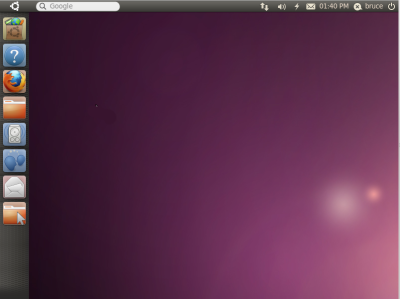 It’s the holiday season and we had time for one more podcast this year. We want to wish everyone a Merry Christmas, Happy Holidays, and a prosperous New Year in 2011. Linux in the Ham Shack has undergone a few changes and weathered a few challenges in the last 2+ years, but we’re still going and expect to be going for a long time to come. We want to thank everyone for their continuing support and continuing listenership. We would not have a podcast without you, and we wouldn’t know what to do if you weren’t there.
So spend time with your families and enjoy all of the wonderful things that life brings at this time of year, and hopefully all the year through. And if you find the time, curl up on the sofa with year headphones next to the roaring fire, crank up LHS and sit back and enjoy our gift of holiday cheer.
73 and Happy Holidays de The LHS Guys
Russ Woodman, K5TUX, co-hosts the Linux in the Ham Shack podcast which is available for download in both MP3 and OGG audio format. Contact him at [email protected].
Frequency check
In all the years I have been a ham and home constructor one item of test equipment I have never possessed is a frequency counter. Whenever I have needed to test if something is oscillating I have just stuck a bit of wire in the antenna socket of a receiver and listened for it, and if I have needed to tune an oscillator on frequency I have just tuned it for zero beat using a receiver that has been adjusted as best I could using WWV or similar.
Recently I decided that it would be useful to actually have a frequency counter, preferably a really accurate one. I know that it is possible to buy secondhand lab grade frequency counters on eBay. The trouble is that when your shack / workshop is the size of a broom cupboard there is no room for boat anchors. I didn’t even have space for one of the inexpensive desktop frequency counters that are available. I decided that I would have to make do with a hand-held device. Farnell had one, but the price of £140 was rather too steep given the amount of use it was likely to get. I was about to give up when I came across the Yaege FC-1 being sold for about £30 on eBay.
My initial thought was that this was such a cheap device that it could not be very accurate and was probably not worth getting. The specification gives the time base accuracy as < 5ppm, which is worse than most ham radio transceivers. However, a bit of searching produced a PDF copy of the manual, which revealed that the TCXO module is user adjustable. I figured that I could get better than the quoted accuracy by regularly calibrating it using my rubidium frequency standard.

I ordered one from one of the Hong Kong traders and it came in just over a week. The antenna socket is a male SMA, similar to that used on the Chinese VHF/UHF hand-held radios and the opposite type to that commonly used by Japanese manufacturers. A short UHF rubber duck antenna is supplied with the counter. I ordered a BNC adapter so I could use my BNC whip antennas and also attach BNC terminated test cables.
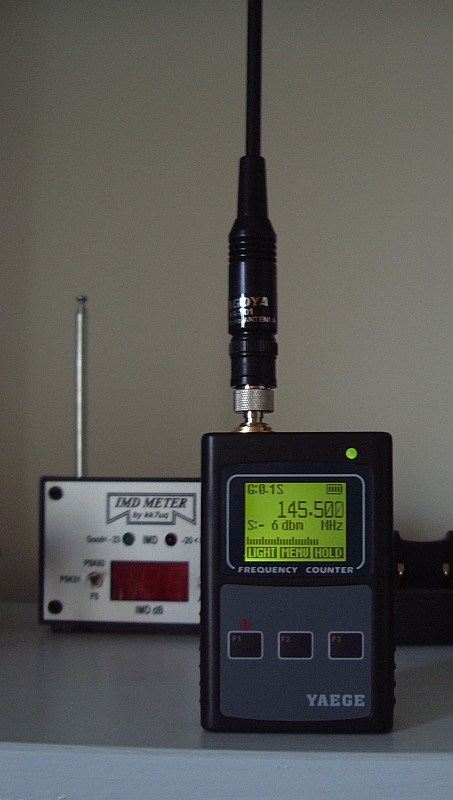
I connected it up to my 10MHz rubidium frequency standard and found that it was already within a couple of Hz of the correct reading. The picture was taken before I set the gate time to 1 second which is necessary to get a reading down to 1Hz.
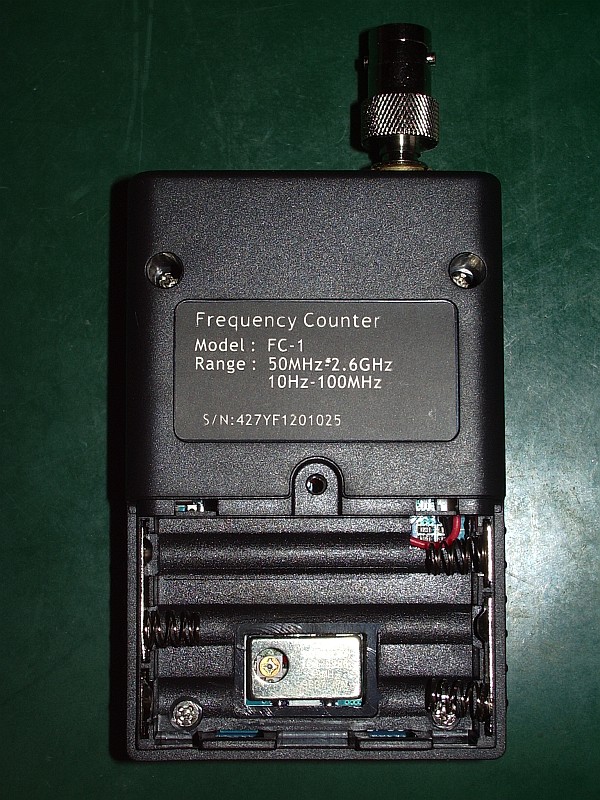 The time base oscillator adjustment is behind the battery compartment so you need to run the device from the charger while adjusting the frequency. You can see the adjuster in the picture on the right. Rather like adjusting the master oscillator in the Elecraft K2 the adjustment is incredibly touchy. The tiniest amount of movement can change the reading by a couple of Hz at 10MHz.
It turns out that it is not worth being so picky. The reading does slowly drift by a few Hz over a period of several minutes so you are never going to get absolute accuracy with a device like this. Nevertheless it is better than advertised and pretty good for the money, in my opinion.
One feature of the Yaege FC-1 that you don’t get with most frequency counters is a signal strength reading calibrated in dBm, as you can see in the top photo taken while I was transmitting a carrier on 145.500MHz. I wasn’t able to check how accurate the actual reading is but as a relative indicator the dB measurements seem quite accurate so this could be quite a useful tool for making antenna comparisons. It turns the frequency counter into a digital field strength meter.
Although it isn’t a lab grade high accuracy frequency counter I think the Yaege FC-1 is a useful addition to my electronic test equipment and is extremely good value for money.

Julian Moss, G4ILO, is a regular contributor to AmateurRadio.com and writes from Cumbria, England. Contact him at [email protected].
QRP kits retirement plan
Quite frankly I can’t think of anything worse than choosing QRP Kits to ‘lay down’ as an investment, rather than build. Mind you it doesn’t look like they need to be put in the cellar for very long!
Stephen Rapley, VK2RH, is a regular contributor to AmateurRadio.com and writes from New South Wales, Australia. Contact him at [email protected].
Long distance QSO with the Warbler

Screenshot of Warbler contact to Alabama
Last night I used the Warbler I finished a few months ago and had a very nice 40 minute QSO on 80m with Ken, KI3N, in Oxford Alabama. First, it great that conditions were good enough for us to chat for 40 minutes using PSK31, but when you consider that the distance between us was about 970 miles then that made it quite an achievement given the band. I was using the Warbler, putting out 3W now after some slight changes, and the 88ft doublet tuned with the homebrew ATU. Ken was using 40W from an Icom IC-756 Pro into an 80m dipole. The screenshot above shows what I was receiving.
Even though the Warbler is rockbound and uses a direct conversion receiver its performance is very good and makes it fun to use. This was the furthest contact I have made so far with that transceiver.


Alan Steele, VA3STL, is a regular contributor to AmateurRadio.com and writes from Ottawa, Ontario. Contact him at [email protected].
Useful RFI
I apologize for being even more grumpy than normal but I haven’t had much sleep. Olga and I were woken up at around 1 in the morning by a lot of noise outside. It was a group of young people who had apparently been having a party in the house opposite. Despite the fact that the temperature was heading for -7C and the girls, according to Olga who was looking out of the window, were none too warmly clad, they were not simply saying goodbye but continuing an animated conversation. Someone decided the party must be carrying on outside so they switched on a car’s headlamps and turned on the stereo very loud. Because of the way the houses are crammed together here with virtually no front gardens this was taking place right below our bedroom window. After ten minutes we were both getting very angry. It isn’t often that Olga uses the f word about people.
I felt like calling the police, but the chances of them actually making an appearance before the miscreants had slept off their hangovers was pretty remote so we discarded that idea. Olga went downstairs and turned on the lights to try and make it obvious that we had been disturbed. I went into the shack, switched on the K2 and sent a 10W dit on 30m, which switched on the security lights of the nearby neighbours that have them. This did appear to have the effect of making the tiny minds think “gosh, other people live around here and oh my, it’s after 1 in the morning, perhaps they are trying to sleep and our noise has disturbed them!” because shortly afterwards the group dispersed and peace and quiet resumed. But neither of us are good sleepers and it took a while before we calmed down enough to sleep again. Hence the foul mood this morning.
It has sometimes been a bit annoying that I can’t go on any band except 80m after dark because of the problem with security lights. But on this occasion it turned out to be useful. If only I knew that the thoughtless young people had touch sensitive lamps by their bedside I might even have been tempted to try a bit of all-night WSPR!

Julian Moss, G4ILO, is a regular contributor to AmateurRadio.com and writes from Cumbria, England. Contact him at [email protected].
ICQ Podcast Series Three Episode Twenty-Six – Bob Burns Heathkit
Series Three Episode Twenty-Six of the ICQ Amateur / Ham Radio Podcast. News Stories include:
- Long-Delay Radio Echos heard on 7 MHz
- Radio Amateurs Angered
- International Short Wave League's 65th anniversary
- Five amateurs in UK Family
- Solar-powered GB2RS broadcast
- ARRL strengthens the case for mandatory BPL notching
- 8.970 kHz - DK7FC's latest tests
- Straight Key Night on OSCAR 2011
- Midland Amateur Radio Society anniversary
- French concerns over 1.2 GHz band
- IRTS Outgoing QSL Service
- British Young Ladies Amateur Radio Association
- New amateur radio bands for Spain
Your feedback and Martin (M1MRB) meets Bob Burns (G3OOU) and discusses Heathkit.
Colin Butler, M6BOY, is the host of the ICQ Podcast, a weekly radio show about Amateur Radio. Contact him at [email protected].
ICQ Podcast Series Three Episode Twenty-Six – Bob Burns Heathkit
Series Three Episode Twenty-Six of the ICQ Amateur / Ham Radio Podcast. News Stories include:
- Long-Delay Radio Echos heard on 7 MHz
- Radio Amateurs Angered
- International Short Wave League's 65th anniversary
- Five amateurs in UK Family
- Solar-powered GB2RS broadcast
- ARRL strengthens the case for mandatory BPL notching
- 8.970 kHz - DK7FC's latest tests
- Straight Key Night on OSCAR 2011
- Midland Amateur Radio Society anniversary
- French concerns over 1.2 GHz band
- IRTS Outgoing QSL Service
- British Young Ladies Amateur Radio Association
- New amateur radio bands for Spain
Your feedback and Martin (M1MRB) meets Bob Burns (G3OOU) and discusses Heathkit.
Colin Butler, M6BOY, is the host of the ICQ Podcast, a weekly radio show about Amateur Radio. Contact him at [email protected].
 Ham Radio Deluxe |
 W5SWL Electronics |
 Ham Radio Prep |
 KB3IFH QSL Cards  Hip Ham Shirts  HamRadioAuctions HamRadioAuctions Reliance Antennas Reliance Antennas Enigma Shop Enigma Shop |  morseDX  Ni4L Antennas  R&L Electronics R&L Electronics antennas.us antennas.us QRV QRV |
- Matt W1MST, Managing Editor
