 |
 “Electricity is NOT a toy”
 2 January 2011 | by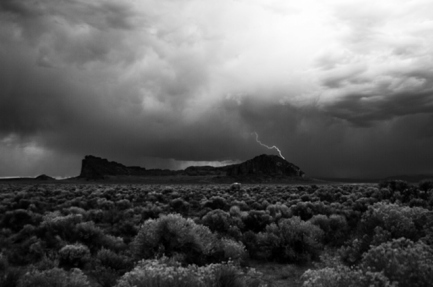
The ARRL 10-meter (28-MHz) contest was a couple of weeks ago. Given that I had bothered to install a 10-meter antenna at this QTH and that conditions seem to be improving, I thought it would be fun to play.
I fired up CQing on Saturday and after a few minutes, Sarah appeared at the shack doorway. This usually means that something is broken or I’m causing RFI to something she wants to be using. Since I’m not KT0R, who used to tell his neighbors that he was “busy and please come back on Monday,” I obliged her. It was the CO detector again. I unplugged it (it’s battery-backed, so it just means that contesting burns through 9-volt batteries) and returned to the game. Peace reigned again in the Miller household.
Sneaking in a little bit of contesting before church on Sunday morning is a long-standing habit of mine, although it seems that the Sunday openings are usually better than the Saturday openings. Today was no exception. I was working hard to extract a few QSOs out of what appeared to be a mostly dead band and Sarah again showed up at the shack doorway—this time with wet hair and quite agitated.
“The outlet is popping when I plug the hair-dryer into it!”
I assured her that I would take care of it, adding that it was “probably just the radio getting into the GFI. Let me send a few dits and see if it starts clicking.”
“No, you stay there, I’ll send the dits. How do you do it?”
“Just press the left paddle.”
And so, Sarah made her first ham radio transmission on 10-meter CW this morning (after which I did identify, for the record). I confirmed that the outlet made a little click. She was not completely convinced, but I told her I would shut down while she dried her hair so I could monitor the situation.
The hairdryer (a prior unit), Sarah, and I have had run-ins before. Several years ago, when we were poor graduate students, a loose screw was causing a nasty vibration in the old hairdryer. So, I tightened it up and gave it back to her, not knowing that there was another screw floating around inside the case. One morning, that screw found its way into the motor and sparked. When Sarah called me on the phone, I thought she’d burnt the house down. As much as it pains me, I no longer attempt to fix any appliances that cost less than $50 as a result of this episode.
Still worked up, Sarah took the opportunity to grill me about the compatibility of contesting with family life…”When have children, how will you hear them if they’re in trouble and you have your headphones on? (In jest, I later proposed wiring a baby monitor into the SOnR audio chain.) Can’t you listen with the speaker? How will we keep them from eating your little parts, bits of wire, and globs of solder? Electricity is not a toy!”
We laughed at the last one. And she added, “I hope they’re all girls who want everything hot pink—so much hot pink that we want to barf.”
I suppose if someone makes a hot-pink Hello Kitty AK-47 (the photo actually looks like a painting of an AR-15) and the Sarah-cuda bow, we can find hot-pink solder irons, paddle finger pieces, headphones, and even radios (I seem to recall that there was a BabyPhat mod’ed hot-pink Motorola HT floating around the web a few years ago).
Anyhow, this post is for Sarah because she puts up with a lot of tinkering, RFI, and headphone time and gets very little blog recognition in return for it.
(The photo above is of Ft Rock, Oregon, taken by me when I was on assignment there.)
Ethan Miller, K8GU, is a regular contributor to AmateurRadio.com and writes from Maryland, USA. Contact him at [email protected].
One-step dipole pruning
Dad and I built a 10-meter rotable dipole some 12-13 years ago using pieces of a large Wilson tribander that I had begged off of a local ham. It was an interesting mechanical design, using a 3/4-inch CPVC tee fitting as the center insulator and mounting bracket. The third leg of the tee slipped over a piece of EMT conduit that we had crimped. The EMT, in turn telescoped into a RadioShack-type TV mast, which was bracketed to our deck. It was a fun antenna back when 10 meters was fun.
That CPVC tee lasted a good deal longer in the UV and wind than we ever imagined. Granted, the antenna was stored in my folks’ garage for 7-8 years while I was in college and graduate school. But, I reinstalled it when we moved to Maryland. Last week brought high winds to the Mid-Atlantic region and the fitting gave up the ghost:
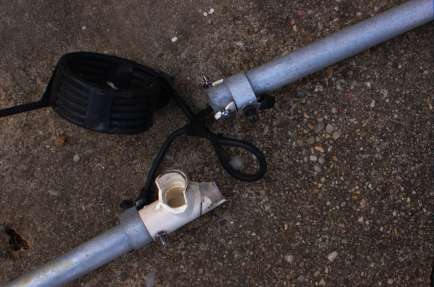
Fortunately, it takes all of a half-hour and another 33-cent fitting to replace it. I did think of running a piece of pipe, dowel, or fiberglass across the element for extra strength. But, I’ll do that if it fails again soon. The process of repairing the antenna reminded me of the technique we used to tune it, which we thought was very clever at the time.
We used the “magic” 468 to set the initial length of the antenna optimized for 28.400 MHz, which was totally wrong since 468 is intended for bare wire, not tapered aluminum. Then, we installed it and measured the VSWR across the band (in the shack). Next, we took the frequency of the minimum VSWR and divided that by the design frequency. Then, took the antenna down and scaled the length of the antenna by the quotient from the previous step. Finally, we reinstalled the antenna and measured the VSWR across the band. It hit dead-on. Dad was impressed that my first two QSOs were KL7 and ZS! It was, of course, ten meters when ten meters was good.
This may be old-hat to a lot of folks, but we thought we were geniuses at the time, although it was purely an act of shade-tree engineering! For those who don’t mind watching sausage made, I will now muse on the validity of the technique.
Suppose you have a “magic factor,” M (=468 or whatever), that defines the frequency of minimum VSWR for an antenna of length l:
 Rearranging that will be useful later:

If we take the partial derivative of each side in the first equation, and substitute M from the second equation we get the following relationship:

Cross-multiplying/-dividing and abusing the partial derivative notation to be a small perturbation yields:
 This is subtly different from the original technique, which can be derived from this using some small-number approximations. But, the point is that there exists a simple technique to prune a dipole to resonance. delta-f is the offset between the design and actual VSWR minimum frequencies, f is the design VSWR minimum, l is the design length, delta-l is the amount that needs to be added (pruned).
Ethan Miller, K8GU, is a regular contributor to AmateurRadio.com and writes from Maryland, USA. Contact him at [email protected].
ICQ Podcast Series Four Episode One – G-QRP Club (2nd January 2011)
Series Four Episode One of the ICQ Amateur / Ham Radio Podcast. News Stories include:
- Distracted Driving - an amateur replies
- Walkie-talkies abroad
- Brightest northern lights display for 50 years
- Gadgets Frequencies?
- iPhone Amateur Radio apps
- Chevy hidden antenna
- Work all Britian 2011
- Amateur Radio World Castles Award
- Greek radio repeater locator app
- Icelandic hams get 5.36-5.41MHz
- Russian engineers plan to extend Internet to space
- British Young Ladies Amateur Radio Association
- New amateur radio bands for Spain
Your feedback and Martin (M1MRB) reviews the G-QRP Club.
Colin Butler, M6BOY, is the host of the ICQ Podcast, a weekly radio show about Amateur Radio. Contact him at [email protected].
ICQ Podcast Series Four Episode One – G-QRP Club (2nd January 2011)
Series Four Episode One of the ICQ Amateur / Ham Radio Podcast. News Stories include:
- Distracted Driving - an amateur replies
- Walkie-talkies abroad
- Brightest northern lights display for 50 years
- Gadgets Frequencies?
- iPhone Amateur Radio apps
- Chevy hidden antenna
- Work all Britian 2011
- Amateur Radio World Castles Award
- Greek radio repeater locator app
- Icelandic hams get 5.36-5.41MHz
- Russian engineers plan to extend Internet to space
- British Young Ladies Amateur Radio Association
- New amateur radio bands for Spain
Your feedback and Martin (M1MRB) reviews the G-QRP Club.
Colin Butler, M6BOY, is the host of the ICQ Podcast, a weekly radio show about Amateur Radio. Contact him at [email protected].
ZS6DJM’s modified FT897 including 70MHz transverter
I was just chatting to Dave, G4AQK on 70MHz and he mentioned that he’d seen a video on YouTube showing how ZS6DJM had modified an FT897 to include a Spectrum 70MHz transverter.
Interesting! The transverter is located in the battery compartment and a switch has been added to the top of the rig to switch the transverter on and off. Very neat

Tim Kirby, G4VXE, is a regular contributor to AmateurRadio.com and writes from Oxfordshire, England. Contact him at [email protected].
New Year’s Eve Tropo
New Year’s Eve dawned with some fairly localised (to me) but quite intense tropo on VHF/UHF. When I first switched on the 144MHz rig around 0815z (It *WAS* a day off!) I noticed the GB3VHF beacon in Kent was well over S9 – it’s normal strength is around S6.
Didn’t get a chance to operate, but I had the FT8900 on in the car as I was driving down to see the bees and noticed that the GB3PO repeater at Ipswich and the GB3BX repeater near Wolverhampton were coming through.
From home, literally seconds before we went off to see Mum in Cheltenham, there was a flurry of activity on 70.450MHz FM. 2E0EKF, 2E0CBP and G0AUI were all coming through. Looked them up this morning and 2E0EKF is in Chigwell, Essex and G0AUI in Haywards Heath, Sussex (can’t find 2E0CBP at the moment!). Shame there wasn’t an opportunity to call them as that would have been an excellent distance on 70Mhz FM.
Happy New Year!

Tim Kirby, G4VXE, is a regular contributor to AmateurRadio.com and writes from Oxfordshire, England. Contact him at [email protected].
From 2010 to 2011
It is that time of the year when it seems everyone is looking back at what was important in the past year. Reflecting on the year, it has been a very good one for me in terms of amateur radio. Here are some of the highlights.
The year started out well by guiding a group of new amateurs at the Carleton University Amateur Radio Club through their exams. The first group passed their exams in February and they were the first of two batches of students to gain their licenses. Also in that month I gave a talk on kit building and homebrew to the Manotick Amateur Radio Group.
In April I started a D-Star net on repeater VA3ODG. I have not reported it here on the blog (probably will be a post in the future) but if you have a D-Star radio and want to join in it starts at 8:30am local time in Ottawa (I will let you do the calculations for your time difference) on Saturdays using VA3ODG module C. We link through to Reflector 16B, so if you are not local that is perhaps the best way to connect in.
Also in April the 160mW from my QRSS beacon was heard in Australia.
June had the Carleton University ARC (CUARC) participating in their first Field Day. The Ottawa Valley Mobile Radio Club were welcoming and we teamed up with them for the event in the grounds of the Canada’s National Science and Technology Museum. CUARC operated on 15m and 10m using antennas built by the club members. The antennas performed well and we made a number of contacts on both bands.
August I attended the first Maplecon QRP convention with Gerry, VA3GLT. I made my first podcast too, an interview with Youkits.
In Fall there was a burst of activity working on putting together the first Ottawa D-Star Symposium. This with done with Rick, VE3CVG, members of the Ottawa Amateur Radio Digital Group and CUARC. The event was held at Carleton University and had excellent sessions and speakers including one from Andrew, MoGRU, who presented from the UK via an internet link.
December I helped get some external antennas set up on one of the campus buildings at Carleton University for use by CUARC. It was good to test out the HF wire antenna (one that was used at Field Day) in the RAC Winter Contest. The operating was casual but I was pleased in the antenna performance when the first contact was a British Columbia station on 40m SSB with just 10W from my K2. The 1.2GHz antenna for the Icom ID-1 D-Star radio still needs to be tested in the new year.
Throughout the year this blog has been enjoyable to write and I would like to thank all the readers and commenters. Sometimes I am busy with work or family and there are longer periods between post but I try and make posts regular. The statistics show a continued increase in post views, indeed I see that this month has the highest number of views of any month. The blog is one of a few reposted on amateurradio.com and at least two antenna posts are listed on dxzone.com.
So 2010 was a busy year with a steady involvement with clubs and members of the local and not-so-local amateur radio community.
As for next year, I will continue my involvement with CUARC as well as the local D-Star group. I have been asked to give a talk on D-Star at the Ottawa Amateur Radio Club in February and I would like to get to Dayton this year for Four Days in May. I am sure many other opportunities and activities will arise too, just like they did last year. I hope you too have an active year with amateur radio. All the best for 2011.


Alan Steele, VA3STL, is a regular contributor to AmateurRadio.com and writes from Ottawa, Ontario. Contact him at [email protected].
 Ham Radio Deluxe |
 W5SWL Electronics |
 Ham Radio Prep |
 KB3IFH QSL Cards  Hip Ham Shirts  HamRadioAuctions HamRadioAuctions Reliance Antennas Reliance Antennas Enigma Shop Enigma Shop |  morseDX  Ni4L Antennas  R&L Electronics R&L Electronics antennas.us antennas.us QRV QRV |
- Matt W1MST, Managing Editor
