 |
 Pieces of eight… or why the Tring Parrot (MB7FM) is no longer sick
 24 January 2011 | by
 When I got the 70MHz PMR set installed again just before Christmas, I remembered the MB7FM ‘simplex’ repeater on 70.4375MHz. The way it works is that you transmit a message, which it stores and then forwards when you stop transmitting. It will store a maximum of 120 seconds of audio. I tried to access the repeater, colloquially known as the parrot, as it repeats what you say. No luck! I assumed at the time that this was because my aerial had degraded and my signals weren’t reaching Tring! Actually, it would appear that the parrot was, er, sick and off-air.
Yesterday I was tuning around 70MHz and noticed a signal on 70.4375MHz. I was delighted to find that it was the parrot and that I could hear it. I had a couple of QSOs through it, one with Andy, 2E0VPX in Leighton Buzzard and with David, G8JGO/P near Peterborough.
Interestingly, I could hear fragments of both stations directly, though it would have been impossible to make a QSO without the parrot.
Apparently the parrot was restored to service early in the New Year. If you’re in the South East of the UK and have 70MHz FM, give it a go – hopefully you will make some interesting contacts through it that you wouldn’t ordinarily be able to make on simplex.

Tim Kirby, G4VXE, is a regular contributor to AmateurRadio.com and writes from Oxfordshire, England. Contact him at [email protected].
Ad Hoc Resolution
I’ve decided to get my QSLing in order and file for DXCC. Call it an “ad hoc” New Year’s resolution. I’ve been eligible for DXCC for seven or eight years now, but just haven’t had the time or inclination to do the paperwork. Perhaps Logbook of the World had something to do with all of this. On a whim I decided to get my LOTW up to date. I hadn’t uploaded to it or checked on it for almost three years. After figuring out that my certificate key thingy expired, I got a new one and managed to learn all over again the process for uploading QSOs.
I like the concept of LOTW, but I’m surprised a lot of people use it. I’m not a computer newbie; I’ve been doing IT for almost 20 years now and I cut my teeth writing assembly on a Commodore VIC-20 when I was a teenager. I find the process for getting LOTW going way overcomplicated. I can’t imagine how others who can barely log in to their computer use LOTW. But I guess where there’s a will there’s a way. Considering that LOTW contacts can be used to file for awards and the costs for paper QSLing has skyrocketed over the years, there’s more of a motivation than ever to use Logbook of the World.
Upon updating LOTW I saw that I was eligible for WAS and Mixed, CW, and Phone DXCC with just LOTW QSOs. That got me looking at my paper QSLs and weeding out what LOTW had. I read the DXCC and LOTW FAQs about five times and I think I’m ready to file. Since getting LOTW up to date, I’ve experienced a resurgence in my interest in DXing. Recently I’ve been working DX on 40 and 80 in the evenings, watching the DX cluster and picking them off the spots. I even cranked the power up to 100 watts from the normal five. (Gasps from the studio audience) I made a contact the other week and caught myself saying “Yes!” and being all giddy. I don’t remember what country it was, but the feeling has stayed with me. After months of questioning my interest in amateur radio it’s good to know the radio artisan spark is still there.


More on Meteor detecting using the NAVSPASUR
Dave, WW2R/G4FRE kindly pointed me in the direction of a really interesting article, dating back to 1998, written by Dr Tony Phillips on the NASA website. Rather than using the GRAVES transmitter in France, this is based on the NAVSPASUR radar in in Texas. This radar operates at 216.98MHz as opposed to the 143.049MHz at GRAVES.
The article shows some great illustrations of reflections AND satellite echoes which is something I was really curious about.
Enjoy the article here
I’d be interested to hear from any North American readers if they have any success listening to this system.

Tim Kirby, G4VXE, is a regular contributor to AmateurRadio.com and writes from Oxfordshire, England. Contact him at [email protected].
Anticipation – – – HAMCATION & IDGOTAES

Tailgate action as K4UPG buys a MFJ 207
Wahoo! It is that time of year again. I am counting down the days to one of my favorite ham radio activities… Orlando Hamcation is coming on Feb 11-13.
After reading the editorial in the new issue of World Radio Online a cord was struck that resonated with this here ham. I realized that I have a common disease. The article says, “Seems there are a lot of radio amateurs suffering from IDGOTAES.” OH NO… I have it. Throughout the month of December and most all of January, I’ve been sidetracked with other priorities and without realizing it have become afflicted with IDGOTAES. ( “I Don’t Get On the Air Enough Syndrome” ) This is a bad one and only can be cured by some serious outdoor QRP activity if you are a true portable QRP op like me.
Praise the Lord, there’s some good opportunities to get on the air coming up and one cannot find a better place to stock up on goodies than the vendors, swap tables and tailgate are of HAMCATION. So kick off the winter snow-bound blues and git on down here and enjoy with me.

Feeding frenzy at the vendor area of Hamcation!

Tailgate area is HUGE!
We’ll be holding an unofficial gathering of QRP types on Saturday Feb 12, 2011 at Hamcation. Let’s meet up at noon at the QRP ARCI booth and swap stories and get to know one another. Look for the wild eyed guy in the bright yellow cap that says K4UPG on it and his very distinctively white haired partner Jim K4AHO won’t be far away! Be there and let’s get over this dreaded disease together as we plan some Central Florida QRP Group outings for the rest of the year. QNI? Ya hear?
72,
Kelly K4UPG PB #173
Kelly McClelland, K4UPG, is a regular contributor to AmateurRadio.com and writes from Florida, USA. Contact him at [email protected].
WSPRing on 80
A blog post by Roger, G3XBM, about how far he was able to be received running 5mW of WSPR on 80m using a lash-up antenna prompted me to give QRPP WSPR a try. But before I could start, I needed to make an attenuator. The lowest power my K3 or K2 will go down to is 100mW, but not with very much accuracy. I decided to make a 20dB attenuator which would divide my power by 100, so I could run 1W and get 10mW output.
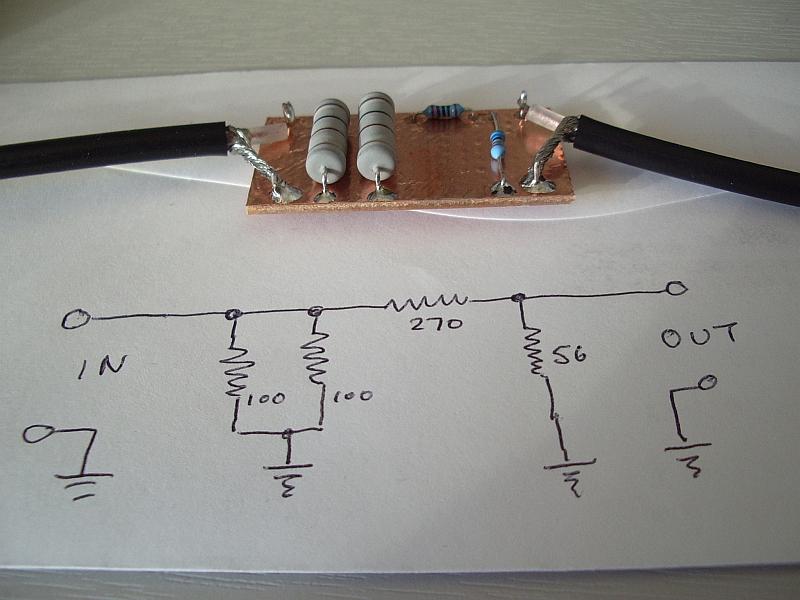
There are numerous websites that will design an attenuator for you given the working impedance and amount of attenuation required. I was not looking for precision – I would be surprised if the output of either of my radios was within 10% of the selected power anyway – and moreover I wanted to build it now using parts from my junk box not have to send off for some exact values and wait for several days for them to arrive. My attenuator was built as shown above and gave a 1.2:1 SWR over the HF range which was good enough for my purposes.
I started yesterday evening running 10mW on 80m into my end loaded attic dipole. I received no spots at all initially. I was puzzled as to why I could hear the WSPR audio using the K3 monitor even though the extension speakers I use with the K3 were switched off. I was about to compose an email to Elecraft enquiring whether the last firmware update had the effect of routing the monitor audio to the internal speaker even when an external speaker is connected when I realized the sound was coming from the computer speakers! Windows had decided to renumber the sound cards since I last used WSPR and although the receive channel was still the same and spots were being decoded the transmit audio wasn’t going to the radio. Doh!
Some time after I began transmitting I received a couple of spots from G3XLW 478km away in the south of the country. But that was all. I decided to leave it running overnight and received spots from David off and on throughout the night. These were augmented in the morning after 0800z by three spots from M0DDT at a distance of 355km to the south east. Not as impressive as Roger’s results. I guess my attic dipole, being very low for an 80m antenna, is a cloud-warmer and sends most of the RF straight up. Roger was loading the feeder of his 10m halo which doesn’t sound like much of an 80m antenna but in effect he had a top loaded vertical which probably has more lower angle radiation. That’s my theory, anyway.
It was an interesting test and I shall try very low power WSPR again on other bands. However I don’t agree with the extremist view held in some circles that people should only use WSPR with such low powers. It’s certainly interesting to discover if you can get to the end of the street on 10uW but higher powers of a few watts will reveal propagation to places lower powers won’t, information that is likely to be more useful when applied to making contacts using other modes.

Julian Moss, G4ILO, is a regular contributor to AmateurRadio.com and writes from Cumbria, England. Contact him at [email protected].
NASA seeks help tracking satellite
NASA has asked amateur radio operators for help to determine if a recently launched satellite is operating. The NanoSail-D satellite was ejected automatically from the Fast Affordable Scientific and Technology Satellite, FASTSAT on Wednesday, January 19. NASA needs reports of the beacon telemetry to determine if it is operating correctly. The beacon signal is on 437.270MHz using standard AX.25 packet so APRS and packet radio operators with 70cm capability should be able to receive it.
Predictions for the satellite can be found here. Reception reports can be submitted here. Full text of the NASA press release here.

Julian Moss, G4ILO, is a regular contributor to AmateurRadio.com and writes from Cumbria, England. Contact him at [email protected].
W7IUV preamplifier
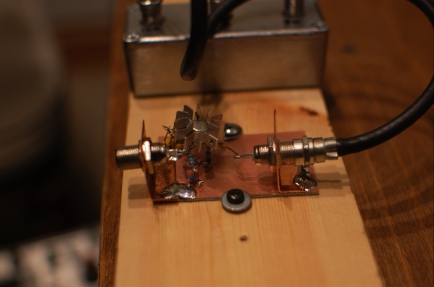
An evening project: W7IUV low-band receive preamplifier. Total cost: < $10. Total time: 1 hour.
It worked pretty well on 80 and 160 with the crossed K9AYs. The 48-volt relays in the box at the antennas are sticking (thanks to using a 40-volt PSU). I need to rebuild this with lower-voltage relays or a higher-voltage power supply.
W7IUV claims that he just leaves his connected to his RX port all the time. But, he probably has more spacing between his TX and RX antennas than I do. It will be interesting to see if I get enough RF coupled from my TX antennas to destroy the transistor.
Ethan Miller, K8GU, is a regular contributor to AmateurRadio.com and writes from Maryland, USA. Contact him at [email protected].
 Ham Radio Deluxe |
 W5SWL Electronics |
 Ham Radio Prep |
 KB3IFH QSL Cards  Hip Ham Shirts  HamRadioAuctions HamRadioAuctions Reliance Antennas Reliance Antennas Enigma Shop Enigma Shop |  morseDX  Ni4L Antennas  R&L Electronics R&L Electronics antennas.us antennas.us QRV QRV |
- Matt W1MST, Managing Editor
