 |
 A fun few hours on VHF
 2 February 2011 | by
 I know some of my “HF only” friends have a slight disregard for VHF and particularly for FM. That’s fine – it’s up to each of us how we choose to enjoy our hobby. But I defy anyone who’s enthralled by the ‘magic of radio’ not to be excited by the following circumstances…
On Monday evening, I was driving home from the station and as usual, had the FT8900 scanning on one of the VFOs. It very quickly became apparent there was some VHF tropo ducting around. 145.750 seemed particularly lively. I could hear the F5ZBH repeater in North-Eastern France very strongly and then to the west, I could hear the GB3BC repeater in South Wales. It made fascinating listening!
When I got home and found a few moments to look at the Hepburn tropo website and found that we were on the edge of a tropo duct, stretching up from western France, along the English Channel across the Netherlands and into northern Germany. I found I couldn’t hear anything along the duct, although I did work F8BRK (IN99) quickly. He was working Dutch, German and even some Polish stations along the duct.
Later on in the evening, I noticed the Swiss beacon, HB9HB coming through steadily on 144MHz. Despite a number of CQ calls in that direction on both 144 and 432MHz, I didn’t work anything, but having said that, I have noticed before that hearing HB9HB is not necessarily an indicator of working F and HB9 stations, as the beacon is so high, it may be that the ducting is going over the heads of the stations that might be available to work.
Next morning, I checked HB9HB before going to work, but it had faded. I had the rig on scan in the car as I drove to the station, looking for any tropo. To my surprise, I heard a loud FM signal with an Italian accent come up. It proved to me on 145.800MHz which meant only one thing – the International Space Station. For around 5 or 6 minutes, I was fascinated to listen to IR0ISS, one of the astronauts aboard the ISS answering questions from schoolchildren at a school near Lyon in France (of course, I could only hear one side of the conversation!).
Truly a varied and magical few hours on VHF! Oh, and by the way, by the look of the Hepburn tropo forecast maps, there could be some propagation from the southern/south-western UK towards Spain and the Canaries this coming weekend! Let’s see!

Tim Kirby, G4VXE, is a regular contributor to AmateurRadio.com and writes from Oxfordshire, England. Contact him at [email protected].
PIC16F88 TNC
I have mentioned before that when I’m not in the shack I like to run a little program called aprsg to gate all the local APRS activity to a UHF frequency so I can see what is going on in the local APRS world using an APRS-capable HT. I have set up a system using sound card software, a USB sound device and my FT-817ND to do this. But I would like to make a standalone box for this. The first step in this project is to find a simple, cheap TNC.
There are products that would fit the bill from Byonics and Argent Data. Unfortunately they are not available in the UK and the cost of importing these kits from the US makes them less than cheap. I looked at the Fox Delta Mini TNC. But that is not a KISS TNC, as was confirmed by an email to Dinesh, the proprietor of Fox Delta.
Whilst searching around for possible solutions I came across a design for a TNC using a PIC16F88 microcontroller by WB8WGA that was originally published several years ago as an article in the ARRL experimenter magazine QEX. It has been modified by DJ7OO and ZL3AME, who had developed a stripboard layout for it. I had all the bits apart from the microcontroller and the clock crystal, which were quickly sourced on eBay. So I thought it would be an interesting project to build and experiment with.
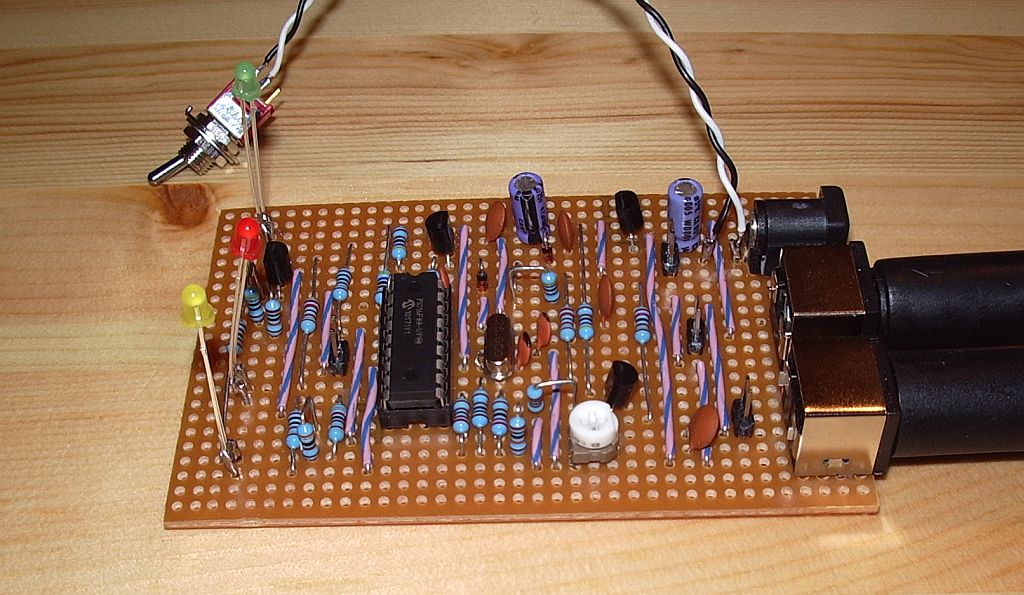
ZL3AME’s stripboard layout results in some quite lengthy signal paths. Despite this, the TNC worked first time, with just a minor glitch caused by my mis-wiring the PTT connection on the transceiver connector. (I have a standardized interface that I use on all my projects, with an 8-pin mini-DIN connector for audio and PTT to the transceiver, and a 6-pin mini-DIN connector for serial and GPS connections. I can then have a standard set of cables to hook the projects up to any radio, connect to the computer or a GPS, etc.)
With all the bits of APRS kit I have it was easy to generate some test signals and I soon had packets being decoded on the terminal screen. I wondered how sensitive the TNC would be as it uses the PIC16F88 to do the decoding instead of a modem chip like the MX614. I have not seen any DX packets decoded yet, but it does seem that decoding success is dependent on the audio level into the TNC. All of my APRS generators were decoded with the exception of my weather station, which has rather low deviation. When using the old Kenwood TH-205E as a receiver I could increase the volume so the weather station was decoded, at the expense of reliable decoding of the other radios. That was not even an option when using the DATA output of a radio, which has a fixed level. I suspect that performance could be improved if you could add an audio ALC on the input.
The TNC can also send APRS beacons and work as a fill-in digipeater. To send a fixed position you can simply encode the position co-ordinates into the beacon text. There are also a couple of jumpers that allow you to connect a GPS to the serial port, which would allow the TNC to work as a standalone tracker. I haven’t tried that, since I already have a standalone tracker. There are no Connect or Disconnect commands so it cannot be used as it stands for packet radio.
This is not a KISS TNC, so it can’t be used with APRSIS32 or aprsg or any of the software I use. I installed UI-View which apparently has the ability to use a TNC for APRS in Converse mode, but it doesn’t work with that either. I think that is due to the fact that the TNC expects CR/LF at the end of each command instead of just CR, so fixing that will be the task of my first attempt at modifying the firmware. Other things I would like to try are making it work at 300baud (for HF packet) instead of 1200baud, and implementing KISS mode. In KISS mode the PC software provides the complete packet and the TNC just has to add a CRC and send it. So in theory it should be simpler to implement than the existing code which has to construct an AX.25 packet from the information entered plus parameters previously set in the configuration. We shall see. The TNC source code is written in assembler, and trying to understand assembler code is to me like not being able to see the wood for the trees. But it will be a good incentive for me to look “under the hood” at how APRS, packet and AX.25 really work.
Many of the links to original information about this project seem now to be dead and I had to do quite a lot of searching to collect the information I have. For the benefit of anyone else who would like to try building one of these TNCs I have assembled all the files and information I found into a zip file which you can download here.

Julian Moss, G4ILO, is a regular contributor to AmateurRadio.com and writes from Cumbria, England. Contact him at [email protected].
Egypt old tech

Another question for the Sphinx?
The people power demonstrations in Egypt over the last week were probably fueled just that bit more by the government’s decision on 27 January to cut mobile phones and the internet. The deteriorating situation in Egypt is currently sharing top news position here in Australia with the monstrous tropical cyclone Yasi due to hit major population centres of far north Queensland in hours!
There’ve been reports of how protesters have turned to ‘old technology’ – fax machines, dial-up modems and even ham radio(!) – to restore communications with each other and the outside world. The BBC report Old technology finds role in Egyptian protests describes how dial-up modems have been used to contact international ISPs.
IDG News journalist Nancy Gohring wrote a piece in PC World explaining how Ham Radio is Not a Viable Option for Egypt. She quotes ARRL’s Allen Pitts stating there are no confirmed transmissions from Egypt yet.
The WeRebuild wiki details frequency bands on 40m and 20m being monitored including 7080.8kHz for CW signals. The wiki page does include transcripts of some messages received – but none since 29 Jan. And it would be a challenge to verify their authenticity.
WeRebuild have even set up an IRC channel for ham operators monitoring these frequencies. The Huffington Post quotes some of the messages.
As I write this there are 91 posts in a discussion thread on QRZ.com debating the use of ham radio by the protesters and overseas operators. Amongst the majority counselling caution and “Keep Ham Radio out of politics – if you don’t, Politics will shut Ham Radio down (in Egypt and in other places, too)”, a minority of posts take an alternate view such as this contributor:
“Freedom is not free. To advocate “staying out of it” on the grounds of damaging ham radio is the same as our founding fathers telling the militiamen on the green at Lexington to stay home, lest the British come take their guns too. The only legitimate reason for staying out of it is the decision of which side you are on — and yes, when it comes to liberty we all have an obligation to investigate the issues and take sides.”
This is a passionate and interesting discussion of what constitutes emergency
communciation and how hams should respond to calls for assistance such as “health and welfare traffic” etc.
Meanwhile closer to home (and across the US as well) people brace themselves for some of the most extreme and destructive weather which is sure to cut power and communications for extended periods. And hams will be there to help.
Cyclone Yasi Update: VK amateurs are maintaining a listening watch on the WICEN frequency 7075kHz. Full details of relevant HF nets and local north Queensland repeaters have been published by the WIA. Tomorrow morning’s 6am Gnarly Net should make for interesting listening on 3600kHz.
The national broadcaster, the ABC is heavily promoting two shortwave frequencies on its 24 hours TV news channel, in anticipation of its local AM and FM towers being damaged by the cyclone. The special rolling coverage of the cyclone can be heard online and on 9710kHz by day and 6080kHz by night.
Stephen Rapley, VK2RH, is a regular contributor to AmateurRadio.com and writes from New South Wales, Australia. Contact him at [email protected].
Packet lives!
I thought packet radio was all but dead. Yesterday I heard Richard MM1BHO mention that there was a packet node in Scotland on 70cm at the same location as the GB3LA repeater which is a monstrous signal here. I asked Richard to tell me the frequency so I could have a listen. I wasn’t optimistic about hearing anything as 70cm has always seemed a bit of a dead loss for me. I had to wait a while to hear anything, and when I did, I found the packet signal was 20dB over S9 which is the strongest signal I’ve ever heard on 70!
I then spent a couple of hours trying to sort out a way of receiving the packet. TrueTTY seemed like a good choice. It decoded the packets and displayed them on its screen. But I couldn’t find any software that would work with its virtual TNC.
I also tried AGW Packet Engine in sound card mode. That, too, decoded packets, so I got the AGW Terminal software as well. But I could not transmit. The software keyed the PTT when it was supposed to, but there was no audio modulation.
Finally I bit the bullet, shut down the APRS gateway and put the Kenwood D710 into packet mode. I then set up AGWPE to talk with the Kenwood’s TNC. That worked, and I was able to connect to the node whose call is GB7WD. I was wondering what to do next when Clive GM4FZH connected to me and I had my first chat over packet radio since the mid-1980s!

I’m afraid after all that time I have forgotten just about anything I knew about packet radio so I’m still pretty clueless as to what to do. I don’t know how to set up a mailbox, or even where to set one up. There seems to be a shortage of material on the interweb aimed at packet newbies (or oldies like me where the onset of Alzheimer’s has erased any memory of what we once knew!)
I think packet radio is something I will enjoy playing with again. I went back to AGWPE soundcard mode and found that the reason I was not getting any audio was because although the software says it uses the left channel which online references claim is the tip of the stereo jack, it was actually present on the ring. After resoldering the connector on the audio cable I was able to transmit packets as well as receive them, and G4ILO is now listening on the GB7WD frequency on the A side of my TM-D710 while my 2m APRS gateway is using the B side. There are just so many things to do in this hobby!

Julian Moss, G4ILO, is a regular contributor to AmateurRadio.com and writes from Cumbria, England. Contact him at [email protected].
CQ 160 CW
We got a dose of Mid-Atlantic winter weather last week—that once or twice a year event that is too much for the utilities and drivers to handle. Snow, sleet, freezing rain, and rain arrived on Wednesday. Power was out from 2030 LT to 0200 LT on Wednesday night/Thursday morning and then again from 1600 LT on Thursday to around 1100 LT on Friday. So, I didn’t get to operate NS this week on account of no power! I did think of going out to the car, but I was too wiped out and cold from the furnace blower being off. I just wanted to crawl under a big pile of blankets and sleep until the electricity came back on. As I have mentioned before, I grew up in an area with many Amish. A coworker many years ago was teasing me about finding an Amish girlfriend. I responded by asking him how an electrical engineer would fare in a society dedicated to not using electricity. He had to agree, although the Amish have rather ingenious mechanisms for harnessing electricity to do their work. But, as usual, I digress—we’re slightly dependent on electricity in ways we probably should not be!
I like contesting on 160 meters (1.8 MHz). When you call CQ, you are usually rewarded with blistering rate from loud stateside stations. When you’re tuning up and down the band, weak DX stations pop out from between said loud stateside stations. Now that I have something resembling a 160-meter antenna, I gave the CQ 160 CW contest a shot after some friends left on Saturday night. Another nice thing was that the station is working well enough (with the exception of the K9AY relays and possibly directivity) that I could just walk into the shack and operate.
So, that’s what I did… Only worked a handful of Europeans, but that’s not too surprising. They were loud here, even with 10 dB of attenuation in line to reduce IMD from really loud local stations. There were numerous other European stations that I could hear (on the TX antenna) but was unable to raise. But, in about four hours (three in the CQ 160 and one in the NAQP) of operating on Topband, I have only the hard states left for WAS from this QTH: ID, SD, ND, WY, AK, HI. I’m waiting for the LoTW confirmations to start showing up!
                    CQ 160-Meter Contest, CW

Call: K8GU
Operator(s): K8GU
Station: K8GU

Class: Single Op LP
QTH: MD
Operating Time (hrs): 3

Summary:
Total:  QSOs = 182  State/Prov = 48  Countries = 8  Total Score = 25,984

Club: Potomac Valley Radio Club
Ethan Miller, K8GU, is a regular contributor to AmateurRadio.com and writes from Maryland, USA. Contact him at [email protected].
ARRL January VHF Sweepstakes
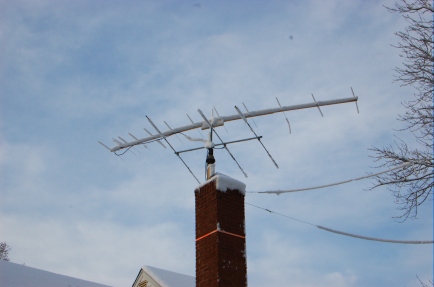
Last weekend (two weekends ago now), Sarah was out of town with friends from college, so I was free to meander in and out of the shack at will. Between making QSOs on 2 meters, I got a “modern” computer set up for SDR. More on this in the future. Was pleased to make some QSOs into New England with the “$200 VHF station” that consists of the TS-700S, Mirage B3016G amplifier, and homebrew FO12 antenna. Nevermind that the Pro-Set, Bencher, and Keyer cost at least that much again.
Still working on getting the other bands going. 50 MHz is very close, although with the recent sale of some extra gear, a K3 is almost within striking distance if I sold one the of the TS-930s. One of the locals has offered to lend me his FT-736R to get on 222 and 432 for now. So, I think I’ll try to finish up the 50-MHz transverter and pick up the ’736 while working on the antenna situation for those bands. I’m going to have to change the rotor/mast situation to do that. Not sure how that will go…I may just duplicate a “rover mast” and accept whatever sacrifice is introduced by stacking the beams too close together.
                    ARRL January VHF Sweepstakes

Call: K8GU
Operator(s): K8GU
Station: K8GU

Class: Single Op LP
QTH: FM19la
Operating Time (hrs):

Summary:
 Band  QSOs  Mults
-------------------
    6:
    2:  44     15
  222:
  432:
  903:
  1.2:
  2.3:
  3.4:
  5.7:
  10G:
  24G:
-------------------
Total:  44     15  Total Score = 660

Club: Potomac Valley Radio Club
Ethan Miller, K8GU, is a regular contributor to AmateurRadio.com and writes from Maryland, USA. Contact him at [email protected].
ICQ Podcast Series Four Episode Three – Magic 6m Band (30 January 2011)
Series Four Episode Three of the ICQ Amateur / Ham Radio Podcast. News Stories include:
- New Amateur Radio bill introduced in Congress
- Italian 145.800MHz repeater shuts down
- Radar intruders in Amateur bands
- Cadets’ using 5MHz WSPR clarified
- Contest University 2011
- FSTV beacon GB3CZ back to full power
- Mass SOTA/WAB activation planned
- Goonhilly rejoin deep space comms programme
- Celebrating 85 years of hospital radio
- D-Star active in Johannesburg
- Cell-phone to fly in space
Your feedback, upcoming events and Martin (M1MRB) discusses the 6m band.
Colin Butler, M6BOY, is the host of the ICQ Podcast, a weekly radio show about Amateur Radio. Contact him at [email protected].
 Ham Radio Deluxe |
 W5SWL Electronics |
 Ham Radio Prep |
 KB3IFH QSL Cards  Hip Ham Shirts  HamRadioAuctions HamRadioAuctions Reliance Antennas Reliance Antennas Enigma Shop Enigma Shop |  morseDX  Ni4L Antennas  R&L Electronics R&L Electronics antennas.us antennas.us QRV QRV |
- Matt W1MST, Managing Editor
