 |
 On the tiles
 18 February 2011 | by
 The best APRS client just keeps getting better. The latest treat for beta testers of APRSISCE/32, the APRS client for Windows desktops and Windows Mobile (which also runs under wine on Linux) is configurable map tile servers. This feature allows users to switch between a variety of different map servers to use a range of different maps in addition to the default OSM mapping.

Probably the most useful for most users will be the Mapquest OSM mapping which is a high contrast map similar in appearance to a road atlas. Mapquest also has a set of satellite view tiles, shown above in a screenshot from my 30m APRS gateway. These tiles don’t unfortunately let you get closer than about 10,000 metres so you can’t zoom in on somebody’s house like you can with Google mapping.
For UK users especially those of us in hilly areas the ability to use the UK specific Freemap mapping is a massive benefit. These OSM based maps show topographical detail (contours) as well as footpaths and walkers’ routes as illustrated by the screenshot below centered on a recent SOTA activation in the Lake District.

The ability to seamlessly pan and zoom around an area as well as switch map types with a couple of mouse clicks puts APRSISCE/32 miles ahead of UI-View. This new feature is another example of the amazing dedication and support given by Lynn, KJ4ERJ, to his program. Only last weekend while Lynn was on a trip to Spain a handful of us were discovering and sharing details of alternative map sources and hand-editing them into the configuration files so use the maps with the software. On his return the suggestion was made that it would be nice to be able to switch between map sources from within the program. Four days later, we’re testing the new feature. It’s like Christmas every day when you’re an APRSISCE/32 user!

Julian Moss, G4ILO, is a regular contributor to AmateurRadio.com and writes from Cumbria, England. Contact him at [email protected].
Ottawa Amateur Radio Club Presentation

Just before the start of the OARC meeting (photo copyright of the OARC)
Last week I drove through a snowy evening to give a presentation to the Ottawa Amateur Radio Club (OARC). The meeting was in one of the rooms in City Hall and I have to admit it was my first time attending the OARC.
I was greeted by Dave, VE3TLY, the president and others and it certainly seems to be an active club. There was a report on the club construction project and talk about the upcoming Canadian Ski Marathon and the amateur radio support that is given.
My talk was on D-STAR in the Ottawa Area and started with some D-STAR principles, covered a little on the local repeater VA3ODG and finished off with a look at the current projects and developments. A pdf of the slides are here:> OARC Presentation PDF.
I finished off with a demonstration and tuned the HT to module B of repeater VA3ODG and chatted with a small group that had assembled there. There was some luck as using the repeater with Maurice-Andre, VE3VIG was Greg, VA3OMP, using his FREE STAR* repeater as well as a station connecting in from Florida. This nicely illustrated the linking to the repeater from outside the local area and use of a different (FREE STAR*) network, which I had just earlier mentioned in my talk.
After the demonstration there was some good questions and comments from the audience. The meeting officially wound-up and over coffee I had pleasant discussions with a number of the club members.
A great evening and thanks to the OARC for inviting me and making me so welcome.


Alan Steele, VA3STL, is a regular contributor to AmateurRadio.com and writes from Ottawa, Ontario. Contact him at [email protected].
Baud with microcontrollers
My homebrew WX-1 weather station, which transmits data directly on 144.800MHz APRS using a PIC based packet modulator and a 10mW VHF transmitter module, is decoded by my VX-8GR and my Kenwood TM-D710 but not my TH-D72 or my homebrew TNC. This is annoying. A week ago I looked at the packet modulation from various devices and found that the tone frequencies of the WX-1 were about 50Hz too high. So I thought I would try to fix it.
The PIC source code for the weather station is available for download. The program code that generates the packet modulation is a bit beyond me, but I think it works by executing a loop and pushing binary values out of 4 ports which are connected to 1K0, 2K0, 3K9 and 5K1 value resistors in such a way as to produce a stepwise approximation of a sine wave. It seemed to me that to lower the tone frequencies I needed to slow the loop down a tad. After a bit of trial and error inserting a nop (no-operation) instruction in various likely-looking places I managed to get the tones nicely symmetrically positioned around the 1200Hz/2200Hz nominal frequencies for 1200baud packet. But the TH-D72 and homebrew TNC still refused to decode any packets!
Wondering what to try next, it occurred to me that the tone frequencies were not the only parameters of a packet signal. There is also the baud rate. I also remembered that the MixW sound card software prints out the measured baud rate next to each decoded packet. So I hooked MixW up to a transceiver and sound card and gave it a selection of signals to decode. I found that whilst my two Kenwood transceivers and the Yaesu VX-8GR all measured 1200 or 1199baud, the WX-1 recorded a value of 1208 baud. That had to be the cause of the problem.
Unfortunately I can’t find a solution. I thought that slowing down the PIC processor’s clock might make the necessary adjustment, so borrowing an idea from a PIC frequency counter circuit I replaced one of the fixed capacitors on the oscillator crystal with a variable one. This made a whole 1 baud of difference! Clearly that approach isn’t going to get me anywhere unless I get myself a 19.867MHz crystal. If I’d done the math in the first place I’d have realized I wasn’t going to pull the oscillator that far with a trimmer.
The solution, if there is one, has to be in the code. But I don’t understand it nor can I find any comments that would point to a routine or value that affects the baud rate. Give me a circuit with discrete components any day. If this is the future of electronic experimentation I don’t think there’s a place for me in it.

Julian Moss, G4ILO, is a regular contributor to AmateurRadio.com and writes from Cumbria, England. Contact him at [email protected].
Promotional Film From The Sixties – Fairchild Briefing on Integrated Circuits
As promotional videos go, this is rather interesting. Very detailed and an interesting look at the burgeoning technology of the sixties. Below is a quote from the video description on YouTube:
[Recorded: October, 1967]
This half hour color promotional/educational film on the integrated circuit was produced and sponsored by Fairchild Semiconductor Corporation and first shown on television on October 11, 1967. In the film, Dr. Harry Sello and Dr. Jim Angell describe the integrated circuit (IC), discuss its design and development process, and offer examples of late 1960s uses of IC technology.
Fairchild Semiconductor Corporation was one of the most influential early high-tech companies. Founded in Palo Alto California in 1957 by eight scientists and engineers from Shockley Semiconductor Laboratory, Fairchild Semiconductor Corporation was funded by Fairchild Camera and Instrument Corporation of Syossett, New York. Rapidly establishing itself as a technology innovator based on its invention of the planar manufacturing process in 1959, the company developed the first monolithic integrated circuit, the first CMOS device, and numerous other technical and business innovations. French oil field services company Schlumberger Limited purchased Fairchild in 1979 and sold a much weakened business to National Semiconductor in 1987. In 1997 National divested a group, formed as the present Fairchild Semiconductor, in a leveraged buy-out. The company re-emerged as a public entity based in South Portland, Maine in 1999 under the corporate name Fairchild Semiconductor International, Inc.Fairchild Semiconductor presented its new products and technologies with an entrepreneurial style, and its early manufacturing and marketing techniques helped give Californias Santa Clara County a new name: Silicon Valley. It was one of the early forerunners of what would become a worldwide high-tech industry, as evidenced in this short promotional film.
Pretty neat stuff, brought to you by The Computer History Museum.
Jonathan Hardy, KB1KIX, is a regular contributor to AmateurRadio.com and writes from Connecticut, USA. Contact him at [email protected].
Handiham World for 16 February 2011
Welcome to Handiham World!
Take a video tour of the KA0PQW ham shack
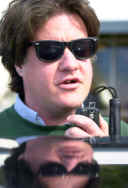
The tour, available in both YouTube video and in MP3 audio from the Handiham website, lasts about nine minutes. Matt describes all of the equipment in his ham shack, which also has some audio equipment for his radio show, which is done on a non-amateur radio feed. The impressive setup includes a repeater! Matt knows the layout of the shack very well, and is of the opinion (which I share) that we should all know enough about our operating area to use the equipment independently. Furthermore, a system of “a place for everything and everything in its place” serves the efficient amateur radio operator well, because when things are where you expect them to be you can grab that first spot in the DX pileup or quickly silence a radio when the phone rings. In an emergency, you certainly want to concentrate on communicating, not on trying to find a microphone or an accessory in a pile of clutter. Since Matt is blind, he needed to develop his own system of knowing where things are in the ham shack. Being organized in this way is a discipline that we can all use to be better amateur radio operators.
Visible in the video, but not mentioned in the audio, is the electrical breaker box in one corner of the room. There is also a basement window, which lets in some natural light. The repeater rests on some 2 by 4 boards, lifting it above the basement floor.
Ready for a tour? Those of you listening to the audio podcast can just keep listening, because we will go right to the audio tour. If you are reading the HTML version, you can follow the link to the story on Handiham.org, which has embedded video.

Pat Tice, WA0TDA, is the manager of HANDI-HAM and a regular contributor to AmateurRadio.com. Contact him at [email protected].
Handiham World for 16 February 2011
Welcome to Handiham World!
Take a video tour of the KA0PQW ham shack
The tour, available in both YouTube video and in MP3 audio from the Handiham website, lasts about nine minutes. Matt describes all of the equipment in his ham shack, which also has some audio equipment for his radio show, which is done on a non-amateur radio feed. The impressive setup includes a repeater! Matt knows the layout of the shack very well, and is of the opinion (which I share) that we should all know enough about our operating area to use the equipment independently. Furthermore, a system of “a place for everything and everything in its place” serves the efficient amateur radio operator well, because when things are where you expect them to be you can grab that first spot in the DX pileup or quickly silence a radio when the phone rings. In an emergency, you certainly want to concentrate on communicating, not on trying to find a microphone or an accessory in a pile of clutter. Since Matt is blind, he needed to develop his own system of knowing where things are in the ham shack. Being organized in this way is a discipline that we can all use to be better amateur radio operators.
Visible in the video, but not mentioned in the audio, is the electrical breaker box in one corner of the room. There is also a basement window, which lets in some natural light. The repeater rests on some 2 by 4 boards, lifting it above the basement floor.
Ready for a tour? Those of you listening to the audio podcast can just keep listening, because we will go right to the audio tour. If you are reading the HTML version, you can follow the link to the story on Handiham.org, which has embedded video.
Pat Tice, WA0TDA, is the manager of HANDI-HAM and a regular contributor to AmateurRadio.com. Contact him at [email protected].
Platform for progress
One of the things at the back of my mind when I was writing that the magic of ham radio wasn’t in high technology was the feeling that anyone who got into the hobby out of a mania for high-tech toys was soon likely to be disappointed. I’ve seen it happen when people who are new to the hobby and don’t yet know much about it get an enthusiasm for APRS or Echolink. They get disappointed that the network coverage is patchy or nonexistent compared to cellphone coverage because they don’t realize that it depends on hams to provide the infrastructure and where there are few hams – or none interested in these particular aspects of the hobby – there are no repeaters and no gateways.

I’ve seen the same people criticize the latest VX-8, TH-D72 and Icom D-Star radios as being overpriced and unimpressive. They don’t like the geeky “walkie talkie” look or the plain 1990s LCD display. They can’t believe that APRS radios don’t support predictive text entry like the cheapest mobile has for more than a decade. And why can’t they have a colour screen and a scrolling map display?
It’s easy to dismiss these criticisms as coming from people who don’t understand that ham radio is a specialized niche market and that amateur HTs don’t benefit from the economies of scale which allow vastly more R&D to be spent on a smartphone costing a similar amount of money. But then I realized that perhaps the critics had a valid case. Manufacturers of smartphones don’t completely reinvent the wheel whenever they release a new model. They just design the hardware. But the hardware is a platform. On it runs a standard OS and various apps, a few of which may be customized to the manufacturer or phone but most of which are generic. Given that software development is one of the most time consuming and expensive parts of any new technology product development, wouldn’t that be a huge saving?
Why can’t top of the range hand-held radios use a similar hardware architecture to cellphones? Instead of a custom design the radio would be a computer running embedded Linux. The RF side could be SDR or it could use conventional technology – it wouldn’t matter, that would simply depend on what is most cost effective and delivers the best battery endurance. But all the control functions, together with transmit and receive audio, would be accessible through an API to software. The user interface would be an app.
Since the radio is a computer the interface would be endlessly customizable and all kinds of things not possible with existing radios could be feasible. Instead of entering local repeater frequencies into memories you could install an app that gets your position from the built-in GPS and shows you the nearest repeaters. One click and you’re listening on it.
Instead of a plain LCD display showing distance and bearing your APRS capable radio could show a full map display just like APRSISCE currently provides on Windows smartphones. You wouldn’t need packet modem hardware in the radio because packet generation and decoding could be done in software. In fact there would be no such thing as an APRS capable radio. The platform would be the same – if you wanted APRS you would just install the APRS application. If you wanted Echolink you could add the Echolink application. If you wanted D-Star you could buy the D-Star app from Icom. If you wanted to work satellites then I’m sure someone would write an app that would keep track of where the satellites are and even control the radio frequencies taking account of doppler.
You could power this hypothetical next generation radio using cellphone battery packs, which are a lot cheaper than the custom battery packs for traditional ham radios. You could even use standard cellphone accessories.
So why won’t this happen? I guess the reason for that is that Yaesu, Icom, Kenwood and the rest don’t make cellphones. Their business is making radios that are intended to be as dumb as most of their users. Ham radio is just an offshoot. The market just isn’t big enough to justify developing what for them would be a completely different and unique hardware platform. So I guess for the foreseeable future we’ll be stuck with our geeky walkie talkies and the cool stuff will all be on cellphones.

Julian Moss, G4ILO, is a regular contributor to AmateurRadio.com and writes from Cumbria, England. Contact him at [email protected].
 Ham Radio Deluxe |
 W5SWL Electronics |
 Ham Radio Prep |
 KB3IFH QSL Cards  Hip Ham Shirts  HamRadioAuctions HamRadioAuctions Reliance Antennas Reliance Antennas Enigma Shop Enigma Shop |  morseDX  Ni4L Antennas  R&L Electronics R&L Electronics antennas.us antennas.us QRV QRV |
- Matt W1MST, Managing Editor
