 |
 Another Notcom opt-out
 23 February 2011 | by
 A few weeks ago the European Union’s Frequency Management Working Group agreed a harmonized specification for Citizens’ Band Radio across Europe to include AM, FM and SSB modes. It will now go to public consultation before being passed to national governments to become law. However Ofcom, the radio regulatory authority in the UK, is expected to live up to its nickname of Notcom by saying “no” to allowing AM and SSB, claiming there is a potential for harmful interference to other services. How absurd!
Now some readers may be wondering why a ham radio blog is concerning itself with whether CB users should be allowed to use the AM and SSB modes. After all, if they want to use those modes they could just get a ham radio license, surely? The test is so easy even a child could pass it, and many do. So what’s to complain about?
But that isn’t the point. The point is this is one more example of how we in Britain always seem to get the mucky end of the stick when it comes to European legislation. We’re told we can’t opt out of European human rights law that seems to attach more importance to the rights of criminals, rapists, murderers and paedophiles than their victims. But when it comes to something as unimportant as giving a few hobbyists the right to use the same modes as their counterparts across the North Sea, opt out we can. Are we in Europe or aren’t we?
If allowing CBers the use of AM and SSB isn’t a problem for the rest of Europe then it isn’t going to be a problem in the UK. If there was “a potential for harmful interference to other services” then that would surely have been proven by now, since there are plenty of people illegally using SSB on 27MHz already. How many people have been caught and prosecuted for using SSB on 27MHz? Hint: it’s a very round number. And if there is a risk of harmful interference to other services from allowing people to use 12W of SSB on 27MHz, why is there no risk from allowing hams to use 400W a few hundred kHz higher?
There is no sound basis for preventing British CBers from enjoying the same frequencies and modes as their counterparts in the rest of Europe, just as there is no sound basis for restricting the use by British radio amateurs of digipeaters and internet connected nodes. It is about time we had a more open regulatory system in this country so that radio users cannot be denied something for false or risible reasons.

Julian Moss, G4ILO, is a regular contributor to AmateurRadio.com and writes from Cumbria, England. Contact him at [email protected].
Free Windows sound recorder needed
Here’s a question for you software experts out there. Do you know of a free, simple, no-frills sound recorder application that can record audio from any sound card?
Windows Sound Recorder has the simplicity I need, but it can only record from the default recording device. If I want to record from the radio I have to change the default input device to whatever sound card is attached to that radio. This usually results in hours of head-scratching later on after I forget to switch the default sound card back.
Audacity is the sound recorder application most people recommend. It is free, and it can record from any sound card, but the user interface is so complicated I can’t figure out how to use it.
So I have decided to ask you, my readers. I imagine this is something that many hams have tried to do. What do you use?

Julian Moss, G4ILO, is a regular contributor to AmateurRadio.com and writes from Cumbria, England. Contact him at [email protected].
Your help is needed to help avoid losing our 420-440Mhz band
A bill has been recently introduced which could result in amateurs losing their currently allocated frequencies on the 70cm band (420-440Mhz). The ARRL is asking that folks write to their legislators to oppose the bill in it’s current form. The FCC is proposing to auction off certain spectrum for commercial use to replace the spectrum given up in the 700Mhz band (formerly used for analog TV) to help make up for the loss of commercial revenue in those bands. The spectrum slated for auction is supposed to be existing Public Safety spectrum (since the 700Mhz block went to Public Safety), but the Amateur allocations appear to have been incorrectly bundled in with those from Public Safety. You can read more about this issue at the ARRL website here and you can read how to help here. Please note that they strongly recommend sending letters to their legislative consultants who will hand-deliver them to Congress due to extensive delays in postal mail screening to members of Congress.
Apologies to those of you outside the US who are reading this US-specific posting.

Your help is needed to help avoid losing our 420-440Mhz band
A bill has been recently introduced which could result in amateurs losing their currently allocated frequencies on the 70cm band (420-440Mhz). The ARRL is asking that folks write to their legislators to oppose the bill in it’s current form. The FCC is proposing to auction off certain spectrum for commercial use to replace the spectrum given up in the 700Mhz band (formerly used for analog TV) to help make up for the loss of commercial revenue in those bands. The spectrum slated for auction is supposed to be existing Public Safety spectrum (since the 700Mhz block went to Public Safety), but the Amateur allocations appear to have been incorrectly bundled in with those from Public Safety. You can read more about this issue at the ARRL website here and you can read how to help here. Please note that they strongly recommend sending letters to their legislative consultants who will hand-deliver them to Congress due to extensive delays in postal mail screening to members of Congress.
Apologies to those of you outside the US who are reading this US-specific posting.
David Kozinn, K2DBK, is a regular contributor to AmateurRadio.com and writes from New Jersey, USA. Contact him at [email protected].
K0BAM reaches 1000 QSO milestone through FM satellites
I noticed a tweet from Jim, K0BAM in Colorado at the weekend, saying that he’d made over 1000 QSOs through the FM satellites. I asked him if he could send me some more information which I will use in the Practical Wireless column. Jim also shared with me this video, which I think you’ll enjoy too.
It’s something a bit different, but completely fascinating and using equipment that many of us already have – though that Arrow dual band antenna looks useful!
Congratulations, Jim!

Tim Kirby, G4VXE, is a regular contributor to AmateurRadio.com and writes from Oxfordshire, England. Contact him at [email protected].
WX-1 baud rate fix
On Thursday I wrote about how my WX-1 APRS weather station was not being received by my TH-D72 and the PIC TNC because the baud rate was slightly fast, and of my unsuccessful attempt to fix it. Glenn W9IQ offered to take a look at the PIC source code and see if there was an easy fix. I sent him a link to the code and a day later I got a reply back. Glenn’s suggestion solved the problem perfectly. But he didn’t just tell me what to change, he explained what the code did and how it worked. I thought that his explanation would be of interest to anyone trying to understand how packet tones are generated using a PIC, so with his permission I am copying it here.
“The baud rate is determined by an interrupt service routine. The interrupt is driven by Timer 0 (TMR0) that is configured to use the instruction clock as its input (frequency of Y1 divided by 4). The input of TMR0 is also initialized to have a divide by 32 prescaler (the code comment says 16 but that is wrong). So at this point the timer is being driven by the frequency of Y1 divided by 128 or (20 MHz / 128) = 156.25 kHZ or a period of 6.4 uS.
Now the math and routines get a little more complicated. The interrupt is serviced by the code in the “packet” file. This code sets the TMR0 count to start at a value of 127. This TMR0 count will tick up one count every 6.2 uS (the clock from the output of the prescaler). When the timer count rolls over from 255 to 0, the interrupt is triggered.
At first glance, it would appear that this would generate an interrupt every 129 counts or 825.6 uS (6.4 uS * 129). That would seem to put the interrupt at roughly 1211 Hertz ( 1/825.6 uS). But this is not correct due to the way the author wrote the interrupt routine plus a small nuance of how a PIC handles the reset of the prescaled interrupt timer.
The interrupt service routine in “packet” executes 6 instructions before resetting the interrupt timer to a value of 127. Each instruction takes 4 clock cycles so this adds another 1.2 uS to the time between interrupts. In addition, when the prescaled interrupt timer register is written, there are another 4 instruction cycles of delay before the timer starts to run again. This is another 0.8 uS added to the interrupt time. So we now have an interrupt cycle of 825.6 uS + 1.2 uS + 0.8 uS totaling 827.6 uS or 1208 Hz. I believe this is what you measured as the current baud rate from your board.
Improving this is fairly straight forward. The interrupt goal is 1200 Hz or 833.3 uS. If we change the TMR0 count to 126 instead of 127, this will add another 6.4 uS to the interrupt period. This would give us 827.6 uS + 6.4 uS = 834 uS. Then if we eliminate one instruction in the interrupt routine, we eliminate a 0.2 uS delay for a total interrupt time of 834 uS – 0.2 uS = 833.8 uS or 1199.3 Hz.
This change is effected in the code located in the “packet” file. Look for the following code fragment:
Change this code fragment to read like this:
Recompile everything and reload the processor and you should see the baud rate drop as described.”
When I ran the modified code the baud rate dropped from 1207/8 baud to 1198/9 baud which is pretty much just as Glenn predicted. The weather station is now being received by the Kenwood TH-D72 as well as my other APRS radios. It can also now be received using the PIC TNC though the level of the receiver audio is critical and unfortunately not the same as that needed to decode the VX-8R. I think that is because the maximum deviation I can get out of the Radiometrix transmitter module is a bit on the low side.
I had an anxious couple of minutes when I found that although the D72 was decoding the packets it was rejecting them as invalid. This turned out to be because the position co-ordinates had a lower case n for North and w for west: In my haste to see what effect the changed code had I had entered the settings carelessly, though the other radios didn’t seem to mind. That was soon fixed.
The WX-1 weather station is now back in position beaconing the temperature, humidity and pressure as G4ILO-5. I would like once again to express my thanks to Glenn W9IQ for acting in the finest spirit of ham radio and helping me out with this.

Julian Moss, G4ILO, is a regular contributor to AmateurRadio.com and writes from Cumbria, England. Contact him at [email protected].
Wallops Island SuperDARN
A few photographs from work on the Wallops Island SuperDARN radar last week…

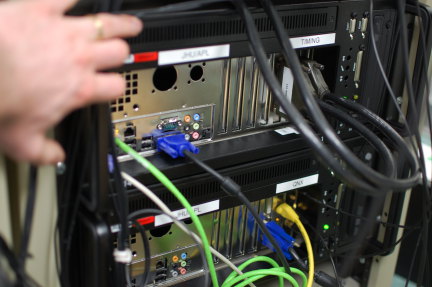
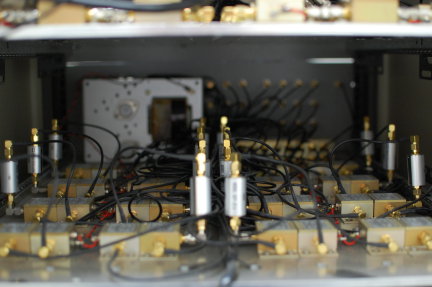

Ethan Miller, K8GU, is a regular contributor to AmateurRadio.com and writes from Maryland, USA. Contact him at [email protected].
 Ham Radio Deluxe |
 W5SWL Electronics |
 Ham Radio Prep |
 KB3IFH QSL Cards  Hip Ham Shirts  HamRadioAuctions HamRadioAuctions Reliance Antennas Reliance Antennas Enigma Shop Enigma Shop |  morseDX  Ni4L Antennas  R&L Electronics R&L Electronics antennas.us antennas.us QRV QRV |
- Matt W1MST, Managing Editor
